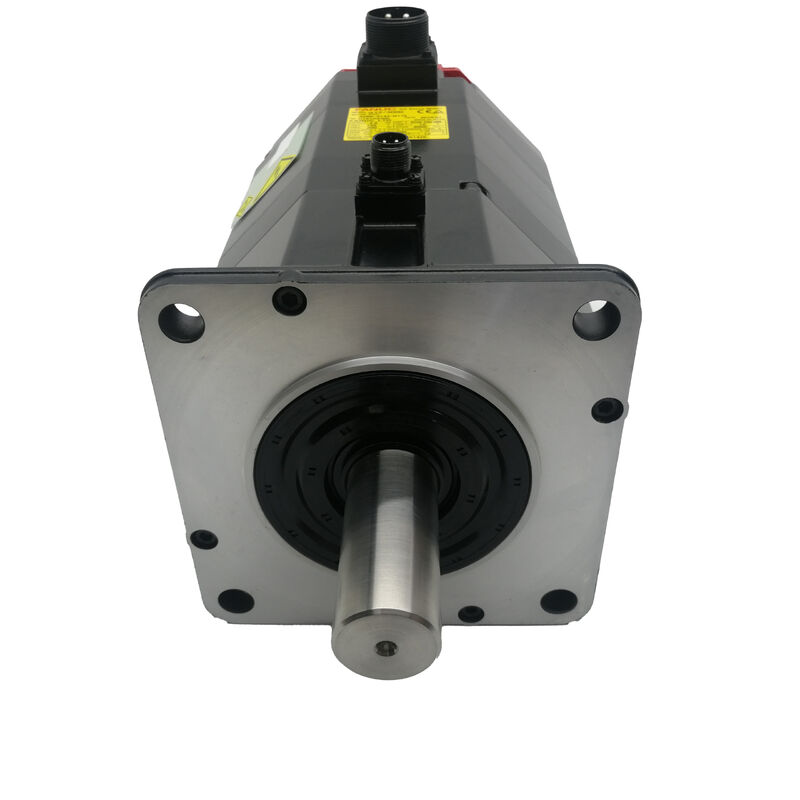
Fanuc A06B-0141-B077 | ALPHA Series AC Servo Motor aC12/2000 — 2.1kW, Straight Shaft, aI64 Encoder
Part Number: A06B-0141-B077
Series: ALPHA AC Servo Motor
Model: aC12 / 2000
Status: Discontinued by Manufacturer — Refurbished & Surplus Stock Available
Condition: Refurbished / Exchange / Surplus
Overview
The Fanuc A06B-0141-B077 is a 2.1 kW AC servo motor from Fanuc's ALPHA series — model aC12/2000 — the plain straight shaft, no-brake incremental encoder variant fitted with the aI64K pulse coder. Running to 2,000 RPM at 155V three-phase, 133Hz, drawing 8.8A continuous, it belongs to one of the most widely deployed servo motor generations in the history of CNC machine tool manufacturing.
The red end cap is the visual identifier of this ALPHA generation, and the aC12/2000 was a production workhorse on small to medium machining centres, turning centres, and multi-axis platforms across the period when Fanuc's ALPHA servo system was effectively the industry standard for this class of machine.
The original description flags 257V and 2.5A alongside the 133Hz frequency — these correspond to the motor's open-circuit back-EMF voltage and the no-load running current characteristic, which appear on some motor nameplates and MRO listings alongside the rated operating parameters.
The primary operational ratings for this motor are 155V, 8.8A, and 133Hz at 2,000 RPM — the values the servo amplifier generates from a 200–230VAC mains supply.
Fanuc has discontinued this motor. The aC12/2000 served its installed base well, and many of those machines remain in active production.
For the facilities maintaining them, a reliable source of tested replacement units remains a routine maintenance requirement.
Key Specifications
| Parameter |
Value |
| Rated Output |
2.1 kW |
| Continuous Torque |
12 Nm |
| Rated Current |
8.8 A |
| Motor Voltage |
155 V |
| Rated Frequency |
133 Hz |
| Phase |
3-Phase |
| Maximum Speed |
2,000 RPM |
| Back-EMF Voltage |
257 V (open circuit) |
| No-Load Current |
2.5 A |
| Encoder |
aI64K Incremental (64,000 ppr) |
| Shaft Type |
Straight Shaft (plain, no keyway) |
| Brake |
None |
| Ingress Protection |
IP67 |
| Series |
ALPHA — aC12/2000 |
| Manufacturer Status |
Discontinued |
The aC12/2000 in the ALPHA Motor Family
The aC12 designation reflects Fanuc's torque class naming for this motor — 12 Nm continuous torque — and the 2000 indicates its maximum speed rating. Within the ALPHA series that preceded the Alpha i and Beta i generations, the aC12/2000 occupied the mid-range slot: more capable than the aC3 and aC6 motors used on lighter auxiliary axes, less demanding on the servo amplifier's current capacity than the aC22 and aC30 units used on heavier saddle and table drives.
That positioning made the aC12/2000 the default specification for the primary feed axes of a broad class of machine tools — X, Y, and Z axes on compact-to-medium vertical machining centres, and the main X and Z axes on production lathes where the moving mass and cutting force requirements sat comfortably within this motor's continuous ratings.
It ran cool, operated reliably over long service intervals, and required minimal attention when the installation environment was appropriate and the servo amplifier was correctly parameterised.
At 2,000 RPM and 2.1 kW, the motor delivers adequate rapid traverse rates through typical ballscrew arrangements and maintains programmed feedrates under real cutting loads without the velocity loop hunting that appears when a motor is operating near its continuous torque limit.
The 12 Nm figure is the continuous rating — peak torque is substantially higher during axis acceleration, providing the responsive positioning behaviour that CNC machining productivity depends on.
Straight Shaft and Shaft Variants
The plain straight shaft on the A06B-0141-B077 uses coupling clamping force for torque transmission — no keyway provides additional mechanical engagement. For the continuous torque levels this motor generates in normal CNC axis operation, a correctly specified and properly torqued precision servo coupling handles the load reliably over the motor's service life.
Two shaft sub-variants exist within the B077 specification: the #7000 plain straight shaft (no keyway) and the #7008 keyed straight shaft (keyway machined into the shaft).
Both carry the same electrical specification and aI64K encoder — the shaft machining is the only difference. Machines built around the plain shaft variant have coupling hubs with plain bores; machines requiring the keyed variant have keyway-bored hubs. Confirming which sub-variant is installed before ordering a replacement prevents the coupling mismatch that is one of the more frustrating installation problems to discover after delivery.
aI64K Encoder — Incremental Pulse Coder
The aI64K is a 64,000 pulse-per-revolution incremental encoder integrated into the rear of the motor. At 2,000 RPM, it generates 2.13 million pulses per second — the feedback density the ALPHA servo amplifier uses to close the velocity and position loops accurately across the full speed range.
Absolute axis position is established through a homing sequence at each machine startup, which is standard operating practice for the CNC control systems this motor was paired with.
On motors with extended service histories, the encoder and its connector are disproportionately represented among failure causes relative to the motor's winding and bearing condition.
Coolant mist infiltration through the connector, pin corrosion from humidity exposure during storage, and cable chafing at the exit strain relief are the common failure modes.
These produce intermittent or degraded encoder output that the servo amplifier may report as encoder alarm codes, position errors, or velocity instability — symptoms that can be mistaken for amplifier faults before the encoder is confirmed as the source.
Discontinued Status and Sourcing
Fanuc discontinued the A06B-0141-B077 as the product line moved forward, but the machines it served continued operating.
The aC12/2000 repair community is well established — the motor's failure modes are documented, compatible bearings and seals are available, and the encoder replacement procedure is practised routinely at specialist servo repair facilities.
Refurbished originals, tested surplus new-old-stock units, and exchange programs remain the practical sourcing options.
The quality gap between a properly refurbished motor and a surface-cleaned unit that has only been visually inspected is not visible from the outside.
A reputable refurbisher will have replaced bearings, tested windings for resistance balance and insulation integrity, verified the encoder output, and run the motor up to rated speed on a Fanuc drive before sale. That test record is the meaningful differentiator — ask for it.
Drive & Control Compatibility
The A06B-0141-B077 is compatible with Fanuc ALPHA series servo amplifiers — SVM modules in the appropriate current class for 8.8A continuous — and integrates with Fanuc CNC platforms including Series 0, 0i, 15, 16, 18, and 21.
The servo amplifier must be parameterised with the motor type code for the aC12/2000 before axis operation. On machines where the drive or control has been upgraded since original build, confirming that the installed amplifier supports the aI64K encoder interface is a necessary step before installing a replacement motor.
FAQ
Q1: What do the 257V and 2.5A figures in the original product listing refer to?
The 257V is the motor's back-EMF voltage — the voltage generated at the motor terminals when the shaft is spinning at rated speed with no drive supply connected.
The 2.5A is the no-load running current at that speed.
Neither is the rated operating voltage or current — those are 155V and 8.8A respectively, generated by the servo amplifier at 133Hz from a 200–230VAC mains supply.
These nameplate figures sometimes appear in MRO listings and can cause confusion, but they do not affect motor selection or installation.
Q2: What servo amplifier is compatible with this motor?
The A06B-0141-B077 requires a Fanuc ALPHA series SVM servo amplifier module rated for at least 8.8A continuous current.
It integrates with Fanuc CNC controls including Series 0, 0i, 15, 16, 18, and 21.
The motor type parameter in the servo amplifier must be set to match the aC12/2000 specification before the axis is operated. An incorrect motor type code affects velocity loop gain, current limits, and speed scaling — all of which must be correct before the axis is run under load.
Q3: What is the difference between the #7000 and #7008 shaft sub-variants?
The #7000 has a plain straight shaft with no keyway. The #7008 has a keyway machined into the straight shaft for use with keyed coupling hubs. Both are electrically identical — same torque, current, speed, and encoder. The only difference is the shaft machining.
Verify which sub-variant is installed on the machine before sourcing a replacement, as fitting the wrong variant requires either modifying the coupling hub or sourcing a new one.
Q4: This motor is discontinued — is it worth repairing rather than replacing with a current-generation motor?
For most applications, a like-for-like refurbished replacement is the lower-risk, lower-cost path. Cross-generation motor substitution requires confirming physical mounting compatibility, connector pinout matching, encoder type compatibility with the servo amplifier, and servo parameter reconfiguration.
These are not insurmountable, but they add time and cost. If the machine's servo amplifier and CNC are also ageing and a full drive upgrade is planned, an upgrade path makes sense — but for a single failed motor on an otherwise functional machine, sourcing a refurbished aC12/2000 is typically the faster return to production.
Q5: What inspection steps are most important for a used A06B-0141-B077?
Check the encoder connector first — inspect for corroded or bent pins and verify the cable exit is undamaged. Measure three-phase winding resistance for balance across all phases and check insulation resistance to earth.
Rotate the shaft by hand to feel for bearing roughness or drag. Inspect the plain shaft end for fretting or coupling contact damage.
Confirm the IP67 shaft seal is intact and not hardened. A bench run-up to 2,000 RPM on a Fanuc ALPHA amplifier with encoder signal monitoring is the correct verification before returning any used unit to production service.


 Your message must be between 20-3,000 characters!