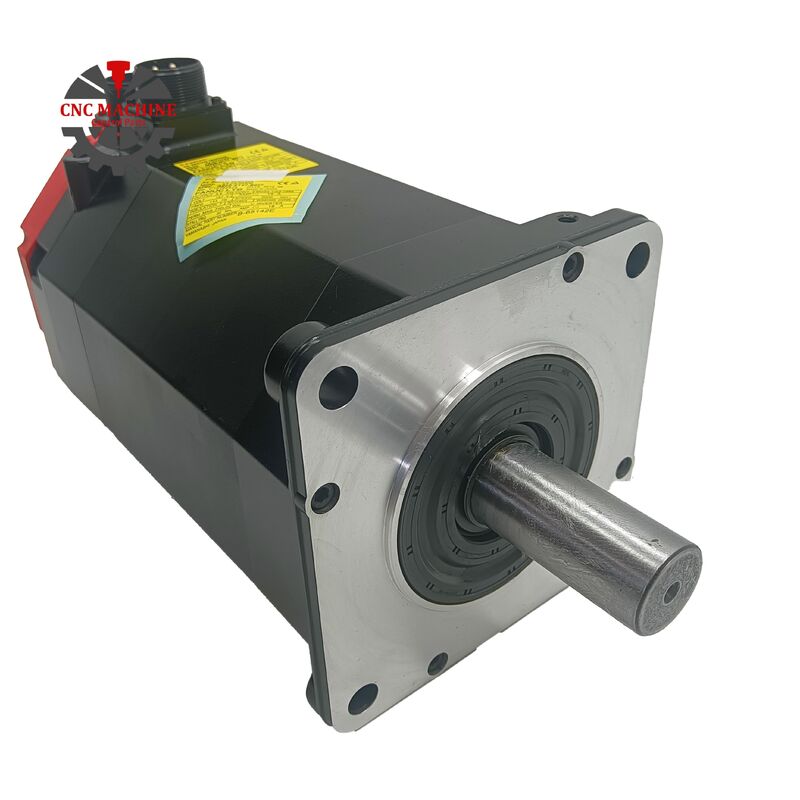
Fanuc A06B-0142-B077 | ALPHA Series AC Servo Motor α12/2000 — 2.1kW, Taper Shaft, IP65, αi64 Encoder
Part Number: A06B-0142-B077
Series: ALPHA AC Servo Motor
Model: α12 / 2000
Condition: New / Refurbished
Overview
The Fanuc A06B-0142-B077 is a 2.1 kW AC servo motor from Fanuc's ALPHA series — model α12/2000, running to 2,000 RPM with 12 Nm stall torque, an αi64 incremental encoder, and a taper shaft output.
Weighing 18 kg and rated to IP65, this motor is sized for the mid-range feed axis demands of small to medium CNC machine tools: substantial enough to handle meaningful cutting loads and axis inertia without drive hesitation, compact enough to fit the mechanical envelope of the machines it was designed for.
Within the ALPHA AC12 family, the taper shaft is the defining mechanical distinction of this variant.
Where the straight-shaft equivalents use coupling-based torque transmission, the A06B-0142-B077's machined conical shaft creates a self-centering interference fit with the mating drive element — a geometry choice made deliberately for applications where shaft concentricity, repeatable assembly, and resistance to high-torque reversals are installation priorities.
On the machine tools that spec this motor, the drive train around it is designed for the taper — and that shapes both the installation and the replacement process.
The 8.8A RMS rated current, 186V, 133Hz electrical characteristics and the αi64 encoder's 64,000 pulse-per-revolution feedback resolution complete a motor that sits solidly in the practical operating range of Fanuc's ALPHA servo amplifier systems across a generation of CNC controls still in productive daily use.
Key Specifications
| Parameter |
Value |
| Rated Output |
2.1 kW |
| Stall Torque |
12 Nm |
| Rated Current |
8.8 A (RMS) |
| Motor Voltage |
186 V |
| Rated Frequency |
133 Hz |
| Maximum Speed |
2,000 RPM |
| Encoder |
αi64 Incremental (64,000 ppr) |
| Shaft Type |
Taper Shaft |
| Ingress Protection |
IP65 |
| Insulation Class |
F |
| Winding |
3-Phase, Y-Connected |
| Excitation |
Permanent Magnet |
| Weight |
18 kg |
| Back-EMF Constant |
47 V |
| Winding Resistance |
1.36 Ω |
| Series |
ALPHA — α12/2000 |
The α12/2000 in the ALPHA Motor Hierarchy
The AC12 designation places this motor in the 12 Nm torque class of the ALPHA family — a level up from the AC3 and AC6 motors on lighter axes, and positioned below the AC22 and larger frames used on heavier machine saddles and table drives.
At 2,000 RPM and 2.1 kW, the α12/2000 was designed for axes that need controlled force output across a working speed range: the kind of sustained feedrate accuracy under cutting load that defines productive CNC machining.
On turning centers, vertical machining centers, and multi-axis machines of the era when this motor was in active production, the X and Z axes were common positions for the α12/2000.
The 12 Nm stall torque translates to meaningful linear thrust through typical ballscrew lead values, maintaining programmed feedrates without velocity droop during heavier passes. The 2,000 RPM ceiling fits direct-coupled ballscrew configurations where rapid traverse rates and cutting feedrates both fall within the motor's operating speed range.
The 18 kg weight reflects the motor's physical size — substantially heavier than the compact AC3 and AC6 units, and appropriate for the mechanical interface it mates with.
Motor mount and coupling design on machines using the A06B-0142-B077 are sized accordingly, which is worth bearing in mind when a replacement needs to be installed by someone unfamiliar with handling a motor of this mass.
Taper Shaft — Fit, Function, and Field Reality
The taper shaft is not a secondary consideration on this motor — it is the feature that defines the mechanical installation from the coupling inward.
The precision-machined conical profile of the shaft engages with a matching taper bore in the driven component, and the interference fit produced by drawing the two together creates a self-centering, concentric connection that transmits torque without relying solely on clamping force or keyways.
In applications where shaft runout must be minimised — where vibration from an eccentric shaft affects surface finish, axis accuracy, or component life — the taper fit consistently outperforms plain shaft clamping arrangements over the long term.
On machines built around this motor, the taper shaft was specified precisely because it holds up better under the combined rotational, radial, and axial loads that a CNC feed axis generates in real cutting conditions.
The practical consequence of the taper shaft at replacement time is this: the driven component — pulley, coupling hub, or gearbox input — must be removed correctly using a proper taper-breaking puller rather than impact tools.
Scored taper surfaces from improper removal change the interference fit geometry and produce shaft runout on reinstallation. On a motor weighing 18 kg, handling the removal and reinstallation also requires planning — the weight alone creates a mechanical challenge that a smaller motor does not.
αi64 Encoder — Feedback at 64,000 ppr
The αi64 is a 64,000 pulse-per-revolution incremental encoder integrated into the rear of the motor housing. It provides the position and velocity feedback the Fanuc ALPHA servo amplifier uses to close the control loops for both velocity and position, generating the signal density that supports accurate contouring and tight position endpoints across the motor's full speed range.
Incremental encoder operation means the machine establishes absolute axis position through a homing sequence on each startup — the control drives the axis to its reference position, resets the position counter from the encoder's index pulse, and the CNC system then has accurate position knowledge from that point forward.
This is standard operating practice for the CNC controls this motor generation was paired with, and homing reliability depends on both encoder condition and the mechanical repeatability of the reference position switch.
On used motors, the encoder housing and connector are the components most exposed to contamination and handling damage. Coolant mist, fine metallic particles, and vibration accumulation over long service hours all affect encoder reliability before winding or bearing failure becomes apparent.
A motor with a degraded encoder presents as position error, axis drift, or an encoder alarm at the drive — symptoms that can be misread as a drive fault without proper diagnostics. Encoder condition should always be assessed as part of any evaluation of a used A06B-0142-B077.
IP65 Sealing and Operating Environment
IP65 provides complete dust ingress protection and resistance to directed low-pressure water jets from any direction. For the machine tool environments this motor was fitted to — where coolant mist, fine swarf, and compressed air cleaning are routine — IP65 delivers adequate long-term protection at the axis drive position when the motor is not directly in a coolant stream.
The Class F insulation rating supports continuous operation at elevated winding temperatures within the motor's normal operating envelope, with thermal margin above the ambient temperature rating of 40°C.
On motors that have run extended service hours, insulation resistance testing during any maintenance inspection confirms that the winding insulation remains effective and that no moisture or contamination has compromised it.
Drive & Control Compatibility
The A06B-0142-B077 is compatible with Fanuc ALPHA series servo amplifiers and the range of Fanuc CNC control platforms — including Series 0, 0i, 15, 16, 18, and 21 families — that were standard equipment during this motor's production period. The servo amplifier must be parameterized with the correct motor type code for the α12/2000, and the αi64 encoder interface must be confirmed as supported by the specific amplifier variant installed.
Correct motor type parameter settings govern the velocity loop gain, current limits, and speed scaling the drive applies to this motor.
An incorrect motor type code produces axis response that can range from sluggish performance to velocity loop instability, and is one of the most common sources of commissioning problems following a like-for-like motor replacement.
FAQ
Q1: How does the taper shaft on this motor differ from the straight-shaft variants in the α12/2000 family?
The taper shaft creates an interference fit between the motor shaft and the mating drive component — a self-centering, concentric connection that does not rely on clamping force alone. Straight-shaft variants use coupling clamping for torque transmission.
The taper delivers better concentricity and holds up more reliably under sustained high-torque and reversal loads, but requires a correctly bored mating component and a proper taper-breaking tool for removal.
Machines built around the taper shaft variant have drive train components that match — fitting a straight-shaft motor in that position requires replacing the coupling or hub.
Q2: What servo amplifier is compatible with the A06B-0142-B077?
The motor is designed for use with Fanuc ALPHA series servo amplifiers — SVM and SVU modules — and is compatible with Fanuc CNC controls including Series 0, 0i, 15, 16, 18, and 21.
The amplifier must be sized for the motor's 8.8A rated current and parameterised with the motor type code for the α12/2000. Confirm that the amplifier supports the αi64 incremental encoder interface before installing a replacement motor.
Q3: What is the practical effect of the 64,000 ppr αi64 encoder on axis performance?
Higher encoder resolution allows the servo drive's velocity and position loops to work with finer data increments, which produces smoother low-speed motion, more accurate positioning endpoints, and better disturbance rejection during cutting.
At 2,000 RPM maximum speed, 64,000 ppr gives the drive good velocity feedback bandwidth across the full working speed range. The encoder is incremental — absolute axis position is established through a homing sequence at startup, not retained through power cycles.
Q4: This motor weighs 18 kg — what should be considered during removal and reinstallation?
The weight requires proper mechanical support during removal and installation. The motor should be supported on a trolley or hoist before disconnecting the drive train — attempting to hold an 18 kg motor while unfastening the taper coupling and mounting bolts creates a handling risk.
The taper must be broken with a proper puller, not driven off with impact tools. On reinstallation, the taper fit should be drawn up evenly and to the correct engagement depth before the motor is fully torqued to its mounting flange.
Q5: What are the most important checks when evaluating a used A06B-0142-B077?
Start with the taper shaft surface — inspect for fretting, scoring, or impact damage from improper previous removal. Any surface damage affects the interference fit geometry on reinstallation. Then check three-phase winding resistance for balance across all phases and measure insulation resistance to earth.
Rotate the shaft by hand to assess bearing condition. Inspect the αi64 encoder connector for corrosion and the cable exit for damage.
A full bench test including encoder signal verification and a no-load run-up to rated speed is the correct standard before returning any used unit to a production axis.


 Your message must be between 20-3,000 characters!