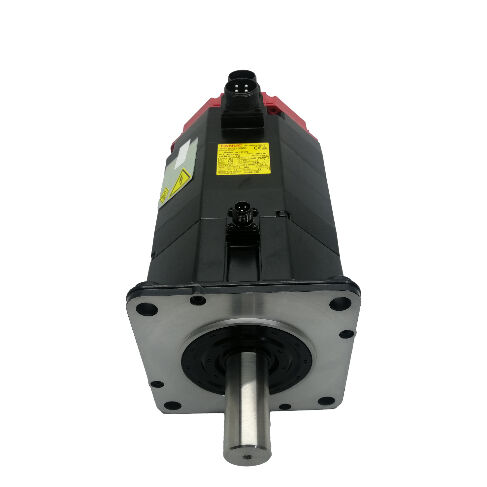
Fanuc A06B-0142-B177 | ALPHA Series AC Servo Motor α12/2000 — 2.1kW, I64 Encoder, Integrated Brake
Part Number: A06B-0142-B177
Series: ALPHA AC Servo Motor
Model: α12 / 2000
Configuration: Integrated Electromagnetic Brake, I64 Incremental Encoder
Origin: Japan
Condition: Refurbished / Exchange Available
Overview
The Fanuc A06B-0142-B177 is a 2.1 kW AC servo motor from Fanuc's ALPHA series — the α12/2000 model in its braked configuration.
Sharing the same frame, output, and electrical ratings as the standard α12/2000 family, this variant adds an integrated electromagnetic holding brake and is paired with the I64 incremental encoder for closed-loop position and velocity feedback.
The combination of 12 Nm torque class, 2,000 RPM operating speed, and the added mechanical holding capability makes this the correct specification for α12/2000 applications where the axis cannot be allowed to move when the servo is inactive.
At 186V, 133Hz, 7.4A on a three-phase supply, this motor runs within the operating envelope of Fanuc's ALPHA series servo amplifiers across the range of CNC control platforms that were current during the ALPHA generation's production period.
The I64 encoder's incremental feedback architecture is compatible with the standard homing-based position reference approach used in these control systems — established, well-understood, and reliable across decades of machine tool production.
The A06B-0142-B177 is supplied as a refurbished unit — an important and legitimate sourcing path for this motor class, which predates Fanuc's ALPHA i series and is no longer in current factory production.
Key Specifications
| Parameter |
Value |
| Rated Output |
2.1 kW |
| Stall Torque |
12 Nm |
| Rated Current |
7.4 A |
| Motor Voltage |
186 V |
| Rated Frequency |
133 Hz |
| Phases |
3-Phase |
| Maximum Speed |
2,000 RPM |
| Encoder |
I64 Incremental |
| Brake |
Integrated Electromagnetic Brake |
| Ingress Protection |
IP65 |
| Series |
ALPHA — α12/2000 |
| Origin |
Japan |
Why the Brake Variant Exists — and When It Matters
The difference between the A06B-0142-B177 and the standard unbraked α12/2000 variants is a single critical capability: mechanical position holding without active servo torque. The integrated brake is spring-applied and electrically released — it locks the shaft automatically whenever the brake circuit loses voltage, whether that loss is planned (controlled shutdown), unplanned (power failure), or event-driven (servo alarm, E-stop).
Restoring the supply voltage releases the brake and returns the motor to normal servo operation.
That fail-safe behavior matters in specific axis configurations that are common enough on CNC machine tools to make the braked variant a frequently specified part.
Vertical Z-axes that carry spindle head or tooling weight will drop under gravity the moment servo torque is removed — without a holding brake, the only protection against that drop is a powered servo system, which is not available during an alarm condition or power interruption.
The same logic applies to rotary B-axes that carry a tilting workpiece table, to W-axes on horizontal boring mills, and to any axis where gravity or spring-loaded mechanisms create a force that the servo is normally counteracting.
On horizontal axes where there is no gravity loading along the axis direction, the brake still serves a function — it holds position precisely during multi-axis machine stops, tool changes, and workpiece loading, where maintaining the last commanded position against vibration and mechanical disturbance is preferable to relying on the servo's active position loop.
I64 Encoder — Incremental Feedback for ALPHA Generation Controls
The I64 is an incremental pulse encoder integrated into the rear of the motor housing. It generates position pulses that the Fanuc servo amplifier uses to close the velocity and position control loops, with an index (marker) pulse once per revolution used to establish the absolute reference during homing.
The "64" refers to the encoder's pulse count characteristic — 64,000 pulses per revolution in the standard I64 configuration — providing the position data resolution the amplifier uses for accurate axis control.
Incremental encoder operation means the machine must perform a homing sequence after each power-up to establish absolute axis position.
The CNC drives each axis to its reference switch, resets the position counter from the encoder's marker pulse, and from that point the system has accurate position knowledge.
This is standard practice for the Fanuc 0, 15, 16, 18, and 21 series controls that the ALPHA motor generation was designed for, and the homing sequence is programmed as part of the machine's startup routine.
In practical maintenance terms, the I64 encoder is the component most likely to cause problems on a motor with extended service history — contamination, connector degradation, and cumulative vibration fatigue affect encoder reliability before winding or bearing failures typically become apparent. When evaluating a used A06B-0142-B177, encoder output integrity is a priority check rather than an afterthought.
Brake Circuit — Wiring, Interlocking, and Commissioning
The brake operates on a dedicated supply circuit separate from the motor power wiring. A 24V DC supply is the standard voltage for the α12 brake coil, sourced from the machine's control power supply and routed through the servo amplifier's brake control output.
The amplifier manages the brake release timing as part of its enable sequence: brake off before axis motion is commanded, brake on before servo disable.
Getting the brake interlock wrong is a common commissioning mistake that produces characteristic symptoms — the motor attempting to move against an engaged brake generates excess current that triggers drive fault alarms, while a brake that releases late produces a position error at the start of the first move.
Both are correctable by verifying the brake supply voltage, confirming the interlock wiring matches the servo amplifier's expected circuit configuration, and checking the amplifier's brake timing parameters.
On a refurbished motor, brake condition should be verified before installation.
The brake must lock the shaft firmly when de-energized and release cleanly when the supply is applied — any dragging, incomplete release, or failure to hold the shaft against manual torque indicates a brake that requires attention before the motor goes back into service.
The ALPHA α12/2000 in Production Context
The α12/2000 power and torque class was sized for the feed axis demands of small to medium CNC machine tools — the machinery category that produced the bulk of Fanuc's ALPHA servo motor installed base. On vertical machining centers, turning centers, and multi-axis platforms of the era, the X, Y, and Z axes regularly carried ALPHA motors in the AC12 class.
Their 12 Nm torque output sustains programmed feedrates through realistic cutting loads without velocity droop, and 2,000 RPM provides a speed ceiling that suits direct-coupled and lightly geared ballscrew arrangements across typical axis travel ranges.
This motor generation has been out of Fanuc's current production catalogue for some time, but the machines it was installed in have not necessarily reached end of life.
For facilities keeping this equipment in production, the A06B-0142-B177 is the part that keeps a braked axis running — and refurbished units from specialist suppliers who test properly represent a reliable sourcing path when new old-stock has been exhausted.
Sourcing Refurbished Units
Refurbished ALPHA series motors from competent suppliers go through a defined inspection and test process: winding resistance and insulation tests, bearing inspection and replacement, brake function verification, encoder signal test, and a no-load run-up on a live Fanuc servo system before the unit is cleared for resale.
This is the standard that separates a motor that will perform reliably in production from one that has simply been cleaned and repackaged.
When sourcing a refurbished A06B-0142-B177, ask specifically for brake test results — static holding torque and clean release confirmation — alongside the standard winding and encoder tests.
A supplier who cannot provide documented test results for a refurbished unit of this age and application criticality is not the right source for a production machine repair.
FAQ
Q1: What is the difference between the A06B-0142-B177 and the A06B-0142-B077?
The B177 variant includes an integrated electromagnetic holding brake; the B077 does not. Both are α12/2000 motors with the same 2.1 kW output and 12 Nm torque rating.
The brake is the only functional difference for standard axis applications, though shaft configuration may also differ between suffix variants — verify the shaft type of the installed motor before sourcing a replacement, as coupling components are bored to match.
Q2: What servo amplifier is compatible with the A06B-0142-B177?
The motor is compatible with Fanuc ALPHA series servo amplifiers — SVM and SVU modules — and integrates with Fanuc CNC controls including Series 0, 0i, 15, 16, 18, and 21. The amplifier must be parameterized with the motor type code for the α12/2000.
The brake circuit requires a 24V DC supply through the amplifier's brake output — confirm this is wired and interlocked correctly before the first axis move.
Q3: Is the brake on this motor suitable for holding a vertical axis during a power failure?
Yes — this is exactly what the spring-applied brake was designed for. When power is removed from the brake circuit for any reason, the spring engages the brake and holds the shaft mechanically without any active power.
This provides a reliable mechanical barrier against gravity-driven axis drop during power loss, servo alarm, or E-stop conditions.
The static holding torque of the brake must be confirmed against the axis gravity load during machine design or commissioning to ensure it is adequate for the specific installation.
Q4: What does the I64 encoder require at machine startup?
The I64 is an incremental encoder — it does not retain absolute position through power cycles. At each startup, the machine must execute a homing sequence that drives the axis to a reference switch, resets the position counter from the encoder's marker pulse, and establishes the absolute axis reference before production motion can begin.
The homing routine is programmed in the CNC and runs automatically as part of the machine startup sequence on controls that this motor generation was paired with.
Q5: What should be checked before installing a refurbished A06B-0142-B177?
Test the brake first: apply and remove 24V to confirm clean release and firm shaft lock when de-energized. Measure three-phase winding resistance for balance across all phases and check insulation resistance to earth. Rotate the shaft by hand to assess bearing condition — roughness or drag indicates worn bearings.
Inspect the I64 encoder connector for pin corrosion and verify the cable exit is undamaged.
For any unit going into a production vertical axis with gravity loading, a bench run-up with encoder signal verification and brake torque confirmation is the correct standard before installation.


 Your message must be between 20-3,000 characters!