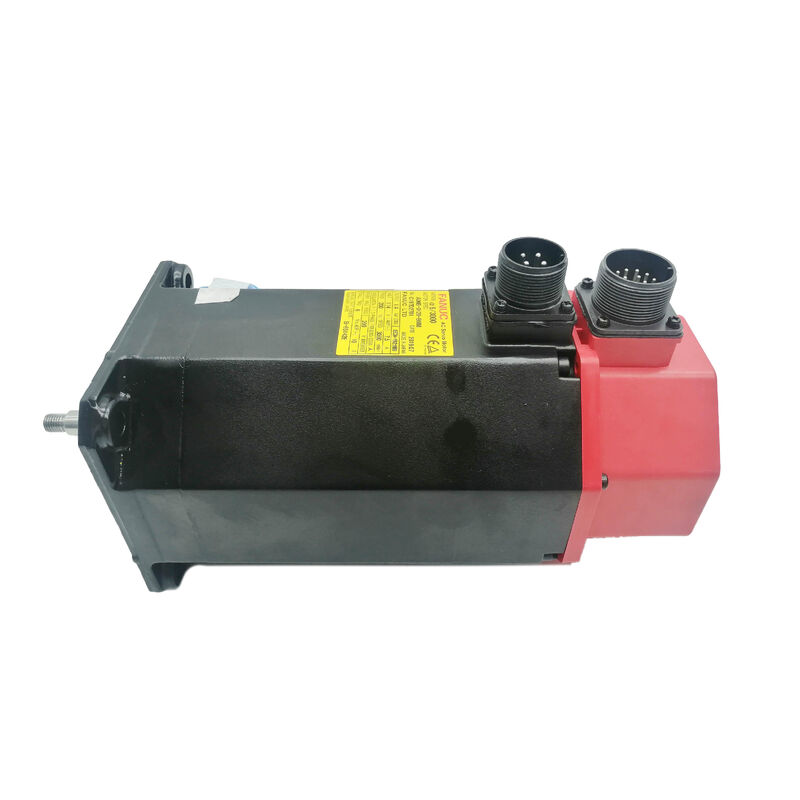
Fanuc A06B-0146-B077 | ALPHA Series AC Servo Motor A22/1500 — 3kW, Straight Shaft, I64 Encoder
Part Number: A06B-0146-B077
Series: ALPHA AC Servo Motor
Model: A22 / 1500
Status: Discontinued by Manufacturer — Refurbished & Surplus Stock Available
Condition: Refurbished / Exchange / Surplus
Overview
The Fanuc A06B-0146-B077 is a 3 kW AC servo motor from Fanuc's ALPHA series — model A22/1500 — the plain straight shaft, no-brake, incremental encoder configuration within the AC22 torque class running at a maximum of 1,500 RPM.
With 22 Nm stall torque, 179V three-phase at 100Hz, and 11A continuous current draw, this is a torque-dense, low-speed motor built for the kind of heavy axis drives on small to medium CNC machine tools that require sustained force output rather than high-speed traverse.
The red end cap identifies this as ALPHA generation — one of the most widely deployed servo motor series in the CNC machine tool industry across its production period.
The A22/1500 in particular was a common specification for X, Y, and Z axis drives on machining centers and turning centers where the moving masses were substantial and the machine's performance was defined by how well those axes resisted cutting loads while maintaining feedrate accuracy.
Fanuc has discontinued this motor, but the machines it was designed for continue to operate in production environments worldwide, keeping the demand for serviceable replacement units firmly active.
Key Specifications
| Parameter |
Value |
| Rated Output |
3 kW (Continuous) |
| Stall Torque |
22 Nm |
| Stall Current |
12 A |
| Rated Current |
11 A |
| Motor Voltage |
179 V |
| Rated Frequency |
100 Hz |
| Phase |
3-Phase |
| Maximum Speed |
1,500 RPM |
| Encoder |
I64 Incremental Pulse Coder (64,000 ppr) |
| Shaft Type |
Straight Plain Shaft (no keyway) |
| Brake |
None |
| Rotor Inertia |
0.012 kg·m² |
| Insulation Class |
F |
| Input Supply |
200–230VAC Inverter |
| Series |
ALPHA — A22/1500 |
| Manufacturer Status |
Discontinued |
High Torque at Low Speed — The A22/1500 Design Logic
The 1,500 RPM ceiling is the parameter that shapes everything about how the A22/1500 is applied. Compared to the A22/3000 variant in the same torque class, this motor was engineered to prioritise force density over speed range.
At 100Hz rated frequency and 179V, it delivers 22 Nm of stall torque from a motor rated for 1,500 RPM — which means significant linear thrust force through a direct-coupled ballscrew, even at low traverse speeds.
For the machines this motor was specified on, that torque priority was the correct engineering trade-off.
On a mid-sized machining center with a heavy worktable or a turning center with substantial saddle mass, the axis needs to hold programmed feedrate against real cutting forces across a full facing pass or roughing cycle.
A motor optimised for low-speed torque output does that job with thermal headroom to spare, without the velocity loop hunting that can appear when a higher-speed, lower-torque motor is pushed near its continuous current limit during aggressive cutting.
The 0.012 kg·m² rotor inertia places this motor in the medium-inertia category — appropriately matched to the ballscrew and mechanical drive inertia of the axis configurations it was designed for, without requiring aggressive servo tuning to achieve stable velocity loop behaviour.
Straight Plain Shaft — SLK Configuration
The A06B-0146-B077 carries a plain straight shaft with no keyway. Torque transmission to the coupling hub relies entirely on clamping force — the coupling's precision bore grips the shaft diameter and holds through controlled clamping torque.
For a 3 kW motor at 22 Nm stall torque on a production axis that cycles continuously, the coupling specification and installation torque matter.
An undersized or improperly torqued coupling can creep under sustained axis loading, producing small rotational slip that accumulates as position error over time without generating an immediate fault indication at the drive.
Precision bellows, jaw, or disc couplings sized appropriately for the shaft diameter and the motor's torque output are the correct choice for this installation.
When a replacement motor is installed, the coupling hub clamping torque should be verified to the coupling manufacturer's specification — not estimated from the previous installation — to ensure the full shaft-to-hub friction capacity is engaged.
The shaft diameter on the A22/1500 frame is consistent across the A06B-0146 family variants, which simplifies coupling sourcing when a replacement motor is installed without mechanical modification to the drive train.
I64 Pulse Coder — Incremental Feedback at 64,000 ppr
The I64 is Fanuc's incremental pulse coder designation for the 64,000 pulse-per-revolution encoder integrated into the rear of this motor. It provides the position and velocity feedback signals the ALPHA servo amplifier uses to close the control loops for axis positioning and feedrate regulation.
At 1,500 RPM maximum speed, the I64 generates 1.6 million pulses per second — comfortably within the feedback processing capability of the ALPHA amplifier systems this motor was paired with.
Incremental operation establishes absolute axis position through a homing sequence at each machine startup.
The CNC drives the axis to its reference position, reads the encoder's marker pulse, and the position register is set from that reference forward. For the production operations this motor supports, homing is a standard startup step and operates reliably when both the encoder and the reference position switch are in good condition.
On motors with extended service histories, the I64 encoder and its connector are the failure points most worth inspecting before installation.
Connector pin corrosion, cable damage at the exit strain relief, and contamination inside the encoder body from coolant ingress are the most common failure modes — and they produce axis position error and encoder alarm codes that can be misdiagnosed as servo amplifier faults before the encoder is identified as the source.
The B077 in the A06B-0146 Family
The A06B-0146 family covers multiple configurations of the A22/1500 motor — different encoder types, brake options, and shaft variants that share the same core electrical specification. The B077 is the straight plain shaft, no-brake, I64 incremental encoder variant.
Other notable members of the family include the B075 (A64 encoder, plain shaft, no brake), the B175 (A64 encoder, with brake), and the B177 (I64, with brake).
The electrical specification — 3 kW, 22 Nm, 179V, 100Hz, 11A — is shared across all these variants.
What changes is the shaft sub-variant (#7000 for plain shaft, #7008 for keyed shaft), encoder type, and brake status.
Verifying the correct variant before sourcing a replacement is essential: a motor with the right base specification but the wrong shaft or encoder type will require either mechanical modification of the drive train or servo drive parameter changes before it can be installed correctly.
Drive & Control Compatibility
The A06B-0146-B077 is compatible with Fanuc ALPHA series servo amplifiers — SVM modules — and integrates with Fanuc CNC controls including Series 0, 0i, 16, 18, and 21. The servo amplifier must be parameterised with the motor type code for the A22/1500 before the axis is operated.
Given the age of this motor series and the range of drive and control upgrades that machines may have undergone since original build, confirming that the installed amplifier supports the I64 incremental encoder interface is a worthwhile step before installing a replacement motor.
For machines where the original A06B-0146-B077 has been in service for many years without incident, the replacement motor should be tested against the same servo amplifier configuration before going into production service — a brief run-up in a test environment or at low federate verifies that the motor type parameter settings and the encoder interface are working correctly before the machine returns to full production cycle.
FAQ
Q1: What is the main difference between the A06B-0146-B077 and the A06B-0146-B075?
Both are A22/1500 motors with the same 3kW output, 22Nm stall torque, 179V / 100Hz / 11A specification, straight plain shaft, and no brake.
The difference is the encoder type: the B077 uses the I64 incremental pulse coder, while the B075 uses the A64 absolute encoder.
The A64 retains position through power cycles, eliminating the homing sequence on restart. The I64 requires homing after each power cycle.
Both are otherwise mechanically identical and use the same servo amplifier pairing — but the encoder change affects servo drive parameter configuration and machine startup behavior.
Q2: Why does this motor run at only 1,500 RPM when the A22/3000 variant reaches 3,000 RPM?
The A22/1500 is designed for maximum torque output at low speed. By limiting the operating speed, the electromagnetic geometry can be optimised for sustained force production — delivering 22 Nm reliably across the full 0–1,500 RPM range without the trade-offs that come with extending the speed ceiling.
On heavy axis drives where the priority is feedrate maintenance under load rather than fast traverse, the A22/1500 is the correct specification. The A22/3000 trades some low-speed torque density for the extended speed range needed on faster machines.
Q3: This motor is discontinued — what are the practical sourcing options?
Refurbished originals through specialist servo motor repair companies, verified surplus new-old-stock units where available, and exchange programs that return a tested unit for a defective core.
The A22/1500 is well-established in the servo repair community — its failure modes, compatible bearings, encoder replacement procedures, and shaft specifications are well documented. A reputable refurbisher can restore this motor to production-ready condition. Insist on documented bench test results rather than visual inspection alone when sourcing a unit for a critical production axis.
Q4: Can the A06B-0146-B077 be replaced with the A06B-0145-B077 (the AC22/1500 IP65 variant)?
The A06B-0145 and A06B-0146 are both A22/1500 motors in the ALPHA series with similar electrical specifications, but they come from different sub-generations and have differences in encoder type, connector configuration, and sealing specification.
A direct substitution requires confirming physical mounting compatibility, connector pinout matching, encoder type compatibility with the installed servo amplifier, and servo drive parameter verification.
They are not confirmed drop-in equivalents — the part number must be matched or the substitution must be verified on the specific machine before installation.
Q5: What are the most important checks when evaluating a used A06B-0146-B077?
Measure three-phase winding resistance for balance across all phases and check insulation resistance to earth — these confirm winding integrity. Rotate the shaft by hand to feel for bearing roughness or drag. Inspect the I64 encoder connector for corroded or bent pins and the cable exit for damage or chafing at the strain relief.
Check the plain shaft end for coupling fretting or impact marks. A no-load bench run-up to rated speed with encoder signal verification on a Fanuc drive is the correct final step before committing a used unit to a production axis — particularly on a motor this age where the service history may not be known.


 Your message must be between 20-3,000 characters!