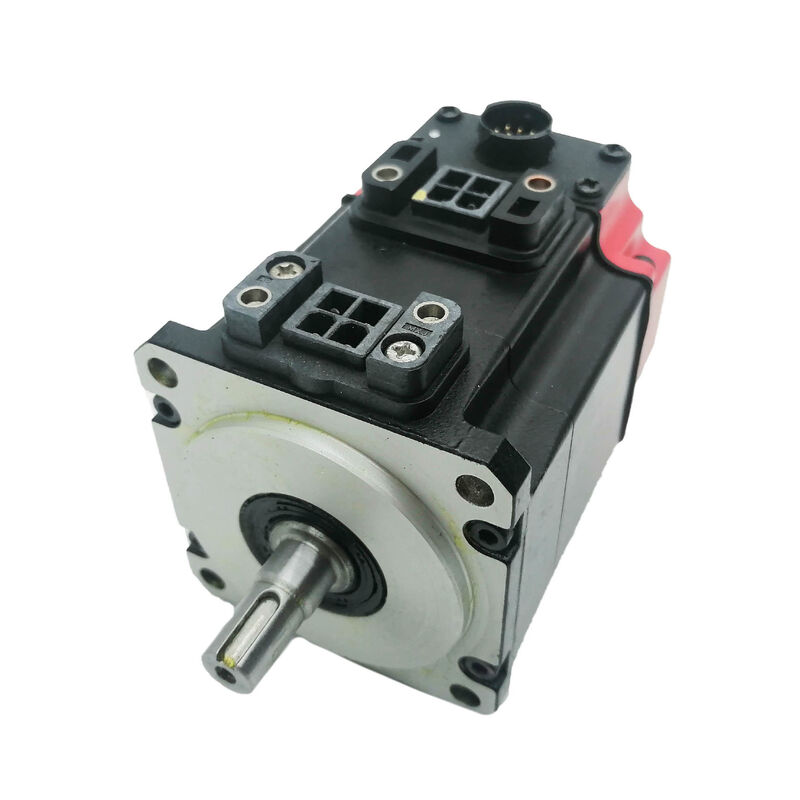
Fanuc A06B-0148-B175 | ALPHA Series AC Servo Motor A22/3000 — 4.4kW, Brake, A64 Encoder, IP67
Part Number: A06B-0148-B175
Series: ALPHA AC Servo Motor
Model: A22 / 3000
Configuration: Straight Shaft, Integrated Brake, A64 Encoder, IP67
Condition: New / Refurbished
Overview
The Fanuc A06B-0148-B175 is a 4.4 kW AC servo motor from Fanuc's ALPHA series — model A22/3000 — the braked variant in the AC22 family running to 3,000 RPM.
At 22 Nm stall torque with a 132V, 200Hz three-phase supply drawing 20A continuous and 32A peak, this motor operates in the substantial end of the ALPHA series range while remaining within the mid-frame physical class.
It is fitted with an A64 pulse coder for position and velocity feedback, a spring-applied electromagnetic brake, and IP67 factory-sealed housing — a complete specification for the axis drives of medium CNC machine tools where mechanical position holding and coolant protection are both requirements of the installation.
The brake is the defining feature of the B175 within the A22/3000 family.
It separates this variant from the B075 and B077 — which share the same electrical ratings but carry no brake — and it signals the installation context: vertical axes, tilting heads, gravity-loaded rotary tables, or any mechanism where the servo alone cannot guarantee position retention when the drive is de-energized.
The IP67 sealing confirms the motor is built for the coolant-heavy environments of production machine tools, where bare housing or lower-rated sealing would mean premature bearing contamination and winding degradation from coolant mist.
Key Specifications
| Parameter |
Value |
| Rated Output |
4.4 kW |
| Stall Torque |
22 Nm |
| Stall Current |
32 A |
| Continuous Current |
20 A |
| Motor Voltage |
132 V |
| Rated Frequency |
200 Hz |
| Phase |
3-Phase |
| Maximum Speed |
3,000 RPM |
| Encoder |
A64 Pulse Coder (64,000 ppr) |
| Shaft Type |
Straight Shaft |
| Brake |
Integrated, Spring-Applied |
| Ingress Protection |
IP67 |
| Insulation Class |
F |
| Series |
ALPHA — A22/3000 |
A22/3000 — Higher Speed Within the AC22 Torque Class
The AC22 torque class covers two primary speed ratings in the ALPHA family — the 1,500 RPM and 3,000 RPM variants. Both deliver 22 Nm stall torque, but the 3,000 RPM ceiling of the A22/3000 opens up a different range of mechanical drive applications compared to the lower-speed A22/1500.
On direct-coupled ballscrew axes with typical lead values, 3,000 RPM translates to faster rapid traverse rates and a wider operating speed range that accommodates both slow precision feedrates and fast positioning moves without the motor approaching its speed limit during normal cycle operation.
The 132V / 200Hz electrical specification reflects the higher-speed design. The 200Hz rated frequency requires the servo amplifier to generate a variable-frequency output at twice the rate of the 100Hz motors in the same torque class — which is handled internally by the ALPHA servo amplifier, with the 200–240V mains supply providing the source from which the drive's internal DC bus is generated.
For the machine tool builder and maintenance engineer, the relevant parameter is the A22/3000 motor type code and the correct servo amplifier pairing, not the 200Hz frequency itself.
The 4.4 kW rated output at 3,000 RPM with 22 Nm stall torque positions this motor for medium machine tool axis drives where the combination of torque density and speed range matches the mechanical demands of X, Y, and Z axis feeds on compact to mid-range vertical machining centers, turning centers, and multi-axis production machines.
Integrated Brake — Spring-Applied, Fail-Safe
The brake on the A06B-0148-B175 is the mechanical feature that defines its installation context as clearly as any electrical parameter.
It is spring-applied and electrically released — in the absence of brake supply power, the spring engages and locks the shaft. The brake releases when the correct supply voltage is applied to the brake coil, allowing normal servo operation.
This fail-safe architecture means that any event which removes power from the brake circuit — a commanded shutdown, an emergency stop, a servo fault alarm, or an unplanned power interruption — results in immediate mechanical shaft locking without requiring any active response from the control system or the servo drive.
For vertical axes carrying worktable or spindle head weight, or rotary axes holding a fixed index position between machining operations, this is not an optional feature — it is the safety requirement.
The practical installation consequence is the 24V DC brake supply circuit and its interlock wiring. The brake must be confirmed to release cleanly before the servo drive commands axis motion, and the interlock must ensure the brake re-engages before the servo drive is disabled at the end of each cycle.
This sequencing is handled through the CNC and servo amplifier's brake control output, and it must be verified during commissioning and after any rewiring of the brake circuit.
On used motors, the brake is the first component to evaluate before installation. A brake that drags during release restricts axis motion and causes excess current at the drive.
A brake that fails to hold when de-energized removes the safety function entirely. Neither condition is acceptable on a production machine — bench test the brake with the correct supply voltage before committing the motor to service.
A64 Pulse Coder — Absolute Position Encoder
The A64 fitted to the B175 is an absolute pulse coder — distinct from the I64 incremental encoder found on other variants in the A22/3000 family. The absolute position capability means the motor retains shaft position data through power interruptions.
On machine startup, the servo drive reads the current absolute position from the A64 without requiring a homing sequence. The CNC has full axis position knowledge immediately, and production can resume from exactly the stopped state without driving the axis to a reference point.
For a machine running multiple shifts or operating in an environment where power interruptions are not uncommon, the absolute encoder capability converts what would be a mandatory homing delay on each restart into an instant-ready condition.
Over the lifetime of a production machine, that cumulative time saving is meaningful — and the absence of the failure modes associated with incremental homing sequences (interrupted homing, reference position drift, missed marker pulses) represents a genuine reliability improvement over incremental feedback.
The A64's 64,000 counts per revolution provide the position resolution the ALPHA servo amplifier uses to close the control loops with the precision needed for accurate contouring and tight position endpoints across the A22/3000's full speed range.
IP67 Sealing — Factory Standard for Machine Tool Environments
The IP67 housing protection on the A06B-0148-B175 is factory-built into the motor, not retrofitted.
The shaft seal, cable entries, encoder housing, and motor body are all rated for temporary immersion to one metre depth for 30 minutes — in a machine tool environment, this means reliable protection against coolant spray, mist saturation, and the accumulated fluid exposure of production machining operations that carry on for years.
IP67 at this torque class and application type is the specification that keeps bearing contamination failure rates low over extended service life.
The front bearing of a servo motor mounted close to the cutting zone on an active machining center is exposed to coolant mist continuously.
At IP67, the shaft seal and housing joints block that mist reliably. At IP55 or lower, the same exposure becomes a slow contamination pathway that shortens bearing and winding service life without producing any obvious symptom until failure is imminent.
Drive & Control Compatibility
The A06B-0148-B175 is compatible with Fanuc ALPHA series servo amplifiers — SVM modules rated for the 20A continuous / 32A peak current class — and integrates with the Fanuc CNC control platforms that covered the A22/3000's production period: Series 0, 0i, 16, 18, and 21 families.
The servo drive must be parameterised with the motor type code for the A22/3000 with A64 encoder. The brake circuit connects to the CNC cabinet's brake supply output and must be correctly interlocked.
When installing a replacement A06B-0148-B175, confirm that the servo amplifier currently on the machine supports the A64 absolute encoder interface — not all ALPHA amplifiers of this generation have identical encoder protocol support, and the A64 absolute interface requires specific amplifier capability.
Substituting a motor with an I64 incremental encoder where the drive and machine parameters are set for an A64 absolute encoder requires parameter changes and restoration of the homing reference before the axis can operate correctly.
FAQ
Q1: What is the key difference between the A06B-0148-B175 and the B075 or B077 variants?
All three are A22/3000 motors with the same 4.4kW output, 22Nm stall torque, 132V / 200Hz / 20A specification, and IP67 sealing. The B075 has no brake and typically uses an A64 encoder without absolute function. The B077 has no brake and uses an I64 incremental encoder.
The B175 adds an integrated spring-applied brake and uses the A64 absolute encoder. The brake and encoder type are the selection criteria that determine which variant is correct for a specific machine position — they are not interchangeable without adjusting both the safety circuit and the servo drive encoder parameters.
Q2: What does the absolute A64 encoder offer compared to the I64 incremental encoder on other variants?
The A64 retains shaft position through power cycles — the drive reads absolute position on startup without a homing sequence.
The I64 loses its reference on power loss and requires the axis to travel to a reference position at each restart. For machines that power cycle regularly or operate in environments with power quality issues, the A64 eliminates homing delays and the class of errors associated with interrupted homing routines.
The absolute function requires battery backup in the servo amplifier to maintain position data — this battery should be checked and replaced on schedule as part of machine preventive maintenance.
Q3: How should the brake circuit be wired and interlocked during installation?
The brake requires a dedicated supply voltage — confirm the correct voltage from the machine documentation, as it varies between ALPHA series motor generations.
The interlock must ensure:
(1) brake releases before the servo drive commands axis motion,
(2) brake re-engages before the servo drive is disabled at cycle end or E-stop. Both conditions are configured through the servo amplifier's brake control output and the CNC's axis enable logic. Verify the brake releases fully and re-engages cleanly with the correct supply voltage before running the axis under load.
Q4: The machine specification calls for the B175, but I can only find B077 units in stock — can I substitute?
Not directly. The B077 has no brake and uses an I64 incremental encoder. Fitting it in a B175 position removes the mechanical position holding for a gravity-loaded or safety-critical axis and changes the feedback type from absolute to incremental. The brake absence is a safety issue on vertical axes.
The encoder change requires servo drive parameter updates and reinstating a homing reference. In an emergency, the substitution is technically possible with these changes — but it is not an equivalent replacement and must be reviewed and documented before the machine returns to production.
Q5: What inspection steps matter most for a used or refurbished A06B-0148-B175?
Test the brake first: apply the correct brake supply voltage and confirm the shaft rotates freely, then remove power and confirm the shaft locks without creep. A dragging brake is a drive overload problem in use; a non-locking brake is a safety failure on a vertical axis.
Next, verify the A64 encoder outputs a valid absolute position signal — use a servo test fixture or the servo amplifier's diagnostic display with the motor connected. Measure three-phase winding resistance for phase balance and insulation resistance to earth.
Rotate the shaft by hand to assess bearing condition and inspect the IP67 shaft seal for hardening or cracking. Full bench run-up to rated speed with brake function and encoder signal verification is the correct pre-installation standard.


 Your message must be between 20-3,000 characters!