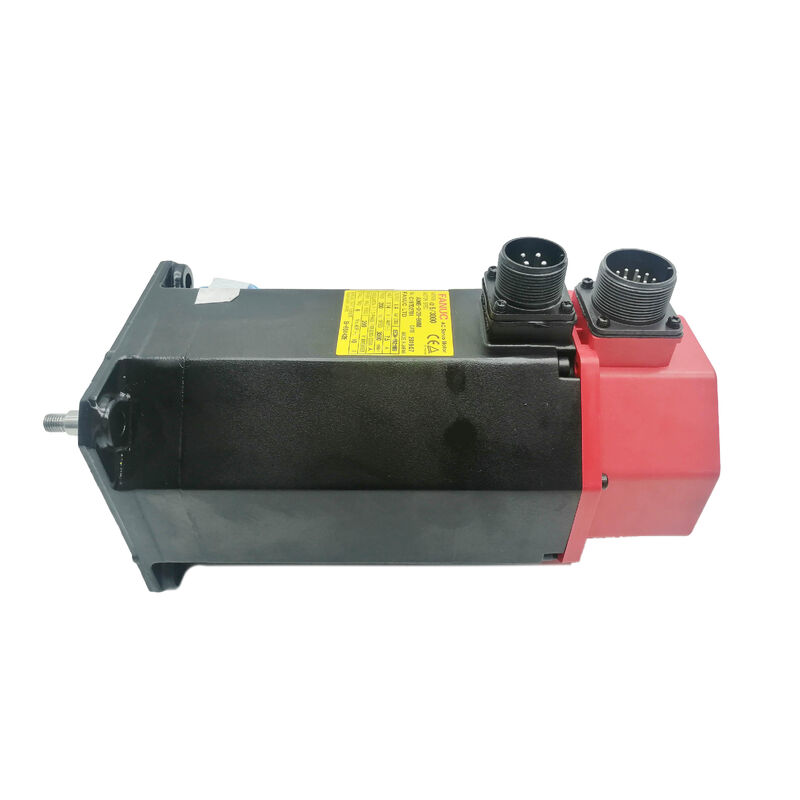
Fanuc A06B-0153-B077 | ALPHA Series AC Servo Motor A30/3000 — 4.8kW, Straight Shaft, I64 Encoder
Part Number: A06B-0153-B077
Series: ALPHA AC Servo Motor
Model: A30 / 3000
Status: Discontinued by Manufacturer — Refurbished & Surplus Stock Available
Condition: Refurbished / Exchange / Surplus
Overview
The Fanuc A06B-0153-B077 is a heavy-duty ALPHA series AC servo motor — model A30/3000 — sitting at a substantially different tier from the compact AC12 and AC22 motors that appear more frequently in the CNC servo market.
At 4.8 kW output, 30 Nm stall torque, 168V three-phase at 200Hz, and 17A continuous current draw, this is a motor for the larger axis drives of medium to large CNC machine tools: the axes that move significant mechanical mass, resist aggressive cutting forces, and need to maintain positioning accuracy under load conditions that smaller motors cannot sustain.
Weighing in at approximately 41 kg, the A06B-0153-B077 is a physically imposing unit by servo motor standards.
That weight is a direct consequence of the copper winding mass and laminated iron core volume required to deliver 30 Nm of stall torque reliably.
It is fitted with a straight shaft and the I64 incremental pulse coder, configured for the coupling-based drive arrangements and incremental axis feedback that were standard on the Fanuc-equipped machining centers and turning centers of its generation.
Fanuc has discontinued this motor. The machines it was built into have not been discontinued — and for the facilities still running them, a reliable source of serviceable A06B-0153-B077 units is a straightforward production necessity.
Key Specifications
| Parameter |
Value |
| Rated Output |
4.8 kW |
| Stall Torque |
30 Nm |
| Rated Current |
17 A |
| Peak Current |
34 A |
| Motor Voltage |
168 V |
| Rated Frequency |
200 Hz |
| Phase |
3-Phase |
| Maximum Speed |
3,000 RPM |
| Encoder |
I64 Incremental Pulse Coder (64,000 ppr) |
| Shaft Type |
Straight Shaft (Plain — no keyway) |
| Brake |
None |
| Weight |
Approx. 41 kg |
| Series |
ALPHA — A30/3000 |
| Manufacturer Status |
Discontinued |
The A30 in the ALPHA Motor Hierarchy
The AC30 designation reflects Fanuc's nominal torque class designation for this motor — 30 Nm stall torque — and the 3,000 RPM speed rating places it at the higher-speed end of the larger ALPHA AC frame motors.
Together these parameters define a motor suited to the kind of axis work that the AC12 and AC22 families are simply not sized for: main spindle positioning on large turning centers, heavy Z-axis drives on gantry-style machining centers, or the primary axis of a machine where the combined mass of the worktable, fixture, and workpiece creates reflected inertia that smaller frames cannot manage without velocity loop instability or sustained overcurrent.
At 4.8 kW and 3,000 RPM, the A30/3000 produces its rated power at an operating speed that suits both contouring operations and the higher-speed traverse moves that reduce non-cutting cycle time on machines with long axis travels.
The peak current of 34A — twice the continuous rated current — delivers the acceleration torque needed for fast traverse on a heavy axis without requiring an oversized drive module to handle normal cutting loads.
The 41 kg body weight is the practical reality that any maintenance procedure on this motor has to accommodate.
Motor removal and reinstallation require mechanical support equipment — a hoist or trolley rated for the load — and the coupling or drive train interface must be re-engaged and aligned with the motor properly supported. This is not a motor that can be swapped out quickly by one technician without planning.
Straight Shaft and Drive Train Integration
The plain straight shaft on the A06B-0153-B077 transmits torque through coupling clamping force — no keyway provides additional mechanical engagement. For a motor delivering 30 Nm stall torque at this frame size, the coupling selection and installation torque specification must be appropriate to the load.
Precision servo couplings of the correct bore size and rated torque capacity are required; undersized couplings risk slipping during axis acceleration from heavy mechanical loads, which produces position error that accumulates over time without an immediately obvious fault indication.
The straight plain shaft also simplifies coupling removal during maintenance compared to keyed variants where the key must be extracted before the hub can come off. For a motor this heavy that will need periodic service access, that simplicity has practical value in the field.
Keyed shaft variants exist within the A06B-0153 family — the B075 and B175 suffixes carry keyways — but the B077 is the plain shaft specification, and machines built around it are designed for plain shaft coupling arrangements.
I64 Pulse Coder — Established Incremental Feedback
The I64 is a 64,000 pulse-per-revolution incremental encoder integrated into the rear of the motor housing. It delivers position and velocity feedback to the ALPHA servo amplifier, with the CNC establishing absolute axis position through a homing sequence on each machine startup.
At 3,000 RPM maximum speed, the I64 generates 3.2 million pulses per second — the feedback bandwidth the ALPHA servo amplifier expects for this motor class.
On a motor of this age and weight class, the I64 encoder and its connector are the components that deserve the most careful inspection when evaluating a used unit.
The encoder body is mounted at the motor's rear and is exposed to the mechanical vibration that a 41 kg motor transmits through its structure during normal operation.
Connector integrity and cable exit condition are the most common encoder-related failure modes on heavy motors with extended service histories, typically presenting as position error or encoder alarm codes at the drive before the fault becomes catastrophic.
Drive & Control Compatibility
The A06B-0153-B077 is compatible with Fanuc ALPHA series servo amplifiers — SVM modules — sized for the 17A continuous / 34A peak current requirements of the A30/3000. It integrates with the Fanuc CNC control platforms that were current during its production: Series 0, 0i, 15, 16, 18, and 21 controls.
The servo amplifier must be parameterized with the motor type code for the A30/3000 before the axis is operated — incorrect parameterization affects velocity loop behavior and current limits at a scale where errors produce damaging overcurrent rather than merely sluggish response.
Given the age of this motor series and the range of control and drive upgrades that machines may have undergone since original build, it is worth confirming that the existing servo amplifier is rated for the A30's current class before installing a replacement motor.
An undersized amplifier paired with this motor will reach its current limit during axis acceleration and produce persistent drive faults under normal operating conditions.
Discontinued Status and Sourcing Reality
Fanuc's discontinuation of the A06B-0153-B077 reflects a product generation transition rather than a reflection of the motor's serviceability.
The ALPHA series was eventually superseded by the Alpha i and Beta i generations, but the machine tools built around the earlier ALPHA series remain in production service in job shops and manufacturing facilities where the economics of keeping a proven machine running outweigh the cost and complexity of a full retool.
For these machines, the practical sourcing options are refurbished originals, verified surplus new-old-stock units, and exchange programs through specialist servo motor repair companies familiar with the ALPHA A30 series.
At 41 kg, shipping costs for this motor are meaningful — it qualifies as freight rather than parcel, which affects both the logistics of sourcing and the economics of repair versus replacement decisions.
When evaluating a refurbished unit, the weight alone should not be mistaken for a sign of condition.
A 41 kg motor can have degraded windings, worn bearings, or a compromised encoder and still feel solid in the hand. Documented bench test results — winding resistance, insulation resistance, encoder output, no-load run-up — are the evidence that matters, not physical appearance.
FAQ
Q1: What ALPHA servo amplifier is compatible with the A06B-0153-B077?
The A30/3000 requires an ALPHA series SVM module sized for at least 17A continuous and 34A peak output current. Compatible drive modules include the SVM1-40L and related ALPHA amplifiers in the correct current class.
The motor type parameter in the servo drive must be set to match the A30/3000 specification before the axis is operated. Confirm drive compatibility before ordering a replacement motor, particularly on machines that have had control or drive upgrades since original build.
Q2: Why is the A06B-0153-B077 so heavy compared to other ALPHA series motors?
The A30's 30 Nm stall torque requires substantially more copper winding mass and laminated iron core volume than the AC12 or AC22 motors produce from smaller frames. The 41 kg weight is a direct physical consequence of the electromagnetic design needed to deliver that torque level reliably at the rated duty cycle.
There is no lightweight alternative that delivers equivalent torque in this motor class — the weight is inherent to the power density the design achieves.
Q3: The motor is discontinued — are refurbished units reliable for production use?
Yes, provided they come from a shop with documented ALPHA series repair capability and verifiable test procedures. A properly refurbished A30/3000 will have had bearings replaced, windings tested for resistance balance and insulation integrity, the I64 encoder evaluated, and a full no-load run-up completed before sale.
The ALPHA A30 is a well-understood motor in the specialist servo repair community — its failure modes, replacement parts, and service procedures are documented. Insist on test documentation, not a visual inspection alone.
Q4: What is the difference between the B077 and B075 or B175 variants in the A30/3000 family?
The B077 has a plain straight shaft, no keyway, and no brake — the base configuration for coupling-based drive arrangements with no gravity-holding requirement. The B075 carries a plain or keyed shaft depending on sub-suffix, also without a brake.
The B175 adds an integrated holding brake for vertical axis or gravity-loaded applications. All share the A30/3000 electrical specification (4.8kW, 168V, 200Hz, 17A, I64 encoder) — the differences are shaft configuration and brake status. Verify which variant is installed before ordering a replacement.
Q5: What are the critical inspection points on a used A06B-0153-B077?
At 41 kg, the motor requires mechanical support during inspection — do not attempt to hold it unsupported while checking the shaft. Rotate the shaft by hand to feel for bearing roughness, noting that the front bearing on a motor this size carries significant radial load.
Measure three-phase winding resistance for balance across all phases and check insulation resistance to earth. Inspect the I64 encoder connector for pin corrosion and the cable exit for damage or chafing. Check the plain shaft end for coupling contact marks or fretting.
A bench run-up under controlled conditions with encoder signal monitoring is the correct verification standard before this motor goes back on a production axis.


 Your message must be between 20-3,000 characters!