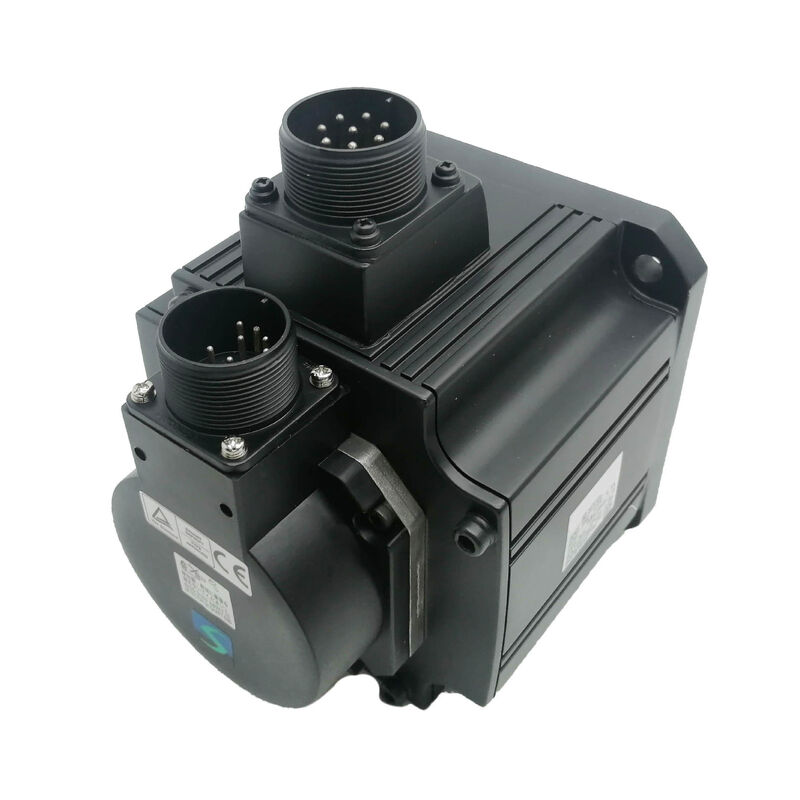
Mitsubishi HC-SFE152K | MELSERVO-J2S Series AC Servo Motor — 1.5 kW, 17-Bit Absolute, Keyed Shaft, IP65
Part Number: HC-SFE152K (also referenced as HC-SFS152K)
Brand: Mitsubishi Electric
Series: MELSERVO-J2S — HC-SF Type
Status: Discontinued by Manufacturer — Refurbished & Surplus Stock Available
Condition: Refurbished / Exchange / Surplus
Overview
The Mitsubishi HC-SFE152K is a 1.5 kW AC brushless servo motor from Mitsubishi Electric's MELSERVO-J2S series — specifically the HC-SF medium-inertia, medium-power motor family.
With a rated torque of 7.16 Nm at 2,000 RPM, a peak torque of 21.6 Nm, and a 17-bit absolute encoder delivering 131,072 counts per revolution, this motor was designed for the kind of feed axis and positioning work where sustained torque accuracy, precise absolute feedback, and long-term reliability in industrial environments are all non-negotiable requirements.
The HC-SFE152K carries a keyed straight shaft, built-in oil seal, and IP65 ingress protection — a configuration that covers the mechanical coupling, shaft sealing, and environmental protection requirements of the machine tool and production automation applications the MELSERVO-J2S series was built for. It operates from a 200VAC class supply, draws 9A at rated load with a maximum current capability of 27A, and mounts on a 130 × 130 mm flange.
Mitsubishi has since discontinued this model. The J2S platform has been superseded by later MELSERVO generations, but a substantial installed base of J2S-equipped machines remains active in manufacturing facilities worldwide — and sourcing a reliable HC-SFE152K replacement remains a practical and ongoing maintenance requirement for many of those operations.
Key Specifications
| Parameter |
Value |
| Rated Output |
1.5 kW (1500 W) |
| Rated Torque |
7.16 Nm |
| Maximum Torque |
21.6 Nm |
| Rated Current |
9 A |
| Maximum Current |
27 A |
| Supply Voltage |
200VAC Class |
| Rated Speed |
2,000 RPM |
| Maximum Speed |
3,000 RPM |
| Encoder |
17-Bit Absolute (131,072 ppr) |
| Moment of Inertia |
0.00200 kg·m² (20 kg·cm²) |
| Shaft Type |
Keyed Straight Shaft |
| Sealing |
Built-in Oil Seal |
| Ingress Protection |
IP65 |
| Flange Size |
130 × 130 mm |
| Dimensions |
H176 × W130 × D225 mm |
| Operating Temperature |
0 to +40°C |
| Storage Temperature |
−15 to +70°C |
| Series |
MELSERVO-J2S — HC-SF |
| Manufacturer Status |
Discontinued |
HC-SF Series — Medium Inertia for Real-World Axis Loads
Mitsubishi designed the HC-SF motor type to match the inertia characteristics of moderate to heavy mechanical loads — the kind of axis inertia that shows up in medium-sized machine tools, multi-axis machining centers, and automation equipment with driven carriages, ballscrew-supported tables, or rotary indexing mechanisms that carry real mass.
The 0.00200 kg·m² rotor inertia is the figure that defines this motor's load-matching behavior. When the reflected load inertia is a reasonable multiple of the motor's own inertia — typically within a 5:1 or 10:1 ratio depending on the application — the servo system can close its velocity and position loops with stable, well-damped response without aggressive gain tuning.
The HC-SF sits in the inertia range where many practical machine tool axis configurations land naturally, which is why it was paired with the axes it was.
At 1,500 RPM rated speed with a maximum of 3,000 RPM, the motor covers both typical cutting feedrate ranges and the faster traverse rates that reduce non-cutting cycle time.
The 21.6 Nm peak torque — three times the continuous rated torque — provides the acceleration headroom needed for rapid axis positioning without requiring an oversized motor running well below its continuous thermal limit.
17-Bit Absolute Encoder — No Homing, No Battery Dependency
The built-in 17-bit encoder resolves 131,072 unique positions per shaft revolution and stores absolute position data directly in the encoder hardware. At startup, the MR-J2S drive reads the current shaft position without requiring the axis to travel to a reference point first.
On a multi-axis machine, this means the control system has full position knowledge of every J2S-equipped axis immediately on power-up — before any motion is commanded.
In production environments, this matters more than it might appear. Homing cycles take time — time that compounds across shifts, planned maintenance windows, E-stop recovery events, and any power interruption that interrupts an active cycle.
Eliminating homing from every startup sequence is a genuine operational gain over incremental encoder systems, particularly on machines running high production volumes where every minute of non-cutting time has measurable cost.
The 17-bit resolution also supports fine velocity granularity at low shaft speeds, which contributes to smooth motion profiles at slow feedrates — relevant for finishing passes, contour interpolation, and any operation where velocity ripple at low speed affects surface quality or dimensional accuracy.
Keyed Shaft and Oil Seal
The keyed straight shaft provides a positive mechanical connection to the driven component — coupling hub, pulley, or gearbox input — that cannot rotate relative to the shaft regardless of torque magnitude, shock loading, or direction reversals.
For a 1.5 kW axis motor developing up to 21.6 Nm peak torque, the key is not optional engineering — it is the appropriate specification for any coupling arrangement where the transmitted torque and the dynamic load profile exceed what clamping force alone can reliably manage over the motor's service life.
The built-in oil seal protects the shaft bearing from the airborne coolant mist, fine metallic particles, and general contamination that are present at the axis drive end of a machine tool in operation.
Seal condition on used motors is a meaningful inspection item — a hardened or worn shaft seal allows contamination to bypass the IP65 housing protection and reach the front bearing, where slow degradation begins before any obvious symptom appears.
This is one of the more common findings on HC-SF motors with extended service histories in wet cutting environments.
IP65 in a Production Context
IP65 seals the motor body against all dust ingress and provides protection against directed low-pressure water jets from any angle.
On a CNC machine tool, this covers the routine coolant exposure — splash from cutting operations, airborne mist in the cutting zone, incidental fluid contact during workpiece loading, and the general fluid migration that occurs around any actively cooled machining process.
The HC-SF family was not designed for submerged or high-pressure coolant jet environments — applications with those conditions warrant IP67 or higher ratings.
For the broad majority of CNC machine tool axis positions, IP65 is the appropriate specification and has proven adequate across the long service history of the J2S platform.
MELSERVO-J2S Drive Compatibility
The HC-SFE152K is designed for use with Mitsubishi's MR-J2S series servo amplifiers. The MR-J2S drive natively supports the HC-SF motor type and the 17-bit absolute encoder protocol. The correct amplifier for this motor class is the MR-J2S-200A — sized for the motor's 1.5 kW output and 9A rated / 27A peak current requirements.
The MR-J2S platform supports both SSCNET high-speed fibre-optic network communication for multi-axis coordinated systems and analogue/pulse-train command inputs for standalone applications. Servo amplifier parameters must be set to match the HC-SF152 motor specification before the axis is operated.
On any machine being returned to service after a motor replacement, confirming parameter integrity — particularly motor type code, encoder type, and rated current — is the correct commissioning step before running the axis under load.
For facilities considering a J2S-to-J4 or J2S-to-J5 drive upgrade alongside motor replacement, note that cross-generation motor compatibility requires specific amplifier configuration and should be verified with Mitsubishi application support before implementation.
Discontinued Status and Sourcing
The HC-SFE152K is no longer manufactured. As with all discontinued MELSERVO components, the practical sourcing options are refurbished originals from specialist servo motor repair facilities, verified surplus new-old-stock units, and exchange programs.
Given the age of the J2S platform, refurbishment quality varies between suppliers — the difference between a motor that has had bearings replaced and been run-tested under load, and one that has simply been cleaned and repackaged, is not visible from the outside.
For critical production axes, the most defensible procurement approach is a supplier who can provide documented test results covering winding resistance, insulation resistance, encoder output integrity, and a no-load run-up — not a verbal assurance and a visual inspection. On a motor this age, those tests are the difference between a reliable repair and an unplanned failure six months later.
FAQ
Q1: What servo amplifier is compatible with the HC-SFE152K?
The HC-SFE152K is designed for use with Mitsubishi MR-J2S series servo amplifiers. The MR-J2S-200A is the correct amplifier for this motor's 1.5 kW output and current ratings.
The drive must be parameterized with the correct motor type code for the HC-SF152 before the axis is operated. Using an incorrectly configured motor type parameter produces velocity loop instability or drive faults and must be resolved before load testing.
Q2: The motor is discontinued — is a newer Mitsubishi servo motor a viable direct replacement?
Not without significant engineering work. Mitsubishi's current HG-SR or HG-MR series motors may match the torque class, but the flange dimensions, shaft geometry, connector pinouts, encoder protocol, and drive compatibility all differ between the J2S and current J4/J5 generations.
A cross-generation substitution requires mechanical reassessment, new cabling, and a drive upgrade alongside the motor.
For a like-for-like maintenance replacement, sourcing a refurbished HC-SFE152K paired with the existing MR-J2S amplifier remains the lower-risk path unless a full system upgrade is planned.
Q3: What does the 17-bit absolute encoder offer compared to an incremental encoder?
A 17-bit absolute encoder stores shaft position physically at 131,072 points per revolution and retains that data without a battery.
On power-up, the drive reads the absolute position immediately — no homing cycle required. An incremental encoder loses position reference on power-down and requires a homing sequence each time the machine restarts.
For production machines with multiple daily startups or frequent E-stop events, the time saved by eliminating homing accumulates to a meaningful productivity advantage over the machine's operating life.
Q4: Why is the peak torque (21.6 Nm) so much higher than the rated torque (7.16 Nm)?
Rated torque is the continuous output the motor sustains indefinitely within its thermal limits. Peak torque is the short-duration maximum available for acceleration — typically for fractions of a second during rapid axis moves.
The 3:1 peak-to-rated ratio is typical for servo motors of this class and provides the acceleration headroom needed for fast positioning cycles without requiring a larger motor that would be thermally oversized for the continuous running load.
Q5: What should be inspected on a used HC-SFE152K before returning it to service?
Measure three-phase winding resistance for balance across all phases and check insulation resistance to earth — both establish winding condition. Rotate the shaft by hand to assess bearing feel; roughness or drag indicates wear. Inspect the oil seal for hardening or cracking at the lip.
Verify the encoder connector and cable exit are undamaged and free from corrosion. Apply and remove power to confirm the encoder outputs a stable absolute position signal. A bench run-up to rated speed with encoder signal monitoring is the correct final verification before any unit is installed on a production axis.


 Your message must be between 20-3,000 characters!