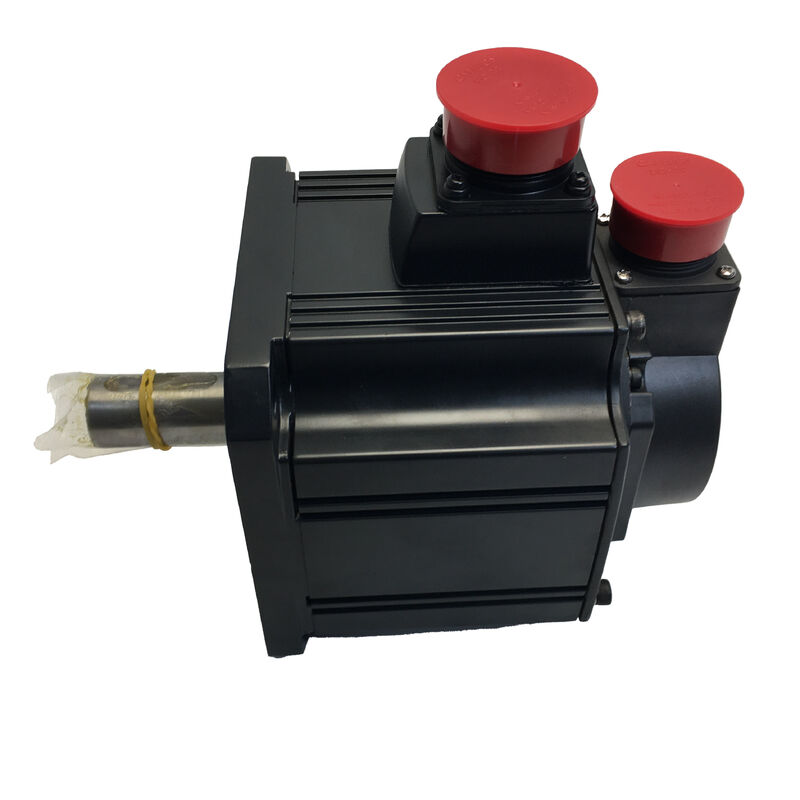
Mitsubishi HC-SFE152 | MELSERVO J2S AC Brushless Servo Motor — 1.5kW, 7.16Nm, 2000rpm, 17-Bit Absolute, Oil Seal, 130×130mm Flange, IP65, MR-J2S
Overview
The Mitsubishi HC-SFE152 is a 1.5kW AC brushless servo motor from the HC-SF family within Mitsubishi's MELSERVO MR-J2S system. It sits at the practical mid-point of the HC-SF power range — providing a 130mm flange footprint, 7.16Nm rated torque, and 2000rpm rated speed in a motor that the MR-J2S amplifier family was built to drive, with the 17-bit absolute encoder and oil seal combination that makes this motor viable in working industrial machine environments.
The HC-SF series carries medium inertia as a design characteristic, which shapes how it behaves in servo systems.
medium-inertia motor creates a more mechanically stable axis than a low-inertia motor under varying load conditions — it resists sudden speed changes from load disturbances, which translates into smoother velocity profiles during cutting operations where the cutting force changes as the tool engages and exits the workpiece.
This is why the HC-SF series found such wide use in machine tool feed axes, material handling systems, and industrial robots where load stiffness and smooth motion quality matter alongside positioning accuracy.
At 7.16Nm rated torque with a 3:1 peak multiplier, the motor covers both the sustained cutting torque requirement and the short-duration acceleration demand of a production machine cycle.
The 21.6Nm peak for acceleration transients is available for a fraction of a second — long enough to rapidly accelerate the axis to rapid traverse speed — while the 7.16Nm continuous torque carries the cutting load through each pass.
This torque-speed profile, combined with the 130mm mounting flange, made the HC-SFE152 a standard specification on a wide range of mid-size CNC machines during the MR-J2S era.
Key Specifications
| Parameter |
Value |
| Rated Output |
1500W / 1.5kW |
| Rated Torque |
7.16 Nm |
| Maximum Torque |
21.6 Nm |
| Rated Speed |
2000 rpm |
| Maximum Speed |
3000 rpm |
| Rated Current |
9A |
| Maximum Current |
27A |
| Encoder |
17-bit absolute (131,072 ppr) |
| Shaft |
Straight, plain (no keyway) |
| Oil Seal |
Yes |
| Flange |
130×130mm |
| IP Rating |
IP65 |
| Inertia |
0.0020 kg·m² |
| Operating Temp |
0 to +40°C |
| Amplifier |
MR-J2S series |
17-Bit Absolute Encoder — Resolution and Function
The 17-bit absolute encoder is one of the defining features that distinguished the MR-J2S generation from its predecessor. 17 bits means 2¹⁷ = 131,072 distinct position values per shaft revolution — a resolution so fine that it far exceeds what any mechanical transmission can position to in a real machine.
The practical significance is not that the machine achieves sub-nanometre positioning; it is that the velocity estimate the servo amplifier derives from this high-resolution data is extremely smooth, free from the quantisation noise that lower-resolution encoders produce and which becomes visible as velocity ripple and surface texture variation in precision machining.
The absolute character means the encoder reports its position immediately at power-on, without any calibration movement.
The MR-J2S amplifier uses battery-backed memory to track multi-turn count across power cycles.
When the machine starts, the amplifier reads the current encoder position and the stored multi-turn count, computes the exact absolute shaft position, and the CNC displays the correct axis coordinate within the first second of power-on.
This is the operational convenience that makes absolute encoders the standard on modern servo systems: no homing routine, no waiting, no risk of referencing errors after an unexpected power loss.
Oil Seal and IP65 — Environmental Protection in Practice
The HC-SFE152's oil seal is a lip seal pressed against the rotating shaft at the motor's front end. Its primary function is to block the migration of lubricant aerosol from the machine's ball screw area into the motor interior — specifically into the encoder compartment at the motor's rear end.
Without this seal, years of lubricant mist accumulation on the encoder disc produce the familiar pattern of intermittent encoder faults that worsen over time until the disc needs replacement.
IP65 adds the housing-level protection that prevents dust and directed water jets from entering the motor body. Together, the oil seal and IP65 housing give the HC-SFE152 robust environmental credentials for standard machining centre environments.
The combination is not suited to submerged or high-pressure direct impingement conditions — those situations demand the IP67 found on newer motor generations — but it handles the day-to-day reality of coolant mist, chip-laden air, and periodic machine wash-down without compromising the motor's service life.
Medium Inertia and Servo System Dynamics
The 0.0020 kg·m² rotor inertia of the HC-SFE152 places it in Mitsubishi's medium-inertia classification. In servo system design, the inertia matching criterion — the ratio of reflected load inertia to motor rotor inertia — is a key parameter for stable, well-tuned servo response. Mitsubishi targets a load-to-rotor inertia ratio of no more than 7:1 for the HC-SF series as a general guideline, though well-tuned systems can operate acceptably at ratios up to 10:1.
For a motor with 0.0020 kg·m² rotor inertia, this means the mechanical components reflected back through the coupling and ball screw to the motor shaft should ideally not exceed about 0.014–0.020 kg·m² of equivalent inertia.
A typical 1.5kW machine tool axis with a 16mm or 20mm diameter ball screw at 5mm pitch and 300mm stroke sits comfortably within this range. Medium-inertia motors like the HC-SFE152 produce inherently stable servo response in these applications with standard MR-J2S real-time autotuning without requiring the manual parameter adjustment that low-inertia motors sometimes need under varying load conditions.
MR-J2S Amplifier Pairing and Cable Selection
The HC-SFE152 is designed specifically for MR-J2S series amplifiers. The amplifier selection is straightforward: with 27A maximum motor current, an MR-J2S-200A (rated continuous current ≥ the motor's rated 9A, and maximum current handling ≥ 27A) or higher covers the motor's demand.
The encoder feedback cable from the MR-JH series (MR-JHSCBL2M-H for 2m, or other lengths) connects the motor's encoder connector to the amplifier's CN2 port.
When the HC-SFE152 is used in a dynamic application where the cable flexes repeatedly through a cable carrier or moving bridge, the MR-JHSCBL_M-H (-H suffix, high bending life) cable is the correct choice.
For static installations where the cable is routed once and clamped, the MR-JHSCBL_M-L standard cable suffices.
FAQ
Q1: The HC-SFE152 is discontinued — which current Mitsubishi motor most closely replaces it?
The HG-SR152 (MELSERVO-J4 series) is the current production equivalent at 1.5kW, 7.16Nm rated, 2000rpm, 130mm flange.
It improves on the HC-SFE152 with a 22-bit absolute encoder (4,194,304 ppr), IP67 protection, and compatibility with the MR-J4 amplifier platform. Upgrading from J2S to J4 requires replacing both the motor and amplifier — J4 amplifiers do not communicate with J2S motor encoders.
For an in-kind replacement keeping the existing MR-J2S amplifier, source an HC-SFE152 or compatible HC-SFS152 variant from surplus stock.
Q2: What MR-J2S amplifier alarms indicate the HC-SFE152's encoder is failing?
AL.16 (encoder error) on the MR-J2S amplifier front panel is the primary encoder fault indicator.
It can appear at power-up (suggesting complete communication loss — check the MR-JHSCBL cable and connectors first) or during operation (suggesting intermittent communication, often from cable flex fatigue or contaminated encoder disc).
AL.17 (controller communication error) may accompany AL.16. Before assuming encoder failure, always inspect and reseat both connector ends of the encoder cable — a loose connector produces identical alarm patterns to a failed encoder.
Q3: Can the HC-SFE152 operate with an MR-J3 amplifier?
Not directly. The MR-J2S and MR-J3 systems use different encoder communication protocols, and the connector pinouts are not the same.
Some MR-J3 amplifiers support operation with select earlier HC-series motors via a 4-wire compatibility mode, but this requires specific parameter configuration and is not a general compatibility statement. Pairing HC-SFE152 with an MR-J3 amplifier outside of Mitsubishi's documented compatibility table is not recommended for production installations.
Q4: How does medium inertia affect servo tuning compared to using a low-inertia motor?
A medium-inertia motor carries more rotor mass than a low-inertia motor at the same power level, which means it changes speed more slowly for a given torque input. This reduces high-frequency disturbance response — the motor cannot respond as quickly to sudden load changes.
In practice, medium-inertia motors in the HC-SF class are more forgiving to tune because the MR-J2S autotuning algorithm has more mechanical inertia to work with and produces stable tuning over a wider range of load conditions.
Low-inertia motors are faster but require more careful gain setting to avoid oscillation on axes with variable load or compliance.
Q5: The motor is rated IP65 with an oil seal. What maintenance should be performed on the oil seal?
The oil seal is a consumable component that wears over time as the seal lip slides against the rotating shaft. In normal continuous-duty service, oil seal replacement is typically considered part of a motor overhaul (along with bearing replacement) after extended service life.
Visual indicators of seal wear include lubricant contamination inside the motor body found during bearing inspection, or encoder faults that correlate with lubrication levels near the motor.
During installation or any work requiring coupling removal, avoid contaminating the seal lip with debris, and never use tools against the shaft surface in the seal contact zone — a scored shaft surface underneath the seal lip will cause immediate leakage regardless of seal condition.


 Your message must be between 20-3,000 characters!