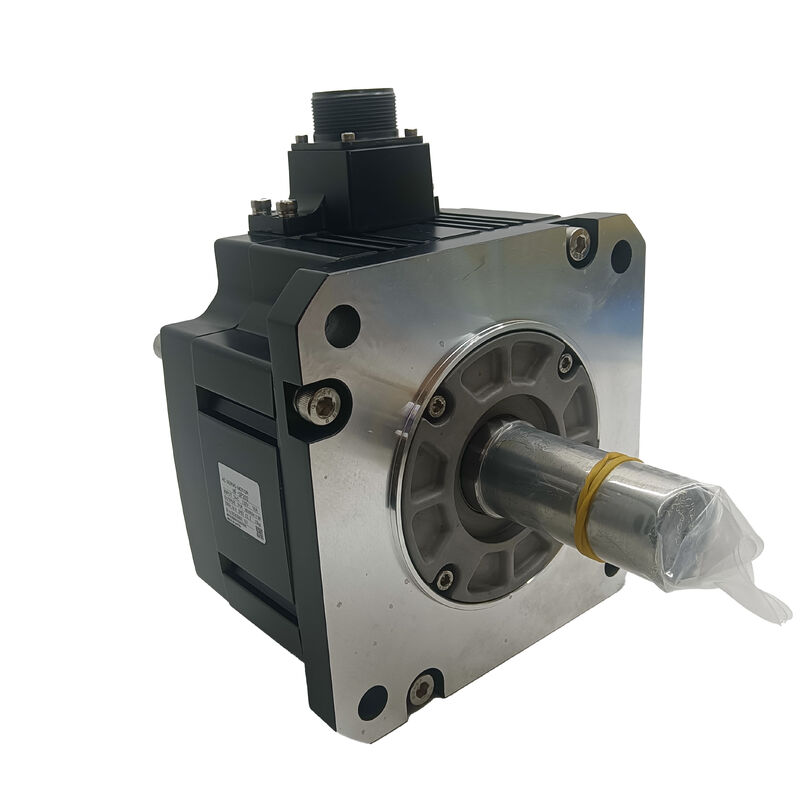
Mitsubishi HF-SE152B | MELSERVO Series AC Servo Motor — 1.5kW, 2000RPM, Electromagnetic Brake, Straight Shaft
Part Number: HF-SE152B
Brand: Mitsubishi Electric
Series: HF-SE — Medium Inertia, Medium Capacity
Configuration: Straight Shaft, Integrated 24V DC Electromagnetic Brake, No Oil Seal
Condition: New / Refurbished / Exchange Available
Overview
The Mitsubishi HF-SE152B is a 1.5 kW AC servo motor from Mitsubishi Electric's HF-SE family — a medium-inertia, medium-capacity motor series designed for the mid-range axis drives of industrial automation equipment, packaging machinery, and general-purpose servo applications.
Rated at 2,000 RPM with a straight output shaft and an integrated electromagnetic holding brake, this motor addresses the positioning and safety-holding requirements of machinery where accurate axis control and mechanical position retention at rest must both be built into a single compact unit.
The B suffix denotes the integrated brake — a spring-applied, electrically released 24V DC holding mechanism that engages automatically when the motor is de-energized.
For vertical axes, rotary indexing mechanisms, and any drive where gravity or external force would cause unwanted movement when the servo is inactive, the brake provides mechanical certainty that purely electronic position holding cannot match.
The HF-SE152B operates without an oil seal — it is a standard configuration for installations where the motor is housed within a cabinet or positioned away from direct fluid exposure.
The motor is designed for use with Mitsubishi's MR-E series servo amplifiers, a platform that covers the precise speed and position control requirements of the applications this motor class serves.
Key Specifications
| Parameter |
Value |
| Rated Output |
1.5 kW |
| Rated Torque |
7.16 Nm |
| Rated Speed |
2,000 RPM |
| Motor Series |
HF-SE (Medium Inertia, Medium Capacity) |
| Supply Voltage |
200VAC Class |
| Shaft Type |
Straight Shaft |
| Electromagnetic Brake |
Integrated — 24V DC, Spring-Applied |
| Oil Seal |
Not Fitted |
| Compatible Amplifier |
MR-E Series |
| Encoder |
Built-in Absolute Feedback (131,072 ppr / 17-bit class) |
| Mounting |
Flange |
| Operating Temperature |
0 to +40°C |
HF-SE Series — Medium Inertia in the HF Family Context
The HF-SE series occupies a specific niche in Mitsubishi's HF servo motor lineup. Where the HF-KP and HF-KE families are built for light, fast-responding loads with low rotor inertia, the HF-SE is designed for applications where the mechanical load inertia is moderate and the axis demands sustained torque delivery rather than ultra-fast dynamic response.
This is not a compromise — it is a design match for a genuinely different class of applications.
At 1.5 kW and 2,000 RPM, the HF-SE152B delivers 7.16 Nm rated torque at its operating point, covering the range of medium-load positioning tasks found in packaging machines, automated assembly systems, conveyor positioning drives, and production equipment where the servo axis moves real mechanical mass on a defined cycle.
The medium-inertia rotor provides a more forgiving load-matching window than a low-inertia motor, tolerating higher reflected load inertia ratios while maintaining stable velocity loop behavior without aggressive gain tuning.
The HF-SE family offers multiple rated speed configurations — the same torque class is available at different speed ratings to match different drive train architectures.
The 152B's 2,000 RPM rating suits direct-coupled or lightly geared arrangements where the motor speed maps closely to the required axis velocity range.
Integrated Electromagnetic Brake — 24V DC, Fail-Safe
The brake on the HF-SE152B is the component most critical to safe axis behavior in the applications that specify it. The spring-applied, electrically released design ensures that brake engagement is the default state — when the brake supply voltage is removed, the spring physically locks the shaft without any active command from the control system.
This matters most in three scenarios.
On vertical axes carrying tooling or workpiece weight, the brake prevents axis drop during servo disable, alarm conditions, or power interruption. On rotary indexing mechanisms that hold position between cycles, the brake maintains the indexed position without consuming continuous servo current.
On machines with complex multi-axis motion where an E-stop must reliably hold all axes in position simultaneously, a spring-applied brake on each relevant motor provides that guarantee at the hardware level.
The 24V DC supply for the brake coil integrates with the standard control power voltage used in most machine panels.
The brake circuit requires dedicated wiring from the servo amplifier's brake output and an interlock that ensures the brake is released before any axis move is commanded. This sequencing is handled in the MR-E amplifier configuration and must be verified during commissioning.
Straight Shaft and Installation Notes
The straight shaft configuration on the HF-SE152B suits coupling-based torque transmission — bellows, jaw, or disc couplings that grip the shaft diameter and transmit torque through clamping force.
For a 1.5 kW motor operating within its rated torque envelope, precision servo couplings of appropriate size handle the load without requiring a keyed connection.
The absence of an oil seal on this variant is relevant for installation planning.
Without a shaft seal, the motor's bearing cavity has no positive protection against liquid ingress at the shaft end. For installations in clean industrial environments, control cabinets, or positions away from direct fluid exposure, this is not a practical limitation.
Where the motor is installed near coolant, lubricant spray, or in areas subject to cleaning liquids, a variant with oil seal fitted — or appropriate local shielding of the shaft end — should be considered.
Mounting uses a standard flange arrangement. The motor's physical dimensions and flange pattern are consistent within the HF-SE 1.5 kW class, simplifying the mechanical installation on machines already designed for this motor frame.
Encoder & Drive Compatibility
The HF-SE series incorporates a high-resolution built-in encoder providing absolute position feedback with 131,072 counts per revolution — equivalent to 17-bit resolution. At this pulse count, the MR-E amplifier's position and velocity loops have fine data granularity across the full speed range, supporting smooth low-speed motion, accurate positioning endpoints, and consistent contouring performance in multi-axis configurations.
The absolute encoder characteristic means the servo system retains position knowledge through power interruptions.
On restart, the drive reads the current absolute shaft position directly — no homing sequence is required before the machine can operate. This eliminates the startup delay associated with incremental encoder systems and removes the class of errors that can occur when homing routines are interrupted or completed incorrectly.
The HF-SE152B is designed for use with Mitsubishi's MR-E series servo amplifiers.
The amplifier must be parameterized with the correct motor type code before commissioning. Gain settings, brake control output configuration, and encoder interface parameters must all be verified against the HF-SE152B specification during initial setup and following any amplifier replacement.
FAQ
Q1: What servo amplifier is compatible with the HF-SE152B?
The HF-SE152B is designed for use with Mitsubishi MR-E series servo amplifiers. The amplifier model must be selected to match the motor's 1.5 kW output class and rated current requirements. Servo amplifier parameters must be configured with the correct motor type code for the HF-SE152 before the axis is operated.
If using a third-party controller, confirm the MR-E amplifier's command interface mode — position, speed, or torque — matches the controller's output type.
Q2: Why does this motor not have an oil seal, and when does that matter?
The standard HF-SE152B is shipped without a shaft oil seal. An oil seal protects the bearing cavity from liquid ingress at the shaft exit point. Without it, the motor relies on the installation environment being free of direct fluid contact at the shaft end.
For installations in control cabinets, clean rooms, or positions shielded from fluid exposure, the absence of a seal is not a practical concern. For positions near coolant or lubricant spray, a variant with an oil seal should be specified, or local shielding should be installed.
Q3: How should the brake interlock be configured during commissioning?
The brake must release before any axis motion is commanded, and must re-engage before the servo drive is disabled. The MR-E amplifier provides a dedicated brake control output that sequences these events automatically when configured correctly.
The brake supply voltage — 24V DC — must be independently verified before the first axis move. A common commissioning error is commanding axis motion before confirming the brake has fully released, which causes the drive to run against an engaged brake and produces torque alarms or position errors.
Q4: What is the difference between the HF-SE and HF-SP series motors at the same 1.5 kW rating?
The HF-SE and HF-SP families both cover the 1.5 kW class but target different application environments. The HF-SP is paired with MR-J3 series amplifiers and is specified with IP67 housing protection as standard — suited for machine tool axis drives with coolant exposure.
The HF-SE is paired with MR-E series amplifiers, carries IP55 protection, and is designed for general-purpose industrial automation where the operating environment is cleaner. Drive compatibility and mechanical dimensions differ, making them non-interchangeable without a corresponding amplifier change.
Q5: Does the absolute encoder eliminate the need for homing on every machine startup?
Yes. The built-in absolute encoder retains shaft position data through power interruptions without a battery in the standard configuration. When the machine powers up, the MR-E drive reads the current absolute position immediately — the control system has full axis position knowledge before any motion is commanded.
This eliminates the startup homing cycle required by incremental encoder systems, reduces non-productive startup time, and removes the risk of homing errors from interrupted reference sequences.


 Your message must be between 20-3,000 characters!