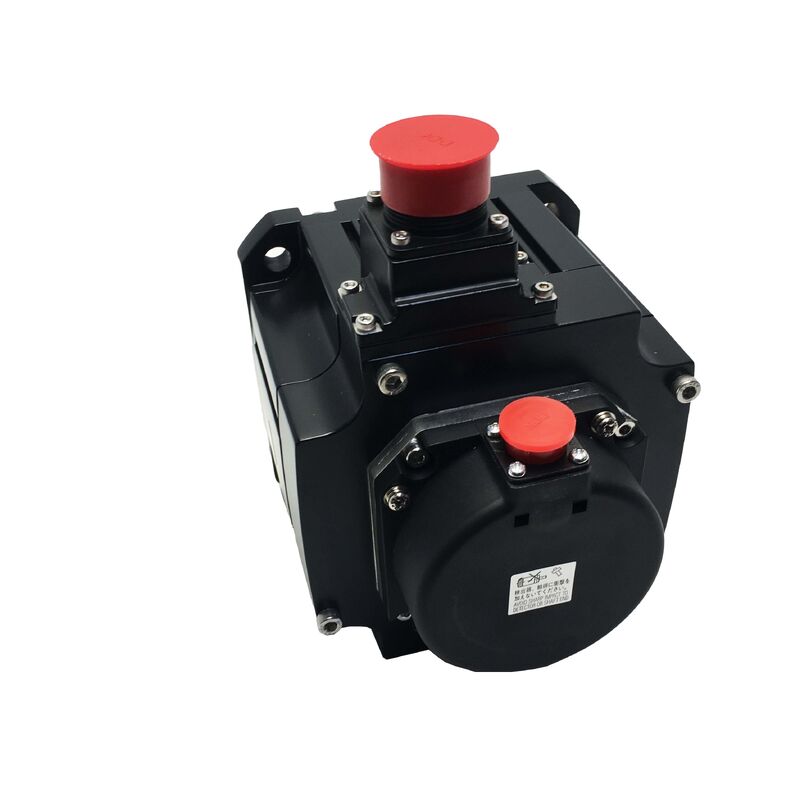
Mitsubishi HF-SE102JW1-S100 | Medium Inertia AC Servo Motor — 1.0kW, 4.77Nm, 2000RPM, Oil Seal, 131072 ppr, MR-E Series
Part Number: HF-SE102JW1-S100 Series: MELSERVO HF-SE — Medium Inertia AC Servo Motor
Rated Output: 1.0 kW
Rated Torque: 4.77 Nm
Peak Torque: 14.3 Nm
Rated Speed: 2,000 RPM
Maximum Speed: 3,000 RPM
Supply Voltage: 200 VAC Class (3-Phase)
Electromagnetic Brake: None
Oil Seal: Yes
Encoder: 17-bit Incremental, 131,072 ppr
Inertia Class: Medium
Compatible Amplifier: MR-E Series (Super MR-E / S100)
Power Facility Capacity: 1.7 kVA
Condition: New
Overview
The Mitsubishi HF-SE102JW1-S100 is a 1.0 kW medium inertia AC servo motor from Mitsubishi Electric's HF-SE series, designed specifically for use with the Super MR-E servo amplifier platform.
At 4.77 Nm rated torque and a 14.3 Nm peak, it delivers the torque reserve needed for responsive acceleration on axis loads with moderate inertia — general industrial machinery, conveyor positioning systems, packaging machines, and similar applications where the load-to-motor inertia ratio is in the practical medium-inertia range.
The "medium inertia" classification is not simply a label — it is the design's core engineering trade-off. Higher inertia rotors are more forgiving of load matching imprecision because the rotor itself acts as a flywheel that smooths velocity response.
The HF-SE series is positioned for applications where the load inertia is predictable and moderate, the servo system needs genuine responsiveness, and the control bandwidth of the MR-E amplifier platform is sufficient for the application's positioning demands.
The combination of 131,072 pulses per revolution encoder feedback, the MR-E amplifier's real-time auto-tuning function, and the 14.3 Nm peak torque makes the HF-SE102JW1-S100 capable of fast, precise positioning cycles without requiring extensive manual gain calibration during commissioning.
The JW1 suffix identifies the specific mechanical configuration: keyed shaft, oil seal, no electromagnetic brake.
The oil seal closes the shaft entry gap against lubricant mist and particulate contamination, extending bearing and winding service life in the machine environments where the HF-SE series is most commonly deployed.
The absence of a brake defines this as a horizontal-axis motor or an axis where an external counterbalance or mechanical holding arrangement handles the gravity load at rest.
Key Specifications
| Parameter |
Value |
| Rated Output |
1.0 kW |
| Rated Torque |
4.77 Nm |
| Peak Torque |
14.3 Nm |
| Rated Speed |
2,000 RPM |
| Maximum Speed |
3,000 RPM |
| Supply Voltage |
200 VAC class |
| Power Facility Capacity |
1.7 kVA |
| Electromagnetic Brake |
None |
| Oil Seal |
Yes |
| Shaft Type |
Keyed |
| Encoder Type |
17-bit Incremental |
| Encoder Resolution |
131,072 ppr |
| Inertia Class |
Medium |
| Compatible Amplifier |
MR-E-100A/AG-QW003 (Super MR-E) |
| Connector |
S100 — Super MR-E front connector |
HF-SE Series — Medium Inertia for Balanced Performance
The HF-SE series fills the practical middle ground in Mitsubishi's HF servo motor lineup. Below it, the HF-MP and HF-KP series target ultra-low and low inertia applications — high-speed light-load positioning where every millisecond of acceleration time matters.
Above it, the HF-SP and HF-JP series handle the higher-capacity demands of heavy-load machine tool axes with correspondingly larger frames.
The medium inertia HF-SE is designed for the most common class of industrial positioning application: loads with defined and moderate inertia, cycle times measured in hundreds of milliseconds rather than tens, and positioning accuracy requirements met by a 17-bit encoder at a competitive system cost.
A conveyor index drive, a rotary table positioning axis, a packaging machine feed mechanism, a material handling shuttle — these are the applications the HF-SE series serves.
At the 1.0 kW level, the HF-SE102 is the second step in the series: the HF-SE52 sits below at 0.5 kW / 2.39 Nm, the HF-SE152 above at 1.5 kW / 7.16 Nm, and the HF-SE202 at the top at 2.0 kW / 9.55 Nm.
All four share the 2000 RPM rated / 3000 RPM maximum speed characteristic and the same MR-E amplifier platform.
For sizing purposes, the transition from SE52 to SE102 roughly doubles both the rated torque and the motor's ability to accelerate a given inertia ratio in a given time.
131,072 ppr Encoder — Precision and Repeatability
The 17-bit incremental encoder at 131,072 pulses per revolution provides the position feedback resolution that makes the HF-SE102JW1-S100 capable of high-precision positioning across a wide range of applications.
At a typical 10mm ball screw pitch with direct motor coupling, 131,072 ppr at the motor translates to approximately 0.076 μm per pulse at the table — resolution that is many times finer than the mechanical accuracy of the ball screw and guideway system it drives.
The encoder is incremental, meaning it counts position changes from a reference point established at startup. Each power cycle requires the axis to perform a reference return (homing) cycle to re-establish its absolute position reference before accepting programmed position commands.
In machine applications where startup time is not a production constraint, this is entirely acceptable.
Where startup latency matters — high-frequency production shift changes, frequent emergency stop/restart cycles — an absolute encoder variant would eliminate the homing requirement; the incremental HF-SE102JW1-S100 is the appropriate selection where this is not a concern.
The 17-bit resolution also underpins the MR-E amplifier's real-time auto-tuning function.
Auto-tuning observes the actual velocity response against the commanded velocity and adjusts the servo gains — proportional gain, integral gain, derivative gain — in real time to minimise following error and settling time.
With 131,072 feedback pulses per revolution, the amplifier has sufficient resolution to detect the small velocity deviations that auto-tuning uses to characterise the mechanical load and optimise the gain settings without manual intervention.
Oil Seal — Environmental Protection Without IP67 Complexity
The oil seal on the HF-SE102JW1-S100 is a lip seal at the shaft exit point. It prevents lubricant mist from ball screw end bearings, gearbox splash, and centralised lubrication systems from migrating into the motor body through the annular gap between the rotating shaft and the motor front endshield.
Without an oil seal, that gap is an open pathway for contamination. Bearing grease migrates outward along the shaft under centrifugal force, while oil mist driven by machine movement migrates inward past the shaft gap under pressure fluctuation.
Once inside the motor housing, lubricant contamination of the winding insulation and the encoder assembly follows progressively — first as a surface coating that increases leakage current, then as absorption into the insulation that accelerates thermal degradation.
The oil seal eliminates this contamination pathway at negligible cost in friction and power loss.
On motors operating adjacent to lubricated ball screws, gearboxes, or centralised lubrication manifolds — which describes the majority of HF-SE102 installations — the oil seal is not a luxury specification but a service life investment. The "J" in the JW1 suffix confirms the oil seal is fitted.
S100 Connector and MR-E Amplifier Integration
The S100 designation identifies the motor's connector configuration as matched to the Super MR-E servo amplifier series. The Super MR-E platform places the motor power and encoder connectors at the front face of the amplifier, making cable connection straightforward even when the amplifier is installed in a confined panel space.
Cable entry from the front — rather than from the top or side — means the cable can run directly from the amplifier face to the motor without routing around the amplifier housing, reducing the cable path length and the number of bends in the encoder cable.
The MR-E amplifier's real-time auto-tuning starts from the moment the servo is enabled and continuously monitors the mechanical response, adjusting gain parameters as the machine's operating conditions change.
For the commissioning engineer, this means less time with an oscilloscope and parameter tables and more time running actual test cycles.
The auto-tuning function uses the encoder's 131,072 ppr feedback to observe velocity following error with enough resolution to detect the subtle mechanical resonances that manual gain adjustment often misses.
FAQ
Q1: Why is the HF-SE102JW1-S100 described as "medium inertia" and what does this mean for axis sizing?
Medium inertia refers to the rotor's moment of inertia — the HF-SE series rotor is heavier than low-inertia designs, which makes it less sensitive to load inertia mismatch but somewhat slower in peak acceleration response.
The practical implication for axis sizing: the load inertia connected to the motor should typically be 15 times the motor's own inertia or less for optimal servo performance.
Exceeding this ratio causes the servo gains required for stable, responsive control to approach the amplifier's stability boundary, making tuning difficult and limiting achievable bandwidth. Medium inertia motors are more tolerant of higher load inertia ratios than low-inertia designs.
Q2: The motor has no electromagnetic brake — can it be used on a vertical axis?
Without an electromagnetic brake, the motor provides no mechanical holding when the servo is de-energised. On a vertical axis, gravity will move the load when servo power is removed unless an external means of support is provided — a pneumatic counterbalance, a mechanical lock, or an external brake.
If none of these are present, the brake-equipped variant of the HF-SE102 (with "B" suffix in the model designation) must be specified. For horizontal axes or gravity-balanced vertical axes, the brake-free HF-SE102JW1-S100 is the appropriate selection.
Q3: Which MR-E servo amplifier is required for the HF-SE102JW1-S100?
The HF-SE102JW1-S100 at 1.0 kW is paired with the MR-E-100A/AG-QW003 servo amplifier. The MR-E-100A is the 1.0 kW class amplifier in the Super MR-E range, matched to the S100 motor connector configuration.
Using a lower-rated amplifier (such as the MR-E-70A) risks overcurrent at the motor's peak torque demand; using a higher-rated amplifier is possible in principle but requires confirming parameter compatibility. The QW003 suffix on the amplifier denotes the Super MR-E configuration matched to S100 motors.
Q4: What is the encoder homing procedure on startup?
The 17-bit encoder on the HF-SE102JW1-S100 is incremental — it has no stored absolute position memory. At every power cycle, the MR-E amplifier must perform a reference return cycle on this axis to establish the coordinate reference point.
The axis traverses to its reference switch or mechanical stop at reduced speed, the amplifier records the encoder count at the reference point, and the coordinate system is established from that point. This must complete successfully before the CNC or PLC accepts position commands on the axis.
If power is lost mid-cycle and the reference return is interrupted, the full reference return must restart.
Q5: What maintenance does the HF-SE102JW1-S100 require in service?
The main periodic checks are the encoder cable and connector condition (inspect for chafing, cracked insulation at bends, and correct connector seating — a partially engaged encoder connector causes feedback errors that present as erratic axis motion), the shaft oil seal condition (inspect for cracking or hardening at scheduled maintenance intervals; a damaged seal allows lubricant ingress), and bearing condition (listen for roughness or vibration during no-load test runs). Mitsubishi recommends bearing replacement at 20,000 hours of operation or when audible roughness develops.
The encoder itself has no serviceable parts; if encoder faults persist after verifying cable and connector integrity, the motor requires replacement or factory repair.


 Your message must be between 20-3,000 characters!