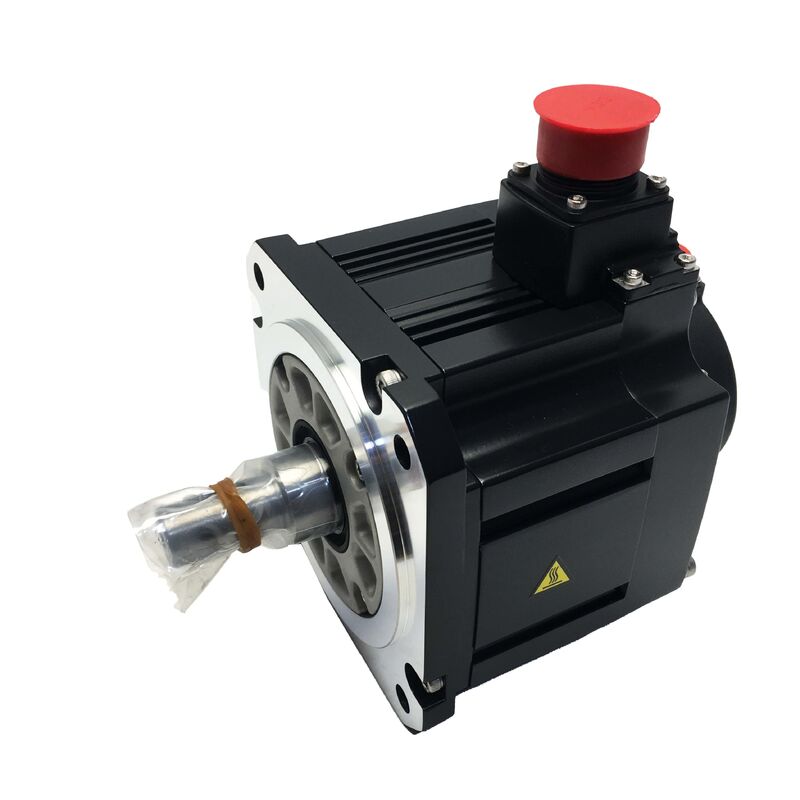
Mitsubishi HF-SE202JW1-S100 | HF-SE Series Medium Inertia AC Servo Motor — 2.0kW, 9.55Nm, 2000RPM, Oil Seal, 131,072ppr, Super MR-E
Overview
The Mitsubishi HF-SE202JW1-S100 is a 2.0 kW medium inertia AC servo motor from the HF-SE series, built for the Super MR-E servo amplifier platform.
At 9.55 Nm rated torque and 2,000 RPM on a 176 × 176 mm flange, it is the 2 kW member of a medium inertia series designed around the same operating principle as the HC-SFS / HC-SFE family — generous torque at moderate speed, tolerant of heavier loads and higher load-to-motor inertia ratios than the low-inertia compact motor classes.
Three configuration details define this specific variant.
The J suffix means an oil seal is factory-fitted at the shaft exit, closing the annular gap between rotating shaft and motor housing against lubricant mist and fine particles that would otherwise track inward along the shaft surface over time.
The W1 suffix identifies the plain straight shaft without keyway, transmitting torque by friction with the coupling hub bore.
No electromagnetic brake is present, which confirms this motor is specified for horizontal or counterbalanced axes where gravity loading does not require mechanical holding when the servo is off.
The S100 designation marks this as a special motor matched to the Super MR-E (MR-E-Super) servo amplifier.
The Super MR-E platform built a simplified wiring architecture into the amplifier design: power and encoder connectors are positioned on the amplifier's front face for direct cable access, and the terminal arrangement reduces the wiring labour compared to earlier amplifier generations.
With real-time auto-tuning as standard, the Super MR-E adjusts servo gains continuously during operation, eliminating the iterative manual gain optimisation that older Mitsubishi amplifier generations required at commissioning.
Key Specifications
| Parameter |
Value |
| Rated Output |
2.0 kW |
| Rated Torque |
9.55 Nm |
| Maximum Torque |
28.65 Nm (approx. 3× rated) |
| Rated Speed |
2,000 RPM |
| Supply Voltage |
200VAC class |
| Encoder |
17-bit Absolute, 131,072 ppr |
| Shaft |
Straight Plain (W1) |
| Oil Seal |
Yes (J) |
| Brake |
None |
| Flange Size |
176 × 176 mm |
| Ingress Protection |
IP65 |
| Insulation Class |
F (155°C) |
| Operating Temperature |
0°C to +40°C |
| Compatible Amplifier |
Super MR-E (S100) |
2.0 kW at 2,000 RPM — Where Medium Inertia Works Best
The HF-SE series operates at 2,000 RPM rated speed, which places it in a different application class from the 3,000 RPM low-inertia motors that dominate smaller machine tool axes. Two thousand RPM at a 10mm pitch ball screw produces 20 m/min rapid traverse — appropriate for medium-capacity machine tools and automation equipment where the axis mechanics are substantially heavier than the compact sub-kilowatt axes.
The medium inertia rotor is what defines the HF-SE's application suitability. Its rotor is physically heavier than a same-frame low-inertia motor, and that added rotor mass acts as a stabilising flywheel in the servo loop.
On axes with heavier tables, larger workpiece holders, or transmission elements that reflect significant inertia to the motor shaft, the medium inertia motor tolerates much higher load-to-motor inertia ratios before servo stability becomes a concern.
Where a low-inertia motor might require conservative gain settings or exhibit resonance at inertia ratios above 5:1, the HF-SE class is designed for ratios up to 15:1 with appropriate amplifier tuning — directly extending the range of mechanical configurations this motor can serve without requiring a gearbox to reduce the reflected load inertia.
At 9.55 Nm rated torque with a typical 3:1 peak-to-rated ratio, the available 28.65 Nm peak supports aggressive acceleration of the heavier loads that suit this motor class.
The duty cycle calculation — confirming that the RMS torque across the full motion profile stays within 9.55 Nm — is the axis sizing step that determines whether the HF-SE202 is correctly matched to the load.
Oil Seal (J) — Shaft Exit Protection in Practice
The oil seal at the shaft exit is the one sealing element that IP65 body protection alone cannot provide. The rotating shaft must pass through the motor's front endshield with a small annular gap to allow free rotation.
Without an oil seal, this gap is an open pathway for lubricant mist from adjacent ball screws, gearboxes, or bearing housings to migrate inward along the shaft surface and accumulate in the bearing cavity and winding area over the motor's service life.
With the J oil seal fitted, a lip seal rides against the rotating shaft surface and actively deflects fluid and particles away from the shaft gap.
The combined effect is that the HF-SE202JW1-S100 is sealed both in body (IP65) and at the shaft — appropriate for installations where the motor shaft is in proximity to lubrication sources or where occasional splash exposure at the shaft is realistic.
The oil seal lip is the maintenance element with the shortest inspection interval on the motor.
The lip material (typically nitrile rubber) hardens slightly over years of thermal cycling and contact with oil.
Periodic inspection for lip cracking, deformation, or visible leakage past the seal — combined with timely replacement when degradation is detected — is the maintenance action that protects the motor's bearings and encoder from contamination throughout the motor's service life.
131,072ppr Absolute Encoder — Direct Position Readout at Startup
The 17-bit absolute encoder built into the HF-SE202JW1-S100 provides 131,072 pulses per revolution with absolute position retention when combined with a battery at the Super MR-E amplifier. At power-up, the amplifier reads the motor shaft's absolute angular position directly from the encoder — the machine's CNC or controller has correct axis position from the first scan cycle, without any reference return traversal.
For a 2 kW medium inertia axis driving a substantial load, the practical value of absolute position retention is significant. Eliminating the reference return means the machine does not need to traverse a heavy table to a reference switch each time the system powers up.
On machines where reference return involves a slow, careful traverse to a limit switch — necessary to protect the tooling and workpiece from the uncertainty of where the axis is at startup — the absolute encoder removes this overhead entirely after the initial home position is established once.
The 131,072 ppr resolution translates to approximately 0.076 μm per count at the table for a 10mm pitch ball screw with 1:1 coupling.
This is well beyond the mechanical accuracy of any real ball screw and guideway system, confirming the encoder is not the limiting factor in positioning accuracy for any axis this motor would drive. The encoder feedback also provides the velocity resolution that allows smooth, stable speed control across the full 0 to 2,000 RPM operating range, including the low crawl speeds used for homing and probe approach sequences.
Super MR-E Amplifier Platform — Wiring Simplicity and Auto-Tuning
The S100 designation matches this motor exclusively to the Super MR-E servo amplifier (MR-E-Super series), Mitsubishi's single-axis servo platform designed for the cost-effective, compact automation market.
The Super MR-E's design philosophy centres on reducing the complexity of integration without compromising control performance.
Connector placement on the amplifier front face — power and encoder connectors accessible from the same face as the signal terminals — simplifies panel layout and cable routing in compact control cabinets.
Standard wiring time is reduced because the cable connections are visible and accessible during assembly, and the front-face arrangement eliminates the need to pre-route cables before the amplifier is mounted in the cabinet.
The real-time auto-tuning function continuously identifies the load inertia connected to the motor shaft and adjusts the servo's velocity and position loop gains to maintain stable, well-damped response.
As the load changes during the machine cycle — as a workpiece is loaded or unloaded, as a conveyor fills or empties — the auto-tuning adapts the gains accordingly, maintaining consistent positioning performance without operator intervention.
This is particularly valuable on machines where commissioning time is limited, as the need for manual gain optimisation across multiple operating conditions is significantly reduced.
FAQ
Q1: What does the plain straight shaft (W1) mean for coupling selection?
The W1 plain shaft has no keyway. All torque transmission relies on friction clamping between the shaft surface and the coupling hub bore.
At 9.55 Nm rated torque with a typical peak near 28 Nm, the coupling hub bore tolerance (ISO h6 standard for this shaft class), the clamping element's specified tightening torque, and the shaft surface condition collectively determine the achievable friction torque at the interface.
For axes with frequent high-torque direction reversals, the clamping torque specification must be verified against the motor's peak output. Re-checking clamping torque after the first 50–100 hours of operation — when initial seating occurs — is standard commissioning practice for plain shaft installations.
Q2: Why does the HF-SE202JW1-S100 have no electromagnetic brake, and when would the braked variant be needed?
The absence of a brake indicates this motor is specified for horizontal axes or axes where an external counterbalance mechanism supports the load when the servo is off. On horizontal axes, no tendency to move exists when motor torque is removed, making a brake unnecessary.
On vertical axes or inclined axes where gravity acts on the load, the braked variant — designated with a B in the part number — provides the fail-safe mechanical holding required when the servo is de-energised. Installing the brake-free W1 variant on an unbalanced vertical axis creates a risk of axis drift at servo disable events.
Q3: The encoder is 131,072 ppr — does this require a battery for absolute retention?
Yes. The 17-bit absolute encoder on the HF-SE202JW1-S100 retains position through power loss only when a backup battery is installed at the Super MR-E amplifier. With the battery fitted and maintained, the amplifier reads the axis's true position at every power-up without homing.
Without the battery, the encoder operates in incremental mode and a reference return is required after each power cycle. Battery condition should be checked at scheduled maintenance intervals, as a depleted battery causes position loss at the next power interruption.
Q4: Can the HF-SE202JW1-S100 be used with a Super MR-E amplifier other than the -200A rating?
The 2.0 kW HF-SE202 requires the MR-E-200A (or equivalent S100 variant) Super MR-E amplifier rated for the 200W class — noting that Mitsubishi's MR-E capacity designations follow a different numbering convention from the motor output power.
The amplifier's rated output current must accommodate the motor's rated current (approximately 11A for the 2kW class).
Using an undersized amplifier limits the available peak torque and may trigger overload protection before the motor can complete its programmed acceleration moves. Confirm the amplifier model code against the Super MR-E selection guide for the HF-SE202 combination.
Q5: What are the critical inspection points for a used HF-SE202JW1-S100?
Inspect the oil seal lip at the shaft exit for cracking or hardening — a degraded seal is the most common fluid ingress pathway on this motor.
Rotate the shaft by hand and check for bearing roughness; the 176mm flange carries larger bearings than smaller motors, and any roughness is audible before it becomes mechanically significant. Verify the shaft surface is free from fretting or scoring from previous coupling installations.
Measure three-phase winding resistance for phase balance and check insulation resistance to earth with a megger. Confirm the encoder battery at the amplifier side is in good condition before assuming the absolute position data is valid.
A bench run-up on a compatible Super MR-E amplifier to 2,000 RPM with auto-tuning active and following error monitored confirms the motor is production-ready before installation.


 Your message must be between 20-3,000 characters!