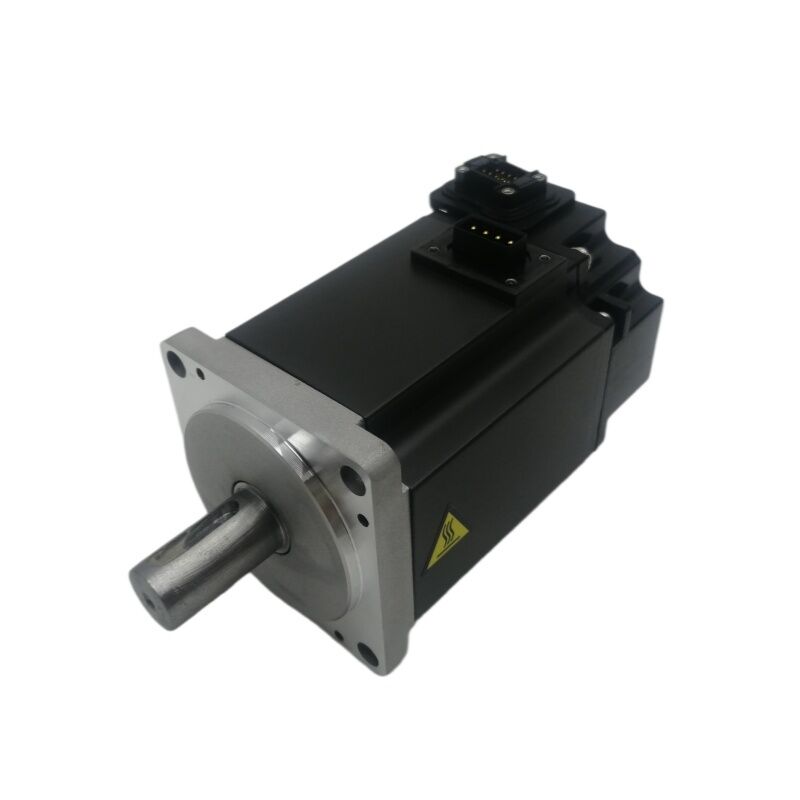
Mitsubishi HF-KE43B AC Servo Motor
Product Overview
The HF-KE43B is a Mitsubishi Electric AC servo motor from the HF-KE family, a motor group Mitsubishi places in its low-inertia servo lineup and in its older MR-E Super migration path. In Mitsubishi’s migration guidance, HF-KE43(B)W1-S100 is explicitly mapped to newer replacement families such as HF-KN43(B)J-S100 and HG-KN43(B)J, which makes it clear that the HF-KE43B belongs to a long-established installed base rather than to a newly introduced platform.
That matters in the real world because parts like this are rarely bought as speculative upgrades.
They are usually sourced to keep an existing machine architecture intact.
In a production environment, the value of a servo motor like the HF-KE43B is not just rotational output.
It is the ability to preserve the original motion behavior of the machine, maintain compatibility with the surrounding Mitsubishi servo system, and reduce the amount of rework needed after replacement.
This is an engineering inference based on Mitsubishi’s own positioning of HF-KE as part of its servo-motor ecosystem and migration path.
Application Value
The HF-KE43B fits best in compact motion systems where fast response, repeatable positioning, and controlled acceleration matter more than sheer motor size.
Mitsubishi’s own product-family materials place the related low-inertia small-capacity servo classes in applications that benefit from quick positioning and compact axis design, which is why motors in this category are commonly chosen for indexing units, packaging mechanisms, light transfer systems, compact handling equipment, and auxiliary machine axes.
This application framing is an engineering inference from the family’s low-inertia classification and successor-series positioning.
From a maintenance perspective, the HF-KE43B is also a practical motor for plants that still run Mitsubishi-based installed equipment and want a like-for-like family match. Mitsubishi’s migration note shows that users of the older MR-E Super generation were expected to move toward HF-KN/HG-KN successors, which implies that HF-KE43B remains relevant primarily in support, retrofit, and machine-life-extension scenarios.
That is exactly the kind of context where an exact servo-motor family match is more valuable than a broad generic equivalent.
Replacement and Selection Perspective
A motor in this class should be selected with the surrounding servo system in mind, not by appearance alone. Mitsubishi’s servo documentation consistently treats servo motors and amplifiers as coordinated system elements, and that is the right way to think about HF-KE43B as well. In practical terms, buyers should care about the original motor family, amplifier compatibility, shaft/mounting fit, and cable/connector arrangement before focusing on resale descriptions or cosmetic similarity.
For independent-station product pages, that makes the HF-KE43B easier to position honestly: it is a Mitsubishi servo motor for installed motion systems, especially where the goal is to preserve established machine behavior and keep replacement work clean and predictable.
That is a stronger and more credible selling angle than generic promises about “high performance.”
This positioning is an inference from Mitsubishi’s migration and family documentation.
Technical Data
| Parameter |
Value |
| Part Number |
HF-KE43B |
| Manufacturer |
Mitsubishi Electric |
| Product Type |
AC Servo Motor |
| Motor Family |
HF-KE |
| Product Position |
Legacy / installed-base servo motor |
| System Context |
Mitsubishi MELSERVO servo systems |
| Inertia Class |
Low inertia family positioning |
| Typical Role |
Compact motion and positioning axis |
| Migration Path |
HF-KN43(B)J-S100 / HG-KN43(B)J |
| Recommended Selection Method |
Match original motor family and system configuration |
FAQ
Q1: What kind of motor is HF-KE43B?
It is a Mitsubishi AC servo motor in the HF-KE family, positioned in Mitsubishi documentation as part of an older installed motion platform with defined migration to newer servo families.
Q2: What applications is it most suitable for?
It is best suited to compact servo axes that need responsive motion and repeatable positioning, especially in machines where low-inertia behavior is important.
This is an engineering inference from the family and successor-series positioning.
Q3: Why is exact replacement important for this motor?
Because servo motors work as part of a matched motion system. Replacing the motor with the correct family and fit helps preserve the original machine behavior and reduces recommissioning effort.
Q4: Is HF-KE43B considered an older Mitsubishi model?
Yes. Mitsubishi’s migration documentation places HF-KE43(B) in the older MR-E Super path and maps it to newer HF-KN and HG-KN replacements.
Q5: What should be checked before ordering HF-KE43B?
Check the installed motor model, amplifier family, shaft/mounting fit, and cable/connector arrangement. On servo systems, those checks matter more than appearance alone.


 Your message must be between 20-3,000 characters!