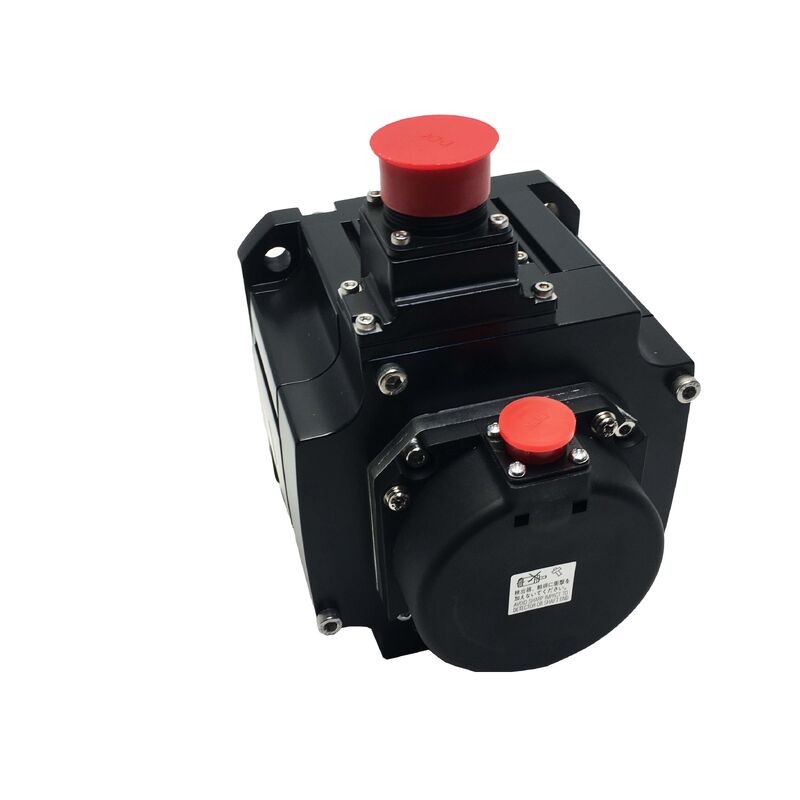
Mitsubishi HF-SP81J | MELSERVO-J3 AC Servo Motor — 850W, 8.12Nm, 1000RPM Rated / 1500RPM Max, Oil Seal, 18-bit Absolute, IP67
Part Number: HF-SP81J
Series: MELSERVO-J3 — HF-SP Series Medium Inertia, Medium Capacity
Design: Straight Shaft, Oil Seal, Built-in 18-bit Absolute Encoder
Rated Output: 850 W (0.85 kW)
Rated Torque: 8.12 Nm
Peak Torque: 24.4 Nm
Rated Speed: 1,000 RPM
Maximum Speed: 1,500 RPM
Rated Current: 4.5 A
Supply Voltage: 200 VAC Class
Moment of Inertia: 0.00178 kg·m² (17.8 kg·cm²)
Flange Size: 130 × 130 mm
Ingress Protection: IP67
Dimensions: H177.5 mm × W130 mm × D217.5 mm
Condition: New
Overview
The Mitsubishi HF-SP81J is an 850W medium inertia AC servo motor from the MELSERVO-J3 HF-SP series, optimised for high-torque, low-speed operation — rated at 1,000 RPM continuous with a 1,500 RPM ceiling.
At 8.12 Nm rated torque and a 24.4 Nm peak, this motor delivers a torque output that far exceeds what a 850W motor running at 3,000 RPM would produce.
The low rated speed is the engineering rationale: torque is power divided by angular velocity, so fixing output power while reducing speed proportionally increases the available torque. The HF-SP81J at 1,000 RPM produces more than three times the rated torque of an equivalent 850W motor rated at 3,000 RPM.
The "J" suffix identifies the oil seal fitment — a lip seal at the shaft exit that protects against lubricant mist, coolant splash, and particulate ingress through the shaft gap. Combined with the IP67 body protection rating, the HF-SP81J is sealed against temporary immersion to a defined depth, making it one of the most robustly protected motors in the HF-SP series.
This sealing level suits the wetter, more contaminated environments that low-speed high-torque axes frequently inhabit: winding machines, tension-control rollers, conveyor drives running near cooling fluid, and machine tool turret or rotary table applications where the motor sits inside a coolant-rich enclosure.
The 18-bit absolute encoder at 262,144 pulses per revolution provides position retention through power interruptions without homing at startup, feeding a MELSERVO-J3 amplifier's high-resolution velocity and position control loop.
The 130 × 130 mm flange and the 177.5 × 130 × 217.5 mm overall envelope place it physically in the same class as other 130mm-flange medium-capacity servo motors, while the extended depth (217.5 mm vs 173.5 mm for a comparable 2,000 RPM model) reflects the longer stator required to produce the high torque at low electrical frequency.
Key Specifications
| Parameter |
Value |
| Rated Output |
850 W (0.85 kW) |
| Rated Torque |
8.12 Nm |
| Peak Torque |
24.4 Nm |
| Rated Speed |
1,000 RPM |
| Maximum Speed |
1,500 RPM |
| Rated Current |
4.5 A |
| Supply Voltage |
200 VAC class |
| Moment of Inertia |
0.00178 kg·m² (17.8 kg·cm²) |
| Encoder |
18-bit Absolute, 262,144 ppr |
| Oil Seal |
Yes |
| Flange Size |
130 × 130 mm |
| Ingress Protection |
IP67 |
| Dimensions |
H177.5 × W130 × D217.5 mm |
| Series |
MELSERVO-J3 HF-SP |
1,000 RPM Rated Speed — Engineering for High Torque
The HF-SP81J's 1,000 RPM rated speed places it in a specialised category within the HF-SP series.
Most servo motors in this output class run at 2,000 or 3,000 RPM rated, reflecting the typical CNC feed axis requirement where ball screw speed governs the required motor RPM. The 1,000 RPM variant — the "1" speed designation in the SP81 — exists for application scenarios where high torque at low shaft speed is the primary requirement, without the inertia and complexity of an intermediate reduction gearbox between motor and load.
Direct-drive applications gain the most from this design.
A motor turning at 1,000 RPM directly coupled to a mechanism can deliver 8.12 Nm continuously without any gearbox — eliminating backlash, reducing mechanical compliance, simplifying maintenance, and removing the gearbox as a potential failure point. For applications where the mechanism's natural speed range is 0–1,000 RPM and the torque demand is sustained, the HF-SP81J provides this through the motor itself rather than through a gearbox stepped down from a 3,000 RPM motor.
The 24.4 Nm peak — three times the rated torque — provides the acceleration impulse needed to move high-inertia loads from rest to working speed rapidly.
With a moment of inertia of 0.00178 kg·m², the rotor itself is substantial compared to smaller motors, which means the motor can couple to moderately heavy loads without the servo system becoming destabilised by large inertia mismatches.
24.4 Nm Peak Torque — Acceleration at High-Inertia Loads
The 3:1 peak-to-rated torque ratio is consistent across the HF-SP series, and at 8.12 Nm rated it yields a 24.4 Nm peak that provides significant acceleration authority on the kinds of loads the HF-SP81J is designed for.
Winding spools, rotary tables, conveyor roller drives, and similar mechanisms can carry substantial rotating mass — and getting that mass from standstill to operating speed within the machine's cycle time budget depends on having peak torque available above the running requirement.
The practical constraint is duty cycle. Peak torque draws peak current — 3.2 times the rated current at the 3:1 peak-to-rated ratio — and the electronic thermal protection in the MELSERVO-J3 amplifier monitors the RMS current demand over time.
Brief acceleration pulses at peak torque are permitted within the thermal model; sustained operation at peak torque is not.
The servo sizing calculation — load inertia, move distance, acceleration time, sustained running torque — must confirm that the duty-cycle-averaged RMS torque demand stays within the 8.12 Nm rated value, while the peak acceleration torque does not exceed 24.4 Nm.
For winding and tension control applications where the load inertia changes continuously as material accumulates on or pays off the spool, the motor's moment of inertia of 0.00178 kg·m² provides a reference mass in the servo loop.
As the spool inertia changes, the amplifier's auto-gain tuning tracks the change and adjusts the servo gains accordingly.
18-bit Absolute Encoder — No Homing, Position Continuity
The 18-bit absolute encoder built into the HF-SP81J provides 262,144 pulses per revolution of position feedback with absolute position retention through power loss.
When the MELSERVO-J3 amplifier powers up, it reads the true shaft position directly from the encoder — the axis has correct position data immediately, without traversing to a reference switch.
For a low-speed, high-torque axis this matters more than it might seem. Low-speed axes are often coupled to mechanisms where a mid-stroke power interruption would leave the load in an indeterminate, potentially unsafe position — a tension-controlled web suspended between driven rollers, a winding spool part-way through a traverse, a rotary index table between stations.
With an absolute encoder, power restoration returns the position system to a known, verified state immediately.
An incremental encoder would require the axis to home — potentially moving the load through an unsafe traverse — before any controlled operation could resume.
The 18-bit resolution also provides the velocity feedback granularity that the HF-SP81J's low speed operation demands.
At 1,000 RPM, each revolution takes 60ms; at 262,144 ppr, the amplifier receives approximately 4,369 feedback pulses per millisecond at rated speed. This density of feedback allows precise velocity control down to very low speeds — the sort of smooth, controlled low-speed running that winding, tension, and web handling systems require.
IP67 and Oil Seal — Full Wet Environment Protection
IP67 represents complete dust exclusion and temporary immersion protection to a defined depth — one step above the jet-water IP65 protection that most servo motors in this class carry.
The HF-SP81J's IP67 rating means the motor body can withstand fluid immersion for brief periods without damage to the internal components, and it is rated to handle the intermittent coolant flooding, cleaning cycles, and high-humidity environments that characterise many of the applications this motor serves.
The "J" oil seal at the shaft exit adds the sealing element that IP67 body protection alone does not cover. The shaft gap — the annular space between the rotating shaft and the motor endshield — is a pathway for lubricant mist and fine particulate even in an IP67-sealed motor body, because the shaft must rotate freely and the gap cannot be sealed completely by the structural housing.
The lip seal at the shaft exit closes this pathway mechanically: the lip rides against the rotating shaft surface and deflects fluids and particles back out.
Over the motor's service life, periodic inspection of the shaft seal lip for hardening or cracking is the primary maintenance activity — a damaged seal allows progressive contamination through the one pathway the IP67 housing rating does not protect.
Together, IP67 and the oil seal make the HF-SP81J appropriate for environments that would degrade a standard IP65 motor within a reasonable service life: continuous coolant mist exposure, regular high-pressure cleaning, applications partially submerged during operation, and installations adjacent to cutting fluid delivery systems.
HF-SP81J in the HF-SP Series — Where the 1,000 RPM Variant Fits
The HF-SP series covers a range of output powers from 0.5 kW to 7.0 kW, each available at 1,000 RPM (speed code "1") and 2,000 RPM (speed code "2") rated variants. The SP81J is the 850W, 1,000 RPM, oil seal variant:
The 2,000 RPM equivalent — HF-SP82J — produces the same 850W output at 2,000 RPM rated speed with correspondingly lower rated torque (approximately 4.1 Nm vs 8.12 Nm), a smaller overall length, and a reduced moment of inertia.
The choice between the SP81J and SP82J comes down to the mechanical system: if the load naturally operates in the 0–1,000 RPM range at the motor shaft (direct drive, or low-ratio coupling), the SP81J provides twice the torque at the same power level.
If the load operates in the 0–2,000 RPM range, the SP82J is the appropriate selection with a shorter motor body.
The physical depth difference — 217.5 mm for the SP81J versus approximately 173.5 mm for a 2,000 RPM equivalent — reflects the longer stator winding required to produce high torque at the lower electrical frequency associated with 1,000 RPM operation.
This depth must be accounted for in the machine's motor mounting cavity design, particularly on retrofits where the original motor was a 2,000 RPM type.
FAQ
Q1: Why does the HF-SP81J have a lower maximum speed (1,500 RPM) than most servo motors?
The 1,000 RPM rated / 1,500 RPM maximum speed is the defining characteristic of the "1" speed variant in the HF-SP series.
The low rated speed is a design choice to maximise torque at a given power level — the same 850W delivered at 1,000 RPM produces 8.12 Nm rated torque, compared to approximately 4.1 Nm if the same power were delivered at 2,000 RPM.
Applications that require high torque at low shaft speed — direct drives, winding axes, tension control, low-ratio geared systems — benefit from this design without the backlash and complexity of a reduction gearbox.
Q2: What is the difference between the HF-SP81J and the HF-SP82J?
Both are HF-SP series motors at 850W on a 130 × 130 mm flange with oil seal and IP67. The HF-SP81J is rated at 1,000 RPM / 8.12 Nm rated / 24.4 Nm peak. The HF-SP82J is rated at 2,000 RPM with approximately half the rated torque at the same output power.
The SP81J is physically longer (217.5 mm depth vs approximately 173.5 mm) due to the longer stator required for high-torque low-speed operation. Choose the SP81J for direct-drive and low-speed high-torque applications; choose the SP82J for higher-speed axes where 2,000 RPM is the natural operating speed.
Q3: The encoder is 18-bit absolute — does the HF-SP81J require homing at each startup?
No. The 18-bit absolute encoder retains the true shaft position through power loss. When the MELSERVO-J3 amplifier powers up, it reads the position directly from the encoder without any homing traverse.
This is particularly important for the application types this motor serves — winding, tension control, and rotary tables — where power interruptions should not require the axis to traverse to a reference position before resuming controlled operation. The absolute encoder eliminates this requirement entirely.
Q4: What makes IP67 necessary rather than the standard IP65 rating?
IP65 protects against water jets from any direction. IP67 additionally protects against temporary immersion. For most servo motor installations, IP65 is sufficient.
IP67 is specified for environments where the motor may be periodically submerged — partial immersion during cleaning, flooding from machine coolant reservoirs, or operation in wash-down environments where directed water jets are insufficient for the level of fluid exposure.
If the installation involves only mist or jet-water exposure, IP65 is adequate; if brief immersion is a realistic operating condition, IP67 provides the additional protection level.
Q5: The HF-SP81J has a moment of inertia of 0.00178 kg·m² — how does this affect axis sizing?
The 0.00178 kg·m² rotor inertia is the reference value for load matching. Mitsubishi recommends keeping the load inertia reflected to the motor shaft within 15 times the rotor inertia for stable servo operation at recommended gain settings — in this case, up to approximately 0.0267 kg·m² reflected load inertia.
For loads exceeding this ratio, gain tuning becomes more demanding and servo bandwidth may be reduced.
The motor's relatively high rotor inertia compared to smaller motors means it inherently tolerates heavier loads before approaching the inertia mismatch boundary — one of the practical advantages of the medium inertia HF-SP design for applications with heavy rotating masses.


 Your message must be between 20-3,000 characters!