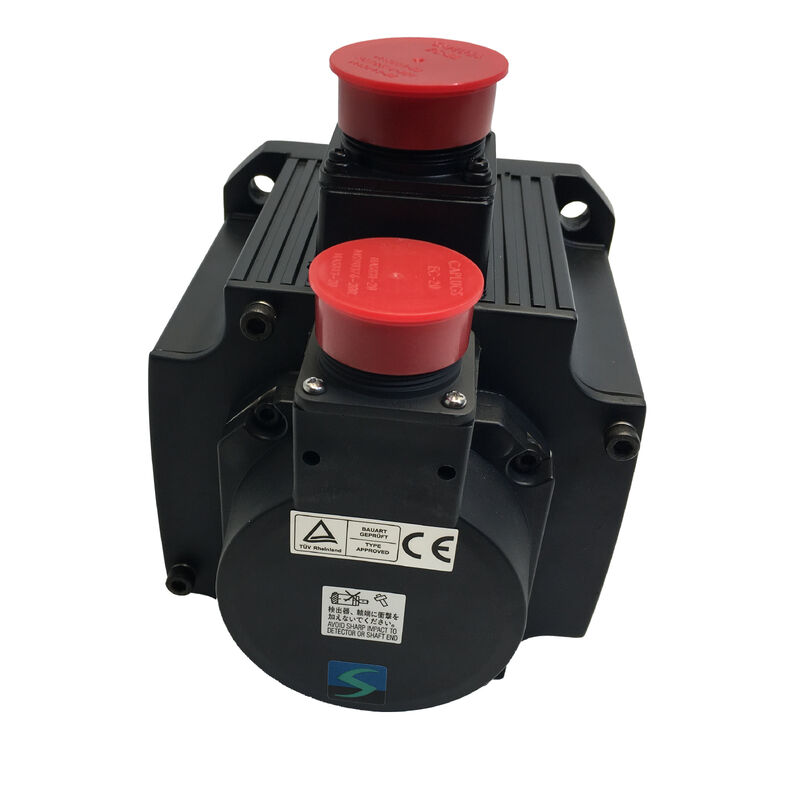
Mitsubishi HC-SFS353 | MELSERVO J2S HC-SF Series AC Servo Motor — 3.5kW, 11.1Nm, 3000RPM, 176×176mm Flange, 17-bit Absolute, IP65
Part Number: HC-SFS353
Series: MELSERVO J2S — HC-SF Series, Medium Inertia, Medium Capacity
Design: Straight Shaft, Oil Seal, Built-in 17-bit Absolute Encoder
Rated Output: 3.5 kW
Rated Torque: 11.1 Nm
Peak Torque: 33.4 Nm
Rated Speed: 3,000 RPM
Maximum Speed: 3,000 RPM
Rated Current: 16.4 A
Supply Voltage: 200 VAC Class
Moment of Inertia: 0.00820 kg·m² (82 kg·cm²)
Encoder: 17-bit Absolute, 131,072 ppr
Flange Size: 176 × 176 mm
Ingress Protection: IP65
Compatible Amplifier: MR-J2S Series
Condition: New / Refurbished / Surplus
Overview
The Mitsubishi HC-SFS353 is a 3.5 kW medium inertia AC servo motor from the MELSERVO J2S HC-SF series, delivering 11.1 Nm rated torque and a 33.4 Nm peak on a 176 × 176 mm mounting flange.
At 3,000 RPM with no speed headroom beyond the rated value — unlike many servo motors that operate at rated speed with a higher maximum — the HC-SFS353 is designed to run at its rated point continuously, with the 33.4 Nm peak available for acceleration and load transients.
At 3.5 kW, this motor steps into the range where the mechanical scale becomes substantial. The 176 × 176 mm flange is the largest standard flange format in the HC-SF series, and the 0.00820 kg·m² rotor inertia reflects the physical mass of a motor that must develop 11.1 Nm continuously — a rotor considerably heavier than the 80 × 80 mm or 130 × 130 mm class motors.
This inertia level has direct implications for axis sizing: the load inertia reflected to the motor shaft must be assessed against the 0.00820 kg·m² rotor inertia, and the ratio determines whether the servo system can maintain stable, well-tuned positioning performance or whether the gains are pushed toward the amplifier's stability limit.
The oil seal at the shaft exit and the IP65 body rating provide the environmental protection that heavy-duty machine tool and industrial automation installations at this power level require.
The 17-bit absolute encoder at 131,072 ppr eliminates reference return at startup — position is known immediately at power-up, which matters operationally when the machine must resume from a mid-cycle interruption without traversing back to a home position first.
Key Specifications
| Parameter |
Value |
| Rated Output |
3.5 kW |
| Rated Torque |
11.1 Nm |
| Peak Torque |
33.4 Nm |
| Rated Speed |
3,000 RPM |
| Maximum Speed |
3,000 RPM |
| Rated Current |
16.4 A |
| Supply Voltage |
200 VAC class |
| Moment of Inertia |
0.00820 kg·m² (82 kg·cm²) |
| Encoder |
17-bit Absolute, 131,072 ppr |
| Oil Seal |
Yes |
| Flange Size |
176 × 176 mm |
| Ingress Protection |
IP65 |
| Compatible Amplifier |
MR-J2S-350A/B |
| Inertia Class |
Medium |
3,000 RPM Rated = 3,000 RPM Maximum — What This Means
Most servo motors have a rated speed lower than their maximum speed. An HC-SFS52 runs at 2,000 RPM rated with a 3,000 RPM maximum; an HF-KP73 runs at 3,000 RPM rated with a 6,000 RPM maximum.
The HC-SFS353 is different: rated speed and maximum speed are both 3,000 RPM. There is no speed reserve above the rated operating point.
This is not a limitation — it is a design characteristic of the 3,000 RPM, large-frame medium inertia class.
The HC-SFS353 is built to deliver full rated torque right up to 3,000 RPM continuously.
The torque-speed curve runs flat at 11.1 Nm from zero speed to 3,000 RPM; there is no field-weakening region where torque tapers off before the maximum speed is reached, because the maximum speed is the rated speed.
The motor can be commanded at any speed from zero to 3,000 RPM and will deliver its full 11.1 Nm rated torque throughout that range.
For machine sizing, this means the table speed ceiling is set by the 3,000 RPM motor rating acting directly through the ball screw or transmission, with no ability to trade torque for higher speed by operating in field weakening.
Applications that require speeds above what the mechanical transmission produces at 3,000 RPM motor speed must address this through the transmission design — gear ratio, screw pitch — not through operating the motor above its rating.
11.1 Nm and 33.4 Nm — High Continuous Torque with 3:1 Peak
At 11.1 Nm rated, the HC-SFS353 sits in the range typically required for primary feed axes on larger machining centres: heavy tables, aggressive cutting, and rapid traverse distances where the axis motor must sustain substantial force throughout the machining cycle.
The 3:1 peak-to-rated ratio at 33.4 Nm provides the acceleration authority to bring these heavy loads up to rapid traverse speed in a brief, controlled acceleration phase.
The practical consequence of running at 3.5 kW and 16.4A rated current is thermal.
The motor generates real heat at rated load, and the surrounding cabinet, motor mounting structure, and machine frame must conduct and dissipate this heat effectively. The rated operating conditions assume adequate cooling at the motor body — the natural convection characteristics of the motor housing, the heat sinking provided by the machine flange, and the ambient temperature in the motor installation area all contribute to the actual steady-state winding temperature under sustained rated load.
The MR-J2S amplifier's electronic thermal protection monitors RMS current continuously and models the motor's thermal state.
Brief operation at 33.4 Nm peak current is permitted; sustained operation at or near peak torque will trip the thermal overload protection before the motor winding reaches a damaging temperature. Correctly sizing the motion profile to keep RMS torque within the 11.1 Nm rated value is the engineering step that ensures reliable, uninterrupted operation.
176 × 176 mm Flange — Scale and Mechanical Integration
The 176 × 176 mm flange marks the HC-SFS353 as a large-frame servo motor.
This flange size is the standard mechanical interface for the highest-capacity motors in the HC-SF series and its successors — the same bolt circle and register diameter used by the HC-SFS502 and HC-SFS702 at higher power levels, allowing machine designs to accommodate a range of motor capacities without changing the structural mounting.
For retrofits and replacements, the 176 mm flange is the key compatibility dimension.
The HC-SFS353 can replace any HC-SF series motor on the same 176 mm flange without structural modification, provided the shaft coupling interface is also compatible.
The physical depth, shaft diameter, and encoder connector position differ between motor variants in the same flange class — these must be verified individually against the machine's mechanical drawings before ordering a replacement.
The flange mounting at this physical scale also imposes practical installation requirements.
A 3.5 kW servo motor in the 176 mm class is a heavy component — handling, alignment, and torquing of the mounting bolts require two-person installation practice and a torque wrench calibrated to the specified bolt torque. Misalignment between the motor register and the machine housing bore imposes radial loads on the motor front bearing that can reduce bearing service life significantly.
17-bit Absolute Encoder — 131,072 ppr, No Homing Required
The HC-SFS353's 17-bit absolute encoder is the MELSERVO J2-Super generation's position feedback system, providing 131,072 pulses per revolution of absolute position data. With a battery fitted at the MR-J2S amplifier, the encoder retains the motor's absolute shaft position through power interruptions.
At startup, the amplifier reads the true shaft position directly — no reference return traverse is required, and the axis is ready for commanded operation immediately after the power-up sequence completes.
For a 3.5 kW axis on a large machining centre or industrial machine, this eliminates the startup overhead of traversing a heavy table to a reference switch at reduced speed, and it eliminates the risk of a mid-homing power failure leaving the axis position indeterminate.
On machines where the axis must restart precisely from wherever it was when power was lost — mid-weld, mid-turn, mid-bore — absolute position continuity is a safety and quality requirement, not a convenience.
The 131,072 ppr resolution at the motor translates, through the mechanical transmission, to the positional resolution at the machine's working surface.
At a 10mm ball screw pitch with 1:1 coupling, each encoder count is approximately 0.076 μm of table movement — resolution several orders of magnitude finer than the achievable accuracy of any real ball screw and guideway system.
The encoder is not the limiting factor in positioning accuracy for any realistic mechanical system the HC-SFS353 would drive.
Oil Seal and IP65 — Environmental Specification for Heavy-Duty Use
The combination of IP65 body protection and the shaft oil seal makes the HC-SFS353 appropriate for the environments where 3.5 kW servo axes operate: the cutting zone of large machining centres, the machine base of turning centres with high coolant flow rates, and industrial automation with regular wash-down maintenance cycles.
IP65 covers the motor body completely — dust exclusion and jet water resistance in all directions.
The oil seal at the shaft exit adds the sealing layer that the IP65 structural rating cannot provide at the rotating shaft interface. Coolant mist, lubricant fog from ball screws and gearboxes, and fine metallic particles generated by heavy cutting all represent contamination risks at the shaft gap that the oil seal mitigates throughout the motor's service life.
The oil seal lip is the maintenance item with the shortest replacement interval in the motor assembly. Periodic inspection of the seal condition — checking for lip hardening, cracking, or visible leakage past the seal — is the primary maintenance action for HC-SFS353 motors in high-coolant-exposure environments.
A damaged seal is inexpensive to replace as a planned maintenance item; contamination that reaches the bearing cavity and encoder from an undetected degraded seal is a much more significant repair.
MR-J2S-350A/B Amplifier — System Configuration
The HC-SFS353 at 3.5 kW and 16.4A rated current is matched with the MR-J2S-350A (analogue/pulse train command interface) or MR-J2S-350B (SSCNET serial network interface). At this power level, the MR-J2S-350 is a substantial amplifier — cooling fan-equipped, with regenerative braking capability to handle the energy returned by decelerating a 3.5 kW motor driving a heavy load.
The HC-SF series at this power level uses cannon-type (MS-type) circular connectors on the motor power and encoder cables.
At 16.4A rated, the power connector must be fully engaged and the locking ring seated before operation — a partially engaged cannon connector at this current level creates a high-resistance junction that will heat rapidly and may arc under current.
The encoder connector must equally be confirmed as fully engaged; an intermittent encoder connection at 3.5 kW produces servo alarms and potential uncontrolled motor behaviour.
For customers moving from MR-J2S to newer amplifier generations, Mitsubishi's renewal tooling supports migration to MR-J4-B amplifiers while retaining the existing MR-J2S-B motion controller, allowing the drive electronics to be modernised without replacing the controller hardware.
FAQ
Q1: Why is the maximum speed identical to the rated speed at 3,000 RPM?
Unlike most servo motors where a speed reserve exists above the rated speed, the HC-SFS353 is rated for full torque operation right up to 3,000 RPM — the maximum and rated speed coincide.
This means the motor delivers 11.1 Nm at any speed from zero to 3,000 RPM without torque de-rating in a field-weakening region.
Applications requiring higher table speeds must achieve them through the mechanical transmission (screw pitch, gear ratio) rather than by operating the motor above its rated speed.
Q2: The rotor inertia is 0.00820 kg·m² — how does this affect axis sizing?
The 0.00820 kg·m² rotor inertia is the reference for load matching. Mitsubishi's general guidance for the HC-SF medium inertia series recommends keeping the reflected load inertia at the motor shaft within approximately 15 times the rotor inertia — in this case, up to about 0.123 kg·m² reflected load inertia.
Exceeding this ratio makes the servo gain settings more conservative and can reduce achievable positioning bandwidth. The substantial rotor inertia of the HC-SFS353 compared to smaller motors means it inherently tolerates heavier mechanical loads before the inertia mismatch becomes problematic.
Q3: Does the HC-SFS353 require a reference return at startup?
No. The 17-bit absolute encoder retains shaft position through power loss when a backup battery is fitted at the MR-J2S amplifier.
At power-up, the amplifier reads the absolute position directly from the encoder — the axis has correct position data without any homing traverse.
Battery condition should be checked at scheduled maintenance intervals; a discharged battery means absolute position data is lost at the next power interruption and homing becomes necessary until the battery is replaced.
Q4: What is the compatible MR-J2S amplifier for the HC-SFS353?
The HC-SFS353 at 3.5 kW requires the MR-J2S-350A (analogue/pulse train interface) or MR-J2S-350B (SSCNET interface). This is the 3.5 kW class amplifier in the MELSERVO J2-Super range, equipped with a cooling fan and regenerative braking capacity.
The "350" designation in the amplifier refers to the capacity class, not watts — it covers 3.5 kW motor applications within the MR-J2S product family. Confirm whether the machine uses individual axis pulse/analogue commands (A-type) or SSCNET motion controller network (B-type) before ordering.
Q5: What are the key installation checks for the HC-SFS353 at 3.5 kW?
Confirm the mounting flange register and bore alignment before torquing the mounting bolts — a misaligned 176 mm flange on a motor this heavy imposes radial loads on the front bearing that accelerate wear.
Verify cannon connector engagement on both power and encoder cables is complete with locking rings fully seated. At 16.4A rated current, check that the motor power cable cross-section and connector contacts are rated for this current without excessive heating at junctions.
After initial installation, run the axis at reduced speed and load while monitoring the MR-J2S amplifier's following error display — any following error that grows with speed indicates a mechanical or encoder connection issue that should be resolved before full-load production operation.


 Your message must be between 20-3,000 characters!