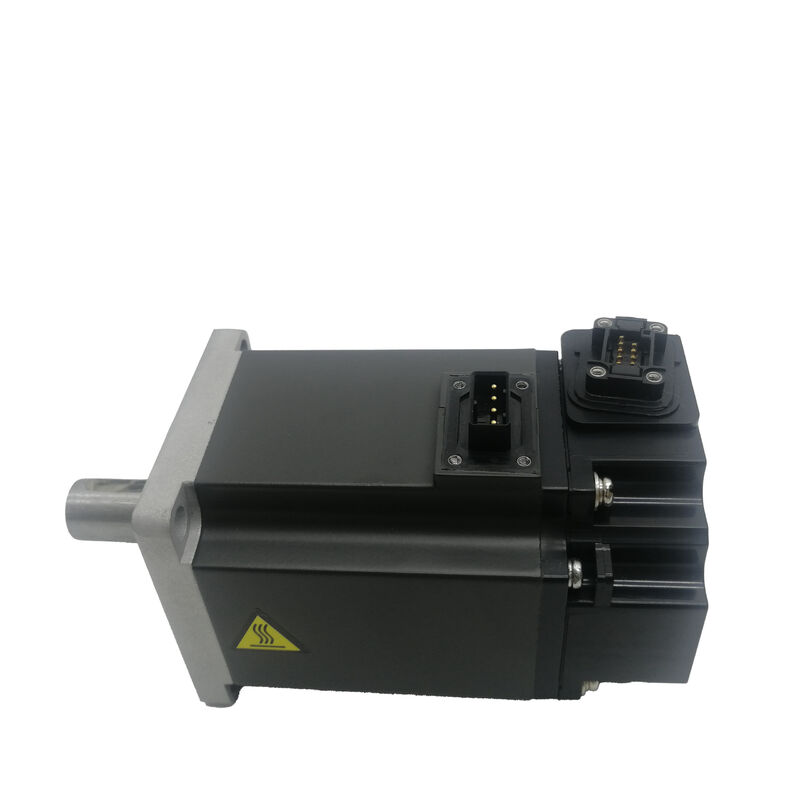
Mitsubishi HF-KE43 | Low Inertia AC Servo Motor — 0.4kW, 1.3Nm, 3000RPM, 60×60mm Flange, 131072 ppr, No Oil Seal, MR-E Series
Part Number: HF-KE43
Series: MELSERVO HF-KE — Low Inertia, Small Capacity AC Servo Motor
Rated Output: 0.4 kW (400 W)
Rated Torque: 1.3 Nm
Peak Torque: 3.8 Nm
Rated Speed: 3,000 RPM
Maximum Speed: 6,000 RPM
Supply Voltage: 200 VAC Class, 3-Phase
Rated Current: 2.9 A
Motor Voltage: 102 V
Electromagnetic Brake: None
Oil Seal: None (Standard)
Encoder: 17-bit Incremental, 131,072 ppr
Inertia Class: Low
Flange Size: 60 × 60 mm
Ingress Protection: IP65
Compatible Amplifier: MR-E Series
Condition: New
Overview
The Mitsubishi HF-KE43 is a 0.4 kW low inertia AC servo motor from Mitsubishi Electric's HF-KE series, designed for use with the MR-E servo amplifier platform.
At 1.3 Nm rated torque and 3.8 Nm peak, operating at 3,000 RPM rated speed with a 6,000 RPM ceiling, and mounted on a compact 60 × 60 mm flange, it delivers responsive positioning performance in a physically small package — the format that suits light-load automation where installation space and system cost both matter.
The HF-KE43 carries no electromagnetic brake and no oil seal.
These are deliberate specification choices rather than omissions. The absence of a brake defines the application class: horizontal axes, or any axis where the load does not require mechanical holding when the servo is de-energised.
The absence of an oil seal means the motor's shaft exit is unsealed, which is acceptable in clean environments and applications where the motor is not exposed to lubricant mist from adjacent mechanisms. In environments where those conditions are not met, the oil seal variant adds that protection.
What the HF-KE43 does carry is a 17-bit incremental encoder at 131,072 pulses per revolution — the resolution that enables the MR-E amplifier's real-time auto-tuning to characterise and match the servo gains to the mechanical load without manual intervention.
Combined with the low inertia rotor design, this produces a motor that can accelerate and decelerate a light positioning load at high cycle rates with the servo system maintaining stable, precise following throughout.
Key Specifications
| Parameter |
Value |
| Rated Output |
0.4 kW (400 W) |
| Rated Torque |
1.3 Nm |
| Peak Torque |
3.8 Nm |
| Rated Speed |
3,000 RPM |
| Maximum Speed |
6,000 RPM |
| Supply Voltage |
200 VAC class, 3-phase |
| Motor Voltage |
102 V |
| Rated Current |
2.9 A |
| Electromagnetic Brake |
None |
| Oil Seal |
None (standard) |
| Encoder Type |
17-bit Incremental |
| Encoder Resolution |
131,072 ppr |
| Inertia Class |
Low |
| Flange Size |
60 × 60 mm |
| Ingress Protection |
IP65 |
| Compatible Amplifier |
MR-E-40A (MR-E series) |
| Operating Temperature |
0°C to +40°C |
| Humidity |
10% to 80% RH, non-condensing |
HF-KE Series — Low Inertia for High-Cycle Positioning
The defining engineering characteristic of the HF-KE series is its low inertia rotor. Inertia in a servo motor's rotor is the rotational equivalent of mass — it determines how much torque is required to produce a given angular acceleration.
A low inertia rotor responds to velocity commands faster because less energy is required to change its speed; the servo system can achieve the commanded position change in less time, and the amplifier's current demand during the acceleration phase is lower for a given move profile.
This matters most in applications where the axis performs many short, fast moves per minute: pick-and-place mechanisms, label applicators, conveyor index drives, electronic assembly feeders, and similar high-cycle automation.
In these applications, the move profile is dominated by acceleration and deceleration rather than sustained velocity running.
A low inertia motor completes each acceleration phase faster, dwells at the target position for less time before the next command, and the overall cycle rate increases without requiring a larger amplifier or more aggressive current limits.
The practical constraint is load inertia matching.
Low inertia motors are more sensitive to the ratio between load inertia and rotor inertia than medium or high inertia designs.
Mitsubishi's application guidance recommends keeping the load-to-rotor inertia ratio within recommended limits — typically 10 to 15 times for the HF-KE class — for stable servo performance without excessive gain requirements.
Exceeding this ratio does not prevent operation, but it makes the servo gains required for responsive, well-damped positioning approach the stability boundary of the amplifier, making tuning more difficult and limiting achievable bandwidth.
131,072 ppr Encoder — Feedback Resolution in Practice
The 17-bit incremental encoder delivers 131,072 pulses per revolution to the MR-E amplifier's position control loop.
The practical positioning resolution this creates depends on the mechanical transmission between motor and load: at a 10mm ball screw pitch with direct motor coupling, each encoder pulse corresponds to approximately 0.076 μm of table travel — finer than the accuracy of any practical ball screw assembly, which means the encoder is not the limiting factor in any real axis positioning system.
The encoder is incremental — it counts pulses from a reference established at startup.
A reference return (homing) cycle is required at every power cycle before the axis accepts position commands. On most machines this is a short, automatic sequence at startup; on systems where emergency stop or power interruptions are frequent, the repeated homing adds a modest operational overhead.
The high pulse count also gives the MR-E amplifier's auto-tuning function sufficient resolution to observe and minimise velocity following error at the sub-millisecond level. Auto-tuning works by observing the gap between commanded and actual velocity during test moves, then adjusting the gain parameters — position loop gain, speed loop gain, integral time — to reduce this error without introducing oscillation.
At 131,072 ppr, the velocity observation is accurate enough for the auto-tuning to converge on stable, well-matched gain settings across the MR-E series' full speed and torque range.
No Oil Seal — Specifying the Right Variant
The HF-KE43 is described as the "servo motor without oil seal" — a standard motor configuration where the shaft exit gap at the front endshield is not sealed against fluid or particle ingress.
This is the baseline specification, and it is fully appropriate for the majority of the motor's application environments: clean machine rooms, enclosure-mounted installations away from cutting fluid zones, electronic assembly equipment, and any installation where the motor body is not directly exposed to lubricant mist or coolant.
Where the installation places the motor near lubricated mechanisms — ball screws with centralised lubrication, gearbox splash zones, or coolant-carrying machine environments — the oil seal variant is the correct choice.
A lip seal at the shaft exit costs nothing in functional performance but eliminates the contamination pathway that causes progressive lubricant ingress into the bearing cavity and, eventually, the encoder assembly.
The equivalent HF-KE43 model with oil seal fitted carries a "J" in its suffix (e.g. HF-KE43JW1-S100), and the physical dimensions are the same.
If there is any uncertainty about the installation environment's cleanliness, specifying the oil seal variant is the lower-risk selection. The cost difference is negligible; the service life difference in a moist or lubricated environment is not.
No Brake — Axis Configuration Implications
The HF-KE43 has no electromagnetic brake. For horizontal positioning axes — the primary application class for a 0.4 kW low inertia motor — this is correct. There is no gravity-driven tendency to move when the servo is de-energised, so no holding mechanism is required between positioning moves or at machine stop.
For inclined or vertical axes where gravity acts on the load when the motor is switched off, the brake-equipped variant (HF-KE43B or equivalent with "B" in the suffix) must be selected. Installing the brake-free HF-KE43 on an unsupported vertical axis creates a drop risk on every servo disable event — at servo alarm, E-stop, programmed servo off, and power loss.
On machines with pneumatic counterbalances that fully support the vertical load, the brake-free variant is again acceptable; the mechanical support substitutes for the brake function.
MR-E Amplifier System — Position, Speed, and Torque Control
The HF-KE43 is designed for the MR-E servo amplifier series, specifically the MR-E-40A for the 400W motor class.
The MR-E platform provides two control interfaces: a pulse train interface for position and speed control (accepting differential or open-collector pulse inputs from a host controller or PLC) and an analogue input interface for speed and torque control (0 to ±10V analogue reference).
Both interfaces are available on the standard MR-E-40A, giving the system designer the choice of control architecture without changing the motor or amplifier hardware.
The MR-E's real-time auto-tuning starts from the moment the servo is enabled and continuously adjusts the gain parameters while the machine runs. Position gains, speed gains, and the speed loop integral time are all managed by the auto-tuning function based on the observed following error.
For the commissioning engineer, this means the motor can be installed, connected, and run productive cycles without a dedicated gain tuning session — auto-tuning converges on appropriate settings within the first few cycles of operation.
Adaptive vibration suppression control is also available through the MR-E amplifier: the amplifier identifies low-frequency mechanical resonances in the load structure and notches them out of the servo response, preventing the resonance from being amplified by the position control loop.
On light-frame machines where mechanical resonance is a concern, this feature can eliminate the need for manual anti-vibration parameter tuning.
FAQ
Q1: What is the difference between the HF-KE43 and the HF-KE43B?
The HF-KE43 has no electromagnetic brake; the HF-KE43B is the same motor with a factory-fitted electromagnetic brake. The electrical specifications — rated output, torque, speed, encoder, and amplifier compatibility — are identical between the two.
The brake-equipped variant is physically longer due to the brake module, draws additional current from the brake supply circuit, and requires the MR-E amplifier's brake interlock sequence. The HF-KE43 (no brake) is specified for horizontal axes and gravity-balanced vertical axes; the HF-KE43B is required for vertical or inclined axes where the load must be held mechanically when the servo is de-energised.
Q2: The motor has no oil seal. Does this mean it is not IP65-rated?
No — the IP65 rating applies to the motor body regardless of whether an oil seal is fitted. IP65 means fully dust-tight and protected against water jets from any direction, which covers the motor housing, winding area, and encoder compartment.
The oil seal specifically addresses the shaft exit gap — a narrow annular space that IP65 testing does not fully protect against lubricant mist ingress under sustained exposure. The standard HF-KE43 without oil seal is appropriate for clean and normal industrial environments.
In environments with lubricant mist, the oil seal variant provides the additional sealing layer at the shaft entry point.
Q3: What amplifier is required, and does the HF-KE43 support both position and speed control?
The MR-E-40A is the matched servo amplifier for the HF-KE43. It supports both position control (via pulse train input for CNC or PLC pulse output) and speed/torque control (via ±10V analogue reference).
The control mode is selected by parameter and wiring configuration, not by hardware variant, so the same motor and amplifier combination can be used in either architecture.
The MR-E-40A also provides a position control mode with encoder pulse output for integration with motion controllers or PLCs that expect quadrature encoder feedback.
Q4: What does the 131,072 ppr encoder resolution mean for positioning accuracy?
Resolution and accuracy are different things: 131,072 ppr is the feedback resolution, which sets the finest position increment the servo system can detect and control. Actual positioning accuracy depends on the mechanical system — ball screw pitch, backlash, guideway straightness, and thermal expansion.
At a 10mm pitch ball screw with direct coupling, 131,072 ppr gives approximately 0.076 μm of travel per encoder count, which is far finer than any practical ball screw's accuracy.
In practice, the encoder is not the limiting factor in positioning accuracy — the mechanics are. What the 17-bit resolution primarily provides is stable velocity feedback at low speeds and the data density the MR-E auto-tuning needs to set accurate servo gains.
Q5: What are the main checks when installing a used HF-KE43?
Rotate the shaft by hand and check for smooth bearing movement with no roughness or grinding — the low inertia rotor of the HF-KE series has a light shaft, and bearing wear is audible before it becomes mechanically significant. Inspect the encoder connector for bent pins and the cable exit strain relief for cracking. Measure winding resistance across all three phases for balance.
Check insulation resistance to earth with a megger — even a standard (no oil seal) motor that has operated in a humid environment may show reduced insulation resistance.
On a test run, monitor the MR-E amplifier's following error display at rated speed and confirm it is within normal bounds; excessive following error at a speed the motor previously handled correctly indicates encoder degradation or mechanical coupling issues rather than a motor winding fault.


 Your message must be between 20-3,000 characters!