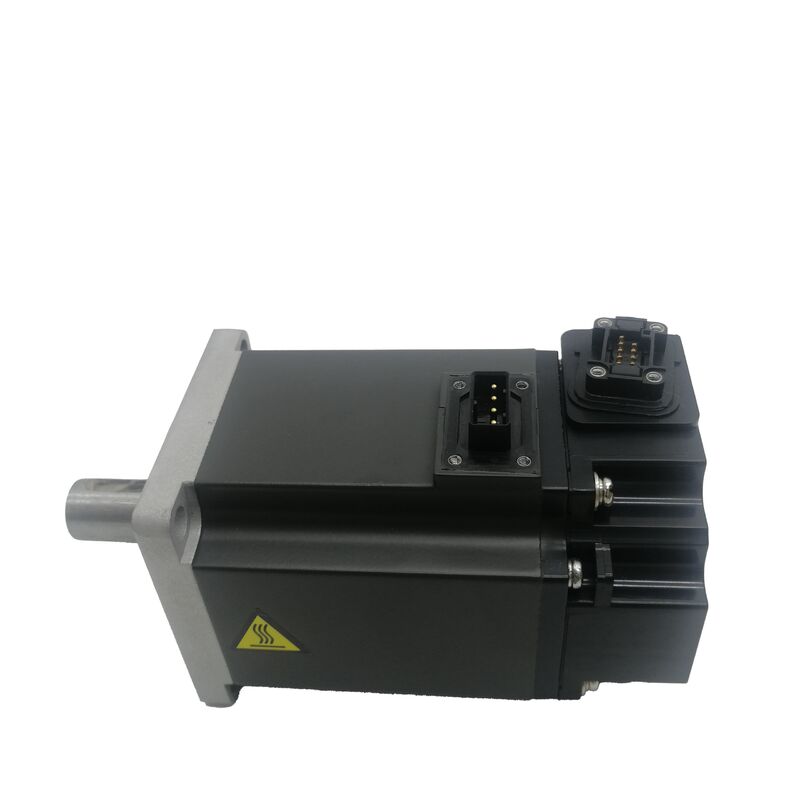
Mitsubishi Electric HF-KE43JW1-S100 AC Servo Motor
400W | 1.3 Nm Rated | 3000 RPM | 17-bit Incremental Encoder | Oil Seal | W1 Front Connector | Super MR-E Compatible | IP65 | 60×60mm Flange
A Specific Motor for a Specific System
Not all servo motors within a manufacturer's lineup are interchangeable at the drive level, and the HF-KE43JW1-S100 illustrates this clearly. While it shares its 400W output class and 60×60mm flange footprint with the standard HF-KE43, this variant carries three additional specifications that define precisely where it belongs: an oil seal on the shaft exit, a W1 front-facing connector format, and an -S100 designation marking it as part of Mitsubishi's Super MR-E system.
The Super MR-E platform — comprising the HF-KE motor series with W1-S100 designation and the MR-E-40A-KH003 amplifier — was introduced to improve both connectorization and compatibility with encoder-related enhancements over the earlier standard MR-E series. The motor's W1 connector faces forward (toward the front face of the motor) rather than radially off the body, a design change that simplifies cable routing in confined machine spaces and reduces the likelihood of connector stress from cable weight or vibration.
The oil seal — signified by the "J" in the model number — is the other defining physical feature. It sits at the shaft exit point of the motor housing and creates a barrier against oil mist, cutting fluid, and atmospheric contaminants that can migrate into the motor body through the shaft bore. For machine tools, food processing lines, and wet process automation, this protection is not optional — it is a prerequisite for reliable motor life in service.
Technical Specifications
| Item |
Specification |
| Model |
HF-KE43JW1-S100 |
| Series |
MELSERVO HF-KE (Super MR-E / S100) |
| Rated Output Power |
400W (0.4 kW) |
| Rated Torque |
1.3 Nm |
| Peak Torque |
3.8 Nm |
| Rated Speed |
3,000 RPM |
| Maximum Speed |
5,000 RPM |
| Encoder Type |
Incremental |
| Encoder Resolution |
131,072 ppr (17-bit equivalent) |
| Supply Voltage |
200V AC class |
| Rated Current |
2.9 A |
| Flange Size |
60 × 60 mm |
| Shaft Type |
Straight (no keyway) |
| Oil Seal |
Installed (J suffix) |
| Connector Type |
W1 (front-facing) |
| Protection Rating |
IP65 |
| Special Designation |
-S100 (Super MR-E special specification) |
| Compatible Amplifier |
MR-E-40A-KH003 (Super MR-E) |
| Operating Temperature |
0°C to +40°C |
| Storage Temperature |
−15°C to +70°C |
| Operating Humidity |
10–80% RH (non-condensing) |
| Structure |
Totally enclosed, natural cooling |
| Insulation Class |
130 (B) |
| Country of Origin |
Japan |
The Oil Seal: What It Does and When You Need It
Standard servo motors — including the base HF-KE43 without the J suffix — rely on the precision fit between the shaft and the motor's front bearing housing for basic environmental exclusion. In clean, dry environments this is adequate. In environments where oil mist is present — machine tool axes adjacent to oil-lubricated gearboxes, cutting fluid splash zones, or food processing lines running wet — the shaft bore becomes an ingress path. Oil drawn in by capillary action or air pressure fluctuations around the spinning shaft contaminates the encoder over time, eventually causing signal errors or encoder failure.
The oil seal installed in the HF-KE43JW1-S100 eliminates this ingress path. A lip seal bearing against the motor shaft at the front housing creates a positive mechanical barrier. The seal is rated to function within the motor's operating speed range, and its presence does not affect the motor's torque or speed characteristics.
One practical point worth noting: the oil seal increases the friction load on the shaft slightly at startup, which is relevant only in applications involving extremely low-friction, low-inertia loads. For the vast majority of machine tool and automation applications, the effect is negligible.
W1 Connector vs. Standard Connector: A Practical Installation Difference
The W1 designation describes the connector's orientation. On standard HF-KE series motors, the encoder and power connectors exit radially from the motor body. On the W1 variant, the connectors face forward — emerging from the same face as the mounting flange. This seemingly minor change has real consequences in machine integration:
In applications where the motor is mounted in a cavity, inside a machine column, or with a reduction gearhead directly on the shaft, radial connectors force the cable to bend through 90° immediately after the connector — a stress point that accelerates cable and connector wear. The forward-facing W1 connector allows cables to run directly away from the motor face without the abrupt turn, reducing cable mechanical stress at the connector termination.
For machine builders who standardize on this motor family across multiple axes, the W1 orientation also offers consistent cable routing geometry regardless of motor mounting angle.
Super MR-E: Where the -S100 Designation Fits
The MR-E series was Mitsubishi's general-purpose servo platform occupying the tier below the full-featured MR-J3/MR-J4 line — simpler interface, lower hardware cost, adequate for the majority of pulse-train position control and analog speed reference applications. The Super MR-E (MR-E-□A-KH003 amplifiers) refined this platform with improved software, updated auto-tuning behavior, and support for the W1-connector motor variants.
Motors marked -S100 are specifically verified and specified for use with these KH003-designated amplifiers. The pairing is not arbitrary — it reflects Mitsubishi's amplifier-motor compatibility matrix. Using an HF-KE43JW1-S100 with a standard MR-E-40A without the KH003 designation is outside Mitsubishi's supported configuration. Conversely, attempting to use a standard HF-KE43 (without the W1-S100 suffix) with a KH003-designated amplifier may result in connector incompatibility.
For maintenance teams sourcing replacement motors: verifying the -S100 (or absence thereof) against the existing amplifier's suffix is the first step before confirming a replacement order.
Where This Motor Typically Operates
The HF-KE43JW1-S100 appears most frequently in three categories of industrial application:
Machine tool auxiliary axes. Feed axes on CNC lathes, milling centers, and grinding machines — turret rotation, tailstock control, chuck actuation — often operate in proximity to cutting oil. The oil seal and IP65 rating make the JW1-S100 the correct choice over the non-sealed HF-KE43W1-S100 for these positions.
Packaging and food processing equipment. Lines running wet or under periodic wash-down benefit from both the IP65 body rating and the oil seal, which together provide defense against both direct spray and vapor infiltration.
Textile and printing machinery. Axes on warp beam drives, traverse guides, and infeed rollers encounter lubricant aerosols from adjacent machinery. The low inertia characteristic of the HF-KE series suits the frequent start-stop demands of these axes, and the sealed shaft extends maintenance intervals in environments where periodic cleaning is the norm.
Automated assembly equipment. Pick-and-place heads, rotary indexing tables, and multi-axis gantries in precision assembly lines where 400W axis torque capacity is matched to the mechanical load, and where machine layout dictates forward-facing cable exit.
Frequently Asked Questions
Q1: What is the exact amplifier required for the HF-KE43JW1-S100, and can it be substituted with a standard MR-E-40A?
The HF-KE43JW1-S100 is specified for use with the MR-E-40A-KH003, which is the "Super MR-E" variant of the MR-E-40A amplifier. The KH003 suffix identifies a specific firmware and hardware revision that supports the W1-S100 motor family's connector and parameter set. A standard MR-E-40A without the KH003 suffix is outside Mitsubishi's supported configuration for this motor, and may present connector incompatibility depending on the amplifier revision. When sourcing a replacement amplifier for an existing HF-KE43JW1-S100 installation, the complete amplifier model including suffix must be matched. Mixing KH003-designated motors with non-KH003 amplifiers is not recommended and may produce operational issues that are not covered by standard fault diagnostics.
Q2: What does the oil seal actually protect against, and does it add any shaft load?
The oil seal in the HF-KE43JW1-S100 is a lip-type seal installed at the motor's front housing shaft exit. It creates a physical barrier against oil mist, cutting fluid, grease vapors, and liquid coolant that could otherwise migrate into the motor interior through the shaft bore gap. Without the seal, these contaminants reach the front bearing and eventually the encoder — the most failure-prone component in a wet environment. The oil seal adds a small amount of friction to the shaft, measurable at startup but negligible under any normal load condition. For the 400W power class of this motor, the friction contribution from the oil seal is not a relevant design factor. The seal is effective throughout the motor's rated speed range.
Q3: Can the HF-KE43JW1-S100 replace an HC-KFE43 motor in an existing machine?
Both motors share the same 60×60mm flange and produce the same 1.3 Nm rated / 3.8 Nm peak torque at 3,000 RPM, so the mechanical mount and load characteristics are directly comparable. However, the encoder interface, connector pinouts, and amplifier compatibility are completely different. The HC-KFE43 uses a 10,000 ppr incremental encoder and pairs with the MR-E-40A (or MR-E-40AG for gearhead versions), while the HF-KE43JW1-S100 uses a 17-bit (131,072 ppr) incremental encoder and requires the MR-E-40A-KH003. A mechanical drop-in replacement without changing the amplifier is not possible. If an existing machine uses HC-KFE43 motors with standard MR-E-40A amplifiers, the correct like-for-like replacement motor remains the HC-KFE43 or an approved MR-E-compatible alternative — not the W1-S100 variant.
Q4: Is the HF-KE43JW1-S100 currently in production, and what is its support status?
The HF-KE43JW1-S100 has been discontinued by Mitsubishi Electric. The current-generation motor for the same mechanical footprint and torque class is the HG-KN43J (MR-JE-40A compatible) or HG-KR43 (MR-J4-40A compatible), both of which offer upgraded 17-bit or 22-bit absolute encoders and IP65 protection. For existing machines using the HF-KE43JW1-S100, stock continues to be available through Mitsubishi distributors and industrial automation specialists, though availability will diminish over time. For new machine designs, specifying the current-generation HG-KN or HG-KR motor series is the preferred approach. Mitsubishi Electric's service network continues to support repair and technical consultation for the MR-E/Super MR-E platform.
Q5: What encoder cable is compatible when connecting the HF-KE43JW1-S100 to the MR-E-40A-KH003 amplifier?
The W1 connector format requires the corresponding MR-E series encoder cable designed for W1-connector motors. These are the MR-EKCBL□M cables from Mitsubishi Electric, where the □ position indicates cable length (standard lengths from 2m to 20m). The cable set is distinct from those used with standard-connector HF-KE motors due to the different connector orientation and pinout at the motor end. When sourcing replacement cables for existing installations, confirming the W1 connector compatibility is essential — encoder cables for the standard-connector (non-W1) HF-KE variants will not mate with the JW1-S100's connector. The amplifier end terminates at the CN2 port of the MR-E-40A-KH003. Cable shielding and routing recommendations follow Mitsubishi's standard EMC practice: segregate encoder cables from motor power cables and use dedicated cable grounding at the amplifier chassis.


 Your message must be between 20-3,000 characters!