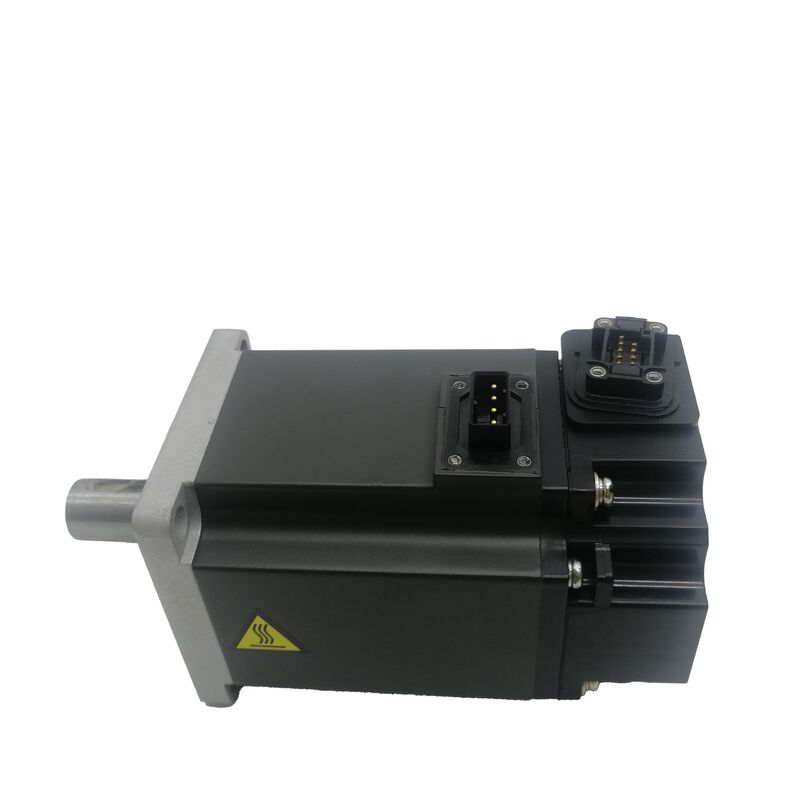
Mitsubishi Electric HF-KE73 AC Servo Motor
750W | 2.4 Nm Rated | 3000 RPM | 17-bit Incremental Encoder | MR-JE-70A Compatible | 80×80mm Flange | Straight Shaft | IP65 | Low Inertia
Precision Where General-Purpose Systems Demand It
There is a well-defined performance tier between entry-level open-loop drives and the full-capability MR-J4/MR-J3 closed-loop platforms. It is occupied by systems that need genuine speed and position feedback accuracy without the engineering overhead of high-end amplifier networks. The Mitsubishi Electric HF-KE73 was designed for exactly this space.
Part of Mitsubishi's HF-KE series and paired with the MR-JE general-purpose servo amplifier, the HF-KE73 delivers 750W rated output, 2.4 Nm continuous torque, and 17-bit encoder feedback in a compact 80×80mm flange format. It is a motor for machine builders who need responsive, closed-loop servo performance across a range of automation axes — without the cost premium of the upper-tier drive platforms.
The HF-KE series spans four output levels: 100W (HF-KE13), 200W (HF-KE23), 400W (HF-KE43), and 750W (HF-KE73). At the series ceiling, the HF-KE73 brings the maximum torque capacity the MR-JE-70A amplifier can drive.
Technical Specifications
| Parameter |
Value |
| Part Number |
HF-KE73 |
| Series |
MELSERVO HF-KE (MR-JE compatible) |
| Rated Output Power |
750W (0.75 kW) |
| Rated Torque |
2.4 Nm |
| Peak Torque (Maximum) |
7.2 Nm |
| Peak-to-Rated Ratio |
3:1 |
| Rated Speed |
3,000 RPM |
| Maximum Speed |
5,000 RPM |
| Encoder Type |
Incremental |
| Encoder Resolution |
131,072 ppr (17-bit equivalent) |
| Supply Voltage |
200V AC class |
| Flange Size |
80 × 80 mm |
| Shaft Type |
Straight (no keyway) |
| Protection Rating |
IP65 |
| Compatible Servo Amplifier |
MR-JE-70A |
| Operating Temperature |
0°C to +40°C |
| Storage Temperature |
−15°C to +70°C |
| Ambient Humidity |
Max 80% RH (non-condensing) |
| Maximum Altitude |
1,000 m above sea level |
| Vibration Resistance (X/Y) |
49 m/s² |
| Insulation Class |
130 (B) |
| Structure |
Totally enclosed, natural cooling |
| Country of Origin |
Japan |
HF-KE vs. HF-KN vs. HF-KP: Same Flange, Different Amplifier Generations
Mitsubishi organizes its 750W low-inertia motor family across several amplifier-matched series, and the differences are not interchangeable at the drive level:
The HF-KE73 pairs with the MR-JE-70A — Mitsubishi's entry-level intelligent servo amplifier with built-in dynamic brake, pulse train or analog command input, and RS-422/RS-485 communication. This combination targets general-purpose automation where pulse-train position control or analog speed reference is the interface method.
The HF-KN73 (MELSERVO-JN series) targets a similar application tier through the MR-JN amplifier — a simplified position-control amplifier that sacrifices some advanced functions for lower hardware cost.
The HF-KP73 (MELSERVO-J3 series) and HG-KR73 (MELSERVO-J4 series) step up to the higher-specification platforms with 18-bit/22-bit absolute encoders, SSCNET III/H network compatibility, and the full advanced function set.
All four motor variants share the same 80×80mm flange footprint and the same 2.4 Nm / 7.2 Nm torque figures. The mechanical dimensions are compatible, but the encoders, connectors, and amplifier interfaces are not. Choosing between them is a system-level decision, not a motor-level one.
What 17-Bit Incremental Feedback Actually Provides
The 131,072 counts per revolution from the HF-KE73's 17-bit encoder is the specification that defines velocity smoothness and position resolution in normal operation. At 3,000 RPM rated speed, this encoder generates over 6.5 million feedback pulses per second — a count rate that allows the MR-JE amplifier's control loops to calculate instantaneous velocity and track position with fine granularity across the motor's full speed range.
For a ballscrew axis with a 10mm pitch, 131,072 counts per revolution translates to a theoretical position resolution of approximately 0.076 micrometres per count — far beyond the mechanical accuracy of any standard ballscrew. In practice, the encoder resolution ceases to be the limiting factor in positioning accuracy, and mechanical factors — backlash, thermal expansion, ballscrew pitch error — dominate instead.
The encoder is incremental, which has one practical implication: every time main power is removed and restored, the axis has no stored position memory. A reference return (homing) sequence is required before valid absolute position is established. For machines where startup homing is a normal, brief procedure — the majority of machining centers and standard positioning applications — this is a minor and well-managed constraint.
IP65: A Step Up From the HC-KFE Generation
The HF-KE73's IP65 body protection rating marks a meaningful improvement over the HC-KFE73's IP55. Where IP55 guards against water jets, IP65 blocks water jets from any direction while also providing complete dust exclusion (first digit 6, versus the HC-KFE's 5). This higher rating opens the HF-KE73 to machine environments where coolant mist, airborne particulates, and periodic wash-down are part of normal production — conditions that compromise IP55-rated motors over time.
The full IP65 protection is maintained at the motor body level. For installations near high-coolant zones, this is a substantive advantage that extends maintenance intervals and reduces encoder contamination risk compared to the older HC-KFE generation.
The MR-JE-70A: A Modern Amplifier for This Motor Class
The MR-JE-70A is a current-production amplifier — active in the Mitsubishi Factory Automation product catalog — rated at 750W to match the HF-KE73's output. It accepts either single-phase or three-phase 200VAC input, incorporates a built-in dynamic brake and regenerative resistor, and provides RS-422/RS-485 communication for parameter access and monitoring.
Command inputs cover both pulse train (for pulse-train position controllers, MELSEC PLC positioning modules, or CNC pulse outputs) and analog voltage for speed control mode operation. The real-time automatic tuning function built into the MR-JE series manages gain adaptation to the connected load, simplifying commissioning for maintenance engineers who may be working without the original drive documentation.
The HF-KE73 / MR-JE-70A pairing represents a current, actively supported servo system — spare parts, firmware updates, and technical support from Mitsubishi's service network remain available, which is a practical maintenance advantage over legacy systems based on discontinued HC-KFE / MR-E hardware.
Application Context: Where the HF-KE73 Belongs
The 750W ceiling of the MR-JE general-purpose platform matches the HF-KE73 to a specific application profile:
Horizontal feed axes and positioning tables — where 2.4 Nm continuous torque at 3,000 RPM meets the cutting and traverse load requirements of medium-duty CNC auxiliary axes, marking systems, and general automation slides.
Packaging and assembly automation — intermittent duty cycle axes performing pick-and-place, indexing, or conveyor positioning where the 7.2 Nm peak torque handles acceleration transients without approaching the motor's thermal limit.
Rotary indexing — where the 80×80mm flange provides a stable mechanical base and the IP65 housing handles the incidental contamination typical of production floor environments.
Textile, printing, and converting machinery — where coordinated web-feed axes require accurate speed regulation and the HF-KE73's 17-bit feedback supports smooth, low-speed operation without velocity ripple.
Frequently Asked Questions
Q1: What is the difference between the HF-KE73 and the HC-KFE73 for a maintenance replacement scenario?
The two motors share the same 80×80mm flange footprint and the same 2.4 Nm / 7.2 Nm rated/peak torque figures, which makes a direct mechanical swap straightforward. However, they use completely different amplifier systems and encoder interfaces. The HC-KFE73 pairs with the discontinued MR-E-70A and uses a 10,000 ppr incremental encoder with pulse train feedback through an older connector format. The HF-KE73 pairs with the current MR-JE-70A and uses a 17-bit (131,072 ppr) incremental encoder with the modern MR-JE signal interface. A mechanical-only drop-in replacement is not possible — both the amplifier and encoder cables must change. The upgrade from HC-KFE73 to HF-KE73 represents a genuine improvement in encoder resolution, IP protection, and access to an actively supported amplifier platform.
Q2: Does the HF-KE73 require a homing sequence on every power-up?
Yes. The 17-bit encoder is incremental, which means position data is lost whenever power is removed from the system. Every startup requires a reference return (homing) cycle to re-establish axis zero before the control system has valid absolute position data. For the vast majority of machine applications — CNC machining centers, packaging lines, assembly automation — this is a routine startup step that takes a few seconds per axis and is handled automatically by the machine's control sequence. If the application requires power-cycle-proof position retention without homing, motors with absolute encoders (such as the HG-KR73 with 22-bit absolute feedback) address this requirement, though at higher system cost.
Q3: Can the HF-KE73 be used on a vertical axis without an electromagnetic brake?
The HF-KE73 is the standard straight shaft variant without a brake. For vertical axes carrying a load that can drift or fall when the servo is de-energized, the base HF-KE73 provides no passive holding — the axis will move freely when the amplifier is turned off. For vertical axes where gravity creates a risk to personnel or the workpiece during de-energized states, the HF-KE73B (with non-excitation electromagnetic brake) is the required specification. The brake variant uses a spring-applied design that engages automatically when 24VDC is removed, holding the load without any controller action. For horizontal axes with no gravity loading, the standard HF-KE73 without brake is the appropriate and lower-cost selection.
Q4: What encoder cable is compatible with the HF-KE73 when connecting to the MR-JE-70A?
The HF-KE73 uses the Mitsubishi MR-JE series encoder cable family, specifically the CNV2E or MR-EKCBL series cables depending on connector orientation and cable routing requirements. Standard bending life cables suit fixed installations; long bending life variants are specified for moving cable carriers or flexible mounting. Cable lengths are available from 2m to 30m within the standard range. Matching the cable bending life specification to the actual installation — fixed routing versus repeated flexing — is an important detail that affects service life. The amplifier end terminates at the MR-JE-70A's CN2 encoder connector using the standard MR-JE series cable assembly.
Q5: How does the HF-KE73 compare to the current-generation HG-KR73 for a new machine design?
For a new machine design without constraints on amplifier selection, the HG-KR73 (MELSERVO-J4 series, MR-J4-70A compatible) is the current-generation preference. It offers a 22-bit absolute encoder (4,194,304 ppr) versus the HF-KE73's 17-bit incremental, IP65 protection (identical), and the full MR-J4 platform functions including SSCNET III/H network compatibility, advanced vibration suppression, and absolute position retention across power cycles. The two motors share the 80×80mm flange. For applications integrating into existing MR-JE amplifier infrastructure, or where the HF-KE73's general-purpose specification and lower cost structure are the governing factors, the HF-KE73 remains a practical and well-supported choice.


 Your message must be between 20-3,000 characters!