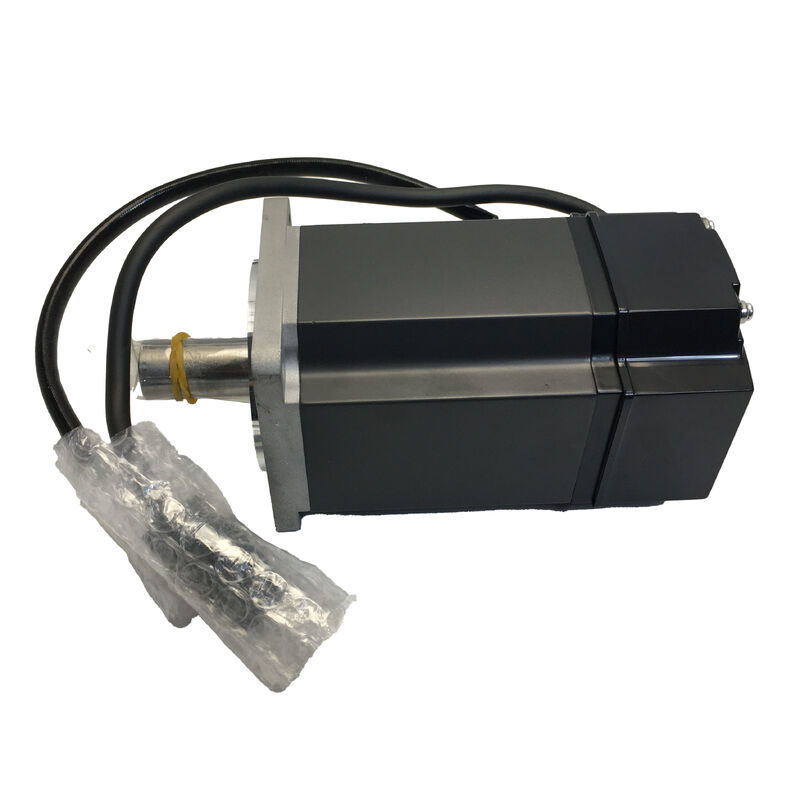
Mitsubishi HC-KFE23 AC Servo Motor
MELSERVO HC-KFE Series | 200W | 3000 RPM | Low Inertia | MR-E Amplifier Compatible
Compact Output, No Wasted Footprint
There's a class of industrial automation task where a 200W servo motor is exactly the right tool — not underpowered, not oversized. Packaging line registration. Small-axis positioning on multi-axis machines. Light-load pick-and-place. Rotary indexing on compact fixtures. The Mitsubishi HC-KFE23 was built for precisely these applications: a low-inertia, small-capacity AC brushless servo motor that delivers precise speed and position control without the bulk and cost of a larger unit.
Part of Mitsubishi's MELSERVO HC-KFE family, this motor pairs natively with the MR-E series of general-purpose servo amplifiers — an economy-class amplifier line that covers the needs of most single-axis positioning and speed control applications without requiring the advanced feature set (and added cost) of the full J2S or J3 platforms.
Technical Specifications
| Parameter |
Value |
| Rated Output |
200 W (0.2 kW) |
| Rated Speed |
3,000 RPM |
| Maximum Speed |
4,500 RPM |
| Rated Torque |
0.64 N·m |
| Peak Torque |
1.9 N·m |
| Supply Voltage |
200 VAC class |
| Motor Series |
HC-KFE (Low Inertia / Small Capacity) |
| Flange Size |
60 × 60 mm |
| Shaft Type |
Straight with Keyway |
| Protection Rating |
IP55 |
| Operating Temperature |
0°C to +40°C |
| Storage Temperature |
-15°C to +70°C |
| Compatible Amplifier Series |
MR-E |
Low Inertia — A Design Choice With Real Consequences
The "KF" designation in Mitsubishi's HC series hierarchy identifies the low-inertia, small-capacity motor class. That classification isn't just a label — it describes how the motor behaves when commanded to start, stop, and reverse direction rapidly.
Low rotor inertia means the motor responds faster to velocity and position commands. For applications with short duty cycles, frequent direction changes, or tight settling time requirements, this characteristic directly translates to throughput. A motor that takes longer to spin up and spin down limits cycle rates in ways that are difficult to compensate for at the control level. The HC-KFE23 removes that constraint for the 200W power class.
The tradeoff — as with any low-inertia motor — is sensitivity to load inertia mismatch. When the reflected load inertia significantly exceeds the rotor inertia, response can become unstable without careful gain tuning. Mitsubishi's MR-E amplifier mitigates this through real-time auto-tuning, which estimates load inertia and adjusts gains automatically during initial machine runs.
MR-E Amplifier Pairing — Practical and Purposeful
The HC-KFE series was designed specifically for use with the MR-E family of servo amplifiers. That relationship matters for a few practical reasons.
The MR-E supports position control, speed control, and torque control modes — as well as mode-switching combinations during operation. This flexibility means the same HC-KFE23 can serve as a positioning axis in one machine and a tension-control element in another, with the operating mode configured via amplifier parameters rather than hardware changes.
The MR-E also includes a built-in real-time auto-tuning function. Rather than requiring manual gain adjustment on commissioning, the amplifier observes the load behavior during initial moves and sets position gain, speed gain, and integral compensation parameters accordingly. For machine builders installing the same motor across many identical machines, this significantly shortens per-unit commissioning time.
60 mm Frame, Straight Keyway Shaft — Integration Specifics
The 60 × 60 mm flange mounting face is the dominant standard for servo motors in this power class, making the HC-KFE23 dimensionally interchangeable with other 60mm-frame motors during machine design. The straight shaft with keyway allows secure power transmission to timing pulleys, gears, and coupling hubs without relying solely on interference fit or set-screw connections — a practical advantage in applications where the shaft sees reversing loads or starts under load.
IP55 protection covers the motor body against dust ingress and low-pressure water jets from any direction. For typical indoor automation environments — including machine tool enclosures with coolant mist and food-processing equipment with periodic wash cycles — IP55 provides adequate coverage. Applications requiring deeper water protection should evaluate IP65-rated variants in Mitsubishi's lineup.
Application Areas
The HC-KFE23 turns up across a broad range of general industrial automation tasks. Based on the application categories documented in Mitsubishi's MR-E series manuals, typical deployments include:
- Conveyor and transfer systems — speed-controlled transport axes where precise velocity matters more than extreme dynamic response
- Packaging machinery — registration and indexing drives on form-fill-seal and labeling equipment
- Specialized machinery — custom-built single-axis or dual-axis systems where the MR-E's simplicity is an asset
- Test equipment — controlled actuation of test fixtures requiring repeatable positioning
- Winders and tension devices — torque-mode operation for web tension regulation
- X-Y tables and light gantries — small-load positioning in both axes simultaneously
Frequently Asked Questions
Q1: Which MR-E servo amplifiers are compatible with the HC-KFE23?
The HC-KFE23 is designed for use with the MR-E series amplifiers in the 200W class — specifically the MR-E-20A and MR-E-20AG. The "20" in the amplifier designation corresponds to the 200W power rating. Connecting to an oversized or undersized MR-E model is not recommended, as the motor parameter settings and overload protection thresholds are calibrated per power class.
Q2: How does the HC-KFE23 compare to the HC-KFS23?
Both are 200W, 3000 RPM, low-inertia motors with the same 60mm flange and rated torque. The key difference is the amplifier ecosystem each targets: the HC-KFS23 is designed for the MR-J2S series amplifiers with a 17-bit high-resolution encoder (131,072 ppr), while the HC-KFE23 pairs with the MR-E series. The MR-E platform is more economical and better suited to simpler, single-axis applications; the J2S platform offers higher performance and multi-axis capability.
Q3: Does this motor come with a keyway as standard?
Yes. Mitsubishi includes keyways with keys as standard on 200W motors in the HC series. The keyway is already machined into the straight shaft at the point of manufacture — no special ordering suffix is required for the keyed shaft variant at this power rating.
Q4: Is a holding brake version of the HC-KFE23 available?
Yes, Mitsubishi offers electromagnetic brake variants within the HC-KFE series. The brake model would carry a "B" in its part designation (e.g., HC-KFE23B). Brake motors require a separate 24 VDC power supply for the brake release circuit and have a slightly higher moment of inertia due to the added brake assembly. They are typically used on vertical axes where the load must be held in position when the drive is de-energized.
Q5: The HC-KFE23 is listed as discontinued — what are the replacement options?
The HC-KFE and MR-E product families have been phased out by Mitsubishi, succeeded by newer platforms. The recommended migration path is to the MR-JE series amplifiers paired with HG-KN or HG-SN series servo motors. The MR-JE-20A with HG-KN23 provides equivalent 200W/3000RPM capability with a 17-bit encoder and improved auto-tuning functions. For facilities maintaining existing MR-E installations, HC-KFE23 units remain available through certified surplus and refurbishment suppliers.


 Your message must be between 20-3,000 characters!