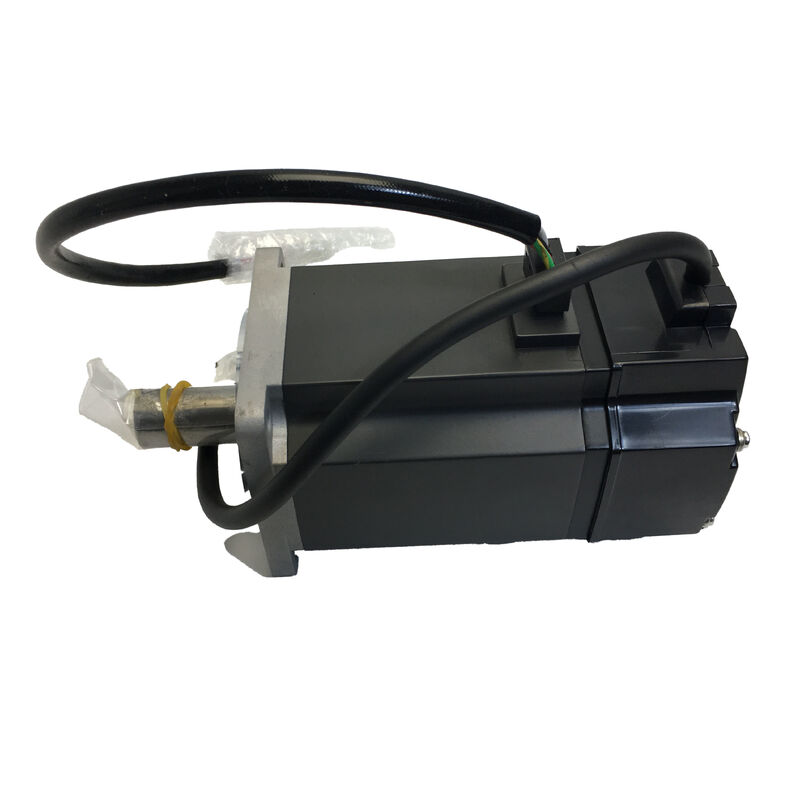
Mitsubishi Electric HC-KFE73 AC Servo Motor
750W | 2.4 Nm Rated | 3000 RPM | 10,000 ppr Incremental Encoder | MR-E-70A Compatible | 80×80mm Flange | Straight Shaft | IP55 Body | Discontinued
The Baselined Version of the Largest HC-KFE Motor
Every option that can be added to a servo motor — brake, keyway, oil seal — addresses a specific application requirement. Remove those options and what remains is the base motor: just the rotor, stator, shaft, and encoder, doing the fundamental job of converting electrical input into controlled mechanical output. That is exactly what the HC-KFE73 represents within the MELSERVO MR-E ecosystem.
At 750W and 2.4 Nm rated torque, it sits at the top of the HC-KFE series output range, paired with the MR-E-70A general-purpose servo amplifier.
There is no brake, and the shaft is straight without a keyway.
For horizontal axes where gravity loads are absent and the drive train's coupling can manage torque transmission without a positive key interlock, this configuration delivers the full 750W output of the series in its most compact and lowest-cost form — no additional sub-assemblies, no extra wiring, no 24VDC brake circuit to design.
Technical Specifications
| Parameter |
Value |
| Part Number |
HC-KFE73 |
| Series |
MELSERVO HC-KFE (MR-E compatible) |
| Rated Output Power |
750W (0.75 kW) |
| Rated Torque |
2.4 Nm |
| Peak Torque (Maximum) |
7.2 Nm |
| Peak-to-Rated Ratio |
3:1 |
| Rated Speed |
3,000 RPM |
| Maximum Speed |
4,500 RPM |
| Encoder Type |
Incremental |
| Encoder Resolution |
10,000 pulses/rev (effective) |
| Supply Voltage |
200V AC class (3-phase) |
| Flange Size |
80 × 80 mm |
| Shaft Type |
Straight (no keyway) |
| Electromagnetic Brake |
None |
| Protection Rating |
IP55 (motor body) |
| IP Exception |
Shaft-through portion and connectors NOT IP55 |
| Compatible Servo Amplifier |
MR-E-70A / MR-E-70AG |
| Operating Temperature |
0°C to +40°C |
| Storage Temperature |
−15°C to +70°C |
| Ambient Humidity |
Max 80% RH (non-condensing) |
| Maximum Altitude |
1,000 m above sea level |
| Vibration Resistance (X/Y) |
49 m/s² |
| Insulation Class |
130 (B) |
| Structure |
Totally enclosed, natural cooling |
| Country of Origin |
Japan |
| Product Status |
Discontinued |
Where the HC-KFE73 Fits: The Top of a Practical Tier
The HC-KFE series covers four output levels — 100W (HC-KFE13), 200W (HC-KFE23), 400W (HC-KFE43), and 750W (HC-KFE73). The 73 designation puts this motor at the ceiling of what the MR-E amplifier platform supports. Step higher in output and you leave the MR-E tier entirely, moving to the MR-J2S or MR-J3 amplifier families with their higher-specification absolute encoder motors.
Choosing the 750W base model rather than one of its variants (HC-KFE73K with keyway, HC-KFE73B with brake, or HC-KFE73BK with both) makes economic sense in two scenarios. The first is a horizontal axis with a rigid coupling that transmits torque reliably through friction alone, eliminating the need for a keyway. The second is any axis that is not subject to gravity loading during servo-off states — conveyor drives, horizontal feed axes, rotary tables on horizontal planes — where the electromagnetic brake serves no safety function and simply adds cost and control complexity.
In these situations, the HC-KFE73 delivers all the torque the MR-E platform can provide, with the simplest possible motor configuration.
Understanding the 2.4 Nm / 7.2 Nm Torque Split
Two torque figures appear on every HC-KFE73 specification: 2.4 Nm rated and 7.2 Nm peak. They answer different questions.
Rated torque (2.4 Nm) is the thermal ceiling — the torque level the motor can sustain indefinitely without exceeding its insulation class temperature limits. When sizing an axis, the RMS effective torque over the full duty cycle must stay at or below this value. For continuous processes like conveyor drives, fan loads, or constant-tension winding, 2.4 Nm is the number that governs selection.
Peak torque (7.2 Nm) represents a transient capability, available during acceleration and deceleration phases. It is three times the rated value — a ratio consistent across the HC-KFE family — and it is constrained by the amplifier's instantaneous current limit rather than by thermal capacity.
On a point-to-point positioning axis with a 20–30% duty cycle at rapid traverse, that 7.2 Nm peak is what drives the axis to speed quickly. It is the figure that determines cycle time on short-travel, high-frequency moves.
Mitsubishi's documentation for vertical axis applications states that unbalanced torque should be kept below 70% of rated torque (i.e., below approximately 1.68 Nm for this motor). For vertical axes approaching that limit, the brake variants are the appropriate specification — the base HC-KFE73 without brake leaves no safety holdng on de-energization.
The 80×80mm Flange and Its Place in the Series
The flange size jump from 60×60mm (used on the 400W class HC-KFE43) to 80×80mm (used on the 750W HC-KFE73) is a hard dimensional boundary. Machine mounting plates designed for the 60×60mm standard cannot accept the 80×80mm motor without machining, because the bolt hole pattern and flange register diameter both change at this transition.
Within the 80×80mm class, however, dimensional consistency is one of the practical virtues of the MELSERVO HC and HF motor family lineage.
The HC-KFE73 shares its flange footprint with the HC-KFS73 (MR-J2S compatible), HC-MFS73, and with current-generation equivalents in the HG-KR and HG-KN series.
This means a machine whose mounting plate was designed for an 80×80mm MELSERVO motor can accept the HC-KFE73 without structural modification.
The axial body length differs between standard, brake, and variant models, so rear clearance must be verified, but the flange face itself is consistent.
For maintenance planning on aging machine tools, this compatibility simplifies mechanical substitution across generations when a drive system upgrade accompanies motor replacement.
The MR-E-70A: What This Amplifier Brings to the System
The HC-KFE73's designated amplifier — the MR-E-70A — is a general-purpose pulse train servo amplifier whose simplicity is a deliberate design choice rather than a limitation. It accepts position commands as pulse trains from an external motion controller, PLC positioning module, or CNC output, and executes them against the motor's incremental encoder feedback.
No network protocols, no fieldbus configuration, no CNC-resident drive software: connect the pulse source, tune the gains, and the axis runs.
The MR-E-70AG variant accepts an analog speed command (±10V) instead of a pulse train, which suits applications where the upper-level system provides speed reference rather than position commands — tension control, winder drives, and conveyor speed regulation, for instance.
Both variants support up to seven internally stored speed settings via parameter, accessible through digital input combinations, which serves applications requiring fixed-speed operation without a continuous pulse source.
The MR-Configurator software provides gain tuning, monitoring, and the built-in real-time auto-tuning function that adapts the servo gains to the connected load automatically on first operation — a practical commissioning feature for maintenance engineers working on machines without detailed drive documentation.
IP55 Body Rating: Reading It Correctly
The IP55 rating on the HC-KFE73 body covers the motor housing surface against dust ingress and water jets from any direction, which places this motor comfortably in open machine environments, near coolant splash zones on horizontal machining centers, and in general industrial installations where periodic wash-down occurs.
Mitsubishi's catalog documentation states explicitly what the rating does not cover: the shaft-through portion and the connectors.
These two locations bypass the housing's protection. Coolant reaching the shaft seal area, or contamination at the encoder connector and motor power connector, can degrade the motor over time regardless of the housing rating.
The encoder connector is particularly sensitive — moisture or metallic contamination on the encoder signal pins produces position feedback anomalies that manifest as servo alarms before any visible connector corrosion becomes apparent.
In wet environments or installations directly exposed to coolant, either adding mechanical protection around the shaft exit point or specifying a motor variant with an oil seal is the engineering-appropriate response.
For the majority of general industrial applications, the HC-KFE73's IP55 body provides adequate environmental protection.
The Incremental Encoder and Machine Startup
The 10,000 ppr incremental encoder on the HC-KFE73 delivers position feedback that the MR-E amplifier uses for both speed and position loop closure. Unlike the absolute encoders fitted to the HC-KFS series, this encoder has no position memory through power-down events.
In practical terms, this means every time main power is restored to the machine, a reference return (homing cycle) must be completed before the CNC or motion controller accepts valid absolute position.
The motor's Z-pulse (once-per-revolution marker) provides the reference for the homing cycle, combined with the machine's limit switches or reference cams. For machines where reference return is a routine, fast operation — as it is on most CNC machining centers and standard axis configurations — this is a minor inconvenience that adds perhaps 15–30 seconds to startup time.
For machines where power interruptions are frequent or where homing cycles would be disruptive to the production process, the absolute encoder variants in the HC-KFS series (17-bit, 131,072 ppr, MR-J2S compatible) address this limitation but come with a higher system cost.
The HC-KFE73 with its incremental encoder is the correct specification when startup homing is operationally acceptable.
Frequently Asked Questions
Q1: What is the correct MR-E amplifier for the HC-KFE73, and does it support both position and speed control modes?
The HC-KFE73 pairs with the MR-E-70A or MR-E-70AG. The MR-E-70A operates in position control mode, accepting pulse train commands from an external controller. The MR-E-70AG adds an analog speed command input for speed control applications.
Both carry the "70" designation that matches the 750W motor class. Neither supports the absolute encoder interface — the MR-E series is designed exclusively for incremental encoder motors in the HC-KFE family. If absolute encoder operation is required, the motor and amplifier must both be upgraded to the MR-J2S or later series.
Q2: The HC-KFE73 has a straight shaft without a keyway. What coupling method is recommended?
For motors without a keyway, torque transmission relies entirely on the coupling's clamping force or interference fit between the coupling bore and the motor shaft. A rigid clamping-type coupling (split hub with tightening screws) is the standard choice for shaft-to-coupling connection on straight shafts.
The coupling design should also provide misalignment compensation — bellows or disc couplings are preferred — to prevent radial forces from misalignment from loading the motor's front bearing. For applications requiring positive torque interlock regardless of clamping force — high cyclic loads, frequent reversal, or elevated torque — specifying the HC-KFE73K (keyway variant) is the appropriate engineering decision.
Q3: How does the HC-KFE73 compare to the HC-KFS73 in terms of application suitability?
The two motors share identical rated and peak torque figures (2.4 Nm / 7.2 Nm), rated speed (3,000 RPM), and flange dimensions (80×80mm). The difference is in the encoder and amplifier tier.
The HC-KFE73 uses a 10,000 ppr incremental encoder and requires the MR-E-70A amplifier, while the HC-KFS73 carries a 17-bit absolute encoder (131,072 ppr) and requires the MR-J2S-70A/B series.
The HC-KFS73 eliminates homing cycles and provides higher resolution feedback, at a higher system cost. For new machine designs where absolute position retention matters, the HC-KFS73 is the better specification. For replacement in existing MR-E-based machines, the HC-KFE73 is the correct match for the installed amplifier.
Q4: Is the HC-KFE73 suitable for vertical axis applications without an electromagnetic brake?
The motor itself is mechanically capable of any mounting orientation, but the lack of a brake creates a safety consideration specific to vertical axes. When the servo amplifier is de-energized — during a controlled shutdown, an E-stop, or a power failure — a vertical axis carrying a load will drift or fall under gravity if there is no holding mechanism. The HC-KFE73 without brake provides no passive holding.
For vertical axes where the load can be held by a mechanical lock or counterbalance, or where axis travel is limited by a hard stop that catches the load on de-energization, the base motor may be acceptable.
For vertical axes where free fall during de-energization represents a safety hazard or a risk of damage to the workpiece, the HC-KFE73B (with electromagnetic brake) is the required specification.
Q5: What current-generation Mitsubishi motors can substitute for the HC-KFE73 when upgrading a machine?
The most direct mechanical substitute in current production is the HG-KR73 series (MELSERVO J4, MR-J4-70A compatible), which shares the 80×80mm flange footprint. The HG-KR73 carries a 22-bit absolute encoder (4,194,304 ppr), operates with the MR-J4-70A amplifier, and delivers the same 2.4 Nm / 7.2 Nm torque figures at 3,000 RPM.
A mechanical swap is straightforward — same flange, same bolt pattern — but the amplifier must be replaced from MR-E-70A to MR-J4-70A, encoder cables changed to MR-J3ENCBL type, and the drive system re-commissioned with servo parameters appropriate for the HG motor. In a planned upgrade context, this transition also provides absolute encoder operation, eliminating homing cycles on every startup.


 Your message must be between 20-3,000 characters!