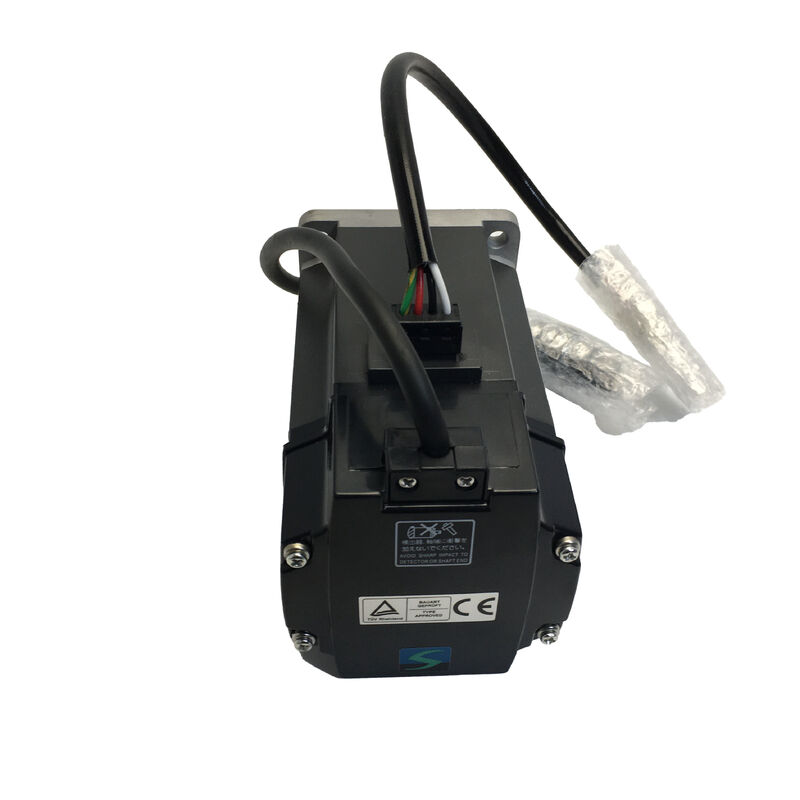
Mitsubishi Electric HC-KFE43 AC Servo Motor
400W | 1.3 Nm Rated Torque | 3000 RPM | 10,000 ppr Incremental Encoder | MR-E Series | 60×60mm Flange | IP55 Body | Discontinued
Built for Value. Designed for Precision.
There is a well-established segment of the servo motor market where high-end absolute encoder systems and the complexity that comes with them are simply unnecessary. General-purpose machinery, textile equipment, packaging lines, standard feed axes — these applications need reliable torque, stable speed control, and predictable positioning without the cost premium of multi-bit absolute feedback or the setup overhead of high-end amplifier systems. The Mitsubishi Electric HC-KFE43 was designed exactly for that space.
Part of the HC-KFE series and matched to Mitsubishi's MR-E general-purpose servo amplifier family, this 400W low-inertia AC servo motor delivers the core performance that made the MELSERVO platform a standard reference in industrial automation — clean torque delivery at 3000 RPM, a 3:1 peak-to-rated torque ratio for acceleration, and an incremental encoder accurate enough for the positioning demands of the applications it was built to serve.
Technical Specifications
| Parameter |
Value |
| Part Number |
HC-KFE43 |
| Series |
MELSERVO HC-KFE (MR-E compatible) |
| Rated Output Power |
400W (0.4 kW) |
| Rated Torque |
1.3 Nm |
| Peak Torque (Maximum) |
3.8 Nm |
| Rated Speed |
3,000 RPM |
| Maximum Speed |
4,500 RPM |
| Encoder Type |
Incremental |
| Encoder Resolution |
10,000 pulses/rev (effective) |
| Supply Voltage |
200V AC class |
| Flange Size |
60 × 60 mm |
| Shaft Type |
Straight shaft |
| Protection Rating |
IP55 (motor body) |
| IP Rating Exception |
Shaft-through portion and connectors NOT IP55 |
| Operating Temperature |
0°C to +40°C |
| Storage Temperature |
−15°C to +70°C |
| Ambient Humidity |
Max 80% RH (non-condensing) |
| Maximum Altitude |
1,000 m above sea level |
| Vibration Resistance (X/Y) |
49 m/s² |
| Compatible Servo Amplifier |
MR-E-40A / MR-E-40AG |
| Insulation Class |
130 (B) |
| Country of Origin |
Japan |
| Product Status |
Discontinued |
Where This Motor Sits in the Mitsubishi MELSERVO Lineup
Mitsubishi Electric organized its MELSERVO product generations around application tiers, and the HC-KFE series occupied the general-purpose tier — positioned below the HC-KFS (MR-J2S compatible, 17-bit absolute encoder) in encoder sophistication, but sharing the same 60×60mm flange footprint and the same 1.3Nm / 3.8Nm rated/peak torque figures at 400W output.
The HC-KFE series pairs exclusively with the MR-E servo amplifier, Mitsubishi's entry point into general-purpose servo control. For the HC-KFE43, that means the MR-E-40A (pulse train input) or MR-E-40AG (analog speed command). The MR-E amplifier accepts pulse train commands from positioning modules, PLCs, or motion controllers, making the HC-KFE43 straightforward to integrate into systems based on MELSEC Q/FX series PLCs or standalone pulse-output positioning units.
Where the HC-KFS series motor carries a 17-bit absolute encoder that retains position through power cycles, the HC-KFE43's 10,000 ppr incremental encoder reports only relative shaft movement from the last reference position. The system requires homing on power-up to establish absolute position — a well-understood constraint in general-purpose applications where the machine geometry is fixed and homing cycles are routine.
Torque Performance: The 3:1 Peak Ratio
At 400W rated output, the HC-KFE43 produces a continuous rated torque of 1.3 Nm — the value against which load sizing is performed and which the motor can sustain indefinitely within thermal limits. The peak torque rating of 3.8 Nm (approximately three times the rated figure) is available for the brief transient demands of acceleration and deceleration cycles.
That peak-to-rated ratio is the number that determines how quickly an axis can accelerate under a given load inertia. For an application where the load inertia ratio is within the MR-E's recommended ceiling (15 times motor inertia for the HC-KFE series), the 3.8 Nm peak torque is fully available to drive rapid point-to-point moves. Axes where acceleration time matters — short-travel pick-and-place, shuttles, indexers — extract real cycle time value from that headroom.
The IP55 Rating and Its Practical Limits
The HC-KFE43 carries an IP55 body rating — protection against dust ingress and water jet from any direction, covering the motor housing. This makes the motor suitable for open machine environments where incidental fluid splash and airborne particles are present.
The stated exception is important for installation planning: the shaft-through portion and connectors on the HC-KFE are not IP55. Liquids or contaminants reaching the shaft entry into the housing or the encoder/power connectors bypass the motor body's protection entirely. In applications where fluid management around the shaft is not possible, an oil seal variant (available in other HC series models) or additional mechanical sealing at the shaft should be evaluated. The encoder cable connection in particular warrants protection from contamination, as encoder signal degradation is a common failure mode in wet or dirty environments.
Mechanical Installation Notes
The 60×60mm square flange mounting is the standard profile for sub-1kW servo motors in the HC/HF/HG MELSERVO lineage — the same flange dimension that spans Mitsubishi's low-inertia 400W motors from the HC-KFE generation through the current HG-KR series. Bolt hole pattern and flange register dimensions are consistent across generations, which has made flange-to-flange mechanical replacement feasible when upgrading drive systems without modifying machine mounting plates.
The motor body housing is suitable for natural (convection) cooling — no forced cooling fan is required, and no clearance for airflow beyond the standard installation gaps is needed. Operating environment requirements follow standard industrial servo practice: indoor installation, free from corrosive or flammable gases, oil mist, and direct sunlight. Maximum installation altitude without derating is 1,000 metres above sea level.
For machine designs that apply unbalanced torque — vertical axis loads, for instance — Mitsubishi's documentation recommends keeping the unbalanced torque component below 70% of the motor's rated torque. This is a design sizing consideration rather than an operational limit.
Replacement and Upgrade Considerations
The HC-KFE43 is a discontinued product, and the MR-E amplifier with which it operates has similarly reached end-of-life status. New units are no longer available through standard Mitsubishi distribution channels; the supply market consists of remaining aftermarket stock, removed-from-service units, and refurbished inventory from industrial automation parts suppliers.
For installations planning a drive system upgrade, Mitsubishi's documented migration path from MR-E to current MELSERVO generations leads to the MR-JE series (for general-purpose applications) or MR-J4 series (for higher-performance requirements). The HG-KN series motors are the current-generation equivalent in the low-inertia 400W category — sharing the same 60×60mm flange footprint, which simplifies mechanical substitution.
Frequently Asked Questions
Q1: What is the specific MR-E amplifier model that pairs with the HC-KFE43?
The HC-KFE43 is designed for the MR-E-40A and MR-E-40AG amplifiers. The MR-E-40A accepts pulse train position commands (pulse + direction or 90° phase difference formats) from external controllers, while the MR-E-40AG adds an analog speed command input for applications where the amplifier operates in speed control mode under an upper-level controller's analog output. The suffix "40" in the amplifier designation corresponds to the 400W motor class, directly matching the HC-KFE43's rated output. Other MR-E frame sizes (10A, 20A, 70A, etc.) are not matched to the HC-KFE43 and should not be substituted.
Q2: Does the HC-KFE43 require a battery backup to retain position between power cycles?
No battery is required, but the motor also does not retain absolute position through power-down. The HC-KFE43 uses an incremental encoder, which requires a homing sequence on every power-up to establish a reference point before the control system has valid absolute position data. This differs from Mitsubishi's HC-KFS series motors with 17-bit absolute encoders, which retain position through the battery-backed encoder even after power is removed. For applications requiring power-cycle-proof position retention without homing, a motor with an absolute encoder is the appropriate selection.
Q3: Can the HC-KFE43 be substituted with a current-production Mitsubishi motor on the same mechanical mounting?
Mechanically, the 60×60mm flange footprint of the HC-KFE43 is shared with current-generation Mitsubishi low-inertia 400W motors including the HG-KR43 series. The flange dimensions allow a direct mechanical swap on the machine without modifying the mounting plate. However, the encoder interface between the HC-KFE43 (incremental, suited to MR-E) and current HG-KR series motors (22-bit absolute, suited to MR-J4) is entirely different. A mechanical-only swap while retaining the existing MR-E amplifier is not feasible; a full motor and amplifier upgrade as a matched pair is the correct approach.
Q4: What does the IP55 exception for the shaft-through portion mean in practice?
The IP55 rating covers the external motor body surface but explicitly excludes the point where the shaft exits the housing and the cable connector locations. In practice, this means that fluid contaminants reaching the shaft seal area — coolant mist, cutting fluid spray, wash-down water — can bypass the motor body's protection and enter the motor or the encoder assembly over time. In clean workshop environments this is rarely an issue. In machine tools or wet-process environments where the motor is mounted near coolant zones, proper shielding of the shaft exit point and cable connectors is essential. Some installations use protective covers or enclosure arrangements to extend effective protection at these vulnerable points.
Q5: Is the HC-KFE43 suitable for vertical axis applications?
The motor itself is mechanically capable of vertical axis use, but Mitsubishi's documentation specifies that unbalanced torque on the motor shaft should be kept below 70% of rated torque for machines with gravitational load imbalance. The base HC-KFE43 does not include an electromagnetic brake. For any vertical axis that must hold its load position when the servo amplifier is de-energized — including controlled shutdowns, emergency stops, or power interruptions — the electromagnetic brake variant (HC-KFE43B) should be specified instead of the standard motor. Relying solely on the servo amplifier's torque output to hold a vertical load when power is removed is not a safe design practice.


 Your message must be between 20-3,000 characters!