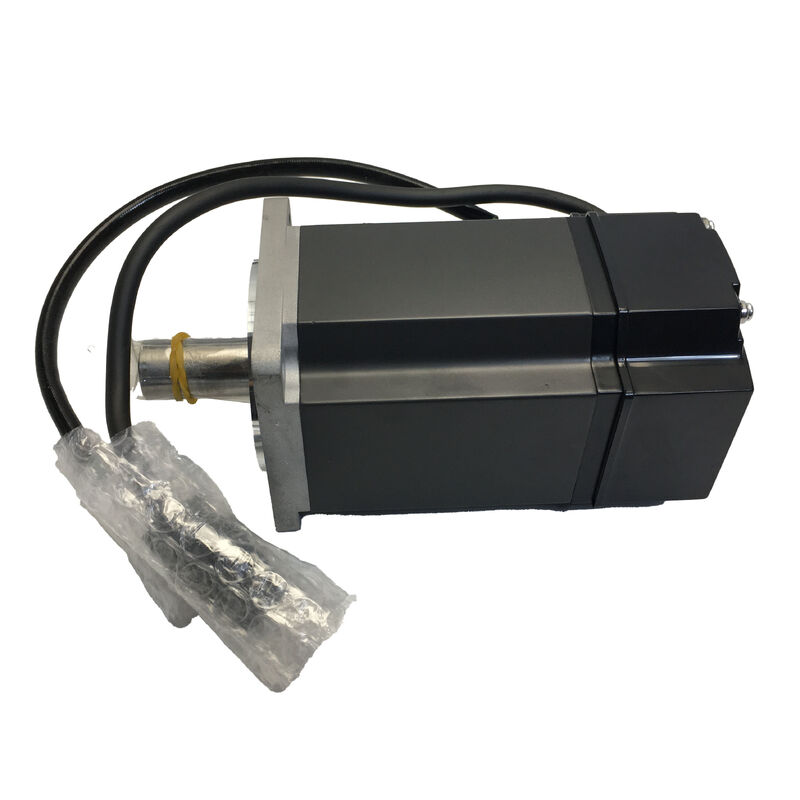
Mitsubishi HC-KFE43K Servo Motor
MELSERVO HC-KFE Series | 400W | 3000 RPM | Keyway Shaft | Low Inertia | MR-E Amplifier Compatible
Compact Power Where Space Is Tight
Not every machine axis needs a large motor. Compact automation cells, pick-and-place stations, auxiliary feed drives, and small-format CNC machines routinely call for a servo motor that delivers reliable closed-loop control in a tight package — with a shaft configuration that actually locks into the mechanical transmission rather than relying on friction alone.
The Mitsubishi HC-KFE43K fills that brief. Part of the MELSERVO HC-KFE series designed specifically for use with the MR-E family of general-purpose servo amplifiers, this 400W low-inertia servo motor carries a standard keyway shaft — the "K" suffix that distinguishes it from the plain straight-shaft HC-KFE43. At 3000 RPM rated speed, 1.3 N·m rated torque, and a 60 × 60mm flange mounting footprint, it brings accurate positioning and speed control to the space and budget constraints of general industrial automation.
Technical Specifications
| Parameter |
Value |
| Rated Output |
400 W (0.4 kW) |
| Rated Speed |
3,000 RPM |
| Maximum Speed |
4,500 RPM |
| Rated Torque |
1.3 N·m |
| Maximum Torque |
3.8 N·m |
| Rated Current |
Approx. 2.3 A |
| Maximum Current |
Approx. 6.9 A |
| Supply Voltage |
200 VAC class |
| Encoder Type |
Built-in Absolute (high-resolution feedback) |
| Motor Class |
Low Inertia / Small Capacity |
| Moment of Inertia |
0.0000460 kg·m² (0.46 kg·cm²) |
| Shaft Type |
Keyway (with key) |
| Flange Size |
60 × 60 mm |
| Protection Rating |
IP55 (note: shaft-through portion and connector are NOT IP55) |
| Operating Temperature |
0°C to +40°C |
| Storage Temperature |
–15°C to +70°C |
| Compatible Amplifier Series |
MR-E |
| Series |
MELSERVO HC-KFE (MR-E Special Motor) |
The Keyway Shaft: Why It Matters for Real Mechanical Loads
A plain smooth shaft transfers torque through interference fit, set screws, or clamping hubs — all of which rely on friction and clamping force. Under repeated reversing loads, that connection can walk over thousands of cycles, causing shaft-to-hub relative rotation, fretting wear, and positioning drift.
The keyway in the HC-KFE43K's shaft changes the torque path. A machined key sits between the shaft and the hub, creating a direct shear connection that can't slip regardless of how many times the axis reverses direction. For timing belt drives, gear hubs, and couplings in applications with frequent direction changes — packaging machinery cycle drives, indexing axes, label applicators — the keyway shaft is the mechanically appropriate choice.
Per Mitsubishi Electric's MELSERVO documentation, keyways with keys are standard on 200W and 400W motors in the HC-KFE series. The HC-KFE43K ships with the key included, ready for direct assembly into matched keyway hubs.
Low Inertia at 400W: Fast Response in a Small Package
The HC-KFE43K's moment of inertia — 0.0000460 kg·m² — is classified as low inertia within the MELSERVO HC series. This low rotor inertia translates directly into faster velocity response: the rotor accelerates and decelerates more quickly for a given torque output, shortening settling times and enabling higher cycle rates in positioning applications.
The tradeoff of low inertia, as with all servo motors in this class, is sensitivity to load inertia mismatch. When the reflected load inertia significantly exceeds the rotor inertia, the closed loop becomes harder to stabilize without careful tuning. Mitsubishi's MR-E amplifier addresses this through real-time auto-tuning, which estimates load inertia continuously during operation and adjusts control gains accordingly — reducing commissioning time and improving stability across a range of load conditions.
The 3× peak torque ratio (3.8 N·m versus 1.3 N·m rated) provides meaningful headroom for acceleration ramps and sudden load disturbances without saturating the drive.
MR-E Amplifier Series: General-Purpose, Straightforward to Commission
The HC-KFE series is specifically designated as the "MR-E special motor" — engineered for direct use with Mitsubishi's MR-E range of general-purpose servo amplifiers. This distinction matters: the HC-KFE43K is not interchangeable with HC-KFS43K (which pairs with MR-J2S amplifiers) or HC-KFS43 (also MR-J2S), even though they share identical electrical ratings.
The MR-E amplifier line supports position, speed, and torque control modes with analog and pulse-train setpoint interfaces. Its real-time auto-tuning function, gain switching capability, and simple parameter structure make it well-suited to single-axis or non-networked automation where the investment in a full J2S or J3 platform isn't justified. The MR-E-40A (general-purpose, pulse/analog interface) is the standard amplifier pairing for the HC-KFE43K in the 400W class.
Where This Motor Gets Specified
The 400W HC-KFE43K is a practical choice across the range of general industrial applications where the MR-E amplifier's simplicity and economy are valued:
- Packaging and labeling equipment — label applicator drive axes, film feed control, seal timing mechanisms
- Food and beverage processing machinery — conveyor positioning, portion control drives, dosing axis control
- Printing and converting lines — web tension auxiliary drives, nip roll control
- General-purpose CNC auxiliary axes — tool changers, rotary tables, ancillary positioning
- Assembly and test equipment — low-cycle-rate precision positioning tasks
- Textile and wire winding machines — traverse and feed axes requiring repeatable positioning
IP55 Rating and Shaft-Through Exception
The HC-KFE43K body carries an IP55 rating — protection against dust ingress and water jets from any direction under standard conditions. However, Mitsubishi Electric's documentation explicitly notes that the shaft-through portion and the connector end are NOT IP55-rated. In applications with direct coolant exposure, splash from below, or immersion risk at the shaft penetration, additional sealing measures or an oil seal variant should be considered. For most indoor automation environments this caveat has no practical consequence, but it is worth confirming for machines with wet or wash-down zones near the motor mounting.
Frequently Asked Questions
Q1: What is the difference between HC-KFE43K and HC-KFS43K?
Both motors share identical electrical specifications — 400W, 3000 RPM, 1.3 N·m rated torque, 17-bit absolute encoder, keyway shaft. The critical difference is the compatible amplifier: HC-KFE43K is designed for the MR-E series amplifiers, while HC-KFS43K is designed for MR-J2S series amplifiers. The two motor families are not interchangeable with each other's amplifiers. Using an HC-KFE motor with an MR-J2S amplifier, or vice versa, is not supported by Mitsubishi.
Q2: Does the HC-KFE43K require a homing cycle after power-up?
No. The built-in absolute encoder retains position data independently of power. When the system is powered up, the motor's current shaft position is read immediately by the MR-E amplifier without any reference return movement. This eliminates homing time at startup and ensures the machine is ready to resume operation from the exact position it was in when power was removed.
Q3: Is a brake version of the HC-KFE43K available?
Yes. The HC-KFE43BK designates the same motor with an integrated electromagnetic holding brake and keyway shaft. The brake is fail-safe (spring-engaged, released by 24 VDC) and is used on vertical axes or applications where the load must be held in position when the drive is de-energized. The BK variant has a higher moment of inertia and greater weight due to the added brake assembly.
Q4: What is the recommended inertia ratio for this motor?
Mitsubishi recommends keeping the load inertia moment to motor inertia moment ratio at 30 times or less for standard MR-E applications, though this can be extended with careful tuning. The HC-KFE43K's rotor inertia of 0.0000460 kg·m² means a load inertia of up to 0.00138 kg·m² stays within this guideline. For loads exceeding this, the MR-E's auto-tuning will attempt to compensate, but response bandwidth and settling time will degrade. If the load inertia is significantly higher, a mechanical reduction stage to improve the inertia ratio is generally more effective than aggressive gain adjustments.
Q5: Is the HC-KFE43K still in production, and how available is it?
The HC-KFE series belongs to the MR-E generation, which Mitsubishi has phased out in favor of newer platforms. The motor is now in spare parts status. However, the MR-E installed base remains large globally, and both new-old-stock and certified refurbished HC-KFE43K units continue to circulate through the industrial automation aftermarket. For facilities maintaining MR-E-based machines, sourcing replacement units is generally straightforward through specialized Mitsubishi parts suppliers.


 Your message must be between 20-3,000 characters!