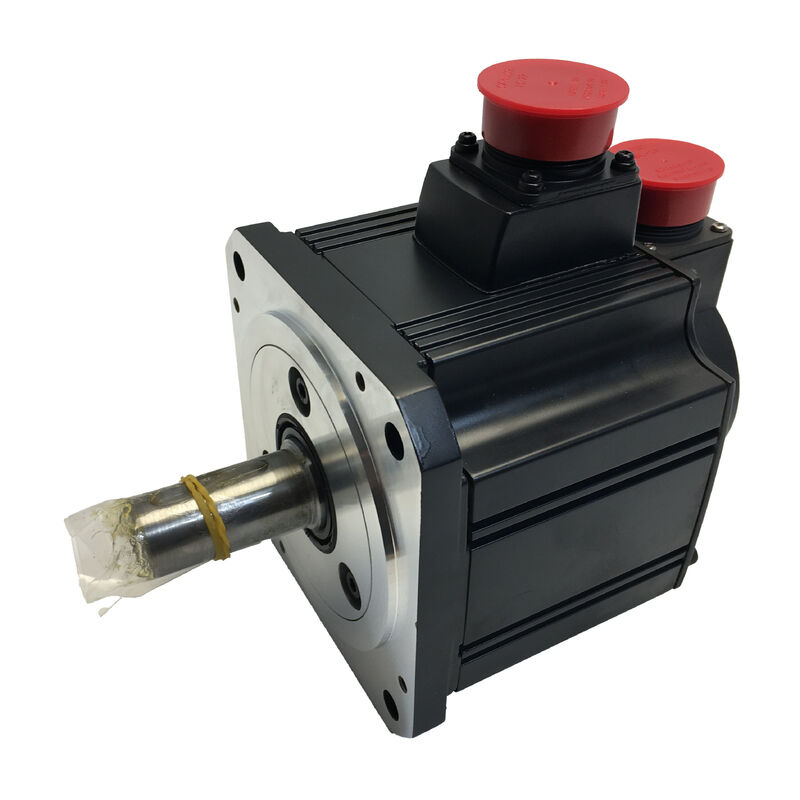
Mitsubishi HC-SFS102K AC Servo Motor
MELSERVO-J2S Series | 1 kW | 2000 RPM | Keyway Shaft | 17-Bit Absolute Encoder | IP65
When Shaft Connection Is Non-Negotiable
Not every mechanical coupling can rely on friction and interference fit alone. Timing pulleys, sprockets, gear hubs, and cams mounted to a servo shaft are typically subject to reversing torque loads — and under those conditions, a straight smooth shaft is a risk. The Mitsubishi HC-SFS102K addresses this directly with a machined keyway shaft, providing a positive mechanical lock between the motor shaft and any driven component fitted with a matching keyway seat.
Beyond the shaft configuration, the HC-SFS102K is identical in specification to the standard HC-SFS102: a 1 kW, 2000 RPM AC brushless servo motor from the MELSERVO-J2S family, carrying a 17-bit absolute encoder and IP65 environmental protection. It's the same proven mid-range motor — with the shaft geometry that belt-driven, gear-driven, and chain-driven applications actually need.
Technical Specifications
| Parameter |
Value |
| Rated Output |
1,000 W (1 kW) |
| Rated Speed |
2,000 RPM |
| Maximum Speed |
3,000 RPM |
| Instantaneous Max Speed |
3,450 RPM |
| Rated Torque |
4.78 N·m |
| Peak Torque |
14.4 N·m |
| Rated Current |
6.0 A |
| Maximum Current |
18.0 A |
| Operating Voltage |
123 V (200 VAC class supply) |
| Encoder Type |
Absolute, 17-bit |
| Encoder Resolution |
131,072 ppr |
| Shaft Type |
Keyway (open slot) |
| Electromagnetic Brake |
None |
| Oil Seal |
Included |
| Flange Size |
130 × 130 mm |
| Protection Rating |
IP65 |
| Insulation Class |
Class F |
| Weight |
Approx. 7.4 kg |
| Series |
MELSERVO-J2S, HC-SFS (Medium Inertia / Medium Capacity) |
The Case for a Keyway Shaft in Servo Applications
A keyway might look like a simple machined slot, but its effect on system reliability is significant. Without a key, power transmission from a servo shaft to a pulley or hub depends entirely on the clamping force of a taper lock, hub set screw, or press fit. When the load reverses — as it does in virtually every servo-controlled axis — that clamping force must oppose the inertial shock of the direction change. Over time, or in the event of an E-stop deceleration, the connection can slip or fretting wear can develop at the interface.
A keyway and key turn that reliance on friction into a direct shear path. The mechanical connection is positive: the key physically prevents relative rotation between shaft and hub. For machines where the servo axis drives a timing belt, a gear stage, or a chain sprocket, the HC-SFS102K's keyway shaft is the specification choice that eliminates a category of potential failure.
Mitsubishi's servo motor instruction manual specifically documents correct keyway assembly procedure: a double-end stud inserted into the shaft end screw hole, with a washer and nut to press the component onto the shaft axially. This prevents the hammer impact on the shaft end that would otherwise damage the built-in encoder.
17-Bit Absolute Encoder — Resolving Down to 0.00274°
At 131,072 positions per revolution, the built-in absolute encoder divides each shaft rotation into steps of approximately 0.00274°. The practical benefit shows up most clearly at low speeds, where a coarser encoder produces visible torque ripple as the control loop steps through discrete count increments. The HC-SFS102K's encoder resolution is high enough that this effect becomes imperceptible across the motor's entire operating speed range.
The absolute nature of the encoder matters for a different reason: position is retained through power cycles. There's no reference return, no homing sequence, no dependency on the motor having remained stationary during a power interruption. The amplifier reads the exact shaft position the moment the system comes online, regardless of what happened while it was off. For machines that cycle power frequently or that need to resume precise positioning after an emergency stop, this is a practical operational advantage rather than a theoretical one.
Compatible Servo Amplifiers
The HC-SFS102K is designed for pairing with 1 kW class MR-J2S amplifiers. Verified compatible models from Mitsubishi's MELSERVO-J2-Super catalog include:
| Amplifier |
Interface / Application |
| MR-J2S-100A |
General-purpose — analog/pulse command |
| MR-J2S-100B |
SSCNET serial bus — multi-axis coordination |
| MR-J2S-100CP |
CC-Link network — PLC-integrated systems |
| MR-J2S-100CL |
CC-Link with linear encoder input |
The MR-J2S-100A supports position, speed, and torque control modes independently, as well as mixed-mode operation during a cycle — position/speed switching, speed/torque switching, torque/position switching — making it the most versatile option for machines that need to change control strategy between phases of operation. The MR-J2S-100B is the right choice wherever multiple axes must move with tight synchronization over SSCNET.
Wiring follows the standard MELSERVO arrangement: motor power to U, V, W terminals; encoder feedback cable to the CN2 connector. No additional interface hardware or parameter file changes are required specifically because of the keyway shaft variant.
Where This Motor Gets Specified
The HC-SFS102K turns up in any application that combines 1 kW servo power with belt or gear power transmission. Documented application areas in the MELSERVO-J2S catalog include:
- Conveyor and transfer machinery — timing belt-driven indexing conveyors where the keyway ensures reliable registration under reversing start-stop cycles
- Industrial robots — arm joint drives where the keyway hub prevents slippage under the high-cycle dynamic loads typical of pick-and-place operations
- X-Y positioning tables — axes using timing belt or ballscrew transmission with belt-drive pulley attachment
- Turret and indexing heads — rotary positioning mechanisms where load changes direction with each index step
- Winders and tension control — spool drives where torque reversal during tension regulation would work against a friction-only shaft fit
- Specialized machinery and test equipment — custom mechanisms where coupling geometry makes a keyed shaft the practical installation choice
Load Inertia: The One Parameter Worth Checking Before Commissioning
Mitsubishi's MELSERVO-J2S documentation recommends keeping the ratio of load inertia moment to motor inertia moment at 15 times or less for stable closed-loop performance. For a medium-inertia motor like the HC-SFS102K, this leaves reasonable room for most typical mechanical loads — but it's worth calculating before commissioning, particularly when the motor is driving a high-inertia load through a 1:1 direct coupling.
When the inertia ratio exceeds the guideline, the MR-J2S-100A's real-time auto-tuning function will still attempt to adapt — but response bandwidth and settling time will degrade. Adding a mechanical reduction stage to increase the effective inertia ratio is often a more reliable fix than gain adjustments alone.
Frequently Asked Questions
Q1: What exactly is the difference between the HC-SFS102K and the standard HC-SFS102?
The only difference is the shaft configuration. The HC-SFS102 has a smooth straight shaft with no keyway. The HC-SFS102K has the same shaft diameter and length but includes a machined keyway slot with a key. All electrical specifications — power, speed, torque, encoder, amplifier compatibility — are identical between the two variants.
Q2: Does the keyway shaft affect maximum permissible radial load?
No. The permissible radial and axial shaft loads are determined by bearing capacity and shaft cross-section geometry, which are the same in both the straight and keyway variants. The keyway does not reduce the shaft's load-carrying capacity in the MELSERVO HC-SFS series. Check the servo motor instruction manual's shaft loading table for the specific values applicable to the HC-SFS102 shaft dimensions.
Q3: Is there a brake version of the HC-SFS102K available?
Yes. The HC-SFS102BK designates the equivalent motor with both a keyway shaft and a built-in fail-safe electromagnetic brake. The brake is spring-engaged and releases when 24 VDC is applied — it holds the axis in position when the drive is de-energized, which is necessary for vertical axes and some safety-critical installations. The BK variant has a higher moment of inertia and greater weight due to the added brake assembly.
Q4: Can the HC-SFS102K be used with newer Mitsubishi amplifier families like MR-J4?
The HC-SFS series belongs to the MR-J2S generation. Direct compatibility with MR-J4 amplifiers is not standard — the encoder interface and communication protocol differ. Mitsubishi does offer conversion tools (the MR-J2S-B renewal tools) that allow MR-J4-B-RJ020 amplifiers to drive HC series motors using existing wiring, which is the recommended upgrade path for facilities that want to retain their HC motors while moving to newer drive hardware. Confirm software version requirements with Mitsubishi before attempting this combination.
Q5: The HC-SFS102K is listed as discontinued — is it still available?
Mitsubishi has phased out the MELSERVO-J2S series through official production channels, but the HC-SFS102K remains widely available from certified surplus and exchange-refurbishment suppliers. The installed base of J2S-era machines continues to create steady demand, so supply availability is generally reliable. For facilities maintaining multiple machines with this motor, holding one spare unit reduces the risk of unplanned downtime during sourcing delays.


 Your message must be between 20-3,000 characters!