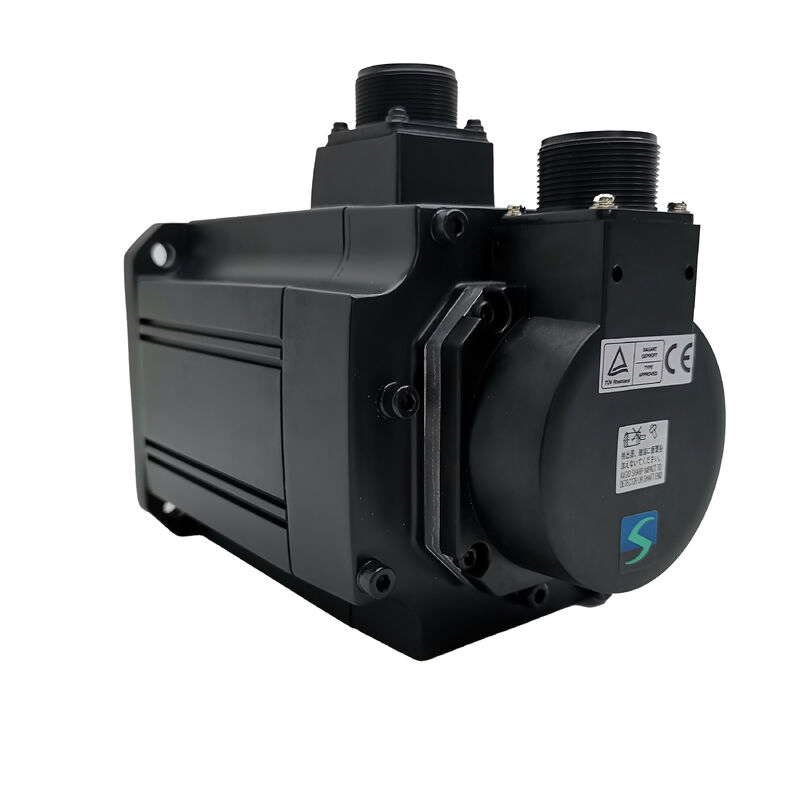
Mitsubishi HC-SFS352 AC Servo Motor
MELSERVO-J2S Series | 3.5 kW | 2000 RPM | 17-Bit Absolute Encoder | IP65
Medium Inertia, Maximum Dependability
In motion control, matching the right motor to the right load is as important as raw output power. The Mitsubishi HC-SFS352 sits in a practical sweet spot: medium inertia, medium capacity, designed for the class of applications where consistent torque delivery and high-resolution feedback matter more than chasing peak speed numbers.
Part of Mitsubishi's MELSERVO HC-SFS series, this 3.5 kW AC brushless servo motor carries a 17-bit built-in absolute encoder — equivalent to 131,072 pulses per revolution — and pairs with the MR-J2S family of servo amplifiers for a closed-loop system that Mitsubishi has engineered and validated as a matched unit. It doesn't need to be home-referenced at startup. It doesn't lose position in a power interruption. It gets to work the moment the system powers on.
Technical Specifications
| Parameter |
Value |
| Rated Output |
3,500 W (3.5 kW) |
| Rated Speed |
2,000 RPM |
| Maximum Speed |
2,500 RPM |
| Instantaneous Maximum Speed |
2,875 RPM |
| Rated Torque |
16.7 N·m (2,364.7 oz·in) |
| Peak Torque |
50.1 N·m (7,094.2 oz·in) |
| Rated Current |
17.0 A |
| Peak Current |
51.0 A |
| Supply Voltage |
200 VAC class (146 V output) |
| Encoder Type |
Built-in Absolute, 17-bit |
| Encoder Resolution |
131,072 ppr |
| Moment of Inertia |
82.0 × 10⁻⁴ kg·m² |
| Flange Size |
176 × 176 mm |
| Shaft Type |
Straight (standard) |
| Oil Seal |
Included |
| Protection Rating |
IP65 |
| Operating Temperature |
0°C to +40°C |
| Weight |
Approx. 19 kg (41.9 lbs) |
| Series |
MELSERVO-J2S |
17-Bit Absolute Encoder — Where the Real Value Lies
Plenty of servo motors quote resolution figures. What sets the HC-SFS352 apart is that its 131,072 ppr encoder is absolute — not incremental. The distinction shows up most clearly in two situations: power cycling and fault recovery.
With an incremental encoder, every controlled restart requires a reference return cycle. Axes must travel back to their home positions before normal operation can resume. On a production line that cycles frequently, or on a machine that recovers from an E-stop multiple times per shift, those seconds accumulate fast. The absolute encoder on the HC-SFS352 eliminates the need entirely. Power it up, and the control system reads the current position immediately — wherever the axis happens to be sitting.
The 17-bit depth also translates into noticeably smooth motion at low speeds, where coarser encoders tend to introduce micro-jitter that shows up as surface finish variation in machining and registration errors in printing or labeling.
Torque That's Built for Real Cycles, Not Just Spec Sheets
The rated torque of 16.7 N·m gives this motor genuine muscle for the 3.5 kW class. More useful in practice is the peak torque figure: 50.1 N·m, exactly three times the rated value. That 3:1 ratio means the motor handles aggressive acceleration ramps and sudden load changes without saturating — which matters in applications with high-inertia loads or short duty cycles that demand repeated hard starts.
The peak current capacity follows the same logic: rated at 17 A, the HC-SFS352 can sustain 51 A momentarily, giving the drive amplifier room to deliver the current burst needed for fast torque response without triggering overcurrent protection under normal dynamic conditions.
IP65 and an Oil Seal — Not Optional in This Environment
The HC-SFS352 ships with both IP65 ingress protection and a built-in oil seal on the shaft penetration. For a motor this size — likely installed near spindles, ballscrews, or hydraulic equipment — these aren't luxury features. Coolant mist, gear oil splash, and fine metallic particles are routine in the environments where a 3.5 kW servo typically works. The IP65 rating blocks dust completely and protects against water jets; the oil seal adds a second barrier specifically at the shaft, where fluid tends to follow a rotating surface into the bearing cavity.
Compatible Servo Amplifiers
The HC-SFS352 is designed for direct pairing with four MELSERVO MR-J2S amplifiers:
| Amplifier |
Type |
| MR-J2S-350A |
General-purpose (analog/pulse command) |
| MR-J2S-350B |
SSCNET network type |
| MR-J2S-350CP |
CC-Link network type |
| MR-J2S-350CL |
CC-Link network type (with linear encoder) |
The MR-J2S-350A supports position, speed, and torque control modes — as well as mixed-mode operation such as position/speed switching and speed/torque switching — making it the most flexible choice for machine builders. The MR-J2S-350B suits multi-axis SSCNET architectures where synchronization between axes is critical.
Connection follows the standard MELSERVO wiring scheme: motor power to U, V, W terminals on the amplifier face; encoder cable to the CN2 port. No additional interface hardware is required.
Where This Motor Gets Specified
The HC-SFS352 appears across a wide range of mid-power industrial automation tasks. Common applications drawn from the MR-J2S application manual and field use include:
- Machine tool feed axes — X, Y, Z positioning on milling centers and turning centers
- Industrial robots — shoulder and elbow joint drives where medium inertia characteristics simplify tuning
- Precision assembly equipment — pick-and-place and indexing stations with demanding cycle rates
- Line control and tension control — web tension regulation in printing, converting, and packaging
- General multi-axis positioning — any application pairing this motor with MELSERVO amplifiers in a coordinated motion system
Frequently Asked Questions
Q1: Does the HC-SFS352 require a homing cycle after power-on?
No. The built-in 17-bit absolute encoder retains position data even when power is removed. When the system powers up, the current shaft position is read directly and transferred to the servo amplifier — no reference return travel is needed.
Q2: Which servo amplifier is recommended for multi-axis synchronized motion?
For multi-axis systems where tight synchronization between axes is required, the MR-J2S-350B is the right choice. It connects over SSCNET (Servo System Controller Network), Mitsubishi's dedicated high-speed serial bus, which delivers position commands and encoder feedback with deterministic timing across all connected axes.
Q3: Is the HC-SFS352B (brake version) compatible with the same amplifiers?
Yes, the brake variant shares the same electrical specifications and amplifier compatibility. The main differences are weight — approximately 25 kg versus 19 kg for the standard model — and a slightly higher moment of inertia due to the added brake assembly. The brake is a 24 VDC fail-safe type, intended for holding vertical axes in position when the drive is de-energized.
Q4: The motor is listed as discontinued — can replacement units still be sourced?
Mitsubishi has phased out the HC-SFS352 through its standard production channels, but the motor remains widely available through certified surplus and refurbished part suppliers. Given the large installed base of MELSERVO-J2S systems still in active service, supply availability is generally reliable. For facilities maintaining multiple machines with this motor, holding at least one spare is a sensible maintenance strategy.
Q5: What is the significance of the "medium inertia" classification for this motor?
Inertia class affects how naturally the motor's own rotor inertia matches the reflected load inertia from the connected mechanism. Medium inertia motors like the HC-SFS352 are suited to loads with moderate reflected inertia — ballscrew-driven linear axes, moderate-mass robot links, indexing tables. If the load inertia ratio is too high relative to the motor, response bandwidth drops and tuning becomes difficult. Mitsubishi's MR-J2S manual provides inertia ratio guidelines for the specific application type; staying within those bounds is the most direct path to stable, well-damped servo response.


 Your message must be between 20-3,000 characters!