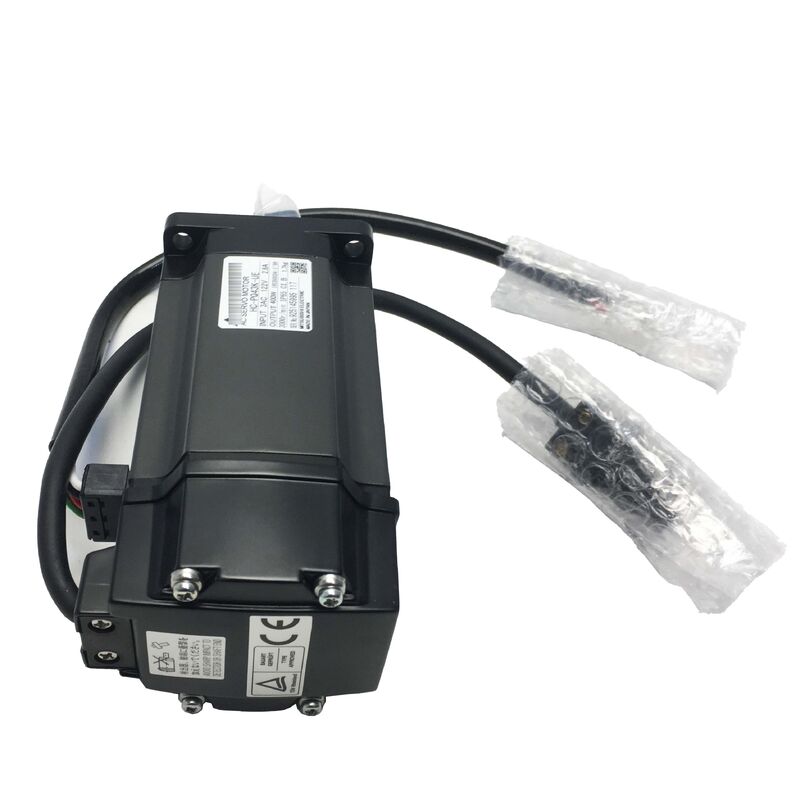
Mitsubishi HC-PQ43B (HCPQ43B) — 400W AC Servo Motor with Electromagnetic Brake, Straight Shaft, 3000 rpm, MELSERVO-C Series
Product Overview
Part Number: HC-PQ43B
Also Searched As: HCPQ43B, HC PQ 43B, HC-PQ-43B
Series: Mitsubishi MELSERVO-C (MR-C Generation)
Classification: Ultra-Low Inertia AC Brushless Servo Motor — 400 W, 200V class, 3000 rpm, Straight Shaft, Electromagnetic Brake
Context: A Different Kind of Servo Motor
Most of the servo motors on this site belong to the HC-SF, HC-SFS, or HA-FF families — motors designed around the J2 or J2-Super amplifier platform for general industrial automation, machine tools, and positioning equipment. The HC-PQ43B comes from a different branch of Mitsubishi's MELSERVO history entirely.
The HC-PQ series was developed as part of the MELSERVO-C platform, introduced in 1999 with a specific mission: offer a genuine servo alternative to customers using stepper motors in small-capacity applications up to 400W. The MR-C amplifier that drives it is extraordinarily compact — just 40mm wide and 130mm tall — and the HC-PQ motors were designed to match that philosophy. Ultra-low inertia, simple wiring with lead-wire pigtail connections, a straightforward control interface, and a price and complexity level that made the step from stepper to servo practical for machines that had never used brushless servo technology before.
The HC-PQ43B is the braked variant of the 400W HC-PQ motor: same 1.3 Nm rated torque, same 3.8 Nm peak, same 3000 rpm rating, same compact IP44-rated housing — with a spring-applied electromagnetic brake added to the motor rear for vertical axis and gravity-loaded mechanism applications.
Technical Specifications
| Parameter |
Value |
| Part Number |
HC-PQ43B |
| Rated Output |
400 W |
| Supply Voltage |
200V class (1-phase 200–240V AC via MR-C40A) |
| Rated Speed |
3,000 rpm |
| Rated Torque |
1.3 Nm |
| Peak Torque |
3.8 Nm |
| Rated Current |
2.8 A |
| Encoder Type |
Incremental serial encoder |
| Inertia Class |
Ultra-low inertia |
| Shaft Type |
Straight (keyway standard on 400W models) |
| Electromagnetic Brake |
Spring-applied, 24V DC release |
| Protection Rating |
IP44 |
| Ambient Temperature (Operation) |
0°C to +40°C |
| Compatible Amplifier |
MR-C40A |
| Brake Power Supply |
Separate 24V DC required |
| Series Generation |
MELSERVO-C |
| Status |
Discontinued (April 2013) — available as surplus stock |
What the MR-C Platform Was Designed to Do
Understanding the HC-PQ43B properly requires understanding the platform it belongs to, because the MR-C and HC-PQ combination served a market segment that the larger J2 and J2-Super platforms were not optimised for.
Stepper motors dominated small-capacity positioning applications for decades because they were simple, inexpensive, and needed no feedback device. Open-loop pulse control was enough for most applications, and the control electronics were straightforward. The weaknesses — resonance at certain speeds, loss of position under overload, poor performance at high speed, no torque feedback — were accepted as inherent limitations of the technology.
The MR-C platform's proposition was that a servo motor could match the simplicity of stepper control while eliminating those limitations. The MR-C amplifier accepted pulse-train commands just like a stepper driver. The HC-PQ motors had lead-wire pigtail connections rather than military-spec round connectors. The amplifier was narrow enough to mount on a standard DIN rail in a compact panel. Commissioning was straightforward enough for engineers accustomed to stepper systems.
For the machine types this platform targeted — small assembly equipment, label applicators, compact pick-and-place mechanisms, light positioning tables, auxiliary axes on printing and packaging machines — the MR-C and HC-PQ combination provided closed-loop servo performance in a format that required no re-education of either the design team or the maintenance staff.
The HC-PQ43B adds a spring-applied brake to this platform for the applications within that machine category that have vertical axes or other gravity-loaded components.
Spring-Applied Brake on a 400W Motor
At 400W and 1.3 Nm rated torque, the loads the HC-PQ43B drives are light compared to medium-capacity servo motors. A small vertical transfer slide. A lightweight robot arm joint. A drill head quill drive on a small automatic drilling machine. A vertical shuttle on a compact assembly station. These mechanisms are modest in scale, but the physics of a spring-applied brake apply at any power level: when the coil is de-energised, the spring closes the brake and holds the axis mechanically, without depending on any active electrical system to do so.
The practical consequence is the same at 400W as at 7kW: if panel power is cut unexpectedly, if the amplifier trips, if the E-stop circuit opens — the axis holds. The 24V DC supply to the brake coil is removed and the spring immediately does its job. On a small vertical mechanism where the moving mass might be only a few kilograms, this is still the correct design choice. The alternative — relying on servo lock from the MR-C40A amplifier to hold position when the amplifier may be the component that has just tripped — is not a reliable safety basis.
The brake on the HC-PQ43B requires a separate 24V DC power supply in the machine panel. This is explicitly stated in the MR-C series documentation: motors with brakes require their own 24V DC supply, separate from the amplifier's control power. The 24V circuit must include a relay with appropriate surge suppression across the brake coil terminals — an inductive coil without suppression will generate damaging voltage spikes when de-energised.
The recommended operating sequence follows the same principle as any spring-applied brake on a servo motor: bring the axis to rest under servo control before engaging the brake, and confirm servo lock is established before releasing the brake on startup. On a small compact machine where these axes complete many cycles per shift, consistent sequencing extends brake disc service life measurably over the motor's operational lifetime.
1.3 Nm Rated Torque: The Ultra-Low Inertia Advantage
One Newton-metre and three tenths. That is a modest continuous torque figure by any measure, and it accurately describes what the HC-PQ43B is: a motor for light, fast axes where the premium is on acceleration performance rather than sustained force.
Ultra-low inertia motors achieve their primary value through the ratio of available torque to rotor inertia. A very low rotor inertia means that a given torque — including the 3.8 Nm peak — produces very high angular acceleration of the motor shaft itself. The axis reaches target speed quickly, settles to position quickly, and is ready for the next move quickly. For applications running many short moves per minute, this translates directly into throughput.
The 3.8 Nm peak — nearly three times the continuous rating — handles the acceleration and deceleration phases efficiently. In the typical duty cycle of a light assembly machine axis, the motor accelerates to traverse speed at peak torque, runs briefly at or below rated torque, decelerates at peak torque, then dwells at position consuming minimal current. This pattern is thermally benign and the 400W amplifier's protection functions manage it without intervention under a well-designed duty cycle.
The constraint is clear: 1.3 Nm continuous is the ceiling for sustained load torque. Applications where the axis must maintain more than 1.3 Nm continuously — sustained cutting resistance, heavy winding tension, significant gravitational load during motion — are beyond this motor's appropriate application range. Axes that spend most of their cycle time at rest or lightly loaded with only brief acceleration transients are where the HC-PQ43B performs best.
IP44: Understanding the Protection Rating
The IP44 protection rating on the HC-PQ43B is lower than the IP65 found on HC-SFS and HC-SF series motors, and that difference is worth understanding before specifying this motor.
IP44 means: solid particle protection against objects greater than 1mm (fine tools, wires, small insects — but not dust in volume), and liquid protection against water splashed from any direction. This is adequate for indoor industrial environments where the motor is not directly exposed to coolant spray, oil mist, or wash-down operations.
IP65 (the rating on HC-SFS and similar motors) adds complete dust ingress protection and protection against directed water jets from any angle.
For the applications the HC-PQ43B was designed for — assembly machines, light automation equipment, compact positioning axes indoors — IP44 is generally sufficient. The motor is not designed for machine tool cutting environments where coolant reaches the motor, nor for wash-down food or pharmaceutical equipment. If the installation environment includes significant coolant, oil mist, or airborne contamination from processing operations, a higher-rated motor should be specified.
When installing the HC-PQ43B with the cable exits downward — which is the preferred mounting orientation for horizontal motor installations — the lead wires and any condensation drains away from the motor body rather than pooling at the cable entry points. The MR-C documentation recommends against mounting the motor with cables routed upward in environments where liquid ingress along the cable jacket is a possibility.
Compatible Amplifier: The MR-C40A
The HC-PQ43B pairs exclusively with the MR-C40A amplifier — the 400W capacity unit from the MELSERVO-C range. This amplifier has a set of characteristics that distinguish it sharply from the J2 and J2-Super amplifiers the HC-SFS and HC-SF series motors use.
The MR-C40A accepts single-phase 200–240V AC input, drawing approximately 2.8A. This is a single-phase supply, not three-phase — meaning the MR-C platform can operate from a standard 200V single-phase circuit, simplifying panel wiring for small machines that do not have three-phase distribution to every axis position.
The amplifier accepts pulse-train position commands — the same interface used by stepper motor drivers — which was central to the platform's positioning as a stepper replacement. The encoder resolution and control performance are servo-class, but the control interface is stepper-compatible, making it straightforward to integrate into existing machine designs that were previously stepper-based.
The MR-C40A is only 40mm wide. On a machine with several small servo axes, a row of MR-C40A amplifiers requires significantly less panel space than an equivalent row of J2-Super amplifiers at the same power rating.
Both the MR-C40A amplifier and the HC-PQ series motors were discontinued in April 2013. Mitsubishi's migration recommendation at that time pointed users toward the MR-JN amplifier with HF-KN or HF-KP series motors — the next-generation compact servo platform at this power level. For machines still in service on MR-C hardware, replacement MR-C40A amplifiers and HC-PQ43B motors remain available as surplus stock.
HC-PQ Series Capacity Overview
| Model |
Output |
Rated Torque |
Peak Torque |
Brake |
| HC-PQ13 |
100 W |
0.32 Nm |
0.95 Nm |
No |
| HC-PQ13B |
100 W |
0.32 Nm |
0.95 Nm |
Yes |
| HC-PQ23 |
200 W |
0.64 Nm |
1.9 Nm |
No |
| HC-PQ23B |
200 W |
0.64 Nm |
1.9 Nm |
Yes |
| HC-PQ43 |
400 W |
1.3 Nm |
3.8 Nm |
No |
| HC-PQ43B |
400 W |
1.3 Nm |
3.8 Nm |
Yes |
The HC-PQ43B is the highest-capacity braked motor in the HC-PQ range and the top of the MR-C platform. Within the 400W capacity, the HC-PQ43 (no brake) and HC-PQ43B (brake) are identical in all electrical and dynamic specifications — the choice between them is made purely by whether the axis requires mechanical holding at rest.
Typical Applications
Vertical Z-axis on small assembly and drilling machines. Small automatic drilling machines, benchtop assembly stations, and compact CNC equipment with light vertical travel axes. The load masses are modest — a small spindle head, a tool holder, a lightweight fixture — but the spring-applied brake provides reliable mechanical holding during tool changes, E-stops, and machine-off periods without depending on servo lock.
Vertical robot arm joint drives. Lightweight SCARA robot second-arm axes, vertical travel components on Cartesian robots, and small articulated robot joint drives on assembly and handling equipment where the joint carries a gravitational load component and brake holding is required when servo power is removed.
Label applicator and print-and-apply vertical feed axes. Vertical product positioning and applicator arm drives on label application equipment where the applicator head must hold position at a defined height during dwell periods. The compact MR-C platform suits the tight space constraints of label application machinery.
Small vertical transfer and lift stations. Part lift mechanisms, small elevator axes, and vertical transfer slides on compact assembly cells and test equipment where light payloads must be held at intermediate positions during station dwell operations. The absolute simplicity of the MR-C control interface matches the straightforward logic typically used to manage these axes.
Stepper motor replacement on legacy vertical axes. Existing machines using stepper motors on vertical axes where position loss under overload or resonance-induced missteps have caused production problems. The HC-PQ43B provides closed-loop servo position control with the same pulse-train command interface as the original stepper driver, eliminating open-loop position loss while the spring-applied brake adds the holding safety that stepper hold torque provides only while the driver is energised.
Frequently Asked Questions
Q1: Which amplifier is compatible with the HC-PQ43B, and what type of power supply does it need?
The HC-PQ43B pairs exclusively with the MR-C40A amplifier. The MR-C40A accepts single-phase 200–240V AC input — not three-phase — making it suitable for small machines without three-phase distribution to each axis position. The amplifier is only 40mm wide and accepts pulse-train position commands, the same interface used by stepper motor drivers. Both the MR-C40A and HC-PQ43B are discontinued but remain available as surplus stock.
Q2: What is the difference between the HC-PQ43B and the HC-PQ43?
The two motors are identical in all electrical and performance specifications — 400W output, 1.3 Nm rated torque, 3.8 Nm peak, 3000 rpm rated speed. The only difference is the brake. The HC-PQ43 has no brake — position at rest is maintained by amplifier servo lock. The HC-PQ43B has a spring-applied electromagnetic brake that engages mechanically when the 24V coil supply is removed. Use the HC-PQ43B on vertical axes, inclined drives, and any application where the load would move at servo-off. The HC-PQ43 is correct for horizontal axes where servo lock is adequate.
Q3: The HC-PQ43B carries an IP44 rating. Is this sufficient for machine tool environments?
IP44 provides protection against solid objects larger than 1mm and water splashed from any direction. It is adequate for enclosed indoor environments without significant coolant exposure. It is not appropriate for machine tool cutting environments where coolant spray, oil mist, or coolant jets reach the motor. For such environments, a motor with IP65 or higher rating — such as motors from the HC-SFS or HC-SF series — is required. The HC-PQ series was designed for assembly machines, handling equipment, and light automation, not for the cutting zone of CNC machine tools.
Q4: Does the brake on the HC-PQ43B require a special power supply circuit?
Yes. Mitsubishi's MR-C documentation explicitly states that motors with brakes require a separate 24V DC power supply — separate from the amplifier's control power. The 24V circuit must include a relay to switch the coil current, with surge suppression (a flyback diode for DC circuits) across the brake coil terminals to absorb the inductive voltage spike when the relay opens. Without surge suppression, relay contacts are vulnerable to arc damage, and the resulting electrical noise can affect the amplifier and controller.
Q5: The HC-PQ43B and MR-C40A are discontinued. What is Mitsubishi's recommended migration path?
Mitsubishi's official migration recommendation at discontinuation was to move to the MR-JN amplifier series with HF-KN or HF-KP series servo motors at equivalent capacity. The HF-KP43B (400W, 3000 rpm, spring-applied brake) on an MR-JN-40 amplifier is the functional equivalent at the next generation level, offering higher encoder resolution and improved servo performance in a similarly compact form factor. Both motor and amplifier must be replaced together, as the encoder protocols are incompatible between generations. For machines that must remain on MR-C hardware, replacement HC-PQ43B motors and MR-C40A amplifiers are available through industrial automation surplus specialists.


 Your message must be between 20-3,000 characters!