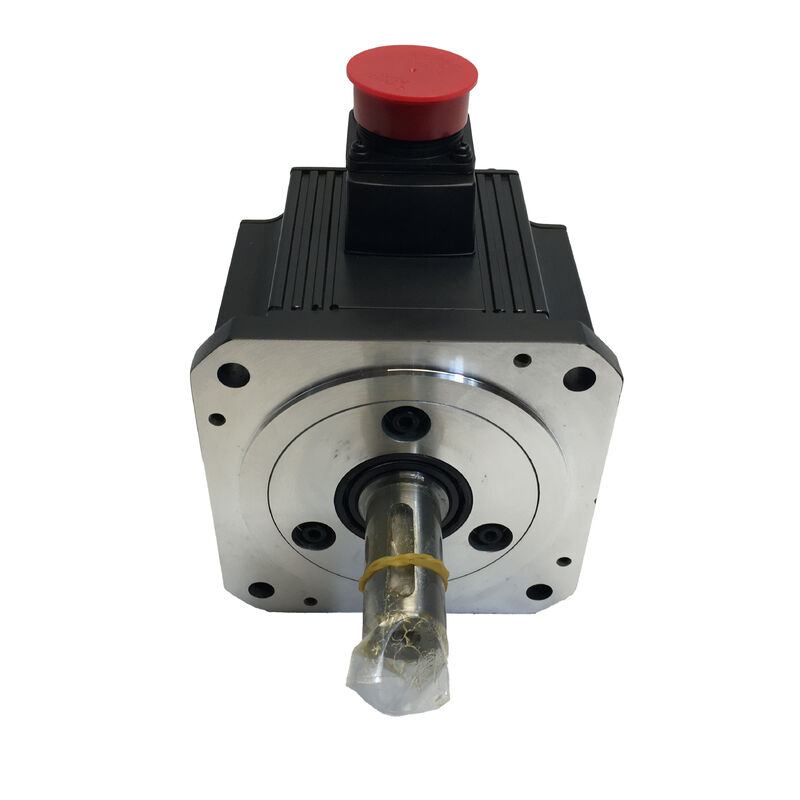
Mitsubishi HC-SFS702K (HCSFS702K) — 7kW AC Servo Motor, Keyed Shaft, No Brake, 2000 rpm, MELSERVO J2-Super Series
Product Overview
Part Number: HC-SFS702K
Also Searched As: HCSFS702K, HC SFS 702K, HC-SFS-702K
Series: Mitsubishi MELSERVO HC-SFS (J2-Super Generation)
Classification: Medium-Inertia AC Brushless Servo Motor — 7 kW, 200V class, 2000 rpm, Keyed Shaft, No Brake
The Top of the 2000 rpm Range, With a Keyed Interface
The Mitsubishi HC-SFS702K is the highest-torque motor in the HC-SFS 2000 rpm family. Seven kilowatts. Thirty-three point four Newton-metres of continuous torque. One hundred Newton-metres on demand for the brief but demanding acceleration and deceleration phases of each positioning cycle. It sits at the ceiling of what the J2-Super platform delivers at this speed point, and the "K" suffix places a machined keyway on the shaft — a specific choice that defines how torque moves from motor to mechanism.
At the 7kW level, the loads being driven are heavy. Ball-screw axes on large CNC machining centres. Primary drives on industrial winding stations handling substantial web tension. Transfer machine main drives. High-capacity rotary indexing tables. Chain and gear-coupled conveyors and transfer mechanisms that run under sustained load. These are not applications where the torque path between motor and driven component can afford any ambiguity. The keyed shaft eliminates that ambiguity. The key transmits torque mechanically through its shear cross-section, and that transmission does not depend on clamping force, does not loosen with vibration, and does not degrade under sustained cyclic loading.
The 17-bit serial absolute encoder at 131,072 ppr and the MR-J2S-700 amplifier complete the system. The motor is discontinued but remains available as surplus and refurbished stock.
Technical Specifications
| Parameter |
Value |
| Part Number |
HC-SFS702K |
| Rated Output |
7,000 W (7 kW) |
| Supply Voltage |
200V class (3-phase 200–230V AC) |
| Rated Speed |
2,000 rpm |
| Maximum Speed |
3,000 rpm |
| Rated Torque |
33.4 Nm |
| Peak Torque |
100 Nm |
| Encoder Type |
17-bit serial absolute |
| Encoder Resolution |
131,072 ppr |
| Shaft Type |
Keyed (machined keyway) |
| Electromagnetic Brake |
None |
| Flange Size |
176 × 176 mm |
| Protection Rating |
IP65 |
| Oil Seal |
Fitted |
| Inertia Class |
Medium inertia |
| Ambient Temperature (Operation) |
0°C to +40°C |
| Storage Temperature |
−15°C to +70°C |
| Vibration Resistance (X axis) |
24.5 m/s² |
| Vibration Resistance (Y axis) |
29.4 m/s² |
| Compatible Amplifiers |
MR-J2S-700A / MR-J2S-700B / MR-J2S-700CP |
| Series Generation |
MELSERVO J2-Super |
| Status |
Discontinued — available as stock |
Why the Keyed Shaft at 7kW
Across the HC-SFS range, every capacity step is available with both a straight shaft and a keyed shaft. At lower power levels — 500W, 1kW — the choice between them is largely a matter of mechanical preference and the specific coupling hardware available. At 7kW with 100 Nm peak torque, the choice becomes more consequential.
A friction-clamp coupling on a straight shaft transmits torque through the contact force between the hub bore and the shaft OD. That force must be sufficient to resist 100 Nm during every aggressive acceleration phase, across the motor's entire service life, under all operating conditions. In a clean laboratory environment with a freshly installed coupling inspected at regular intervals, friction clamping handles this reliably. In a production machine running continuously for years — subject to vibration, thermal cycling, coolant splash, and the practical reality that coupling inspections sometimes get deferred — the margin that was adequate at installation can erode. When it does at this torque level, the consequences are not subtle. A 100 Nm slip event on a heavy machine axis is a mechanical event, not just a positioning error.
The keyway changes the torque transmission mechanism entirely. The key occupies matched slots in both shaft and hub. Torque is transmitted through the key's shear cross-section — a mechanical calculation based on material properties and geometry, not on friction and clamping force. Reversal torque, sustained cyclic loading, shock inputs from gear tooth contact or chain link engagement, the full 100 Nm peak during every rapid acceleration — none of these challenge a properly dimensioned and installed key the way they challenge a friction interface that has seen years of production service.
For the specific mechanical interfaces most common at 7kW — gear couplings to heavy gear drives, chain sprockets on heavy conveyor systems, worm gear input shafts, large timing belt pulley hubs — a keyed bore is either standard or preferred, and the HC-SFS702K is simply the right motor for those connections.
33.4 Nm Continuous: The Working Torque at This Level
Thirty-three point four Newton-metres is the highest continuous torque in the HC-SFS 2000 rpm family. Putting that number in mechanical context helps clarify which applications genuinely need it versus which might be adequately served by a smaller motor.
On a 10mm pitch ball screw with 90% screw efficiency, 33.4 Nm continuous motor torque sustains approximately 18.9 kN of axial feed force. That covers the heaviest table and workpiece combinations on large-format CNC machining centres — the kinds of horizontal machining centres and gantry mills that handle large castings and weldments where table mass alone runs to several tonnes. On a 16mm pitch screw used on large rapid-traverse axes, 33.4 Nm produces about 11.8 kN of sustained axial force at full production feed rates.
For winding drives in torque control mode, 33.4 Nm at 2,000 rpm places this motor at the top of the range for medium-to-large industrial winding stations. Web tension requiring 25–30 Nm of motor torque across the operating diameter range is well within the continuous rating with useful margin remaining.
The 100 Nm peak — three times the continuous figure — is where the motor's acceleration performance lives. A heavy machine axis accelerating to rapid traverse speed draws heavily on peak torque for the acceleration ramp, then settles to a fraction of rated torque during constant-velocity traverse. That duty pattern is thermally benign as long as the settled-speed torque stays below rated and the acceleration phases are brief relative to the cycle time. The MR-J2S-700's electronic thermal model tracks this cumulative loading and protects the motor if duty cycles push the average thermal load too high.
One consistent guideline from Mitsubishi's documentation: on horizontal axes where inertia mismatch is the primary concern, the recommended load inertia ratio is generally kept below a defined multiple of the motor inertia for stable auto-tuning response. At 7kW on a 176 × 176 mm frame, the rotor inertia is substantial — larger loads can be driven stably, but axes with very high reflected inertia ratios may require manual gain adjustment rather than relying on auto-tuning to converge.
The Keyed Shaft in Installation Practice
Choosing a keyed shaft motor creates a design requirement that does not exist with a smooth shaft: the driven component's hub must have a matching keyway. For applications where the hub is purpose-made — custom pulleys, gear blanks, sprockets made to order — specifying the keyway is straightforward. For applications using off-the-shelf hubs, confirming that the standard keyway in the catalogue hub matches the motor shaft's keyway dimensions is the critical check before committing to this variant.
Hub installation at the 176 × 176 mm frame: The same rule that applies to straight-shaft motors at this frame size applies here, and arguably with more force given the additional mechanical interface complexity. Always use the M12 threaded hole at the shaft end and a drawbolt to pull the hub axially onto the shaft. Do not press or hammer the hub on, even with the key fitting in place. Axial impact during hub installation travels through the shaft to the encoder disc and rear bearing. At this frame size the shaft is long and the impact energy reaching the encoder end is not negligible. The failure mode — subtle encoder bearing or disc damage — produces intermittent encoder faults under vibration rather than immediate alarms, and tracing those faults back to an installation event weeks or months later requires significant diagnostic effort. The drawbolt method costs an additional minute and prevents the problem entirely.
Key fit: The key should have a light press or close sliding fit in the shaft keyway and a clearance or transition fit in the hub keyway. A key that is loose in either slot introduces backlash into the torque transmission — which undermines the primary reason for using a keyed shaft in the first place. At 100 Nm peak torque, key fit tolerances matter. Verify the fits against the motor shaft and hub keyway dimensions before assembly.
No Brake: Confirming the Application
The HC-SFS702K carries no electromagnetic brake. At 7kW, this requires a more deliberate confirmation than at lower power levels, because the loads this motor drives are large enough that unrestrained gravitational movement is a significant mechanical and safety event.
The no-brake variant is appropriate when the axis is horizontal, or when the axis is balanced such that no net force acts in the direction of shaft rotation when servo current drops to zero. For these axes, the MR-J2S-700's servo lock holds position through the closed position loop — the 17-bit encoder monitors shaft angle at high resolution, and the amplifier continuously supplies corrective current to hold zero following error. This is reliable, accurate, and draws no additional panel resources.
The confirmation question for each axis: if the servo is disabled unexpectedly — E-stop, power fault, amplifier trip — does the load move? On a horizontal machining centre table axis where the axis weight acts perpendicular to the direction of motion, the answer is no, and the HC-SFS702K is the correct and complete specification. On a large winding drive with a horizontal arbour where roll weight is carried by mechanical bearings rather than the servo axis, the answer is similarly no.
The answer becomes yes on vertical axes, inclined feeds, gravity-loaded rotary tables tilted off horizontal, and any mechanism where the load's weight component acts along the servo axis direction. For those applications, the HC-SFS702BK (keyed shaft plus spring-applied electromagnetic brake) is the required motor. The spring-applied brake engages immediately on loss of coil power and holds the load mechanically without depending on any active system. At 7kW on a vertical axis, this is not an optional safety enhancement — it is the specification that makes the axis safe.
On a machine with multiple 7kW axes, some horizontal and some vertical, the discipline of specifying the correct brake configuration for each axis — rather than defaulting to brakes on all axes or, worse, omitting brakes where they are needed — produces both a safer machine and a simpler panel design.
Compatible Amplifiers
The HC-SFS702K requires the MR-J2S-700 amplifier family — the 7kW capacity J2-Super platform. Three interface variants cover the main control architectures at this power level:
MR-J2S-700A is the general-purpose interface amplifier. It accepts pulse-train position commands from CNC controllers and PLCs, and analog speed or torque references. All control modes — position, speed, torque, and switched combinations — are available. Input pulse frequency up to 500 kpps for differential receiver inputs. RS-232C connects to MR Configurator for commissioning and parameter management. On machines where the axis command source is an external CNC system, motion controller, or PLC, the MR-J2S-700A is the standard choice.
MR-J2S-700B connects to Mitsubishi A-series and Q-series motion controllers via SSCNET fiber-optic serial bus. All axis commands and all feedback data travel over the fiber network — no separate analog or pulse wiring from controller to amplifier. For large multi-axis machines where several 7kW axes must operate in coordinated motion — portal machining centres with simultaneous multi-axis contouring, large transfer lines with synchronised heavy drives, multi-axis gantry systems — the SSCNET bus provides the real-time axis coupling that is not achievable through pulse or analog interfaces.
MR-J2S-700CP provides built-in single-axis positioning with up to 31 stored point-table positions, activated by digital I/O or CC-Link network command. For standalone 7kW indexed positioning axes — heavy rotary tables, primary winding station drives, large transfer shuttle mechanisms — that do not require real-time coordination with other axes, the CP eliminates the need for a dedicated motion controller on that axis.
All three amplifiers incorporate the MR-J2S-700's built-in dynamic brake, real-time auto-tuning, adaptive vibration suppression, machine resonance suppression filter, and the full J2-Super suite of motor protection and monitoring functions.
Compatibility notes. The HC-SFS702K requires an MR-J2S-700 amplifier. It is not compatible with the first-generation MR-J2-700 amplifier, which cannot decode the 17-bit J2-Super encoder serial protocol and will fault immediately on startup. For machines running original MR-J2-700 hardware, the HC-SF702K (same keyed shaft specification, 14-bit encoder) is the correct motor. Not compatible with MR-J3 or MR-J4 amplifiers without a renewal adapter kit.
HC-SFS 2000 rpm Family — The 702K at the Top
| Model |
Output |
Rated Torque |
Peak Torque |
Shaft |
Flange |
| HC-SFS202K |
2,000 W |
9.55 Nm |
28.6 Nm |
Keyed |
176 × 176 mm |
| HC-SFS352K |
3,500 W |
16.7 Nm |
50.1 Nm |
Keyed |
176 × 176 mm |
| HC-SFS502K |
5,000 W |
23.9 Nm |
71.6 Nm |
Keyed |
176 × 176 mm |
| HC-SFS702K |
7,000 W |
33.4 Nm |
100 Nm |
Keyed |
176 × 176 mm |
The HC-SFS702K is the highest-torque keyed-shaft motor in the HC-SFS 2000 rpm range and the top of the J2-Super platform at this speed point. All four models share the 176 × 176 mm flange — a machine frame designed for any one of them accepts all four without mechanical modification. This is practically useful for machine variants: a machine model offered in different cutting capacity tiers can share a common structural design while the servo axis is scaled from 2kW to 7kW purely by changing motor and amplifier.
The torque step from the HC-SFS502K (23.9 Nm) to the HC-SFS702K (33.4 Nm) is approximately 40% — a meaningful increase when an axis is operating regularly near the 5kW motor's continuous torque ceiling, or when a future capacity upgrade to the machine requires more sustained axis force without a structural redesign.
The full 7kW 2000 rpm family covers all four shaft-and-brake configurations: straight shaft (HC-SFS702), straight shaft with brake (HC-SFS702B), keyed shaft (HC-SFS702K), and keyed shaft with brake (HC-SFS702BK). All four use the MR-J2S-700 amplifier.
Typical Applications
Primary feed axes on large-format CNC machining centres. X and Y table axes on large horizontal machining centres, gantry milling machines, and heavy-duty bridge mills handling multi-tonne table and fixture mass. The HC-SFS702K's 33.4 Nm continuous torque sustains heavy production cutting loads at full feed rates; the keyed shaft secures the ball-screw nut hub or pulley coupling against the sustained and cyclic forces these mechanisms generate under load.
Main drives on heavy chain and gear-coupled conveyors. Large assembly and machining transfer lines, heavy-duty pallet conveyors, and chain-driven transfer systems where the primary drive shaft is connected to the motor through a keyed sprocket or gear hub. Chain drives impose cyclic shock loads at each link engagement — the keyed interface handles these reliably and indefinitely where friction clamping would be progressively challenged.
Primary winding and unwinding station drives. Large industrial winding stations for paper, film, foil, and heavy textile substrates where the motor is coupled through a keyed gear or coupling hub to the winding arbour. The 33.4 Nm continuous torque in tension control mode covers the full diameter range of large-format winding operations with appropriate margin; the keyed shaft interface is standard practice on winding station drives where the coupling hub sees sustained tension loads.
Heavy rotary indexing table drives. Large-format rotary indexing tables — multi-tonne rotary fixtures on machining centres, pallet changers on horizontal machining cells, large turntable transfer stations — using worm gear or spur gear reduction between the motor and table. The keyed motor-to-gear coupling handles the input shaft torque; the 17-bit absolute encoder maintains precise indexing position knowledge across power interruptions; the 100 Nm peak drives rapid index movements between stations efficiently.
High-capacity servo press feeder main drives. Primary material feed axes on large progressive die presses, coil straightener-feeder combinations, and heavy plate handling systems where the feed roll or gripper mechanism is driven through a keyed gear or sprocket coupling. The cyclic nature of press feeding — high-torque acceleration to feed speed, constant-velocity feed, rapid deceleration to stop, dwell — cycles through the full peak-to-continuous torque range on every press stroke, and the keyed interface reliably sustains this duty over millions of press cycles.
Frequently Asked Questions
Q1: Why choose the HC-SFS702K over the HC-SFS702 (straight shaft) at 7kW?
The choice is determined entirely by the driven component's hub design and the operating conditions. If the hub has a keyway bore — a gear hub, chain sprocket, worm input coupling, or any hub where the keyway is standard or required by the driven mechanism — the HC-SFS702K is the natural match. If the hub is a smooth-bore precision servo coupling, the straight-shaft HC-SFS702 is simpler and equally reliable. At 7kW with 100 Nm peak torque, applications involving cyclic loading, sustained reversal, or chain/gear shock inputs are better served by the keyed interface, which transmits torque mechanically rather than through friction clamping that must resist 100 Nm peak indefinitely through the motor's service life.
Q2: Which amplifiers are compatible with the HC-SFS702K?
The HC-SFS702K requires the MR-J2S-700 amplifier — the 7kW J2-Super platform. The three variants are MR-J2S-700A (analog/pulse-train command, general-purpose), MR-J2S-700B (SSCNET fiber-optic bus for Mitsubishi motion controllers), and MR-J2S-700CP (built-in positioning, up to 31 point tables, CC-Link compatible). The motor is not compatible with the first-generation MR-J2-700, which cannot read the 17-bit J2-Super encoder. For machines on MR-J2-700 hardware, the HC-SF702K (14-bit encoder) is the compatible motor.
Q3: What is the difference between the HC-SFS702K and the HC-SFS702BK?
Both are 7kW, 2000 rpm, keyed-shaft J2-Super motors with identical electrical and dimensional specifications. The difference is the brake. The HC-SFS702K has no brake — position at rest is held by amplifier servo lock. The HC-SFS702BK has a spring-applied electromagnetic brake that engages mechanically when the 24V brake coil is de-energised. Use the HC-SFS702BK on vertical axes, inclined mechanisms, and any gravity-loaded drive where axis movement at servo-off would be hazardous or damaging. On confirmed horizontal axes with no gravitational load component, the HC-SFS702K is the correct and simpler specification.
Q4: Where is the absolute encoder backup battery located?
The backup battery — Mitsubishi A6BAT lithium cell — is housed inside the MR-J2S-700 servo amplifier, not in the motor. It maintains the multi-turn absolute counter through all power-off periods, allowing the axis to report its exact position immediately on restart without any homing movement. Replace the A6BAT at the first low-battery alarm from the amplifier. Allowing full depletion resets the multi-turn counter and requires a reference-return cycle before the axis can resume production.
Q5: The HC-SFS702K is discontinued. Is it still obtainable, and what is the upgrade path?
Despite official discontinuation, the HC-SFS702K remains available through industrial automation surplus dealers and Mitsubishi servo specialist suppliers as new old stock and tested refurbished units — a practical sourcing path for machines committed to the J2-Super platform. For new machine designs or full platform upgrades, the current-generation mechanical equivalent is the HG-SR702K (MR-J4 series, 7kW, 2000 rpm, keyed shaft, 22-bit encoder, 176 × 176 mm flange, IP67) paired with an MR-J4-700 amplifier. Upgrading requires replacing both motor and amplifier together as the encoder protocols are incompatible between generations.


 Your message must be between 20-3,000 characters!