Home
>
Products
>
Industrial Servo Motor
>
| Parameter | Value |
|---|---|
| Part Number | HC-SFS702 |
| Alternate Code | HCSFS702 |
| Manufacturer | Mitsubishi Electric Corporation |
| Platform | MELSERVO J2S / HC-SFS Series |
| Inertia Class | Medium Inertia, Medium Capacity |
| Rated Output | 7,000 W (7 kW) |
| Supply Voltage | 200 V AC class |
| Rated Current | 35 A |
| Rated Torque | 33.4 Nm |
| Maximum Torque | 100 Nm |
| Rated Speed | 2,000 rpm |
| Maximum Speed | 3,000 rpm |
| Encoder | Built-in Absolute, 17-bit (131,072 ppr) |
| Electromagnetic Brake | None |
| Shaft Type | Straight with Oil Seal |
| Flange Dimensions | 176 × 176 mm |
| Protection | IP65 |
| Insulation Class | F |
| Cooling | Totally Enclosed, Self-Cooled |
| Power Supply Capacity | 10 kVA |
| Operating Temperature | 0 °C to +40 °C |
| Compatible Amplifier | MR-J2S-700A / MR-J2S-700B |
| Condition | New In Box |
Seven kilowatts. Thirty-three point four newton-meters of continuous torque. A peak capability of 100 Nm — three times the rated value — available for the duration of an acceleration transient. The HC-SFS702 is the highest-output member of Mitsubishi's HC-SFS 200V series, the motor that sits at the top of the J2S medium-inertia lineup before the application moves to the HA-LFS heavy-duty class or a 400V supply voltage.
For machine builders, that position in the product hierarchy has a concrete meaning: the HC-SFS702 is the answer when the axis load is too heavy for a 5kW motor and the system must stay on 200V AC. Large CNC machining center main feed axes, heavy-load robotic joints, large rotary table drives, and substantial material handling axes all fall into this power window. The motor handles them on the same MELSERVO J2S platform — same MR-J2S amplifier family, same encoder interface, same MR Configurator setup software — as every other HC-SFS motor in the system.
Rated torque figures describe steady-state capability — what the motor can sustain continuously without exceeding its thermal limits. The HC-SFS702's 33.4 Nm at 2,000 rpm is the torque available throughout the cutting pass on a milling axis, throughout the feed stroke on a press, throughout the winding tension cycle on a large web drive.
The 100 Nm peak — available for the short duration of an acceleration move — is what allows heavy loads to reach target speed quickly despite their inertia. A large rotary table or a heavy ballscrew carriage presents significant inertia that must be overcome at the start of every move. The three-to-one torque headroom above rated gives the MR-J2S amplifier the authority to accelerate those loads aggressively without operating the motor in an overcurrent condition.
The medium-inertia HC-SFS design intentionally supports a broader range of load inertia ratios than low-inertia motors of equivalent output. At the 7kW level, where connected loads are typically heavy and have significant inertia of their own, that characteristic is not incidental — it is the reason this motor class is specified for large machine axes rather than a low-inertia alternative at the same power level.
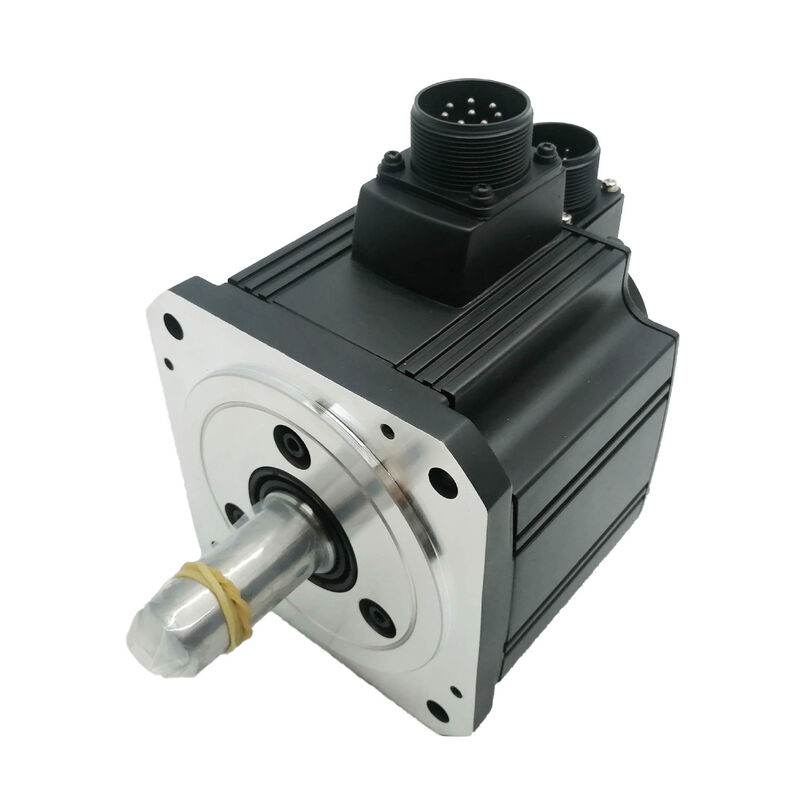
The HC-SFS702 ships with a factory-fitted oil seal at the drive-end shaft and a 176×176mm motor body rated to IP65. At 7kW, this motor goes onto large machine tools — horizontal machining centers, large-format CNC lathes, heavy grinding machines. Those environments have coolant at pressure, metallic chip spray, and lubricant mist as constants throughout the working day.
The oil seal blocks the primary contamination entry point: the annular gap between the rotating shaft and the stationary motor housing. Without it, fine coolant mist and particulate gradually work their way into the bearing cavity and encoder housing over the motor's operating life, degrading both. With the seal in place, that path is closed.
IP65 housing means the motor body is fully dust-tight and withstands direct water jet from any direction — not splash protection, but jet resistance. Together, these two features allow the HC-SFS702 to be mounted directly on the machine structure in the working zone without additional protective enclosures. That is the standard Mitsubishi specification for this motor in machine tool applications.
The 17-bit built-in encoder reads the motor shaft position at 131,072 counts per revolution and transmits that data to the MR-J2S amplifier via Mitsubishi's high-speed serial encoder link. As an absolute device, it maintains a complete position register — both within-revolution and multi-turn — that survives power interruptions when the A6BAT backup battery is installed in the amplifier.
The operational consequence is that the machine knows where every axis is the moment power is applied. No homing cycles. No careful manual management of a 7kW axis through a reference return sequence with heavy loads and significant inertia. Startup is immediate: the controller reads current position, compares to last commanded position, and begins normal operation.
For large machine axes specifically, eliminating homing time matters. A 7kW feed axis on a machining center does not home the same way a small auxiliary axis does — the move involves heavy mechanical mass, potentially large travel distances, and careful speed management. Battery-backed absolute position removal of that sequence represents real startup time recovered across the machine's operating life.
The HC-SFS702 pairs with the MR-J2S-700A and MR-J2S-700B — the 7kW-rated members of the MELSERVO J2S amplifier family. Both amplifiers include forced ventilation cooling (built-in fan), dynamic braking, and the full J2S protection suite: overcurrent shutdown, regenerative overvoltage protection, electronic thermal overload, encoder fault protection, overspeed, and excess error protection.
MR-J2S-700A is the general-purpose interface variant. It accepts pulse-train commands (up to 500 kpps differential, 200 kpps open-collector) for position control, and analog voltage input for speed and torque control modes. Control mode switching — between position/speed, speed/torque, and torque/position — is available during operation via I/O signal. RS-232C and RS-422 serial communication ports support MR Configurator software for parameter setup, auto-tuning, and oscilloscope monitoring from a Windows PC.
MR-J2S-700B connects to the SSCNET serial network, linking the amplifier to Mitsubishi A-series and Q-series motion controllers (Q172D, Q173D, A172SHCPUN) via the high-speed synchronous bus. In SSCNET systems, all connected axes receive position commands simultaneously at each communication cycle, enabling true multi-axis synchronization — interpolation, electronic gearing, and coordinated feed control — across all machine axes without inter-axis timing variation.
For large machining centers and multi-axis industrial machines, the SSCNET B-type amplifier is the typical choice. For single-axis applications, press feeders, and PLC-driven positioning systems, the A-type with pulse-train or analog interface is the standard path.
CNC machining center main feed axes — X, Y, and Z feed axes on large horizontal and vertical machining centers, where cutting forces and table mass demand 5–7kW drive authority for full-depth, full-width material removal at programmed feed rates.
Heavy-load rotary table and pallet shuttle drives — pallet changers and rotary work-holding tables on large machining centers where the combination of heavy fixture mass and fast cycle time defines the drive requirement. The HC-SFS702's 100 Nm peak torque handles the inertia of a loaded pallet system.
Large-format CNC lathe feed axes — carriage and cross-slide drives on large-diameter turning centers where cutting forces on heavy workpieces at aggressive feedrates load the axis continuously at or near rated torque.
Industrial robot main joint drives — shoulder and elbow joints on medium-to-large payload industrial robots, where the combination of 7kW output, medium-inertia design, and J2S platform integration defines the specification.
Heavy-duty material handling and press feed systems — coil handling, straightener drives, and press feed axes on metal forming equipment where high-force, controlled-speed feeding is the primary function.
All HC-SFS702 variants share the 7kW output, 33.4 Nm rated torque, 100 Nm peak torque, 17-bit encoder, oil seal, IP65, and 176×176mm flange:
| Model | Shaft | Brake |
|---|---|---|
| HC-SFS702 | Straight | No |
| HC-SFS702B | Straight | Yes |
| HC-SFS702K | Keyed | No |
| HC-SFS702BK | Keyed | Yes |
The HC-SFS702 (this listing) is the standard straight-shaft, no-brake configuration — correct for horizontal axes, balanced loads, and applications where the servo's dynamic braking handles deceleration without mechanical shaft holding being required. For vertical axes or gravity-loaded mechanisms, the B brake variant applies.
Q1: Which servo amplifier is compatible with the HC-SFS702?
The HC-SFS702 requires the MR-J2S-700A (analog/pulse-train command interface) or MR-J2S-700B (SSCNET serial network interface). Both are 7kW-rated MELSERVO J2S amplifiers with forced ventilation cooling and built-in dynamic braking. The A variant is correct for PLC-based or standalone CNC systems; the B variant integrates into Mitsubishi SSCNET multi-axis motion controller systems. Power supply requirement is approximately 10 kVA — this must be accounted for in machine electrical panel design.
Q2: Does the HC-SFS702 retain absolute position data after power-down?
Yes, when the Mitsubishi A6BAT lithium battery is properly installed in the servo amplifier's battery holder. Multi-turn absolute position is preserved through any power interruption, allowing the machine to restart with all axis positions known immediately. Without the battery, position data is lost at power-down and a reference return is required at next startup. The amplifier issues a low-battery alarm before voltage falls below the operating threshold.
Q3: The HC-SFS series is listed as discontinued — is the HC-SFS702 still available as a replacement part?
New-in-box HC-SFS702 units remain available through industrial automation parts distributors for maintenance of existing MELSERVO J2S installations. As a direct replacement for a failed unit, no amplifier changes or parameter modifications are required — it is plug-compatible with the existing MR-J2S-700A or 700B amplifier and cabling. For new machine designs, Mitsubishi's current equivalent in the 7kW / 2,000 rpm class is the HG-SR702 (MELSERVO J4 series), which requires J4 amplifiers and different encoder cables.
Q4: What is the maximum permissible load inertia ratio for the HC-SFS702?
Mitsubishi's MELSERVO J2S documentation specifies a recommended load-to-motor inertia ratio of 15 times or less for the HC-SFS medium-inertia series at this power level. The MR-J2S-700A/B amplifier includes real-time auto-tuning that adapts gain settings to the connected load within this range. Loads exceeding the recommended ratio are possible but require manual gain adjustment consultation with Mitsubishi application engineering, as servo loop stability cannot be guaranteed by the auto-tuning function alone.
Q5: Can the HC-SFS702 be used with a 400V power supply?
No. The HC-SFS702 is a 200V AC class motor, rated for 200–230V three-phase supply. Mitsubishi offers separate 400V-class variants of the HC-SFS 7kW motor for 380–480V supply applications — these are distinct part numbers and are not electrically interchangeable with the 200V HC-SFS702. Always verify supply voltage class before ordering.
Contact Us at Any Time