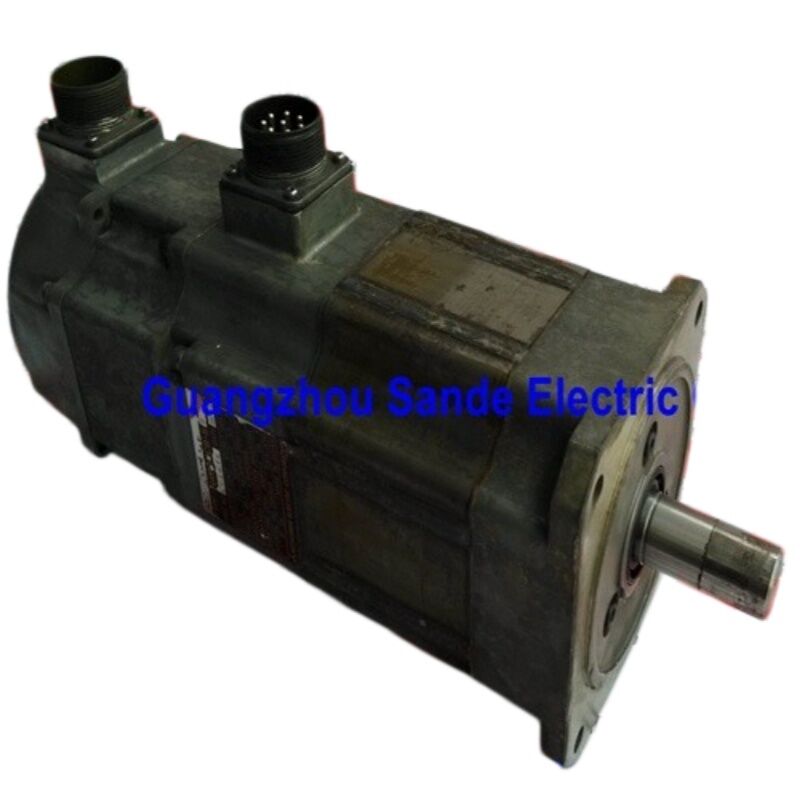
Mitsubishi HC-SFS103 (HCSFS103) — 1kW AC Servo Motor, Straight Shaft, No Brake, 3000 rpm, MELSERVO J2-Super Series
Product Overview
Part Number: HC-SFS103
Also Searched As: HCSFS103, HC SFS 103, HC-SFS-103
Series: Mitsubishi MELSERVO HC-SFS (J2-Super Generation)
Classification: Medium-Inertia AC Brushless Servo Motor — 1 kW, 200V class, 3000 rpm, Straight Shaft, No Brake
The Motor in One Paragraph
The Mitsubishi HC-SFS103 is a 1kW, 3,000 rpm medium-inertia servo motor — compact enough to fit the 130 × 130 mm flange, fast enough to drive ball screws and belt drives without a reduction stage, and precise enough to close a sub-micron position loop through its 17-bit serial absolute encoder. It is a clean, uncomplicated motor: straight shaft, no brake, paired with the MR-J2S-100 amplifier. For the machine axes it serves — light-to-medium load positioning drives, fast-cycling assembly machine axes, auxiliary feeds on machine tools — that combination hits exactly the right balance of speed, torque, and physical size.
Technical Specifications
| Parameter |
Value |
| Part Number |
HC-SFS103 |
| Rated Output |
1,000 W (1 kW) |
| Supply Voltage |
200V class (3-phase 200–230V AC) |
| Rated Speed |
3,000 rpm |
| Maximum Speed |
4,500 rpm |
| Rated Torque |
3.18 Nm |
| Peak Torque |
9.55 Nm |
| Encoder Type |
17-bit serial absolute |
| Encoder Resolution |
131,072 ppr |
| Shaft Type |
Straight (no keyway) |
| Electromagnetic Brake |
None |
| Flange Size |
130 × 130 mm |
| Protection Rating |
IP65 |
| Oil Seal |
Fitted |
| Inertia Class |
Medium inertia |
| Ambient Temperature (Operation) |
0°C to +40°C |
| Storage Temperature |
−15°C to +70°C |
| Compatible Amplifier |
MR-J2S-100A / MR-J2S-100B / MR-J2S-100CP |
| Series Generation |
MELSERVO J2-Super |
| Status |
Discontinued — available as stock |
3000 rpm vs 2000 rpm: Why the Speed Point Matters
The HC-SFS103 is a 3,000 rpm motor. Its direct counterpart in the 2,000 rpm HC-SFS family is the HC-SFS102 — same 1kW output, same 130 × 130 mm flange, same J2-Super encoder and amplifier class, but running at two-thirds the shaft speed with proportionally higher continuous torque (4.78 Nm vs 3.18 Nm).
Choosing between them is an application question, not a quality question.
At 3,000 rpm, the motor covers more angular distance per unit time. A ball screw driven at 3,000 rpm with 10mm pitch reaches 30 m/min linear speed — genuinely fast for a positioning axis. For high-throughput applications where rapid traversal between positions is the primary cycle time driver, the 3,000 rpm rating delivers that traversal speed without a gear or belt stage. The tradeoff is lower continuous torque at the motor shaft; 3.18 Nm sustained means the mechanism must be appropriately light, or a suitable gear reduction placed between motor and load.
At 2,000 rpm, the same 1kW produces 4.78 Nm continuously. The axis moves more slowly per revolution but sustains higher force at the shaft. Better for axes that spend their duty cycle fighting load torque rather than covering distance quickly.
For light-load, high-cycle-rate applications — small assembly machine axes, ATC mechanisms, lightweight XY stages, auxiliary feeds on CNC equipment — the HC-SFS103 at 3,000 rpm is typically the natural choice. The axis moves fast, the load is manageable at 3.18 Nm continuous, and the compact 130 × 130 mm frame keeps the motor from dominating the machine structure.
3.18 Nm Continuous: Understanding the Duty Budget
Three point one eight Newton-metres is a specific number with a specific meaning. It is the torque the HC-SFS103 can sustain indefinitely at rated speed without the winding temperature rising above the design limit — provided the application's duty cycle does not push the average thermal load above what the MR-J2S-100's electronic thermal model accounts for.
For a well-sized axis on this motor, the working picture looks something like this: acceleration at peak torque (9.55 Nm) for a fraction of the move, cruise at or below rated torque, decelerate at peak again, dwell at position with minimal servo lock current. The brief peak torque transients are absorbed into the thermal model without issue because they are short and infrequent relative to the settling and dwell phases. The continuous 3.18 Nm rating is the constraint on sustained torque — what the axis can demand indefinitely, not momentarily.
Where this motor starts to feel its limits is an axis that must maintain close to 3.18 Nm continuously — a sustained cutting feed against significant resistance, a winding drive maintaining constant tension through a large diameter range, a conveyor section running loaded all day. Those applications approach the thermal ceiling quickly. An axis that regularly demands more than 3.18 Nm in its average working cycle will overheat and trip. The correct response is to either reduce the load (better mechanical efficiency, lighter payload, additional reduction stage) or move to a higher-capacity motor.
The peak torque, however, is genuinely useful. At 9.55 Nm — three times continuous — there is real acceleration force available for the transient phases of each positioning move. For a light-load axis completing dozens of short moves per minute, this peak capacity is what keeps cycle times short without requiring a larger motor.
Straight Shaft at 1kW: Coupling Choices
A straight, keyway-free shaft suits the vast majority of 1kW servo coupling applications. At this capacity and torque level, friction-clamp couplings — split-hub jaw couplings, bellows couplings, disc couplings — transmit torque reliably to smooth shafts without the risk of slip that might concern a larger motor at higher torque.
The peak torque of 9.55 Nm governs coupling selection, not the 3.18 Nm rated figure. A coupling sized for rated torque alone will be marginal during every aggressive acceleration phase. Selecting to the peak torque — 9.55 Nm — with a modest service factor gives a coupling that handles the full operating range comfortably.
Timing belt drives are particularly common on 3,000 rpm axes in this capacity class. The high shaft speed makes direct coupling to ball screws impractical in many machine geometries, and a timing belt stage with a modest reduction ratio (1.5:1 to 3:1) simultaneously lowers the effective shaft speed at the screw, multiplies the motor torque, and allows the motor to be positioned away from the screw axis — useful for space-constrained machine designs. The belt pulley on the motor side connects directly to the smooth straight shaft using a taper-lock or shrink-disc hub.
For applications where a keyed hub is genuinely required — gear hubs, chain sprockets, certain custom pulleys — the HC-SFS103K (keyed shaft, no brake) is mechanically identical in all other respects and uses the same MR-J2S-100 amplifier. The choice between straight and keyed shaft is purely a mechanical interface decision; it changes nothing about the motor's electrical or dynamic behaviour.
No Brake on a 3000 rpm Motor
At 3,000 rpm on horizontal and symmetrically loaded axes, the absence of an electromagnetic brake is simply the correct specification. The MR-J2S-100 amplifier holds axis position through closed-loop servo lock continuously while the servo is enabled — position loop active, 17-bit encoder monitoring shaft angle at 131,072 counts per revolution, corrective current supplied to hold zero following error. On a clean, well-tuned axis, this is solid and reliable.
The practical benefits of the no-brake configuration at this motor size are tangible. A smaller motor body — no brake housing added to the rear. No 24V DC brake circuit in the panel. No relay, no surge suppressor, no MBR interlock in the PLC logic. No brake disc inspection on the maintenance schedule. Lighter weight on a moving machine axis or robot arm where every gram of dead mass has a cost in inertia and structural design.
The boundary condition is straightforward: if the axis has a gravitational load component that would cause movement when servo current drops to zero, a brake is required. Vertical axes, inclined feeds, and any mechanism where unresisted load torque would move the shaft at servo-off should use the HC-SFS103B (straight shaft, spring-applied brake) rather than the HC-SFS103. For horizontal axes and symmetrically balanced mechanisms — by far the majority of applications this motor serves — no brake is needed and adding one would be adding cost and complexity without functional benefit.
17-Bit Absolute Encoder: Precision and Practicality
The encoder built into the HC-SFS103 is the 17-bit serial absolute unit common to the entire J2-Super HC-SFS range. One hundred and thirty-one thousand and seventy-two discrete positions per shaft revolution. Multi-turn absolute count maintained through power-off by the A6BAT battery in the MR-J2S-100 amplifier.
On a 3,000 rpm motor serving compact, high-cycle-rate axes, the encoder's practical contribution shows up in two places that matter most in daily production.
Velocity loop resolution at high speed. At 3,000 rpm, the shaft is moving fast — 50 revolutions per second. Even at that speed, 131,072 counts per revolution gives the velocity loop a highly granular view of instantaneous shaft velocity. Smooth speed response through acceleration ramps, stable constant-velocity performance at any point in the speed range, and quick dynamic recovery from load disturbances all depend on having enough encoder resolution to compute an accurate velocity signal. The 17-bit count at 3,000 rpm provides that resolution to spare.
Absolute position on restart. When the machine stops — for a shift change, a maintenance window, or an unplanned E-stop — the encoder freezes the absolute shaft angle in memory. On restart, the MR-J2S-100 reads that angle immediately. The controller knows exactly where every axis is before anything moves. For machines with many such axes, this eliminates a sometimes lengthy homing sequence and gets production running faster.
Battery location and replacement. The A6BAT that powers the multi-turn counter is in the MR-J2S-100 amplifier, not in the motor. Battery replacement is a panel-level task. Replace at the first low-battery alarm from the amplifier — do not defer. A fully depleted battery resets the counter, requiring a reference-return cycle on the next startup.
Compatible Amplifiers
The HC-SFS103 pairs with the MR-J2S-100 amplifier class — the 1kW capacity J2-Super platform. Three interface variants:
MR-J2S-100A is the general-purpose analog and pulse-train interface amplifier. It accepts pulse-train position commands from CNC controllers and PLCs and analog speed or torque references. All control modes — position, speed, torque, and switched combinations — are available. RS-232C connects to MR Configurator for commissioning and diagnostics. For standalone axes and axes on non-SSCNET machine tool and automation equipment, this is the standard choice.
MR-J2S-100B connects to Mitsubishi A-series and Q-series motion controllers via SSCNET fiber-optic bus. All axis commands and encoder feedback travel over the fiber network. On coordinated multi-axis machines — particularly where several compact axes must move in synchronised patterns — the SSCNET bus provides tight axis coupling that analog or pulse interfaces cannot match.
MR-J2S-100CP provides built-in single-axis positioning with up to 31 point-table positions, activated by digital I/O or CC-Link network command. For standalone indexed or point-to-point positioning axes that do not require motion controller coordination — ATC station drives, simple transfer axes, indexed assembly machine stations — the CP eliminates the cost and complexity of a dedicated motion controller.
Compatibility notes. The HC-SFS103 requires an MR-J2S-100 amplifier. It is not compatible with first-generation MR-J2-100 amplifiers, which cannot decode the 17-bit J2-Super encoder protocol. For machines running original MR-J2-100 hardware, the HC-SF103 (same mechanical specification, 14-bit encoder) is the correct motor. Not compatible with MR-J3 or MR-J4 amplifiers without a renewal adapter kit.
HC-SFS 3000 rpm Family — Capacity Context
| Model |
Output |
Rated Torque |
Peak Torque |
Flange |
Amplifier |
| HC-SFS53 |
500 W |
1.59 Nm |
4.77 Nm |
130 × 130 mm |
MR-J2S-60 |
| HC-SFS103 |
1,000 W |
3.18 Nm |
9.55 Nm |
130 × 130 mm |
MR-J2S-100 |
| HC-SFS153 |
1,500 W |
4.78 Nm |
14.3 Nm |
130 × 130 mm |
MR-J2S-200 |
| HC-SFS203 |
2,000 W |
6.37 Nm |
19.1 Nm |
130 × 130 mm |
MR-J2S-200 |
| HC-SFS353 |
3,500 W |
11.1 Nm |
33.3 Nm |
176 × 176 mm |
MR-J2S-350 |
The HC-SFS103 is the second step in the HC-SFS 3000 rpm range, sitting above the HC-SFS53 (500W) and sharing the 130 × 130 mm flange with the HC-SFS153 and HC-SFS203. All four compact-frame models in this range use the same physical mounting interface — a machine designed for the 130 × 130 mm flange can accommodate any of them without mechanical modification. The amplifier class changes between the 103 (MR-J2S-100) and the 153/203 (MR-J2S-200), so capacity upgrades within this family require an amplifier change alongside the motor swap.
Every model in the HC-SFS 3000 rpm range is available in the standard shaft-and-brake matrix: straight shaft no brake (HC-SFS103), straight shaft with brake (HC-SFS103B), keyed shaft no brake (HC-SFS103K), and keyed shaft with brake (HC-SFS103BK). All four configurations use the MR-J2S-100 amplifier at this capacity.
Typical Applications
Assembly machine axis drives. Pick-and-place axes, component feed mechanisms, and transfer slides on electronic assembly and general automation equipment. The 3,000 rpm rated speed enables fast traversal between positions; the compact 130 × 130 mm frame fits multi-axis assembly machine structures without dominant motor mass. High cycle rates — dozens to hundreds of moves per minute — are well within the duty budget on light-load horizontal axes.
CNC machine tool auxiliary axes. Auxiliary and secondary feed axes on CNC machining centres, grinders, and turning centres — tool change arms, tailstock drives, chip conveyor feeds, coolant nozzle positioning axes — where the primary feed axes may use larger motors but the auxiliary functions need a compact, capable servo in the 1kW range.
Laser cutting and marking machine positioning. Lightweight cutting head positioning axes on small-format laser cutting systems and laser marking machines where axis mass is minimised by design and the primary performance requirement is traversal speed rather than sustained cutting force.
Packaging machine feed drives. Film drives, register control axes, and product spacing mechanisms on packaging lines where the servo axis must track a speed reference precisely, respond quickly to demand changes, and maintain registration accuracy throughout the production run.
Textile and printing machine secondary axes. Tension rollers, dancer arm actuators, and auxiliary feed drives on printing presses and textile machines where a compact, responsive servo in the 1kW range manages web tension or secondary feed functions alongside larger primary drives.
Frequently Asked Questions
Q1: What is the difference between the HC-SFS103 and the HC-SFS102?
Both are 1kW J2-Super motors on a 130 × 130 mm flange with 17-bit encoders and identical mechanical dimensions. The difference is the rated operating point. The HC-SFS102 is a 2,000 rpm motor with 4.78 Nm continuous torque — higher torque, lower speed. The HC-SFS103 is a 3,000 rpm motor with 3.18 Nm continuous torque — lower torque, higher shaft speed. Both use the MR-J2S-100 amplifier. The decision between them is entirely determined by whether the axis is torque-limited (choose the 102) or speed-limited (choose the 103).
Q2: Can the HC-SFS103 be used with a first-generation MR-J2-100 amplifier?
No. The HC-SFS103 uses the 17-bit J2-Super encoder serial protocol, which the original MR-J2-100 amplifier cannot read. Connecting the HC-SFS103 to a first-generation MR-J2-100 will produce an encoder communication fault. For machines running MR-J2-100 hardware, the correct motor is the HC-SF103 — mechanically identical, 14-bit encoder, compatible with both MR-J2-100 and MR-J2S-100 amplifiers.
Q3: What is the maximum speed and when can it be used?
The HC-SFS103 has a rated speed of 3,000 rpm and a maximum speed of 4,500 rpm. Operation above rated speed is permitted in the constant-power region of the torque-speed curve, where available torque decreases as speed increases above 3,000 rpm. Not all applications can use the extended speed range — the load torque demand at that operating point must be verified against the available torque at the running speed. Consult the motor's torque characteristic curve in the Mitsubishi HC-SFS series specification sheet before operating above rated speed.
Q4: The HC-SFS103 is discontinued. Is it still obtainable for machine maintenance?
Yes. Despite being discontinued by Mitsubishi, the HC-SFS103 remains available through industrial automation surplus suppliers and Mitsubishi servo specialist dealers as new old stock and tested refurbished units. For machines that must stay on J2-Super hardware, this sourcing path is well established and practical. For new machine designs or major platform upgrades, the current-generation equivalent is the HG-KR103 or HF-KP103 (MR-J4 or MR-JE series), which requires a current-generation amplifier to match.
Q5: Where is the absolute encoder battery, and how long does it typically last?
The backup battery — Mitsubishi A6BAT lithium cell — is located inside the MR-J2S-100 servo amplifier, not in the motor. It maintains the multi-turn absolute counter through all power-off periods. Battery life depends on how long the amplifier is powered off cumulatively; Mitsubishi's documentation indicates several years of typical service under normal operating patterns. The amplifier will display a battery-low alarm when the cell approaches the end of its service life. Replace the A6BAT at that first alarm — do not wait for full depletion, which resets the absolute counter and forces a reference-return cycle before the axis can resume production.


 Your message must be between 20-3,000 characters!