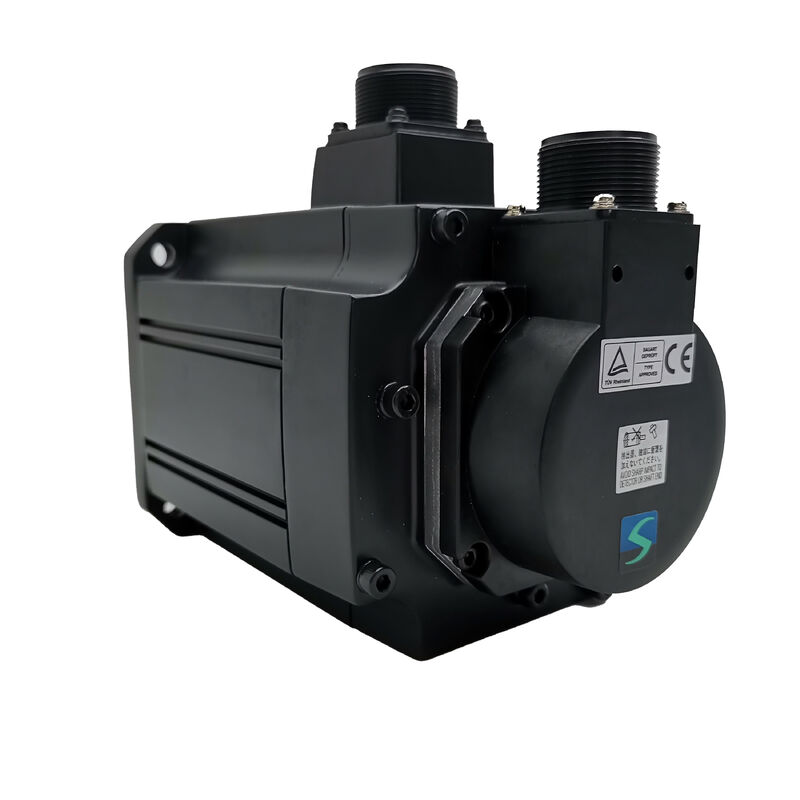
Mitsubishi HC-SFS153K (HCSFS153K) — 1.5kW AC Servo Motor, Keyed Shaft, No Brake, 3000 rpm, MELSERVO J2-Super Series
Product Overview
Part Number: HC-SFS153K
Also Searched As: HCSFS153K, HC SFS 153K, HC-SFS-153K
Series: Mitsubishi MELSERVO HC-SFS (J2-Super Generation)
Classification: Medium-Inertia AC Brushless Servo Motor — 1.5 kW, 200V class, 3000 rpm, Keyed Shaft, No Brake
Opening: A Motor With a Specific Purpose
There are servo motors designed for flexibility and servo motors designed with a particular mechanical interface in mind.
The Mitsubishi HC-SFS153K leans toward the latter. The "K" suffix is the critical designator — a machined keyway on the shaft that fundamentally changes how torque is transmitted from the motor to the driven component.
At 1.5kW and 3,000 rpm on a 130 × 130 mm flange, the HC-SFS153K fits into the compact end of the medium-capacity servo range.
Its 4.78 Nm continuous torque and 14.3 Nm peak sit in a practical band for machine tool auxiliary axes, medium-speed conveyor drives, and any mechanism where the motor-to-load coupling must be both precise and mechanically positive.
The keyed shaft is the feature that makes it right for those applications where a plain straight shaft, however reliably clamped, introduces some doubt about the torque path integrity over the motor's service life.
Behind the shaft: the same 17-bit serial absolute encoder at 131,072 ppr that runs throughout the J2-Super HC-SFS family, paired with the MR-J2S-200 amplifier class.
Technical Specifications
| Parameter |
Value |
| Part Number |
HC-SFS153K |
| Rated Output |
1,500 W (1.5 kW) |
| Supply Voltage |
200V class (3-phase 200–230V AC) |
| Rated Speed |
3,000 rpm |
| Maximum Speed |
4,500 rpm |
| Rated Torque |
4.78 Nm |
| Peak Torque |
14.3 Nm |
| Encoder Type |
17-bit serial absolute |
| Encoder Resolution |
131,072 ppr |
| Shaft Type |
Keyed (machined keyway) |
| Electromagnetic Brake |
None |
| Flange Size |
130 × 130 mm |
| Protection Rating |
IP65 |
| Oil Seal |
Fitted |
| Inertia Class |
Medium inertia |
| Ambient Temperature (Operation) |
0°C to +40°C |
| Storage Temperature |
−15°C to +70°C |
| Compatible Amplifiers |
MR-J2S-200A / MR-J2S-200B / MR-J2S-200CP |
| Series Generation |
MELSERVO J2-Super |
| Status |
Discontinued — available as stock |
Why the Keyed Shaft Changes Things
Most servo applications use a smooth straight shaft and friction-clamp coupling. It works well, the coupling range is wide, and installation is straightforward. So when is a keyed shaft the right answer instead?
The answer has to do with what the friction-clamp interface is actually doing.
A split-hub or shrink-fit coupling transmits torque through the friction between the hub bore and the shaft OD. That friction is set by the clamping force at installation — typically a set screw or through-bolt on the split hub — and it must be large enough to resist the peak torque without slip: in this case, 14.3 Nm on every acceleration transient, cycle after cycle, across the motor's full service life.
Under ideal conditions, friction couplings at 1.5kW handle this reliably. Under less ideal conditions — vibration-induced hub loosening over thousands of hours, thermal cycling that slightly changes clamping geometry, shock inputs from chain engagement or gear tooth contact — the safety margin that seemed adequate at installation can erode.
When it does, slip is usually intermittent and the following error is small enough that no alarm trips. The axis develops a position repeatability problem that is genuinely difficult to diagnose because it only appears when the axis is working hard.
The keyway eliminates this failure mode. The key occupies matched slots in both shaft and hub, transmitting torque through its shear cross-section rather than through friction.
The torque path is mechanically positive — it does not depend on clamping force, does not degrade with vibration, and does not loosen with thermal cycling.
Cyclic loading, reversal, and shock inputs that would challenge a friction interface do not affect a keyed joint.
For a 1.5kW motor at 3,000 rpm where the driven component — a timing sprocket, worm gear input, synchronous belt pulley, or gear hub — has a keyway bore either by design or by customer requirement, the HC-SFS153K is the correct and natural choice.
There is no performance tradeoff. The 4.78 Nm rated torque and 14.3 Nm peak are identical to the straight-shaft HC-SFS153.
1.5kW at 3000 rpm: The Operating Point
Four point seven eight Newton-metres at 3,000 rpm is a specific combination that suits a well-defined set of axis types.
It is more torque than the 1kW HC-SFS103 (3.18 Nm at the same speed), which becomes relevant when the axis sustains moderate load through its entire operating range rather than just during acceleration transients. A 1kW motor whose axis regularly demands close to 3.18 Nm continuously is operating near its thermal ceiling with little margin.
The HC-SFS153K at 4.78 Nm continuous gives that same axis roughly 50% more sustained torque capacity — headroom that shows up as lower operating temperature, longer winding life, and reduced frequency of overload alarms on demanding production cycles.
The 3,000 rpm rated speed serves the same purpose it does throughout the HC-SFS 3000 rpm range: enabling direct coupling to mechanisms that need shaft speed rather than shaft torque. A 5mm pitch ball screw driven at 3,000 rpm reaches 15 m/min linear speed — fast enough for many CNC auxiliary axes without any reduction stage.
A timing belt drive with a 2:1 ratio converts this to 1,500 rpm at the driven shaft while doubling the available torque, placing the working point closer to where many gear-coupled or belt-driven mechanisms actually need it.
The maximum speed of 4,500 rpm extends the operating range above the rated point in the constant-power region, where available torque decreases proportionally.
This extended range is useful for rapid traversal phases on positioning axes where the load is light and the traversal torque demand is well below the rated figure.
Sitting Between the 103 and the 203
The HC-SFS 3000 rpm range on the 130 × 130 mm flange runs from 500W (HC-SFS53) through 2,000W (HC-SFS203) in four steps. The HC-SFS153K sits at the third step — above the 1kW HC-SFS103, below the 2kW HC-SFS203, and sharing the same physical frame and mounting interface with both.
| Model |
Output |
Rated Torque |
Peak Torque |
Amplifier |
| HC-SFS53K |
500 W |
1.59 Nm |
4.77 Nm |
MR-J2S-60 |
| HC-SFS103K |
1,000 W |
3.18 Nm |
9.55 Nm |
MR-J2S-100 |
| HC-SFS153K |
1,500 W |
4.78 Nm |
14.3 Nm |
MR-J2S-200 |
| HC-SFS203K |
2,000 W |
6.37 Nm |
19.1 Nm |
MR-J2S-200 |
One detail worth noting: both the HC-SFS153K and the HC-SFS203K use the same MR-J2S-200 amplifier. The flange is identical, the mechanical mounting is the same, and the amplifier pairing is the same.
This means a machine frame designed for the HC-SFS153K can accommodate the HC-SFS203K without any mechanical or electrical panel change — the only parameter adjustment needed is setting the amplifier to recognise the new motor. For applications where future capacity expansion is a possibility, this is a useful design flexibility.
No Brake: The Right Default for Horizontal Keyed-Shaft Axes
The HC-SFS153K carries no electromagnetic brake. This is the correct configuration for the overwhelming majority of horizontal and symmetrically loaded axes where the keyed shaft makes sense.
Keyed-shaft applications typically involve mechanical couplings — sprockets, gear hubs, worm input shafts, belt pulleys — all of which are most common on horizontal mechanisms: conveyor drives, material feed systems, rotary indexers on horizontal planes, auxiliary axes on horizontally mounted machine assemblies.
On these axes, servo lock through the MR-J2S-200's closed position loop is entirely adequate for holding position at rest.
The 17-bit encoder monitors shaft angle continuously; the amplifier supplies corrective current to hold zero following error. There is nothing for a brake to add on a horizontal, balanced mechanism.
The no-brake configuration's practical advantages at this motor size are real. No 24V DC brake circuit in the panel. No relay, no surge suppressor.
No MBR interlock in the PLC. No periodic brake wear inspection on the maintenance schedule. The motor is lighter and shorter than its braked equivalent, which matters on axes where motor mass contributes to the moving structure's inertia.
The HC-SFS153K with a keyed shaft and no brake describes a straightforward mechanical interface: the hub is keyed and locked, the motor is connected to the MR-J2S-200, and the axis operates cleanly without additional holding hardware.
Where the axis is genuinely vertical or gravity-loaded, the HC-SFS153BK (keyed shaft plus spring-applied brake) is the correct specification.
On a machine with several axes of this capacity, applying the vertical-axis test deliberately to each one and specifying accordingly produces a cleaner design than defaulting to brakes everywhere.
Compatible Amplifiers
The HC-SFS153K is paired with the MR-J2S-200 amplifier family — the 2kW capacity J2-Super platform. Despite the motor being 1.5kW, the current demand at 3,000 rpm requires the 2kW amplifier class rather than the 1kW MR-J2S-100. This is consistent across the HC-SFS 3000 rpm range: both the HC-SFS153 and HC-SFS203 use the MR-J2S-200.
MR-J2S-200A handles analog and pulse-train commands from CNC systems, PLCs, and external motion controllers. Position, speed, and torque control modes are all available, along with the switched-mode combinations P/S, S/T, and T/P. RS-232C connects to MR Configurator setup software. This is the standard choice for machine tool and general automation applications.
MR-J2S-200B connects to Mitsubishi A-series and Q-series motion controllers via SSCNET fiber-optic serial bus.
All axis commands and encoder feedback travel over the fiber network. Required for multi-axis machines where coordinated axis motion — electronic gearing, contouring, synchronised feeds — is managed by a Mitsubishi motion controller.
MR-J2S-200CP incorporates built-in single-axis positioning with up to 31 point-table positions, activated by digital I/O or CC-Link network signals.
For standalone indexed positioning axes that do not require coordination with other axes, the CP eliminates the cost of a dedicated motion controller.
Compatibility notes. The HC-SFS153K requires an MR-J2S-200 amplifier. It is not compatible with the first-generation MR-J2-200, which cannot decode the 17-bit J2-Super encoder protocol.
For machines running original MR-J2-200 hardware, the HC-SF153K (keyed shaft, 14-bit encoder, same mechanical dimensions) is the correct motor. Not compatible with MR-J3 or MR-J4 amplifiers without a renewal adapter kit.
Typical Applications
Timing belt and synchronous drive primary axes. Machine axes where the motor drives a timing belt reduction — a very common arrangement on 3,000 rpm servo motors — use keyed pulleys as a matter of standard design practice.
The belt tension pre-loads the pulley hub radially, and the key prevents the pulley from rotating on the shaft under the combined radial and tangential loading of the belt drive. The HC-SFS153K's keyed shaft is precisely what these drives require.
Worm gear input drives. Rotary indexing tables, servo-driven turrets, and angular positioning mechanisms using worm gear reducers connect the motor to the worm shaft through a keyed coupling hub.
The worm drive's resistance to back-driving means the motor is often holding position through the gear reduction rather than through servo lock, and the keyed interface ensures the motor-to-worm coupling is mechanically positive throughout the positioning cycle and the hold phase.
Chain sprocket drives on conveyor and transfer systems. Servo-driven conveyor sections and transfer mechanisms using chain drives mount a sprocket on the motor shaft using a keyed bore.
Chain drives impose intermittent shock loads — each chain link engagement creates a brief torque spike — and the keyed interface handles these cyclic shock inputs robustly where friction clamping would be progressively challenged.
CNC machine tool auxiliary axis drives. Pallet changer rotation axes, rotary tool magazine drives, and swarf conveyor drives on CNC machining centres often use keyed couplings at the motor-to-mechanism interface, particularly where the axis connects to an existing geared mechanism designed around a keyed shaft input.
Textile and converting machine drive rolls. Feed roll and tension roll drives on slitting machines, laminating lines, and textile processing equipment where the roll hub is keyed to the drive shaft throughout the product range. Replacing the motor on such machines without changing the roll hub is straightforward when the motor carries the same keyway specification.
Frequently Asked Questions
Q1: Why does the HC-SFS153K use the MR-J2S-200 amplifier rather than the MR-J2S-100, given that it is only 1.5kW?
The amplifier class is determined by the motor's current demand, not its power rating alone. At 3,000 rpm and 1.5kW, the HC-SFS153K draws a current that exceeds the MR-J2S-100's rated output. Mitsubishi's motor-amplifier compatibility tables confirm the MR-J2S-200 for the HC-SFS153 and HC-SFS203 at 3,000 rpm.
This is consistent with the HC-SFS152 (1.5kW at 2,000 rpm) also using the MR-J2S-200 — the current envelope at this power and speed combination requires the larger amplifier regardless of the motor's nameplate wattage.
Q2: What is the practical difference between the HC-SFS153K (keyed) and HC-SFS153 (straight shaft)?
The performance specifications are identical — same 4.78 Nm rated torque, same 14.3 Nm peak, same encoder, same amplifier. The difference is purely the shaft-to-hub torque path. The HC-SFS153K's machined keyway transmits torque mechanically through the key's shear cross-section; the HC-SFS153's straight shaft relies on friction clamping from the coupling hub.
The keyed variant is appropriate when the driven component has a keyway bore, when the mechanism involves cyclic reversal or shock loading, or when long-term torque path integrity under vibration is a design priority. For smooth-bore precision couplings on clean horizontal axes, the straight-shaft HC-SFS153 is simpler and equally reliable.
Q3: Can the HC-SFS153K substitute for an HC-SF153K on a machine running an MR-J2-200 first-generation amplifier?
No. The HC-SFS153K's 17-bit encoder is incompatible with the first-generation MR-J2-200 amplifier.
Only the HC-SF153K (keyed shaft, 14-bit encoder) is compatible with original MR-J2-200 hardware.
If the machine has already been upgraded to an MR-J2S-200 amplifier, the HC-SFS153K is a direct drop-in replacement mechanically, and the higher encoder resolution is an automatic benefit.
Q4: Where is the absolute encoder backup battery?
The battery — Mitsubishi A6BAT lithium cell — is inside the MR-J2S-200 servo amplifier, not in the motor. It maintains the multi-turn absolute counter through power-off periods. Replace it at the first low-battery alarm from the amplifier.
Do not defer: a fully depleted battery resets the multi-turn counter, requiring a reference-return cycle on the next startup before the axis can return to production. On high-availability machines, the low-battery alarm should be treated as an immediate maintenance task.
Q5: The HC-SFS153K is discontinued. What are the sourcing and upgrade options?
The HC-SFS153K remains available as surplus stock and tested refurbished units through Mitsubishi servo component specialists, making it a practical option for maintaining existing J2-Super platform machines.
For new machine designs or full platform upgrades, the current-generation equivalent draws from the HG-KR or HF-KP series with MR-J4 or MR-JE amplifiers — but both motor and amplifier must be replaced together as the encoder protocol is incompatible.
For machines with many HC-SFS153K units where the amplifiers are still functional, maintaining the existing J2-Super platform through surplus motor sourcing is often more cost-effective than a full drive system upgrade.


 Your message must be between 20-3,000 characters!