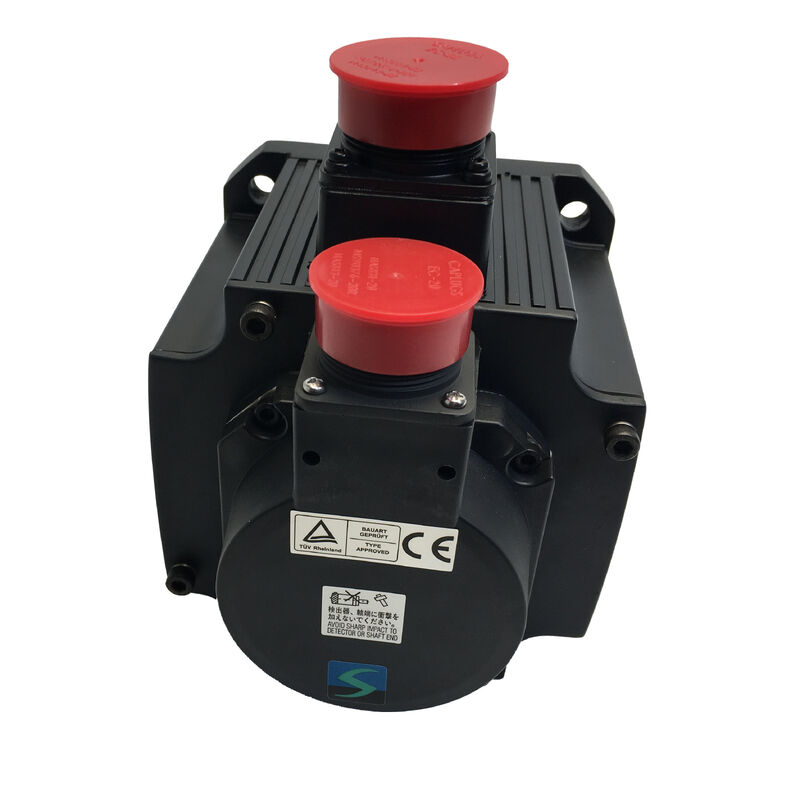
Mitsubishi HC-SFS102BK Servo Motor — 1kW | Keyed Shaft | Electromagnetic Brake | 17-Bit Absolute Encoder | IP65 | MELSERVO J2S
Quick Reference
| Parameter |
Value |
| Part Number |
HC-SFS102BK |
| Alternate Code |
HCSFS102BK |
| Manufacturer |
Mitsubishi Electric |
| Series |
MELSERVO J2S / HC-SFS |
| Rated Output |
1,000 W (1 kW) |
| Supply Voltage |
200 V AC class |
| Rated Current |
6 A |
| Rated Torque |
4.78 Nm |
| Peak Torque |
14.3 Nm |
| Rated Speed |
2,000 rpm |
| Maximum Speed |
3,000 rpm |
| Encoder |
Built-in Absolute, 17-bit (131,072 ppr) |
| Shaft Type |
Keyed |
| Electromagnetic Brake |
Yes — Spring-Applied, Power-Off Type |
| Oil Seal |
Yes |
| Flange |
130 × 130 mm |
| Protection |
IP65 |
| Inertia Class |
Medium Inertia, Medium Capacity |
| Cooling |
Totally Enclosed, Self-Cooled |
| Operating Temp. |
0 °C to +40 °C |
| Compatible Amplifier |
MR-J2S-100A / MR-J2S-100B |
| Condition |
New In Box |
Overview
The HC-SFS102BK occupies a well-defined position in Mitsubishi's MELSERVO J2S servo motor lineup: it is the 1kW member of the HC-SFS medium-inertia family, configured with both an electromagnetic brake and a keyed shaft. Those two features together — brake holding and a positive mechanical shaft engagement interface — define a specific type of application need, one where the servo must drive a load through a keyed coupling, pulley, or sprocket, and must hold that load securely against external forces when the machine is not actively running.
At 1kW output with 4.78 Nm continuous torque at 2,000 rpm, this motor handles the middle range of industrial positioning and feed axis requirements. The medium-inertia HC-SFS design gives it better load tolerance than low-inertia variants — the servo loop stays stable across a wider range of connected load inertia without the gain tuning sensitivity that smaller-rotor motors require. The 17-bit absolute encoder delivers 131,072 position counts per shaft revolution and, with a backup battery in the amplifier, retains position data through every power cycle.
The Keyed Shaft: Why It Matters for Power Transmission
Servo motors most commonly ship with a plain straight shaft, relying on friction couplings or zero-backlash clamp hubs for torque transmission. The K suffix on this motor identifies the alternative: a shaft with machined keyway, accepting a standard key to create a positive mechanical connection between the motor shaft and the driven component.
For applications that use belt pulleys, chain sprockets, gear pinions, or couplings with keyways — especially where the load torque is high, cyclic, or involves direction reversals — the keyed connection provides positive drive without the risk of slippage under peak torque conditions. A clamp coupling on a plain shaft transmits torque through friction; that friction can be overcome under shock loads or repeated reversals. A keyed interface is mechanically positive and does not depend on clamp preload.
The 1kW HC-SFS102 can produce up to 14.3 Nm peak torque — three times the rated continuous value — during acceleration transients. At those peak levels, a properly fitted key and keyway ensures the full torque reaches the load without micro-movement or fretting at the shaft interface.
Electromagnetic Brake: Spring-Applied, Power-Off
The B in this motor's part number designates a spring-applied, electrically-released electromagnetic brake built into the motor body. The mechanics are straightforward: a compression spring physically locks the brake plate against the rotor hub whenever the brake coil is de-energized. Apply 24V DC to the coil, the spring compresses, the shaft rotates freely. Remove the voltage — by design, by fault, or by emergency stop — and the shaft locks immediately, without any command from the control system.
This fail-safe behavior is the reason brake-equipped motors are specified for a well-understood class of applications:
- Vertical ballscrew axes where gravity acts on the carriage or workpiece when the servo is unpowered
- Inclined slides and tilted rotary positioners where the load produces a constant torque urging the axis to move
- Clamping mechanisms where the workpiece must remain clamped through a power interruption
- Safety-critical axes on equipment where unexpected movement at power-down poses a hazard
On horizontal axes with balanced loads, the brake is unnecessary — those applications use the non-brake HC-SFS102K. On the class of axes described above, the HC-SFS102BK's brake provides the mechanical certainty that electronic servo lock cannot.
Installation requirement: the brake coil needs a dedicated 24V DC power supply connected to the motor's brake cable — separate from the servo amplifier supply. This circuit must be included in the machine electrical design; the MR-J2S amplifier does not source brake coil power.
Oil Seal and IP65: Ready for the Machine Floor
Every HC-SFS102BK ships with a factory-fitted oil seal at the drive-end shaft opening. In machine tool environments, coolant mist and lubricant vapor are constants. Over time, without the seal, those contaminants migrate along the shaft into the bearing housing and encoder compartment, degrading both. The oil seal is the primary mechanical barrier preventing that ingress path.
The IP65 motor enclosure adds complete dust exclusion and resistance to water jets from any direction. Together, the oil seal and IP65 rating make this motor directly mountable on CNC machining centers, lathes, grinding machines, and general production equipment without additional protective housings or enclosures around the motor body. That is exactly the standard Mitsubishi specifies for machine tool use, and the specification this motor meets.
17-Bit Absolute Encoder: 131,072 ppr, Battery-Backed
The encoder built into the HC-SFS102BK resolves the motor shaft into 131,072 equal positions per revolution. As an absolute device, it knows its position within that resolution at all times — including immediately after a power cycle, before the servo amplifier has issued a single motion command.
With a Mitsubishi A6BAT lithium battery installed in the servo amplifier's battery holder, the multi-turn counter is preserved through any shutdown. When the machine restarts, every axis reports its last known position to the controller without a reference return sequence. For a keyed-shaft axis driving a pulley or sprocket connected to an external mechanism — where homing might involve careful manual management of the brake and driven mechanism — that retained position reference is particularly valuable.
The encoder's 131,072 ppr resolution is the standard across the HC-SFS and HC-MFS J2S series. It represents the practical positioning resolution of the system, subject to the mechanical transmission between the motor shaft and the load.
Servo Amplifier: MR-J2S-100A and MR-J2S-100B
The HC-SFS102BK is rated for use with the MR-J2S-100A (pulse-train / analog command interface) and MR-J2S-100B (SSCNET serial network interface) amplifiers, both at the 1kW rating within the MELSERVO J2S family.
MR-J2S-100A receives position commands as differential or open-collector pulse trains from PLCs, motion cards, and standalone CNC controllers. It supports position control, speed control, and torque control modes, with mode-switching capability between position/speed, speed/torque, and torque/position during operation. Parameter setup uses RS-232C or RS-422 communication with MR Configurator software.
MR-J2S-100B uses SSCNET — Mitsubishi's dedicated high-speed serial servo network — to connect multiple amplifiers to a motion controller. The SSCNET bus carries synchronized motion commands to all axes simultaneously, enabling precise multi-axis coordination: electronic gearing, interpolation, synchronized clamping cycles. For machines with multiple J2S servo axes, the B variant integrates the HC-SFS102BK into the same SSCNET system as the other axes without additional wiring complexity.
HC-SFS102 Family Configuration Reference
All variants share the same 1kW output, 4.78 Nm rated torque, 2,000 rpm rated speed, 17-bit encoder, oil seal, IP65, and 130×130mm flange. The differences are shaft type and brake:
| Model |
Shaft |
Brake |
| HC-SFS102 |
Straight |
No |
| HC-SFS102B |
Straight |
Yes |
| HC-SFS102K |
Keyed |
No |
| HC-SFS102BK |
Keyed |
Yes |
The HC-SFS102BK is the correct selection when both a keyed shaft interface and electromagnetic brake holding are required simultaneously. For straight shaft applications with brake, use HC-SFS102B. For keyed shaft without brake, use HC-SFS102K.
FAQ
Q1: What is the purpose of the keyed shaft on the HC-SFS102BK, and when should it be specified?
The keyed shaft provides a positive mechanical torque transmission interface between the motor shaft and a driven component — pulley, sprocket, gear, or keyed coupling hub. It is the correct choice when the application uses keyed components, when peak torque loads are high or reversing, or when the application requires a shaft interface that cannot rely on friction clamp preload alone. For applications using zero-backlash clamp hubs on plain shafts, the non-keyed HC-SFS102B is the simpler option.
Q2: Which servo amplifier is compatible with the HC-SFS102BK?
The HC-SFS102BK operates with the MR-J2S-100A (pulse-train and analog command interface) or MR-J2S-100B (SSCNET serial network interface). Both are 1kW-class amplifiers in the MELSERVO J2S platform. The electromagnetic brake requires a separate 24V DC power supply connected directly to the motor brake cable — this circuit is independent of the amplifier and must be included in the machine electrical design.
Q3: Does the HC-SFS102BK encoder retain position data after a power-down?
Yes, when a Mitsubishi A6BAT lithium battery is installed in the servo amplifier's battery holder. The 17-bit absolute encoder's multi-turn position counter is preserved through power-off cycles, so the machine is at its last known position immediately on restart without a reference return sequence. The amplifier issues a low-battery warning alarm before the battery drops below the minimum voltage threshold, providing advance notice for scheduled replacement.
Q4: What is the difference between the HC-SFS102BK and the older HC-SF102BK?
The HC-SFS102BK belongs to the MELSERVO J2S series (high-resolution, 17-bit absolute encoder). The older HC-SF102BK is from the earlier MELSERVO J2 platform with a lower-resolution encoder. The two series use different amplifiers and different encoder cables and are not electrically interchangeable. When replacing an HC-SFS102BK in an existing J2S-platform machine, the replacement must be the HC-SFS102BK — substituting an HC-SF102BK would require amplifier and wiring changes.
Q5: Is the HC-SFS102BK still available, and what is the current-generation equivalent?
The HC-SFS series is part of the MELSERVO J2S generation, which has been succeeded by J4 and J5 platforms. New-in-box HC-SFS102BK units remain available through industrial automation parts distributors for maintenance and replacement of existing J2S machines — it is a direct drop-in for failed or damaged units without any system changes. For new machine designs, the functional current-generation equivalent in the 1kW / 2,000 rpm / keyed / brake class is the HG-SR102BK (MELSERVO J4 series), which requires J4 amplifiers and different encoder cables.


 Your message must be between 20-3,000 characters!