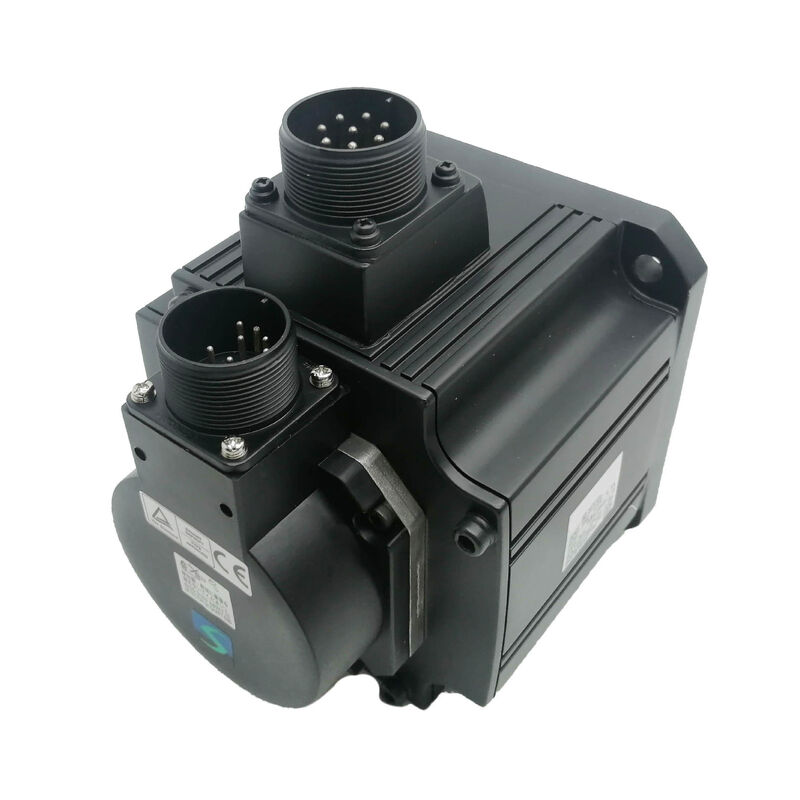
Mitsubishi HC-SFS352 (HCSFS352) — 3.5kW AC Servo Motor, Straight Shaft, No Brake, 2000 rpm, MELSERVO J2-Super Series
Product Overview
Part Number: HC-SFS352
Also Searched As: HCSFS352, HC SFS 352, HC-SFS-352
Series: Mitsubishi MELSERVO HC-SFS (J2-Super Generation)
Classification: Medium-Inertia AC Brushless Servo Motor — 3.5 kW, 200V class, 2000 rpm, Straight Shaft, No Brake
The Motor in Its Range
The Mitsubishi HC-SFS352 occupies a specific and well-defined position in the J2-Super servo platform. It is not the entry-level 2kW motor that covers general-purpose light axes, nor the upper-bracket 5kW or 7kW units that belong on the heaviest machine tool and industrial machinery drives. It is the 3.5kW middle step — the motor that handles axes where 2kW has been outgrown but 5kW is more than the application demands.
In practical terms: 16.7 Nm of continuous torque at 2,000 rpm. Fifty-one Newton-metres available on demand for acceleration. A 176 × 176 mm flange that shares its bolt circle with every other large-frame HC-SFS variant. A straight shaft for clean coupling to precision servo coupling devices. No brake — servo lock holds the axis at rest, without the wiring complexity, relay maintenance, and additional panel resources that an electromagnetic brake requires.
Behind all of that is the J2-Super platform's 17-bit serial absolute encoder: 131,072 positions per revolution, multi-turn absolute count maintained through power-off by a battery in the MR-J2S-350 amplifier, immediate absolute position reporting on every restart. The encoder is what elevates the HC-SFS352 above the first-generation HC-SF352 mechanically and operationally — higher resolution, absolute position without homing, and better low-speed velocity smoothness from finer feedback granularity.
Technical Specifications
| Parameter |
Value |
| Part Number |
HC-SFS352 |
| Rated Output |
3,500 W (3.5 kW) |
| Supply Voltage |
200V class (3-phase 200–230V AC) |
| Rated Speed |
2,000 rpm |
| Maximum Speed |
3,000 rpm |
| Rated Torque |
16.7 Nm |
| Peak Torque |
50.1 Nm |
| Encoder Type |
17-bit serial absolute |
| Encoder Resolution |
131,072 ppr |
| Shaft Type |
Straight (no keyway) |
| Electromagnetic Brake |
None |
| Flange Size |
176 × 176 mm |
| Protection Rating |
IP65 |
| Oil Seal |
Fitted |
| Inertia Class |
Medium inertia |
| Ambient Temperature (Operation) |
0°C to +40°C |
| Storage Temperature |
−15°C to +70°C |
| Vibration Resistance (X axis) |
24.5 m/s² |
| Vibration Resistance (Y axis) |
29.4 m/s² |
| Compatible Amplifiers |
MR-J2S-350A / MR-J2S-350B / MR-J2S-350CP |
| Series Generation |
MELSERVO J2-Super |
| Status |
Discontinued — available as stock |
16.7 Nm Continuous: What That Torque Actually Does
Torque is the currency of a servo axis, and 16.7 Nm continuous deserves to be understood in concrete mechanical terms rather than as an abstract specification number.
On a ball screw axis with 10mm pitch and 90% efficiency, 16.7 Nm of sustained motor torque translates to roughly 9.4 kN of axial feed force. That is enough to drive medium-to-heavy machining centre table axes at full production feed rates without approaching the thermal ceiling. On a 16mm pitch screw — more common on larger machines where rapid traverse speed matters — 16.7 Nm produces approximately 5.9 kN of sustained axial force. Both scenarios cover a substantial range of real production cutting loads without overloading the motor.
For winding and tension drives running in torque control mode, 16.7 Nm at 2,000 rpm establishes the working torque range available across the roll diameter. As roll diameter grows and the required motor speed to maintain line speed drops, the available torque stays at 16.7 Nm — or, if running below rated speed, even more torque is available from the torque-speed characteristic without exceeding thermal limits. This is why 3.5kW medium-frame servo motors are well represented on mid-sized winding stations.
The 50.1 Nm peak — exactly three times continuous — is what makes rapid positioning possible without motor oversizing. A 3.5kW axis making fast point-to-point moves spends a small fraction of each cycle at peak torque during the acceleration ramp, the majority of the cycle at or below continuous torque during constant-velocity motion, and another brief fraction decelerating. The MR-J2S-350's electronic thermal model tracks this duty cycle continuously, integrating the thermal load over time and alarming before the winding temperature reaches a damaging level. In practice, a well-sized axis running a typical positioning duty cycle will never see that alarm trigger under normal production conditions.
HC-SFS352 vs HC-SF352: The Encoder Generation Distinction
The HC-SFS352 and HC-SF352 are mechanically identical. Same 176 × 176 mm flange. Same shaft diameter. Same IP65 rating. Same coupling interface. They are dimensionally interchangeable in every physical respect, and a machine mounting designed for one accepts the other without modification.
The difference is entirely in the encoder and the amplifier compatibility it creates.
The HC-SF352 carries a 14-bit encoder — 16,384 positions per revolution. It is the J2-generation motor, compatible with both the first-generation MR-J2-350 amplifier and the J2-Super MR-J2S-350 amplifier.
The HC-SFS352 carries a 17-bit encoder — 131,072 positions per revolution, eight times the resolution. It is the J2-Super generation motor, compatible exclusively with the MR-J2S-350 amplifier family. A first-generation MR-J2-350 amplifier cannot read the 17-bit serial protocol and will fault immediately on startup.
The resolution difference has tangible consequences. Eight times more encoder counts per revolution means eight times finer velocity feedback at any given shaft speed. This shows up as smoother motor behaviour at low feed rates — less velocity ripple, better following error performance, more stable torque output during slow constant-velocity operation. For applications where low-speed smoothness matters — surface grinding wheel head feeds, slow-speed winding drives, fine finishing passes on precision machining operations — the HC-SFS352's 17-bit encoder delivers noticeably better performance than the HC-SF352's 14-bit predecessor.
The absolute position capability is structurally the same in both generations, but the resolution advantage of the 17-bit unit applies to the absolute position register as well as the velocity loop.
Straight Shaft at 3.5kW: Coupling Selection and Installation
At 3.5kW with 50.1 Nm peak torque, the coupling that connects the HC-SFS352 to its driven mechanism is doing real work, and the selection needs to account for the full torque range — not just the 16.7 Nm rated figure.
The peak torque governs coupling selection. A flexible coupling rated to 16.7 Nm handles rated conditions but is marginal during every acceleration transient at 50.1 Nm. The standard approach is to select the coupling at the peak torque value with an appropriate service factor — 1.5× for inertial loads with smooth cycling, higher for applications with mechanical shock. At 50.1 Nm peak with a 1.5× service factor, the coupling design target is 75 Nm or above. This is squarely within the range of standard industrial servo couplings at the 176 × 176 mm motor frame size, where shaft diameters are large enough to support substantial bore capacity.
Bellows couplings and disc couplings in this torque range offer the combination of high torsional stiffness and angular/parallel misalignment accommodation that servo positioning axes require. High torsional stiffness matters because a compliant coupling between the motor and the position feedback introduces lag between what the encoder measures and what the load is actually doing — a compliance that can cause oscillation in high-gain position loops. At 3.5kW on a well-sized positioning axis, this is a real design consideration, not a theoretical one.
The drawbolt rule at this frame size. The 176 × 176 mm motor has an M12 threaded hole at the shaft end for exactly this purpose: always use a drawbolt to pull coupling hubs axially onto the shaft during installation. The alternative — pressing or tapping the hub on — transmits axial impact through the shaft to the encoder disc and rear bearing. At this frame size, the shaft is long enough that the impact energy reaching the encoder end is significant. The damage does not produce an immediate fault; it shows up weeks later as intermittent encoder errors under vibration, a symptom that takes time and effort to trace back to the installation event. The drawbolt method prevents this entirely and adds thirty seconds to the installation.
For applications requiring a keyed coupling interface — gear hubs, sprockets, worm gear inputs, custom pulleys with keyway bores — the HC-SFS352K (keyed shaft, no brake) is mechanically and electrically identical to the HC-SFS352 in every respect other than the shaft keyway. Both motors use the same MR-J2S-350 amplifier, have the same torque specifications, and use the same encoder.
No Brake: Where This Configuration Fits
The HC-SFS352 without an electromagnetic brake is the right motor for every 3.5kW axis where no gravitational or sustained load force acts in the direction of shaft rotation when servo current is absent.
That covers more ground than it might initially seem. Horizontal machining centre table axes, where the table weight acts perpendicular to the direction of motion and servo lock comfortably holds position at rest. Horizontal conveyor drives and transfer shuttles with symmetric loading. Rotary indexing tables mounted on horizontal planes where balanced indexing mechanism design means no net gravitational torque at any station angle. Winding drives with horizontal arbour axes where roll weight is carried by arbour bearings, not by the servo axis.
On all of these, servo lock through the MR-J2S-350's closed position loop holds position reliably and accurately. The 17-bit encoder monitors shaft angle continuously; the amplifier responds to any deviation with corrective current. For well-tuned axes, the shaft does not move perceptibly at rest.
The advantages of omitting the brake on horizontal axes are real and cumulative across a machine with several servo axes. No 24V DC brake circuits to design and wire. No brake relay and surge suppressor on each axis. No MBR interlock sequence in the PLC program. No brake disc wear measurement on the maintenance schedule. A lighter motor on each axis where the motor is part of the moving structure. Simpler commissioning with fewer parameters to set.
The boundary is straightforward: any axis where servo current loss would cause the load to move under gravity or other sustained force needs a brake. For those applications — vertical Z-axes, inclined feeds, gravity-loaded mechanisms — the HC-SFS352B (straight shaft, spring-applied brake) is the correct specification. On a machine with a mix of horizontal and vertical axes at this capacity, specifying the HC-SFS352 on the horizontal ones and the HC-SFS352B on the vertical ones is the optimal design outcome.
Compatible Amplifiers
The HC-SFS352 is designed for the MR-J2S-350 amplifier family — the 3.5kW capacity J2-Super platform. Three interface variants:
MR-J2S-350A is the general-purpose analog and pulse-train interface amplifier. It accepts pulse-train position commands from CNC controllers and PLCs, plus analog speed and torque references. All control modes — position, speed, torque, and switched combinations P/S, S/T, T/P — are available. RS-232C port supports MR Configurator for parameter configuration, auto-tuning, and diagnostic monitoring. For machine tool feed axes and general industrial positioning where the axis receives commands from an external CNC system or PLC, this is the standard choice.
MR-J2S-350B connects to Mitsubishi A-series and Q-series motion controllers via SSCNET fiber-optic serial bus. All axis commands, encoder feedback, alarm status, and monitoring data travel over the fiber link — there is no separate pulse or analog wiring from the controller to the axis. For multi-axis machines requiring coordinated motion — simultaneous contouring, electronic gearing, synchronised feed axes — the SSCNET bus provides the tight real-time axis coupling that analog and pulse interfaces cannot deliver.
MR-J2S-350CP provides built-in single-axis positioning with up to 31 stored point-table positions, activated by digital I/O or CC-Link network command. No separate motion controller is required for axes where the positioning logic is simple enough to express as a set of target positions, speeds, and acceleration times. Suitable for indexed rotary tables, shuttle axes, and standalone transfer mechanisms.
Compatibility notes. The HC-SFS352 requires an MR-J2S-350 amplifier. It is not compatible with the first-generation MR-J2-350, which cannot decode the 17-bit J2-Super encoder serial protocol. For machines running original MR-J2-350 hardware, the HC-SF352 (same mechanical specification, 14-bit encoder) is the correct motor. Not compatible with MR-J3 or MR-J4 amplifiers without a renewal adapter kit.
HC-SFS 2000 rpm Family — The 352 in Perspective
| Model |
Output |
Rated Torque |
Peak Torque |
Flange |
Amplifier |
| HC-SFS202 series |
2,000 W |
9.55 Nm |
28.6 Nm |
176 × 176 mm |
MR-J2S-200 |
| HC-SFS352 series |
3,500 W |
16.7 Nm |
50.1 Nm |
176 × 176 mm |
MR-J2S-350 |
| HC-SFS502 series |
5,000 W |
23.9 Nm |
71.6 Nm |
176 × 176 mm |
MR-J2S-500 |
| HC-SFS702 series |
7,000 W |
33.4 Nm |
100 Nm |
176 × 176 mm |
MR-J2S-700 |
The HC-SFS352 sits between the 2kW and 5kW capacity points, all sharing the same 176 × 176 mm mounting flange. A machine frame designed for any one of these motors accommodates all four without mechanical modification — only the amplifier and motor are changed. This mechanical consistency across the entire 2–7kW capacity range is a significant design advantage: machine variants with different axis torque requirements can share a common structural design.
The torque step from the HC-SFS202 (9.55 Nm) to the HC-SFS352 (16.7 Nm) is roughly 75%. That gap is meaningful when an axis is regularly operating near the HC-SFS202's continuous torque ceiling and occasional overload alarms are occurring in production. Moving to the HC-SFS352 provides substantial headroom without requiring any mechanical design change beyond the motor mount itself — same flange, different amplifier class.
Every model in the HC-SFS 2000 rpm range is available in four shaft and brake configurations: straight shaft (HC-SFS352), straight shaft with brake (HC-SFS352B), keyed shaft (HC-SFS352K), and keyed shaft with brake (HC-SFS352BK). The amplifier pairing is MR-J2S-350 for all four variants.
Typical Applications
Horizontal machining centre feed axes. X and Y table axes on vertical machining centres, horizontal machining centres, and bridge mills handling medium-to-heavy table and workpiece mass. The 16.7 Nm continuous torque sustains production feed rates without overloading; the 50.1 Nm peak accelerates the table mass efficiently during rapid traverse; the 17-bit encoder closes the position loop with the resolution needed for dimensional accuracy on finished workpieces.
Large-format plasma and waterjet cutting machine gantry axes. Servo-driven gantry bridge and carriage axes on large cutting tables where bridge or carriage mass and required traverse speed together demand 3.5kW. The straight shaft couples to rack-and-pinion or timing belt gantry drives; the absolute encoder eliminates homing on startup, which matters on large cutting tables where the gantry can stop at any position along a multi-metre travel range.
Medium-format winding and unwinding tension drives. Winding station drives on paper, film, and converting lines running in torque control mode to maintain constant web tension as the roll diameter varies. The 16.7 Nm sustained torque capacity covers the tension-and-speed working envelope of mid-range winding stations; the J2-Super amplifier's real-time auto-tuning manages the changing inertia as roll diameter grows.
Transfer machine and shuttle axes. Servo-driven transfer shuttle drives, pallet transfer axes, and part handling mechanisms on machining cells and assembly transfer lines. Horizontal transfer mechanisms with this torque requirement run cleanly on the no-brake HC-SFS352; the absolute encoder eliminates homing at each cell startup; and the 176 × 176 mm frame handles the mounting requirements of transfer machine structural designs.
CNC grinding machine feed and dressing axes. Grinding wheel head feed axes, table drive axes, and wheel dressing mechanism drives on cylindrical, surface, and profile grinding machines. The 17-bit encoder resolution supports the fine position increments used in grinding cycles and spark-out operations; the straight shaft couples to precision ball-screw assemblies through stiff bellows or disc couplings appropriate to the machine's accuracy requirements.
Frequently Asked Questions
Q1: What is the practical difference between the HC-SFS352 and the HC-SF352?
Both motors are 3.5kW, 2000 rpm, straight-shaft units on a 176 × 176 mm flange with identical mechanical dimensions and IP65 protection. The difference is the encoder generation. The HC-SF352 uses a 14-bit encoder (16,384 ppr) and is compatible with both first-generation MR-J2-350 and J2-Super MR-J2S-350 amplifiers. The HC-SFS352 uses a 17-bit encoder (131,072 ppr) and requires an MR-J2S-350 amplifier only. For machines already running MR-J2S-350 amplifiers, the HC-SFS352 is the preferred choice for its higher resolution and better low-speed performance. For machines still on original MR-J2-350 hardware, the HC-SF352 is the compatible motor.
Q2: Why does the HC-SFS352 need the MR-J2S-350 amplifier specifically, not the MR-J2S-200?
The amplifier class is matched to the motor's rated output and current demand. At 3.5kW, the HC-SFS352 draws more current than the MR-J2S-200 is rated to supply. Mitsubishi's compatibility tables are explicit: the MR-J2S-200 pairs with motors up to 2kW (and the 1.5kW and 2kW 3000 rpm variants) while the MR-J2S-350 is the correct amplifier for the 3.5kW capacity group. Using an undersized amplifier would result in overload faults during normal production operation.
Q3: Can the HC-SFS352 be used on a vertical axis without a brake?
Only after carefully verifying that the axis is safe without mechanical holding. Servo lock holds position reliably when the amplifier is enabled under normal operating conditions, but it provides no restraint if servo current drops to zero unexpectedly. On a vertical axis where the load would fall or move under gravity at servo-off, the HC-SFS352B (straight shaft with spring-applied brake) is the correct specification. On confirmed horizontal or symmetrically balanced axes — where no net force acts in the direction of shaft rotation when servo is inactive — the HC-SFS352 without a brake is the cleaner and correct specification.
Q4: Where is the absolute encoder backup battery and when should it be replaced?
The backup battery — Mitsubishi A6BAT lithium cell — is located inside the MR-J2S-350 servo amplifier, not in the motor. It maintains the multi-turn absolute counter through all power-off periods. Battery replacement is a panel-level task that does not require touching the motor or coupling. Replace the A6BAT at the first low-battery alarm from the amplifier. A fully depleted battery resets the multi-turn counter and requires a reference-return cycle before the axis can resume production. On any machine where that homing movement requires preparation or carries risk, the low-battery alarm should be treated as an immediate maintenance item.
Q5: Is the HC-SFS352 still available, and what is the long-term replacement path?
The HC-SFS352 is discontinued by Mitsubishi but remains available through industrial automation surplus dealers and Mitsubishi servo specialist suppliers as new old stock and tested refurbished units. For machines committed to J2-Super hardware, this sourcing path is well established. For new machine designs or full platform upgrades, the current-generation mechanical equivalent is the HG-SR352 (MR-J4 series, 3.5kW, 2000 rpm, 22-bit encoder, 176 × 176 mm flange, IP67) paired with an MR-J4-350 amplifier. Upgrading from HC-SFS352 to HG-SR352 requires replacing both motor and amplifier as a matched pair.


 Your message must be between 20-3,000 characters!