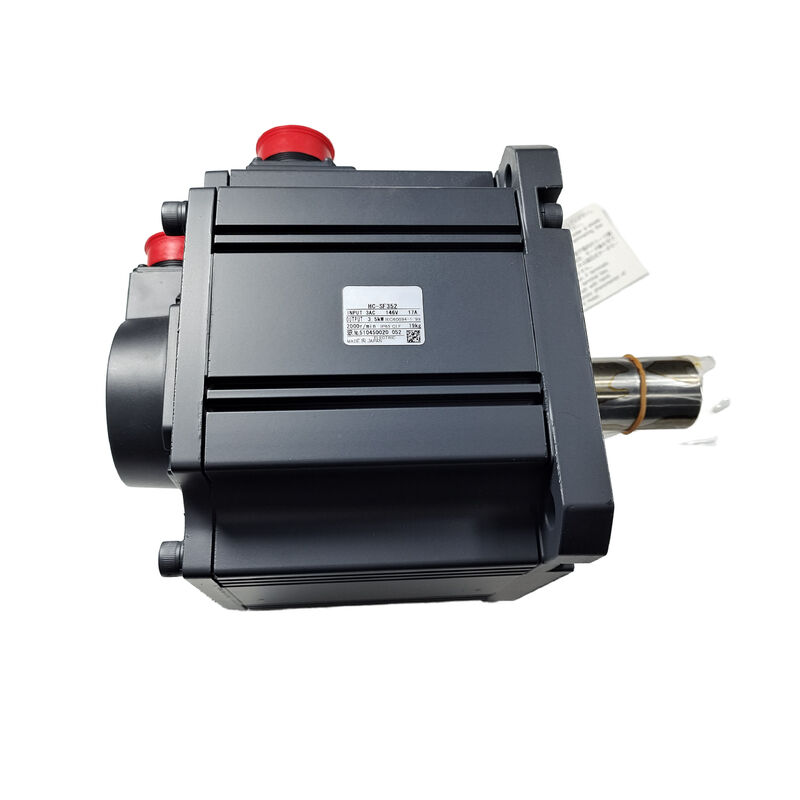
Mitsubishi HC-SF352 (HCSF352) — 3.5kW AC Servo Motor, Straight Shaft, No Brake, 2000 rpm, MELSERVO J2 Series
Product Overview
Part Number: HC-SF352
Also Searched As: HCSF352, HC SF 352, HC-SF-352
Series: Mitsubishi MELSERVO HC-SF (J2 Generation)
Classification: Medium-Inertia AC Brushless Servo Motor — 3.5 kW, 200V class, 2000 rpm, Straight Shaft, No Brake
Placing the HC-SF352 in Context
Before getting into specifications, one distinction is worth making plainly because it affects amplifier selection directly.
The HC-SF352 belongs to the J2 (first-generation MELSERVO) platform, not the J2-Super. Its encoder is 14-bit — 16,384 positions per revolution — and it is compatible with both the original MR-J2-350 and the newer MR-J2S-350 amplifiers.
The J2-Super equivalent is the HC-SFS352, which carries a 17-bit encoder and requires an MR-J2S amplifier exclusively.
This distinction matters in two practical situations. First, when sourcing a replacement for an existing machine: knowing which generation the machine was designed around determines which motor is appropriate.
An MR-J2-350 amplifier will run the HC-SF352 correctly; it will not accept the 17-bit protocol of the HC-SFS352.
Second, when evaluating whether a particular used or surplus motor is the right fit: the HC-SF352 and HC-SFS352 are physically interchangeable — same flange, same shaft dimensions — but electrically they serve different amplifier generations.
With that clarified: the HC-SF352 is a 3.5kW, 2000 rpm, medium-inertia servo motor rated at 16.7 Nm continuous torque and 50.1 Nm peak, on a 176 × 176 mm flange with IP65 protection and a straight shaft without electromagnetic brake.
Technical Specifications
| Parameter |
Value |
| Part Number |
HC-SF352 |
| Rated Output |
3,500 W (3.5 kW) |
| Supply Voltage |
200V class (3-phase 200–230V AC) |
| Rated Speed |
2,000 rpm |
| Maximum Speed |
3,000 rpm |
| Rated Torque |
16.7 Nm |
| Peak Torque |
50.1 Nm |
| Encoder Type |
14-bit serial (16,384 ppr) |
| Shaft Type |
Straight (no keyway) |
| Electromagnetic Brake |
None |
| Flange Size |
176 × 176 mm |
| Protection Rating |
IP65 |
| Oil Seal |
Fitted |
| Inertia Class |
Medium inertia |
| Ambient Temperature (Operation) |
0°C to +40°C |
| Compatible Amplifiers |
MR-J2-350 / MR-J2S-350A / MR-J2S-350B / MR-J2S-350CP |
| Series Generation |
MELSERVO J2 |
| Status |
Discontinued — available as stock |
3.5kW at 2000 rpm: The Torque Story
Sixteen point seven Newton-metres of continuous torque. At 2,000 rpm, that is a substantial sustained force capability for industrial servo axes — enough to drive heavy ball-screw tables on large CNC machining centres, maintain constant tension on industrial winding machines handling heavy substrates, power the input shaft of a worm gear reduction on a heavy rotary indexer, or sustain the feed force on a servo-driven press or forming machine across a full production cycle.
The 50.1 Nm peak — three times the continuous rating — comes into play during the acceleration and deceleration phases of positioning cycles.
For a heavy axis making rapid point-to-point moves, the peak torque drives the velocity ramp aggressively, spending the acceleration phase well above rated torque while keeping the thermal budget intact because those transients are brief relative to the settled-speed phase.
That 3:1 peak-to-continuous ratio is the J2-generation norm across the HC-SF 2000 rpm family, and it is what allows a motor rated at a given continuous torque to execute fast positioning cycles without requiring oversizing relative to the sustained load requirement.
One sizing note worth making explicit: on vertical axes with unbalanced loads, Mitsubishi's documentation consistently recommends keeping the sustained gravitational torque component at 70% or below the rated continuous torque.
At 16.7 Nm rated, that ceiling is approximately 11.7 Nm of sustained gravitational load. Axes approaching or exceeding that figure need either a counterbalance or a motor with a higher continuous torque rating.
HC-SF vs HC-SFS: The 14-Bit Question
The most important thing to get right when procuring or replacing an HC-SF352 is the encoder generation, and it comes down to a single practical question: what amplifier is the machine running?
HC-SF352 (14-bit, 16,384 ppr) — Compatible with MR-J2-350 (first generation) and MR-J2S-350 (J2-Super).
This motor works with both generations because Mitsubishi designed the J2-Super amplifiers to remain backward-compatible with J2-generation motors.
HC-SFS352 (17-bit, 131,072 ppr) — J2-Super only. This motor requires an MR-J2S-350 amplifier and will not communicate with an original MR-J2-350 amplifier.
The consequence for replacement sourcing: a machine running an MR-J2-350 amplifier needs the HC-SF352, not the HC-SFS352.
Installing the SFS variant on an MR-J2-350 amplifier will produce an encoder communication fault on startup.
Conversely, if the machine is already running an MR-J2S-350 amplifier, either motor will work — but the HC-SFS352 delivers higher encoder resolution (131,072 vs 16,384 ppr) and is the preferred choice for machines where positioning accuracy benefits from finer feedback.
The mechanical dimensions of both motors are identical: same 176 × 176 mm flange, same shaft diameter, same mounting interface. The choice is entirely determined by the amplifier generation on the machine.
Straight Shaft: Coupling Design at 3.5kW
A straight shaft without a keyway is the standard starting point for servo motor coupling design, and at 3.5kW with a 50.1 Nm peak torque, the coupling selection deserves deliberate attention.
The critical figure for coupling selection is the peak torque, not the rated continuous torque. A coupling or hub sized to the 16.7 Nm rated figure will be undersized during every acceleration cycle that approaches peak torque.
Standard practice at this capacity is to use the peak torque as the sizing baseline, then apply an appropriate service factor — typically 1.5 to 2× for applications with inertial loads and moderate shock, higher for applications with significant mechanical shock from gear mesh or chain engagement.
At 50.1 Nm peak with a 2× service factor, the coupling selection target is 100 Nm or above.
This is well within the range of standard industrial servo coupling products — bellows couplings, disc couplings, and jaw-type couplings rated for this torque range are catalogue items from major coupling manufacturers.
The 176 × 176 mm frame motor's shaft diameter is larger than compact-class motors, which means higher bore capacity for standard hub designs and generally lower stress at the shaft-hub interface.
For applications where the driven component — a gear, sprocket, or pulley — requires a keyed bore, the HC-SF352K (keyed shaft, no brake) uses the same amplifier and delivers identical electrical performance. The two variants are interchangeable from the amplifier's perspective.
Hub installation reminder at this frame size. The shaft-end threaded hole on 176 × 176 mm motors is there for a specific purpose: use a drawbolt to pull the coupling hub axially onto the shaft rather than pressing or hammering it on.
Axial impact loads during hub fitting travel through the shaft to the encoder disc and rear bearing, and the resulting damage — typically subtle encoder bearing degradation — tends to appear weeks later as intermittent encoder errors under vibration rather than immediately. Using the drawbolt method takes moments longer and prevents the problem entirely.
No Brake: Assessing the Application
The HC-SF352 carries no electromagnetic brake. At rest, axis position is maintained by the amplifier's servo lock — the position loop remains active, encoder feedback continuously monitors shaft angle, and the amplifier supplies the current needed to hold zero following error.
For horizontal axes and balanced mechanisms, this is reliable, accurate, and practically maintenance-free.
There is no relay to inspect, no brake disc to measure for wear, no 24V circuit to maintain, and no MBR interlock sequence adding logic to the PLC program. On a machine where most servo axes are horizontal, the no-brake configuration is the clean choice.
The situation changes when the axis has a gravitational load component.
The 3.5kW capacity range is common on Z-axes of large CNC machining centres, vertically travelling gantries, servo-driven lift mechanisms, and inclined feed drives — all applications where the load has weight that acts in the direction of shaft rotation when servo current drops to zero. In those cases, the mechanical brake is not optional.
The HC-SF352B (straight shaft, spring-applied brake) or HC-SF352BK (keyed shaft, brake) are the correct choices.
If the question for a given axis is genuinely unclear — "is this axis horizontal enough that servo lock is sufficient?" — the conservative and correct answer is to specify the brake. Removing an unneeded brake costs some mechanical simplicity; omitting a needed brake on a gravity-loaded vertical axis creates a hazard.
Compatible Amplifiers
The HC-SF352 is compatible with the MR-J2-350 first-generation amplifier and the full range of MR-J2S-350 J2-Super amplifiers.
MR-J2-350A — First-generation general-purpose interface. Pulse-train and analog command inputs. Position, speed, and torque control.
The original paired amplifier for machines built around the HC-SF352 during the J2 platform era. Still in service on many older machine tools.
MR-J2S-350A — J2-Super general-purpose interface. Pulse-train and analog commands, all control modes, RS-232C for MR Configurator.
The preferred amplifier for new installations using the HC-SF352, offering real-time auto-tuning, adaptive vibration suppression, and improved servo performance over the first-generation MR-J2.
MR-J2S-350B — J2-Super SSCNET bus interface. Connects to Mitsubishi A-series and Q-series motion controllers via fiber-optic SSCNET serial link. All axis commands and feedback travel over the network. Required for coordinated multi-axis motion under a Mitsubishi motion controller.
MR-J2S-350CP — J2-Super with built-in positioning. Up to 31 point-table positions, activated by I/O or CC-Link command. Standalone indexed positioning without a separate motion controller.
The HC-SF352 is not compatible with MR-J3 or MR-J4 amplifiers without a renewal adapter kit.
For machines being upgraded to later-generation Mitsubishi servo platforms, both motor and amplifier require replacement as a matched set.
HC-SF 2000 rpm Family — Capacity Perspective
| Model |
Output |
Rated Torque |
Peak Torque |
Encoder |
Flange |
| HC-SF52 |
500 W |
2.39 Nm |
7.16 Nm |
14-bit |
130 × 130 mm |
| HC-SF102 |
1,000 W |
4.78 Nm |
14.4 Nm |
14-bit |
130 × 130 mm |
| HC-SF152 |
1,500 W |
7.16 Nm |
21.6 Nm |
14-bit |
130 × 130 mm |
| HC-SF202 |
2,000 W |
9.55 Nm |
28.6 Nm |
14-bit |
176 × 176 mm |
| HC-SF352 |
3,500 W |
16.7 Nm |
50.1 Nm |
14-bit |
176 × 176 mm |
| HC-SF502 |
5,000 W |
23.9 Nm |
71.6 Nm |
14-bit |
176 × 176 mm |
| HC-SF702 |
7,000 W |
33.4 Nm |
100 Nm |
14-bit |
176 × 176 mm |
The HC-SF352 is the mid-point of the 176 × 176 mm frame range — above the HC-SF202 (2kW) and below the HC-SF502 (5kW). Machines designed around this flange can accommodate all three without any mechanical modification. The torque step from HC-SF202 (9.55 Nm) to HC-SF352 (16.7 Nm) is roughly 75% — meaningful headroom if the axis is operating near the limit of the 2kW unit under sustained production conditions.
Every model in the HC-SF 2000 rpm family is available in four shaft and brake variants: straight shaft (no suffix), straight shaft with brake (B), keyed shaft (K), and keyed shaft with brake (BK). Amplifier pairing is the same within each capacity group regardless of shaft or brake configuration.
Typical Applications
CNC machining centre feed axes. Primary X, Y, and Z feed axes on horizontal and vertical machining centres handling medium-to-large table masses.
The 16.7 Nm continuous torque sustains heavy table loads at production feed rates without pushing the motor into overload territory; the 50.1 Nm peak manages rapid traverse acceleration efficiently.
Large-format cutting and routing machines. Servo-driven gantry axes on plasma cutting tables, waterjet positioning systems, and large-format routers where gantry mass and required traverse speed together demand 3.5kW at this speed-torque combination.
Straight-shaft coupling to timing belt or rack-and-pinion drives.
Industrial winding and unwinding drives. Tension-control winding stations on paper, film, and foil converting lines where the motor runs in torque control mode to maintain constant web tension as the roll diameter changes.
The 16.7 Nm sustained torque at 2,000 rpm covers mid-range winding station requirements with appropriate torque headroom across the working roll diameter range.
Servo-driven press and stamping machine feed axes. Material feed axes on progressive die presses, coil straightener-feeders, and fine blanking presses where accurate high-speed feeding under significant feed force is required at each stroke of the press.
The 50.1 Nm peak handles the force transient at the start of each feed stroke.
Rotary indexing and transfer line drives. Gear-reduced rotary indexing table drives and servo-driven transfer shuttle axes on assembly and machining transfer lines.
The 3.5kW capacity handles medium-weight indexing mechanisms with good acceleration performance; the 14-bit encoder, while lower resolution than J2-Super units, is sufficient for most indexing accuracy requirements.
Frequently Asked Questions
Q1: Can the HC-SF352 be used with an MR-J2S-350 amplifier, or does it require the older MR-J2-350?
The HC-SF352 works with both generations. Mitsubishi designed the J2-Super amplifiers (MR-J2S) to maintain backward compatibility with J2-generation motors.
The HC-SF352's 14-bit encoder is fully supported by the MR-J2S-350A, B, and CP. In fact, pairing the HC-SF352 with an MR-J2S-350 amplifier is generally preferable to using the older MR-J2-350, because the J2-Super amplifier provides better auto-tuning, adaptive vibration suppression, and improved overall servo performance.
Q2: What is the difference between the HC-SF352 and the HC-SFS352?
Mechanically, they are identical — same 176 × 176 mm flange, same shaft diameter, same mounting dimensions, same IP65 rating. The difference is the encoder generation. The HC-SF352 has a 14-bit encoder (16,384 ppr) and is compatible with both MR-J2 and MR-J2S amplifiers.
The HC-SFS352 has a 17-bit encoder (131,072 ppr) and requires an MR-J2S amplifier only.
If the machine is running an original first-generation MR-J2-350 amplifier, only the HC-SF352 will work. If the machine is on MR-J2S-350, either motor is mechanically compatible, but the HC-SFS352 delivers roughly 8× better encoder resolution.
Q3: How does the 16.7 Nm continuous torque relate to ball-screw axis design?
For a practical reference: a 10mm-pitch ball screw with reasonable efficiency (90%) driven at 16.7 Nm continuous motor torque can sustain approximately 9.4 kN of axial feed force on the table.
That covers most medium-to-large machining centre table axes at normal cutting feeds. The 50.1 Nm peak translates to roughly 28.2 kN peak axial force during rapid traverse acceleration.
These are order-of-magnitude figures — actual values depend on screw pitch, efficiency, pre-load, and friction — but they give a useful sense of what 16.7 Nm continuous means on the most common servo axis mechanism.
Q4: Where is the absolute encoder backup battery on a system using the HC-SF352?
The 14-bit encoder on the HC-SF352 supports absolute mode. The backup battery — typically an MR-BAT lithium cell — is housed in the servo amplifier, not in the motor. On the MR-J2S-350, the battery holder is accessible at the front of the amplifier.
Replace it when the amplifier displays a battery-low alarm. Allowing the battery to fully discharge resets the absolute counter and requires a reference-return cycle before the axis can resume production.
Q5: Is the HC-SF352 still available, and what is the current-generation replacement?
The HC-SF352 is discontinued but remains available as surplus and refurbished stock through industrial automation parts suppliers. For machines running MR-J2 or MR-J2S amplifiers, surplus HC-SF352 units are the straightforward replacement path.
For new machine designs or platform upgrades, the current-generation equivalent is the HG-SR352 (MR-J4 series, 3.5kW, 2000 rpm, 22-bit encoder, 176 × 176 mm flange, IP67), which requires an MR-J4-350 amplifier. Upgrading from HC-SF352 to HG-SR352 requires replacing both motor and amplifier together.


 Your message must be between 20-3,000 characters!