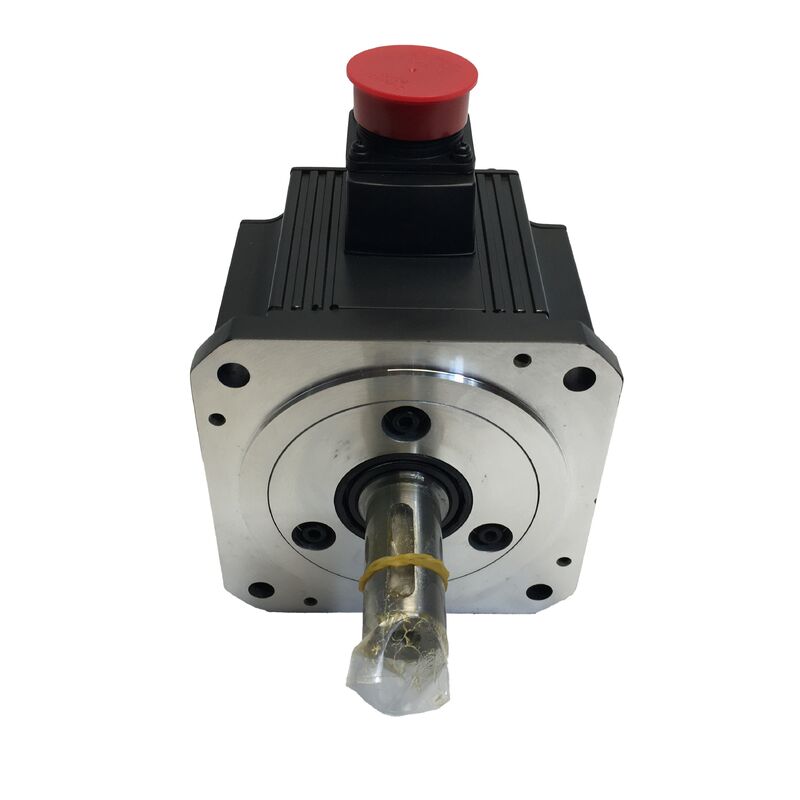
Mitsubishi HC-SFS352K AC Servo Motor — 3.5 kW, Keyed Shaft
Part Number: HC-SFS352K
Series: HC-SFS | Compatible Amplifiers: MR-J2S / MR-J3 / MR-J4
Overview
3.5 kilowatts. 2,000 rpm. Keyed shaft for direct mechanical coupling.
The Mitsubishi HC-SFS352K is a mid-range AC servo motor that delivers 3.5 kW of rated output with 16.7 N·m of continuous torque at 2,000 rpm. The keyed shaft configuration sets this variant apart from the standard straight-shaft version — the machined keyway locks the coupling, pulley, or sprocket to the shaft mechanically, eliminating rotational slip under load reversals, shock loading, and sustained high-torque operation.
For machine designs that rely on direct mechanical power transfer rather than friction-fit couplings, the 352K is the correct specification from the start.
Key Specifications
| Parameter |
Value |
| Rated Output |
3.5 kW |
| Rated Speed |
2,000 rpm |
| Rated Torque |
16.7 N·m |
| Peak Torque |
50.1 N·m |
| Supply Voltage |
200V AC |
| Shaft Configuration |
Keyed (with keyway) |
| Encoder Type |
17-bit Absolute |
| Encoder Resolution |
131,072 p/rev |
| Protection Rating |
IP65 (shaft seal) |
| Insulation Class |
Class F |
| Frame Series |
HC-SFS |
The Keyed Shaft — A Specification That Matters
Servo motor shaft variants exist for good reasons. The standard straight shaft suits applications using zero-backlash servo couplings, where the coupling's clamping force provides sufficient torque transmission. The keyed shaft is for everything else — applications where the transmitted torque is high enough, or the load reversals sharp enough, that a pure friction fit isn't a reliable long-term solution.
At 3.5 kW and a peak torque of 50.1 N·m, the HC-SFS352K operates at a level where shaft-to-coupling integrity is a genuine engineering consideration, not a formality. The keyway ensures the driven component moves exactly when the motor moves — no micro-slip, no progressive fretting, no coupling reseating required after run-in.
Practically, this matters most in:
- Direct gear or sprocket drives where the transmission element is pressed or keyed directly onto the motor shaft
- High load-reversal applications such as press feeders and reciprocating axes where torque direction changes frequently
- Belt drive configurations where pulley retention under tension loads demands positive mechanical engagement
- High-inertia loads where acceleration and deceleration generate transient torques well above the continuous rated value
Performance Across the Operating Range
17-bit absolute encoder — position integrity without compromise. With 131,072 pulses per revolution and absolute position retention across power cycles, the HC-SFS352K gives the servo system accurate shaft position at all times. Restart after an e-stop or power interruption requires no homing sequence — the controller picks up exactly where the axis stopped.
IP65 shaft sealing. The shaft entry is rated to resist pressurized water jets and fine dust ingress — a meaningful specification in press rooms, machining cells, and food-adjacent production environments where contamination is an ongoing concern rather than an edge case.
Class F insulation. Rated for sustained operation at higher winding temperatures than Class B motors, this adds thermal margin in applications running continuous duty cycles in warm cabinets or poorly ventilated machine enclosures.
Amplifier compatibility across generations. The HC-SFS352K works with MR-J2S, MR-J3, and MR-J4 amplifier families. Facilities managing equipment across different installation vintages can source a single motor variant that fits multiple drive generations on the floor.
Where the HC-SFS352K Gets Installed
Press Feeders & Roll Feed Units — Mid-weight feed axes that transmit torque through keyed rollers or sprockets, where load reversals at the end of each stroke demand positive shaft engagement.
CNC Machining Centers — Feed axis drives on larger-format machines where 3.5 kW provides the torque-speed profile for cutting under realistic chip load conditions.
Rotary Tables & Indexing Heads — Driven through gear reducers with keyed shaft connections, where the motor must overcome static friction and inertia at the start of each index.
Conveyor & Transfer Drives — Line shafts and transfer conveyor drives where the motor shaft connects directly to a drive sprocket or bevel gear unit.
Winding & Tension Control Systems — Applications that regulate web or material tension under varying load, where shaft slip between motor and winding element would directly compromise process quality.
A Practical Note on Replacement and Stocking
The HC-SFS352K occupies a segment of the HC-SFS range that sees consistent deployment across mid-size CNC platforms and purpose-built automation equipment. Lead times on specific shaft variants — particularly the keyed version — can extend when distribution inventory runs low. Production facilities and machine builders with active installations benefit from having a spare unit on hand before an unplanned failure forces the timeline.
Frequently Asked Questions
Q1: What is the difference between the HC-SFS352 and the HC-SFS352K?
A: The HC-SFS352 has a standard straight shaft, relying on the coupling's clamping force for torque transmission. The HC-SFS352K adds a machined keyway, providing a positive mechanical lock between the shaft and the driven component. Choose the K variant when the application uses gears, sprockets, or pulleys that require a keyed connection, or when load reversals make a friction-only fit unreliable.
Q2: Which servo amplifiers are compatible with the HC-SFS352K?
A: The HC-SFS352K is compatible with Mitsubishi MR-J2S, MR-J3, and MR-J4 series servo amplifiers. Confirm the amplifier's rated output is matched to the motor's 3.5 kW / 200V specification before wiring and commissioning.
Q3: Does the HC-SFS352K include a built-in electromagnetic brake?
A: No. The HC-SFS352K is the standard variant without a brake. For vertical axis applications or gravity-loaded setups requiring mechanical position holding on power loss, the HC-SFS352BK — brake and keyed shaft — is the correct specification.
Q4: What key size does the HC-SFS352K shaft use?
A: The HC-SFS352K uses a keyway dimensioned to JIS B 1301 standards as specified in Mitsubishi's HC-SFS series mechanical drawings. Refer to the official Mitsubishi Electric servo motor specification sheet for the exact key width, height, and depth dimensions before machining the mating coupling or hub.
Q5: Does the 17-bit encoder require battery backup to retain absolute position?
A: For single-turn absolute operation, no battery is required. Multi-turn absolute position retention — tracking position across multiple full shaft revolutions through a power cycle — requires a battery on the amplifier side. This is an amplifier-level requirement and applies regardless of which HC-SFS motor variant is used.


 Your message must be between 20-3,000 characters!