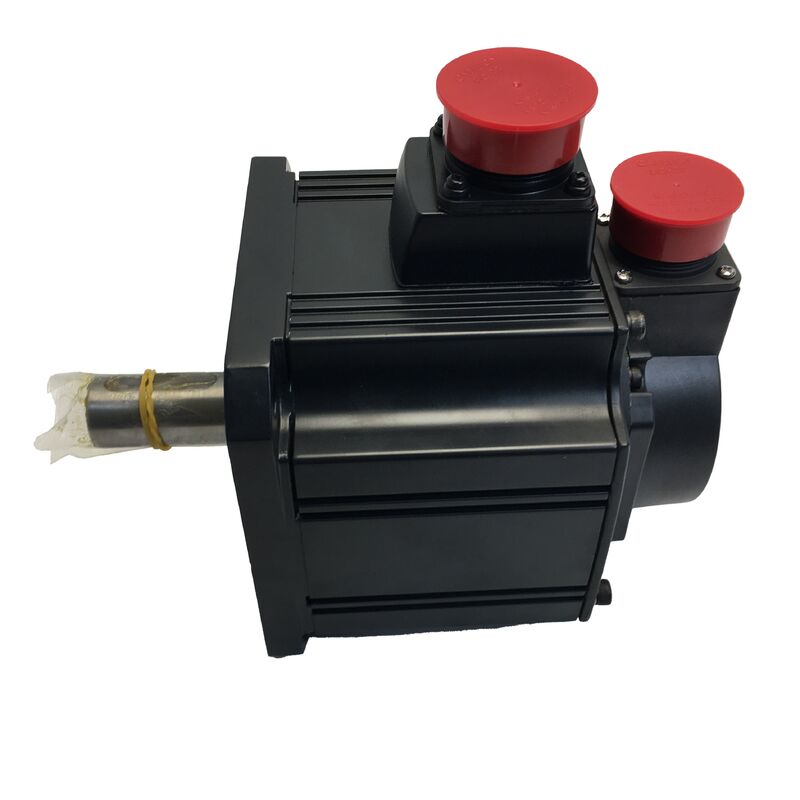
Mitsubishi HC-SFS81 AC Servo Motor — 850W MELSERVO J2S Medium-Inertia Motor for Precision Industrial Motion
When a machine demands reliable axis control — steady torque from low speed through rated speed, fast dynamic response, and a position feedback system that doesn't need re-homing after every power cycle — the motor at the end of the drive chain has to deliver.
The Mitsubishi HC-SFS81 is an 850 W AC brushless servo motor from the MELSERVO J2S series, occupying a practical slot in the HC-SFS family's medium-inertia, medium-capacity lineup that has made it a standard choice across CNC machine tools, robots, and general industrial automation equipment.
Where the HC-SFS81 Sits in the HC-SFS Family
The HC-SFS series runs from compact 500 W motors through high-output 7 kW units, all sharing the same design philosophy: medium rotor inertia balanced against medium output capacity, rated for 3,000 rpm or 2,000 rpm depending on the variant, with a fully enclosed self-cooled structure and oil seal construction that keeps the drive-end bearing protected from the industrial environments these motors work in.
The HC-SFS81 is the 850 W member at the base of the 3,000 rpm sub-series — small enough to fit in compact machine designs, capable enough for the majority of axis drive applications in production machinery. Its 130 × 130 mm flange footprint is shared across the mid-range of the HC-SFS family, which means physical interchangeability within the same frame size when upgrading or replacing between power ratings.
Technical Specifications
| Parameter |
Value |
| Part Number |
HC-SFS81 |
| Manufacturer |
Mitsubishi Electric Corporation |
| Series |
MELSERVO J2S / HC-SFS |
| Motor Type |
AC Brushless Rotary Servo Motor |
| Rated Output |
850 W (0.85 kW) |
| Supply Voltage |
200 V AC class |
| Rated Current |
5.1 A |
| Rated Torque |
approx. 2.7 Nm |
| Rated Rotational Speed |
3,000 rpm |
| Maximum Speed |
4,500 rpm |
| Encoder Type |
Built-in absolute, 17-bit |
| Encoder Resolution |
131,072 ppr |
| Shaft Type |
Straight with oil seal |
| Flange Dimensions |
130 × 130 mm |
| Protection Rating |
IP65 |
| Insulation Class |
F |
| Cooling Method |
Totally enclosed, self-cooled |
| Operating Temperature |
0 °C to +40 °C |
| Storage Temperature |
−15 °C to +70 °C |
| Humidity |
80% RH max (operating), 90% RH max (storage) |
| Max. Altitude |
1,000 m above sea level |
| Weight |
approx. 11.5 kg |
| Inertia Class |
Medium |
| Origin |
Japan |
17-Bit Absolute Encoder — 131,072 Pulses Per Revolution
The encoder built into the HC-SFS81 is not just a pulse counter. It's a 17-bit absolute optical encoder — 131,072 unique positions per revolution — operating via Mitsubishi's high-speed serial communication link to the servo amplifier.
The absolute architecture means position data is retained through power-off, with battery backup in the paired servo amplifier maintaining the multi-turn position counter.
At machine startup, the drive reads the encoder and the axis position is immediately known. No reference return homing cycle. No waiting. Just ready.
For production machines that cycle through multiple power-on/power-off sequences per shift, or for machines that need to recover quickly after emergency stops, the practical value of eliminating homing time adds up across a production schedule.
One home position set during commissioning covers the machine's operational lifetime.
Medium Inertia — A Design Choice That Matters
Servo motor inertia is about fit. A low-inertia motor accelerates quickly but may struggle to smoothly drive a high-inertia load without hunting.
A high-inertia motor is robust under load but responds sluggishly to rapid direction changes. Medium inertia, as in the HC-SFS series, represents the balance point for the wide range of machinery where the motor's own inertia and the load inertia need to be reasonably matched for stable, responsive servo control.
For the HC-SFS81 specifically, Mitsubishi's documentation specifies a permissible load-to-motor inertia ratio of up to 30 times, which gives machine designers significant flexibility in how much load inertia this motor can drive while maintaining stable closed-loop control.
That 30× figure is meaningfully higher than low-inertia motor families, reflecting the HC-SFS's tolerance for heavier mechanical loads.
Oil Seal Construction and IP65 Protection
The straight shaft on the HC-SFS81 includes an oil seal at the drive end bearing — a practical feature for machine tool installations where cutting fluid, coolant mist, and lubricant-laden air routinely reach the motor end.
The seal prevents contamination from migrating into the bearing cavity and from there into the encoder space.
Combined with the IP65 rated housing (fully dust-tight, protected against water jets from any direction), the HC-SFS81 is built to run in production environments without special environmental protection measures.
Machining centers, packaging lines, and assembly equipment routinely expose motors to exactly the conditions IP65 was designed for.
Compatible Servo Amplifiers
The HC-SFS81 is paired with Mitsubishi MR-J2S-100A or MR-J2S-100B servo amplifiers (1 kW class, the appropriate rating for an 850 W motor). The MR-J2S-100A uses an analog pulse-train command interface, while the MR-J2S-100B communicates over SSCNET high-speed serial for use in multi-axis motion controller systems.
Both amplifiers work with the same HC-SFS81 motor — the selection depends on whether the upstream controller issues analog position commands or connects via SSCNET.
The motor is also compatible with newer-generation amplifiers via Mitsubishi's renewal tool approach, supporting upgrades from the J2S amplifier generation to the MR-J4-B series when machine performance requirements or amplifier availability demand it.
Where the HC-SFS81 Is Deployed
The 850 W output and 3,000 rpm rated speed position the HC-SFS81 in the range most commonly needed for general machine tool axis drives and mid-scale automation:
CNC Machining Centers — feed axis drives (X, Y, Z) on vertical and horizontal machining centers where the 130 mm flange and 850 W output match the requirements of medium-sized machines
CNC Lathes and Turning Centers — Z and X axis servo drives, along with turret positioning axes, on CNC turning equipment
Industrial Robots — joint drive motors on SCARA robots and smaller articulated arm configurations where medium inertia and high resolution support smooth, accurate joint control
Automated Assembly Machines — precision insertion, press-fit, and material handling stations in electronic and mechanical assembly automation
Conveyor and Transfer Systems — indexing and positioning drives on pallet transfer systems and automated storage equipment
X-Y Positioning Tables — two-axis precision positioning stages in testing, dispensing, and measurement equipment
HC-SFS81 Variant Summary
The HC-SFS81 base motor is available in several suffix variants to cover different installation requirements:
- HC-SFS81 — standard, straight shaft, no brake
- HC-SFS81B — with built-in electromagnetic brake
- HC-SFS81K — with key and keyway on shaft
- HC-SFS81BK — with both electromagnetic brake and keyed shaft
All variants share the same motor ratings, encoder, flange dimensions, and IP65 protection. Select the variant that matches your shaft coupling method and whether gravity load hold on the axis is required.
FAQ
Q1: What servo amplifier is compatible with the Mitsubishi HC-SFS81?
The HC-SFS81 pairs with the Mitsubishi MR-J2S-100A (analog command interface) or MR-J2S-100B (SSCNET digital interface) servo amplifiers in the 1 kW class.
For multi-axis systems using Mitsubishi motion controllers, the MR-J2S-100B with SSCNET communication is the standard choice.
Q2: Does the HC-SFS81 support absolute position operation without a homing cycle?
Yes. The built-in 17-bit absolute encoder retains axis position through power-off, backed by battery in the paired servo amplifier.
Once a home position is set during initial commissioning, the axis reports its position immediately at every subsequent power-up — no reference return required.
Q3: What is the difference between the HC-SFS81 and HC-SFS81B?
The HC-SFS81 is the standard motor without an electromagnetic brake. The HC-SFS81B adds a built-in spring-applied electromagnetic brake that locks the shaft when the brake coil is de-energized — essential for vertical axes, robot joints, or any load that must be held at rest without continuous drive power.
All electrical and mechanical specifications are otherwise identical.
Q4: What is the maximum permissible load inertia for the HC-SFS81?
Mitsubishi specifies a maximum load-to-motor inertia ratio of 30 times for the HC-SFS81.
This is the upper limit for maintaining stable closed-loop servo control without excessive gain tuning compromises. Applications with higher load inertia should consult Mitsubishi's servo selection guidelines or engage the auto-tuning function in the MR-J2S amplifier.
Q5: Is the HC-SFS81 still in production, and what is its current-generation equivalent?
The HC-SFS series belongs to the MELSERVO J2S generation, which has been succeeded by newer J4 and J5 series motor families. The current-generation equivalent in Mitsubishi's lineup is the HG-SR series (J4) for the same medium-inertia, medium-capacity class.
HC-SFS motors remain widely available in the industrial automation aftermarket for maintenance and replacement of existing J2S installations.


 Your message must be between 20-3,000 characters!