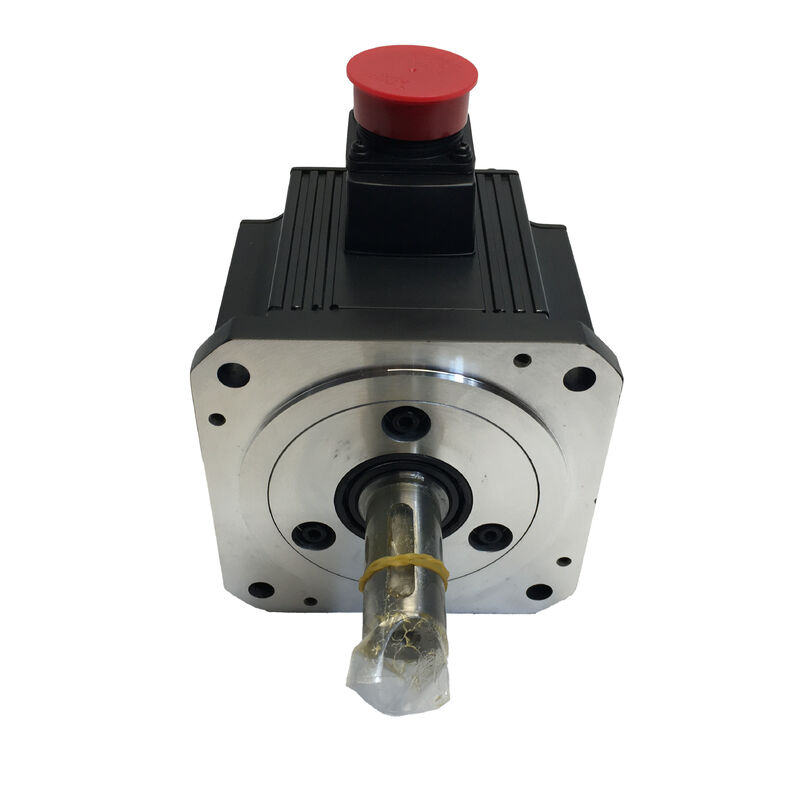
Mitsubishi HC-SFS202 (HCSFS202) — 2kW AC Servo Motor, Straight Shaft, No Brake, 2000 rpm, MELSERVO J2-Super Series
Product Overview
Part Number: HC-SFS202
Also Searched As: HCSFS202, HC SFS 202, HC-SFS-202
Series: Mitsubishi MELSERVO HC-SFS (J2-Super Generation)
Classification: Medium-Inertia AC Brushless Servo Motor — 2 kW, 200V class, 2000 rpm, Straight Shaft, No Brake
The Motor at a Glance
The Mitsubishi HC-SFS202 is the entry point to the larger-frame HC-SFS 2000 rpm family — the first model in the 2000 rpm range to step up from the 130 × 130 mm flange to the 176 × 176 mm mounting face. That transition is significant: it marks the boundary between compact-class servo motors and the medium-frame units intended for axes with heavier loads, higher torque demands, and more demanding duty cycles.
At 2kW with 9.55 Nm of continuous torque and a 28.6 Nm peak, the HC-SFS202 sits in the most commonly populated capacity band in general industrial automation. Machine tool feed axes, medium-weight conveyor drives, rotary indexing tables, winding tension controls — this torque range covers a very broad slice of the applications that machine designers encounter daily. It is not a niche motor. It is, in many respects, the workhorse of the HC-SFS lineup.
What keeps it honest is the J2-Super platform underneath: a 17-bit serial absolute encoder at 131,072 ppr, multi-turn absolute position backed by an A6BAT battery in the MR-J2S-200 amplifier, real-time auto-tuning, adaptive vibration suppression, and a full suite of protective functions. The straight shaft and no-brake configuration represent the simplest possible mechanical and electrical integration — no keyway machining requirements on the hub, no brake relay wiring, no MBR interlock in the PLC logic.
Technical Specifications
| Parameter |
Value |
| Part Number |
HC-SFS202 |
| Rated Output |
2,000 W (2 kW) |
| Supply Voltage |
200V class (3-phase 200–230V AC) |
| Rated Speed |
2,000 rpm |
| Maximum Speed |
3,000 rpm |
| Rated Torque |
9.55 Nm |
| Peak Torque |
28.6 Nm |
| Encoder Type |
17-bit serial absolute |
| Encoder Resolution |
131,072 ppr |
| Shaft Type |
Straight (no keyway) |
| Electromagnetic Brake |
None |
| Flange Size |
176 × 176 mm |
| Protection Rating |
IP65 |
| Oil Seal |
Fitted |
| Inertia Class |
Medium inertia |
| Ambient Temperature (Operation) |
0°C to +40°C |
| Storage Temperature |
−15°C to +70°C |
| Compatible Amplifiers |
MR-J2S-200A / MR-J2S-200B / MR-J2S-200CP |
| Series Generation |
MELSERVO J2-Super |
| Status |
Discontinued — available as stock |
Why 2kW at 2000 rpm Is Such a Common Design Point
Nine point five five Newton-metres at 2,000 rpm. That operating point appears on an enormous range of real industrial machinery, and there is a straightforward reason for it.
At 2,000 rpm, the motor speed is low enough to drive moderate-pitch ball screws and gear trains directly — without an intermediate reduction stage that adds inertia, backlash, and mechanical complexity. Yet it is fast enough to achieve practical linear velocities on those same ball screws without running the motor above its thermal operating range. A 10mm-pitch ball screw driven at 2,000 rpm produces 20 m/min linear feed rate. On a CNC machine tool feed axis, 20 m/min is comfortable rapid traverse speed. On a servo-driven transfer shuttle, it is brisk and productive. On a winding drive, 2,000 rpm provides meaningful speed range for roll diameter variation.
The 9.55 Nm continuous torque is similarly well-placed. It is enough to drive a 10mm-pitch ball screw against a several-hundred-kilogram table load at moderate acceleration. It covers medium-weight conveyor sections under full production load. It sustains constant tension control on a winding drive through the working diameter range. It powers a rotary indexing table through multi-station cycles.
The 28.6 Nm peak — exactly three times continuous — handles the acceleration and deceleration phases of each positioning cycle. Those are brief transients compared to the constant-velocity phase at rated torque; the motor's thermal budget absorbs them without complaint, and the MR-J2S-200's electronic thermal model tracks cumulative loading to ensure the protective alarm trips before the windings see a damaging temperature.
What all this adds up to is a motor that fits the torque and speed requirements of a very wide range of general industrial axes without needing either oversizing or creative mechanical design to make it work.
Straight Shaft: Coupling Options and Selection
The HC-SFS202's straight shaft — no keyway, no flat, standard cylindrical OD — is the universal starting point for servo motor coupling design. Every major coupling type for servo applications works with a straight shaft: jaw couplings, bellows couplings, Oldham couplings, disc couplings, and taper-lock timing belt hubs all clamp to the shaft OD using a split hub or shrink fit.
At 9.55 Nm continuous and 28.6 Nm peak, the coupling selection must account for the peak figure, not just the rated torque. A jaw coupling sized for 9.55 Nm rated will be marginal during aggressive acceleration cycles at 28.6 Nm peak. Standard practice is to select the coupling at 1.5–2× the peak torque when the load involves shock inputs, and at the peak torque value when the load is purely inertial. Either way, 28.6 Nm is the number that governs the coupling sizing, not the 9.55 Nm rated figure.
For applications where a keyed hub is either required or preferred — chain sprockets, certain timing pulleys, gear input hubs — the HC-SFS202K (keyed shaft, no brake) is mechanically identical in every other respect and uses the same MR-J2S-200 amplifier. Performance specifications are unchanged. The only difference is the machined keyway in the shaft.
Hub fitting: the drawbolt method at 176 × 176 mm frame. Mitsubishi's instruction manuals are consistent on this point for large-frame motors: always use the shaft-end threaded hole and a drawbolt to pull a coupling or hub axially onto the shaft. Never press or hammer. The 176 × 176 mm frame motor has a longer shaft than the 130 × 130 mm units, and impact loading during hub installation travels through the shaft to the encoder disc and rear bearing. The resulting damage — typically minor encoder bearing damage or encoder disc misalignment — usually does not produce an immediate alarm. It shows up weeks or months later as intermittent encoder noise faults under vibration, which can take significant diagnostic effort to trace back to an installation event. Thirty extra seconds with a drawbolt eliminates this risk entirely.
No Brake: When Servo Lock Is the Right Answer
The HC-SFS202 carries no electromagnetic brake. Position at rest is maintained by the MR-J2S-200 amplifier's closed-loop servo lock — the position loop stays active, the 17-bit encoder monitors shaft angle at high resolution, and the amplifier supplies whatever current is needed to hold the commanded position. On a healthy axis with proper gain tuning, this holds position to within one or two encoder counts — effectively zero visible movement.
For horizontal axes and symmetrically loaded mechanisms where no gravitational or spring force acts in the direction of shaft rotation, servo lock is entirely reliable and adequate. There is no mechanical reason to add a brake, and the no-brake configuration's advantages are tangible: simpler panel wiring, no relay, no 24V brake circuit, no surge suppression components, no MBR interlock sequence in the PLC, no periodic brake disc inspection, and a lighter motor than the equivalent braked variant.
The engineering question to ask for each axis in a machine is simple: if servo current drops to zero unexpectedly, does the axis move under any remaining force? If the answer is no — horizontal table, symmetrically balanced rotary indexer, flat conveyor section — the HC-SFS202 without a brake is the correct and complete specification. If the answer is yes — vertical Z-axis, inclined feed, gravity-loaded mechanism — the HC-SFS202B (straight shaft with spring-applied electromagnetic brake) is required. Both use the same MR-J2S-200 amplifier.
On a machine with several servo axes at this capacity, applying this test systematically and selecting accordingly — rather than defaulting to brakes on all axes — produces a simpler machine design with a lower component count.
The 17-Bit Encoder in Daily Production
The encoder built into the HC-SFS202 is Mitsubishi's 17-bit serial absolute unit, providing 131,072 discrete angular positions per shaft revolution along with multi-turn absolute count maintained through power-off by the A6BAT battery in the amplifier.
In practice, what this means for a production machine is straightforward:
Startup without homing. When the machine powers up after a weekend shutdown, after a maintenance stop, or after an emergency stop, the MR-J2S-200 reads the absolute shaft angle immediately. The controller knows the exact axis position without any shaft movement. Production can resume directly. For machines where a homing routine would require moving through a danger zone, or where the axis position at shutdown was critical and must be known precisely for the restart sequence, this is not a convenience — it is a functional requirement.
High-resolution velocity feedback. At 131,072 counts per revolution, the velocity loop has extremely fine position data to work with, even at low shaft speeds. This is one reason J2-Super axes run smoothly at low feed rates without velocity ripple — the feedback resolution is high enough that the control algorithm always has accurate velocity information regardless of how slowly the shaft is turning. For applications like slow-speed winding drives, creep-speed axes on machine tools, or torque-control drives where low-speed smoothness matters, the 17-bit resolution makes a measurable difference compared to 14-bit predecessors.
Battery maintenance. The A6BAT in the MR-J2S-200 amplifier maintains the multi-turn counter through power-off. Replace it when the amplifier displays a battery-low alarm. A fully depleted battery resets the absolute counter, requiring a reference-return cycle before the axis can resume production. On high-availability production lines, replacing the battery proactively at the first low-battery alarm — rather than waiting for full depletion — eliminates unplanned downtime from an avoidable cause.
Compatible Amplifiers
The HC-SFS202 pairs with the MR-J2S-200 amplifier family — the 2kW capacity J2-Super platform. Three interface variants address the main control architectures:
MR-J2S-200A is the general-purpose interface amplifier. It accepts pulse-train position commands from CNC controllers and PLCs, plus analog speed and torque references. All control modes are available: position, speed, torque, and the switched-mode combinations P/S, S/T, T/P. RS-232C connects to MR Configurator for parameter setting and diagnostics. This is the standard choice for machine tool feed axes and general industrial positioning applications.
MR-J2S-200B connects to Mitsubishi A-series and Q-series motion controllers via SSCNET fiber-optic bus. Position commands, encoder feedback, alarm data, and monitoring signals all travel over the fiber link. For coordinated multi-axis machines — machining centres running simultaneous multi-axis contouring, transfer systems with synchronised axes, electronic gearing applications — the SSCNET bus provides the real-time synchronisation that analog or pulse interfaces cannot match.
MR-J2S-200CP provides built-in single-axis positioning. Up to 31 target positions are stored in the amplifier's internal point tables and activated by digital I/O or CC-Link network signals. For standalone indexed positioning axes that do not require coordination with other axes, the CP eliminates the cost and complexity of a dedicated motion controller.
Compatibility notes. The HC-SFS202 requires a J2-Super (MR-J2S) amplifier. It is not compatible with original MR-J2-200 (first-generation) amplifiers, which cannot read the 17-bit encoder serial protocol. For machines running first-generation MR-J2 hardware, the HC-SF202 (same mechanical specification, 14-bit encoder) is the correct motor. The HC-SFS202 is also not compatible with MR-J3 or MR-J4 amplifiers without a renewal adapter kit.
HC-SFS 2000 rpm Family — Capacity Context
| Model |
Output |
Rated Torque |
Peak Torque |
Flange |
| HC-SFS52 series |
500 W |
2.39 Nm |
7.16 Nm |
130 × 130 mm |
| HC-SFS102 series |
1,000 W |
4.78 Nm |
14.4 Nm |
130 × 130 mm |
| HC-SFS152 series |
1,500 W |
7.16 Nm |
21.6 Nm |
130 × 130 mm |
| HC-SFS202 series |
2,000 W |
9.55 Nm |
28.6 Nm |
176 × 176 mm |
| HC-SFS352 series |
3,500 W |
16.7 Nm |
50.1 Nm |
176 × 176 mm |
| HC-SFS502 series |
5,000 W |
23.9 Nm |
71.6 Nm |
176 × 176 mm |
| HC-SFS702 series |
7,000 W |
33.4 Nm |
100 Nm |
176 × 176 mm |
The HC-SFS202 is the first model in the 2000 rpm range on the 176 × 176 mm flange and the lowest-capacity option in the larger frame. The step down from the HC-SFS202 to the HC-SFS152 means moving to the smaller 130 × 130 mm frame. For machine designs that need the larger flange — whether for motor mass distribution, shaft diameter requirements, or future capacity headroom — the HC-SFS202 is the starting point.
All capacity variants in the 2000 rpm family come in four shaft and brake configurations: straight shaft (HC-SFS202), straight shaft with brake (HC-SFS202B), keyed shaft (HC-SFS202K), and keyed shaft with brake (HC-SFS202BK). All four use the MR-J2S-200 amplifier class.
Typical Applications
CNC machine tool feed axes. Ball-screw driven X, Y, and secondary Z axes on vertical and horizontal machining centres. The 9.55 Nm continuous torque and 3,000 rpm maximum speed suit moderate table mass at practical rapid traverse speeds without a reduction stage between motor and screw.
Medium-duty conveyor and transfer drives. Servo-controlled conveyor sections, shuttle mechanisms, and part transfer systems on assembly and test lines. The 2kW capacity covers moderate line loads; the absolute encoder eliminates homing on restart, which matters for high-availability production systems that cycle power frequently.
Rotary indexing tables. Multi-station rotary indexing tables where the motor connects through a worm gear or zero-backlash spur gear reduction to the table. The 17-bit encoder delivers the angular resolution needed for precise station positioning; the 28.6 Nm peak handles the acceleration torque for rapid index movements between stations.
Winding and unwinding tension drives. Material winding drives running in torque control mode to maintain constant web tension across a changing roll diameter. The 9.55 Nm continuous torque at 2,000 rpm covers a useful range of winding station sizes and web tension setpoints. Real-time auto-tuning in the MR-J2S-200 helps maintain consistent tension response as the roll inertia changes with diameter.
Injection moulding machine auxiliary axes. Servo-driven ejector, core pull, and screw rotation axes on injection moulding machines where the motor must maintain precise position under load during the mould cycle. The straight shaft couples cleanly to rack-and-pinion ejector mechanisms; the no-brake configuration is appropriate on horizontal ejector axes where servo lock is adequate.
Frequently Asked Questions
Q1: What is the difference between the HC-SFS202 and the HC-SF202?
Both are 2kW, 2000 rpm, straight-shaft motors on a 176 × 176 mm flange, and both are mechanically identical in dimensions and coupling interface. The critical difference is the encoder generation. The HC-SF202 carries a 14-bit (16,384 ppr) encoder and is compatible with both original MR-J2 and MR-J2S amplifiers. The HC-SFS202 carries a 17-bit (131,072 ppr) encoder and requires an MR-J2S-200 amplifier — it will not operate with a first-generation MR-J2. For a machine already running MR-J2S-200 amplifiers, the HC-SFS202 is the correct motor. For machines on original MR-J2-200 hardware, specify the HC-SF202.
Q2: Can the HC-SFS202 be used on a vertical axis without a brake?
Only with careful analysis. Servo lock through the MR-J2S-200 holds horizontal axes reliably at rest, but on a vertical axis, the gravitational load acting on the axis when servo current drops to zero will cause downward movement. For any axis where movement at servo-off is hazardous or mechanically damaging — including most vertical axes — the HC-SFS202B (straight shaft, spring-applied electromagnetic brake) is the correct specification. The brake engages by default and holds the axis mechanically regardless of servo state.
Q3: The HC-SFS202 is on the 176 × 176 mm flange. Does this mean it needs a larger mounting than the 1.5kW HC-SFS152?
Yes. The HC-SFS152 and its 130 × 130 mm flange variants are physically smaller motors. The HC-SFS202 steps up to the 176 × 176 mm flange, which requires a different motor mounting interface — larger bolt circle, different pilot diameter. If a machine was designed around the 130 × 130 mm flange and you are considering the HC-SFS202 as an upgrade, the motor mounting plate will need modification. If the machine frame already uses the 176 × 176 mm mounting, then the HC-SFS202 fits alongside the HC-SFS352, HC-SFS502, and HC-SFS702 variants without any mechanical change.
Q4: What amplifier is needed, and where is the absolute encoder battery?
The HC-SFS202 requires a MR-J2S-200 amplifier — either the A (analog/pulse), B (SSCNET), or CP (built-in positioning) variant. The backup battery for the multi-turn absolute counter is the Mitsubishi A6BAT lithium unit, located inside the amplifier, not in the motor. Replace it at the first low-battery alarm from the amplifier. A fully depleted battery resets the absolute position memory and requires a reference-return cycle before the axis can resume production.
Q5: Is the HC-SFS202 still available despite being discontinued?
Yes. Although Mitsubishi officially discontinued the HC-SFS series alongside the wider MR-J2S platform, the HC-SFS202 remains widely available through industrial automation surplus dealers and specialist Mitsubishi servo component suppliers, both as new old stock and as tested refurbished units. For machines that must remain on J2-Super hardware, surplus sourcing is straightforward. For new machine designs, the current-generation equivalent is the HG-SR202 (MR-J4 series, 2kW, 2000 rpm, straight shaft, 22-bit encoder, 176 × 176 mm flange, IP67), which requires an MR-J4-200 amplifier.


 Your message must be between 20-3,000 characters!