logo
Guangzhou Sande Electric Co.,Ltd.
Email Sales01@sande-elec.com TEL: 86--18620505228
Home > Products > Industrial Servo Motor >
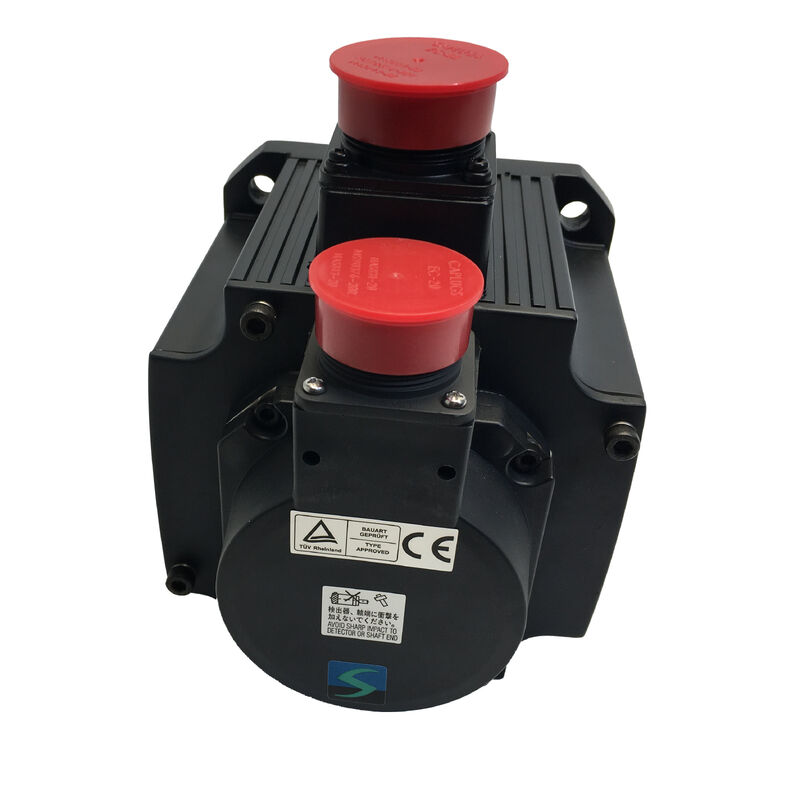
Mitsubishi Servo Motor HC-SFS502K HCSFS502K HC-SFS5O2K
  • Mitsubishi Servo Motor HC-SFS502K  HCSFS502K  HC-SFS5O2K

Mitsubishi Servo Motor HC-SFS502K HCSFS502K HC-SFS5O2K

Place of Origin JAPAN
Brand Name MITSUBISHI
Certification CE ROHS
Model Number HC-SFS502K
Product Details
Condition:
New Factory Seal(NFS)
Item No.:
HC-SFS502K
Origin:
JAPAN
Highlight: 

mitsubishi industrial servo motor

,

mitsubishi yaskawa ac servo motor

Payment & Shipping Terms
Minimum Order Quantity
1 pcs
Packaging Details
original packing
Delivery Time
0-3 days
Payment Terms
T/T, PayPal, Western Union
Supply Ability
100 pcs/day
Product Description

Mitsubishi HC-SFS502K (HCSFS502K) — 5kW AC Servo Motor, Keyed Shaft, No Brake, 2000 rpm, MELSERVO J2-Super Series

Product Overview

Part Number: HC-SFS502K

Also Searched As: HCSFS502K, HC SFS 502K, HC-SFS-502K

Series: Mitsubishi MELSERVO HC-SFS (J2-Super Generation)

Classification: Medium-Inertia AC Brushless Servo Motor — 5 kW, 200V class, 2000 rpm, Keyed Shaft, No Brake


The Motor That Earns Its Place at 5kW

There is a reason the 5kW point in a servo motor lineup tends to be well-populated. It sits at the boundary between axes that a compact motor can handle and axes that genuinely need a larger frame. For machine designers, it represents the last capacity step before the 176 × 176 mm flange becomes unavoidable — and the Mitsubishi HC-SFS502K arrives at exactly that point already on the larger frame, with 23.9 Nm of continuous torque and a 71.6 Nm peak ready to handle whatever the axis demands.

The "K" suffix is direct: machined keyway on the shaft, no electromagnetic brake. That combination defines the mechanical integration. The keyed shaft provides a positive, mechanically locked torque path to the driven component — a worm gear input, a chain sprocket, a timing belt pulley, or any hub that requires more than friction to transmit the full 5kW reliably. The absence of a brake keeps the circuit simple on axes that do not need one. Between those two choices, the HC-SFS502K covers a substantial share of real-world 5kW axis designs.

Behind the shaft, the 17-bit serial absolute encoder at 131,072 ppr does what J2-Super encoders do: delivers absolute multi-turn position on power-up without a homing cycle, feeds 131,072 angular positions per revolution back to the MR-J2S-500 amplifier, and stores the accumulated turn count through any power-off event on a battery in the amplifier. The axis knows where it is the moment power returns.


Technical Specifications

Parameter Value
Part Number HC-SFS502K
Rated Output 5,000 W (5 kW)
Supply Voltage 200V class (3-phase 200–230V AC)
Rated Speed 2,000 rpm
Maximum Speed 3,000 rpm
Rated Torque 23.9 Nm
Peak Torque 71.6 Nm
Encoder Type 17-bit serial absolute
Encoder Resolution 131,072 ppr
Shaft Type Keyed (machined keyway)
Electromagnetic Brake None
Flange Size 176 × 176 mm
Protection Rating IP65
Oil Seal Fitted
Inertia Class Medium inertia
Ambient Temperature (Operation) 0°C to +40°C
Storage Temperature −15°C to +70°C
Vibration Resistance (X axis) 24.5 m/s²
Vibration Resistance (Y axis) 29.4 m/s²
Compatible Amplifiers MR-J2S-500A / MR-J2S-500B / MR-J2S-500CP
Series Generation MELSERVO J2-Super
Status Discontinued — available as stock

23.9 Nm Continuous, 71.6 Nm Peak: What Those Numbers Mean in Practice

Torque is the currency of a servo axis. Speed matters too, but for most positioning and process drives, the question the engineer actually needs to answer is: can this motor sustain the required torque at the required duty cycle without triggering an overload alarm or thermally degrading the windings?

At 23.9 Nm continuous, the HC-SFS502K has genuine capacity. It can drive a 20mm pitch ball-screw at moderate load, run a winding drive maintaining constant web tension across a meaningful roll diameter range, feed material through a press or forming station, or power a rotary indexing table through a full production cycle. The continuous rating is not a derated peak — it is the torque the motor can sustain indefinitely at rated speed under the thermal conditions the J2-Super amplifier's electronic thermal model accounts for.

The 71.6 Nm peak — exactly three times the continuous figure — is available for the acceleration and deceleration transients in each positioning cycle. A 5kW axis making rapid point-to-point moves spends a small fraction of its cycle time at peak torque during the acceleration ramp, most of the cycle time at or below continuous torque, and another brief fraction decelerating. The 3:1 peak-to-continuous ratio accommodates that pattern. The MR-J2S-500's built-in electronic thermal model tracks the cumulative thermal load across the full duty cycle and raises an alarm before the motor reaches a damaging thermal state — not at the moment of overload, but predictively based on the running history.

One number worth keeping front of mind during system design: the MR-J2S-500 amplifier instruction manual recommends keeping unbalanced torque on vertical axes at 70% or less of the motor's rated torque. At 23.9 Nm rated, that means keeping the gravity-induced unbalanced torque below roughly 16.7 Nm for reliable operation. If the application exceeds this threshold, a motor with a higher continuous torque rating is the correct path — not accepting marginal operation at the limit.


Why the Keyed Shaft Changes the Conversation

The decision between a straight shaft and a keyed shaft rarely gets much space in servo motor documentation. It should, because the choice has practical consequences that show up in installation, in long-term reliability, and occasionally in troubleshooting calls that take weeks to resolve.

A friction-clamp coupling transmits torque through contact force between the hub bore and the shaft OD. That force is established at installation and must remain sufficient to resist the full peak torque — 71.6 Nm in this case — throughout the motor's service life. Vibration, thermal cycling, and normal mechanical wear all reduce clamping force over time. A coupling that was adequate on day one may develop slip under peak torque transients after a year of production. When it does, the slip is usually intermittent, the following error that results is small, and the alarm may never trip — but position repeatability degrades, and the root cause is genuinely difficult to find.

The keyway on the HC-SFS502K removes that vulnerability entirely. Torque is transmitted through the shear cross-section of the key itself, not through friction. Reversal, vibration, shock inputs from chain engagement or gear mesh, the 71.6 Nm peak torques during aggressive acceleration cycles — none of these challenge a properly fitted key the way they challenge a friction clamp. The torque path is mechanically positive and does not degrade with service hours.

The practical trade-off: keyed hubs require a keyway bore, which is a slightly more involved machining operation than a smooth bore. For hubs that are being made to order — custom pulleys, gear blanks, sprockets — this adds nothing significant. For off-the-shelf hubs that are only available with a smooth bore, the straight-shaft variants (HC-SFS502 or HC-SFS502B) are the right motor to specify. The HC-SFS502K is the right motor when the driven component already has a keyway, or when the design can specify one.

Hub installation at the 176 × 176 mm frame: the drawbolt method. Mitsubishi's servo motor instruction manuals are explicit about this for large-frame motors. Always use the shaft-end threaded hole and a drawbolt to pull the hub axially onto the shaft — never press or hammer. The 176 × 176 mm frame has a longer shaft overhang than smaller motors, and impact loading during hub fitting travels directly through the shaft to the encoder disc and rear bearing. The damage does not show up immediately. It appears weeks later as intermittent encoder faults under vibration, with nothing in the service history to point back to the installation event. The drawbolt method adds thirty seconds and prevents the problem entirely.


No Brake: The Correct Default for Most 5kW Axes

Every axis that does not need an electromagnetic brake benefits from not having one. The wiring is simpler — no 24V DC brake circuit, no surge absorber, no MBR interlock sequence in the PLC. The panel design is cleaner. Brake disc inspection disappears from the maintenance schedule. The motor is lighter and shorter than its brake-equipped counterpart.

The HC-SFS502K is appropriate wherever servo lock through the MR-J2S-500's closed position loop is sufficient to hold the axis at rest — which, for horizontal axes and symmetrically loaded mechanisms, it reliably is. The position loop stays active at servo-on, the 17-bit encoder monitors shaft angle continuously, and the amplifier supplies whatever current is needed to hold zero following error. On a well-tuned axis, the shaft does not move perceptibly at rest.

The calculus changes for vertical axes, inclined feeds, or any mechanism where the load has a gravitational component in the direction of shaft rotation. When servo current drops — at E-stop, at power loss, or at planned servo-off — those axes will move unless something mechanical holds them. Servo lock cannot hold an axis that is trying to fall. Those applications belong to the HC-SFS502BK (keyed shaft, spring-applied electromagnetic brake). The spring-applied design means the brake is engaged by default and released only when the brake coil is energised — so a power loss automatically applies the brake rather than releasing it.

For a machine with several 5kW axes, deciding which ones need brakes and which do not — and specifying accordingly — produces a better system than defaulting to the brake variant everywhere out of caution.


Compatible Amplifiers: MR-J2S-500 Platform

The HC-SFS502K pairs with the MR-J2S-500 class amplifier, the 5kW capacity J2-Super platform. Three interface variants cover the main control architectures encountered in industrial automation:

MR-J2S-500A accepts pulse-train position commands and analog speed/torque references from external CNC controllers, PLCs, and motion controllers. Supports full position, speed, and torque control modes and all switched-mode combinations. RS-232C port for MR Configurator setup software. The general-purpose choice for machine tool feed axes, general industrial positioning, and any application where the command source is a pulse or analog signal.

MR-J2S-500B connects to Mitsubishi A-series and Q-series motion controllers via SSCNET fiber-optic serial bus. All axis commands travel over the fiber network; encoder data, absolute position, alarm status, and monitoring data return through the same link. The correct amplifier for coordinated multi-axis systems where axes must move in precise geometric synchronisation — contouring, interpolation, electronic gearing, cam following.

MR-J2S-500CP incorporates built-in positioning. Up to 31 target positions stored as point table data in the amplifier, activated by digital I/O or CC-Link network command. No external motion controller required. Suited to standalone indexed positioning axes, rotary table stations, and any application where the positioning logic is simple enough to implement in point tables.

All three share the same 5kW amplifier hardware, the same real-time auto-tuning, adaptive vibration suppression, machine resonance suppression filter, and the full J2-Super suite of protective functions.

Compatibility notes. The HC-SFS502K requires a J2-Super (MR-J2S) amplifier. It is not compatible with first-generation MR-J2-500 amplifiers, which cannot decode the 17-bit encoder serial protocol. For machines running original MR-J2 hardware, the HC-SF502K — mechanically identical, 14-bit encoder — is the correct motor. Not compatible with MR-J3 or MR-J4 amplifiers without a renewal adapter kit.


HC-SFS 2000 rpm Family — Capacity Perspective

Model Output Rated Torque Peak Torque Flange
HC-SFS52 series 500 W 2.39 Nm 7.16 Nm 130 × 130 mm
HC-SFS102 series 1,000 W 4.78 Nm 14.4 Nm 130 × 130 mm
HC-SFS152 series 1,500 W 7.16 Nm 21.6 Nm 130 × 130 mm
HC-SFS202 series 2,000 W 9.55 Nm 28.6 Nm 176 × 176 mm
HC-SFS352 series 3,500 W 16.7 Nm 50.1 Nm 176 × 176 mm
HC-SFS502 series 5,000 W 23.9 Nm 71.6 Nm 176 × 176 mm
HC-SFS702 series 7,000 W 33.4 Nm 100 Nm 176 × 176 mm

The HC-SFS502K is the second-highest capacity motor in the HC-SFS 2000 rpm family. It shares the 176 × 176 mm flange with the 202, 352, and 702 variants, so any machine frame built for this flange size can accommodate the full range from 2kW to 7kW without any mechanical modification. Stepping up from the HC-SFS502K to the HC-SFS702K means accepting a heavier motor and a 40% increase in continuous torque — appropriate if the axis genuinely needs it; unnecessary overhead if 23.9 Nm is already sufficient margin for the worst-case operating point.

Each capacity point in the 2000 rpm family is available in the four shaft-and-brake configurations: straight shaft (no suffix), straight shaft with brake (B), keyed shaft (K), and keyed shaft with brake (BK). All variants at 5kW 2000rpm use the MR-J2S-500 amplifier regardless of shaft or brake configuration.


Typical Applications

Heavy-duty machine tool feed axes. CNC horizontal machining centres, gantry mills, and grinding machines with large table mass and heavy cutting loads use 5kW servo motors on their primary linear axes. The HC-SFS502K's 23.9 Nm continuous torque and 71.6 Nm peak handles the ball-screw drive demands of these mechanisms, with the keyed shaft securing the ball-screw nut hub or pulley interface.

Winding and tension control drives. Material winding drives on paper, film, and textile lines operating in torque control mode require sustained continuous torque across varying roll diameters. The 5kW operating point suits mid-range winding stations where the web tension setpoint requires 15–20 Nm of continuous motor torque, with headroom to the 23.9 Nm limit for safety.

Press and stamping machine feed axes. Servo-controlled material feed axes on progressive die presses, fine blanking presses, and stamping lines run at moderate speed under significant feed force. The 71.6 Nm peak torque handles the high-force transients at the start of each feed stroke; the keyed shaft ensures the drive sprocket or feed roll hub stays locked under the cyclical shock loading these mechanisms generate.

Rotary indexing and transfer machine drives. Multi-station rotary indexing tables and transfer machine drive shafts using gear-coupled or chain-driven servo drives at the 5kW level. The keyed motor-side hub connects positively to the gear or sprocket, the 17-bit absolute encoder maintains indexing precision on restart, and the 23.9 Nm continuous torque drives the loaded mechanism through each index reliably.

Large-format cutting and routing machines. Servo-driven gantry axes on large-format routers, plasma cutting tables, and waterjet positioning systems where axis mass and travel speed demand 5kW or more. Straight-shaft coupling would be acceptable here, but machines with toothed belt primary drives often use a keyed pulley hub for the positive engagement the belt tension demands.


Frequently Asked Questions

Q1: What amplifiers are compatible with the HC-SFS502K?

The HC-SFS502K requires an MR-J2S-500 class amplifier. The three interface variants are: MR-J2S-500A (general-purpose, pulse/analog command), MR-J2S-500B (SSCNET fiber-optic bus for Mitsubishi motion controllers), and MR-J2S-500CP (built-in positioning, up to 31 point tables). First-generation MR-J2-500 amplifiers are not compatible — they cannot read the 17-bit J2-Super encoder. MR-J3 and MR-J4 amplifiers are also not directly compatible.

Q2: What is the difference between the HC-SFS502K and the HC-SFS502BK?

Both are 5kW, 2000 rpm, keyed-shaft motors on a 176 × 176 mm flange with 17-bit encoders and identical electrical specifications. The sole difference is the brake: the HC-SFS502K has no brake — position is held at rest by amplifier servo lock. The HC-SFS502BK has a spring-applied electromagnetic brake that engages when the brake coil is de-energised. Use the 502BK on vertical axes, gravity-loaded mechanisms, and any drive where movement at servo-off would be hazardous. On horizontal or symmetrically loaded axes, the 502K is the correct and simpler specification.

Q3: Can the HC-SFS502K replace an HC-SF502K on an existing machine?

Mechanically yes — the flange dimensions, shaft diameter, and keyway are identical, so the motor physically fits the same mounting. The critical difference is the encoder: the HC-SF502K uses a 14-bit (16,384 ppr) encoder compatible with both MR-J2 and MR-J2S amplifiers, while the HC-SFS502K uses a 17-bit (131,072 ppr) encoder that requires an MR-J2S-500 amplifier. If the machine is running an original MR-J2-500 amplifier, swap to the HC-SF502K, not the HC-SFS502K. If the machine is already on MR-J2S-500, the HC-SFS502K is the correct upgrade and the amplifier parameters need to be checked for any electronic gear ratio settings that depended on the original encoder resolution.

Q4: Where is the absolute encoder backup battery, and when does it need to be replaced?

The battery — Mitsubishi A6BAT lithium — is housed inside the MR-J2S-500 servo amplifier, not in the motor. It is replaced at the panel without touching the motor or coupling. Replace it when the amplifier displays a battery-low alarm. If the battery is allowed to fully discharge, the multi-turn absolute counter resets and the axis requires a reference-return cycle before production can resume.

Q5: The HC-SFS502K is listed as discontinued. Is it still available, and what is the long-term replacement?

Yes — despite being discontinued by Mitsubishi, the HC-SFS502K remains widely available as surplus and refurbished stock through industrial automation suppliers. For machines that must remain in service on J2-Super hardware, surplus stock is the practical sourcing path. For new machine designs or major retrofits, the current-generation equivalent is the HG-SR502K (MR-J4 series, 5kW, 2000 rpm, keyed shaft, 22-bit encoder, 176 × 176 mm flange, IP67) — a direct mechanical replacement that requires an MR-J4-500 amplifier.

Contact Us at Any Time

+86 18620505228
10/F,Jia Yue Building, Chebei Road,Tianhe district,Guangzhou,China
Send your inquiry directly to us