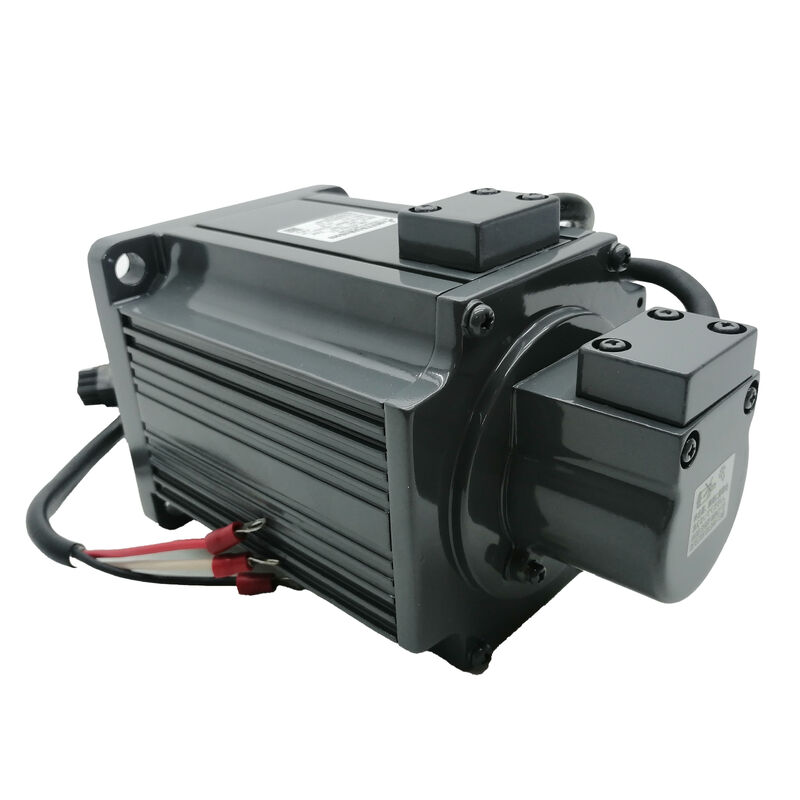
Mitsubishi HA-FF33C-S5 (HAFF33CS5) — 300W AC Servo Motor, Cannon Connector, Special Spec, 3000 rpm, MELSERVO HA-FF Series
Product Overview
Part Number: HA-FF33C-S5
Also Searched As: HAFF33CS5, HA FF 33C S5, HA-FF33C S5
Series: Mitsubishi MELSERVO HA-FF (Low Inertia, Small Capacity)
Classification: Low-Inertia AC Brushless Servo Motor — 300 W, 200V class, 3000 rpm, Cannon Connector, Special Specification
Understanding This Part Number in the HA-FF Family
The Mitsubishi HA-FF series represents an earlier generation of MELSERVO small-capacity motors — compact, low-inertia units covering the 50W to 600W range, all rated at 3,000 rpm. Within that family, the HA-FF33 is the 300W representative, with a rated torque of 2.9 Nm, a 70mm centering diameter flange, and an IP54 protection rating.
What separates the HA-FF33C-S5 from the base HA-FF33 are two specific designators that define its physical and configuration identity.
The C in the part number indicates a Cannon-type (MS-type round) power connector, replacing the lead-wire exits of the standard motor variant.
The power phases connect through a circular military-style connector rather than pigtail leads — a meaningful difference when the motor lives inside a machine where connector engagement and disengagement is a regular maintenance task.
The -S5 is a factory special specification designation, indicating a defined modification from standard — typically a shaft length change, specific cable arrangement, encoder modification, or OEM assembly requirement. The performance parameters of the motor itself remain those of the base HA-FF33 platform.
For procurement and maintenance purposes, the full exact part number — HA-FF33C-S5 — must be used without substitution.
An HA-FF33B-S5 or HA-FF33C without the S5 suffix is a different physical part.
Technical Specifications
| Parameter |
Value |
| Part Number |
HA-FF33C-S5 |
| Rated Output |
300 W |
| Supply Voltage |
200V class (3-phase) |
| Rated Speed |
3,000 rpm |
| Rated Torque |
2.9 Nm |
| Rated Current |
~1.9 A |
| Inertia Class |
Low inertia |
| Power Connector |
Cannon (MS-type round connector) |
| Electromagnetic Brake |
None (standard; B-suffix adds brake) |
| Centering Diameter |
70 mm |
| Protection Rating |
IP54 |
| Ambient Temperature (Operation) |
0°C to +40°C |
| Compatible Amplifier Family |
MR-J2-40 class |
| Series Generation |
MELSERVO HA-FF |
| Special Specification |
S5 (factory-defined OEM specification) |
| Status |
Discontinued — available as surplus/refurbished stock |
The -S5 special specification defines a factory-defined variation of the base HA-FF33C. Confirm exact configuration details against the Mitsubishi S5 specification sheet for this part number before use in a new design.
The HA-FF Series: Small, Fast, Light Load
Mitsubishi's HA-FF series was designed for a specific type of servo application: compact machines where the load is light, the operating speed is high, and cycle time is a primary concern. Electronic component assembly equipment, semiconductor handling mechanisms, small pick-and-place systems, lightweight X-Y positioning tables, and label application heads are the environments this series was built around.
The defining characteristic of low-inertia motors is their ability to accelerate and decelerate quickly.
When the rotor's own angular momentum is small relative to the torque the amplifier can supply, the axis responds to velocity commands almost instantly. For applications running many short positioning moves per minute — the defining duty cycle of assembly and handling equipment — this translates directly into higher throughput.
A low-inertia motor completes each move faster, spends less time at peak current, and allows the mechanical designer to specify shorter dwell times between moves.
The 300W HA-FF33 sits in the middle of the HA-FF range. It is twice the output of the HA-FF13 (100W) and half that of the HA-FF63 (600W).
For the type of light-duty automation these motors serve, 300W and 2.9 Nm rated torque is often the exact capacity required — enough to drive a moderate-weight stage or transfer mechanism without sizing up to a larger, heavier motor that would add unnecessary mass and inertia to the moving structure.
The Cannon Connector: Why the C Suffix Matters
In the standard HA-FF33, the motor power connections exit as lead wires — pigtail conductors that the installer connects to the amplifier through a terminal block or hand-crimped connector. The HA-FF33C replaces those leads with a Cannon MS-type circular connector mounted directly on the motor housing.
This is more than a cosmetic difference. Round military-style connectors — the connector family Mitsubishi and many other motor manufacturers used on HA-FF series motors — have specific practical advantages in machine environments:
Positive engagement confirmation. The bayonet locking ring on MS-type connectors locks with a definitive click that the installer can feel through gloves.
Unlike a lead wire crimped to a terminal, there is no ambiguity about whether the connection is complete.
Easy disconnection for maintenance. Removing a motor for encoder replacement, bearing service, or motor swap requires nothing more than twisting the locking ring and pulling the connector body. The alternative — releasing lead wires from a terminal block — requires tools and careful note-keeping about which wire goes where.
Cable compatibility and replacement. The Cannon connector on the motor has a defined mating connector standard.
Replacement power cables are available from Mitsubishi as catalogue items, with specified cable lengths. Lead-wire motors require the installer to prepare custom terminations; connector-type motors use defined assemblies.
For machines that will be serviced in the field, particularly multi-axis machines where several motors may need to be exchanged over the machine's lifetime, the connector interface reduces service time and the risk of wiring errors.
Special Specification -S5: What It Means in Practice
Mitsubishi uses alphanumeric suffixes — S1, S5, S13, S15, and others — to designate factory special specifications.
These are defined variations from the standard product, created to meet specific OEM requirements and documented in internal Mitsubishi specification sheets. They may encompass a modified shaft length or diameter, a specific cable exit direction, a different encoder type or resolution, a modified flange pilot diameter, or combinations of several of these.
What is consistent across all special specifications is that the performance data of the base motor — rated speed, rated torque, encoder type, and amplifier compatibility — remains unchanged. The HA-FF33C-S5 performs identically to the base HA-FF33C in all electrical and dynamic parameters.
The S5 designation records a physical or configuration attribute of the specific unit.
The practical consequence for sourcing: only the exact suffix is interchangeable with the original. An HA-FF33C without an S5 suffix, or with a different special spec number, may not physically fit the original machine mounting.
When procuring the HA-FF33C-S5 as a replacement, match the full part number. When in doubt, compare the physical dimensions of the unit on hand against the original before installation.
Compatible Amplifiers
The HA-FF33 series motors pair with the MR-J2-40 class amplifiers — the 400W capacity unit in the first-generation MR-J2 platform. The HA-FF33C pairing with the MR-J2-40CT (CC-Link-compatible positioning amplifier) is documented in the MR-J2-CT instruction manual; the standard HA-FF33 also pairs with the general-purpose MR-J2-40A.
It is worth being explicit about the generational context: the HA-FF series predates the J2-Super (MR-J2S) platform.
These motors use an earlier serial encoder, not the 17-bit J2-Super protocol. They are not compatible with MR-J2S amplifiers without a hardware adapter, and not compatible with MR-J3 or MR-J4 amplifiers at all.
For machines running original MR-J2-40 (first-generation) amplifiers and HA-FF33C-S5 motors, the sourcing path is straightforward: replace like-for-like.
For machines that are being refurbished or upgraded to later-generation Mitsubishi servo platforms, the motor must also be upgraded — typically to an HC-KFS43 or similar low-inertia small-capacity motor from a later series that matches the new amplifier generation.
The battery for the absolute position backup — if the system uses absolute encoder mode — is located in the MR-J2 amplifier, not in the motor.
HA-FF Series Capacity Overview
| Model |
Output |
Rated Torque |
IP Rating |
| HA-FF053 series |
50 W |
0.48 Nm |
IP54 |
| HA-FF13 series |
100 W |
0.95 Nm |
IP44 |
| HA-FF23 series |
200 W |
1.9 Nm |
IP44 |
| HA-FF33 series |
300 W |
2.9 Nm |
IP54 |
| HA-FF43 series |
400 W |
3.8 Nm |
IP54 |
| HA-FF63 series |
600 W |
5.7 Nm |
IP54 |
All models in the range share the 3,000 rpm rated speed and the low-inertia, small-capacity design philosophy.
The HA-FF33 occupies the middle of the capacity range, with the same IP54 rating as the 050W, 400W, and 600W units. (The 100W and 200W models carry IP44 rather than IP54 — a detail worth checking when the motor is used in environments with occasional water or coolant splash.)
Typical Applications
Electronic component assembly and handling. Pick-and-place heads, component tape feeders, and bonding stage axes on surface-mount assembly equipment are classic HA-FF series applications. The combination of low rotor inertia — fast acceleration — and a compact physical envelope suits multi-axis assembly machines where many small servo drives fit into a confined machine volume.
Semiconductor wafer handling equipment. Wafer transfer arms, magazine loaders, and stage drives on semiconductor processing equipment use small low-inertia servo motors at 200V in precisely the capacity range the HA-FF33 covers. The sealed construction at IP54 provides adequate protection against the process-environment dust and mild airborne contamination present in these systems.
Label application and print-and-apply machines. Servo-driven label dispensing and applicator heads require precise speed synchronisation with the production line, light mechanical construction to minimise inertia on the applicator arm, and a compact motor form factor.
The HA-FF33C-S5, with its connector interface and 300W capacity, fits this application type well.
Small X-Y positioning and inspection stages. Coordinate measurement fixtures, optical inspection systems, and small CNC machining aids with lightweight stage mass use low-capacity servo drives where the dominant design constraint is acceleration performance rather than sustained torque.
Auxiliary axes on larger machines. Not every servo axis on a machine tool or packaging line is a primary feed or forming drive.
Tool change arms, part ejectors, shuttle mechanisms, and auxiliary clamping actuators often run at 200–400W with light loads. The HA-FF33 handles these secondary axes cleanly within its IP54-rated envelope.
Frequently Asked Questions
Q1: What does the "C" suffix mean on the HA-FF33C-S5, and is it interchangeable with the standard HA-FF33?
The "C" designates a Cannon-type (MS-type round) connector for the motor power input, in place of the lead wires on the standard HA-FF33. The electrical and performance specifications are identical — 300W, 2.9 Nm rated torque, 3,000 rpm.
They are not physically interchangeable without a cable modification, because the standard motor terminates in bare leads while the C variant terminates in a mating circular connector body. Ensure your power cable assembly uses the correct mating connector for the C variant before ordering.
Q2: What does the "-S5" special specification designate, and can a standard HA-FF33C substitute?
The -S5 is a factory special specification that defines a modification from the standard motor — commonly a shaft dimension, cable routing, or mounting feature specified by an OEM customer. The base motor performance is unchanged.
Whether a standard HA-FF33C can substitute depends entirely on what the -S5 modification actually specifies.
Without confirming the S5 specification sheet from Mitsubishi, substitution carries the risk of a physical fit or configuration mismatch. Match the full part number for direct replacement.
Q3: Which amplifier is compatible with the HA-FF33C-S5?
The HA-FF33C series pairs with the MR-J2-40 class amplifier — the 400W capacity first-generation MR-J2 platform. The MR-J2-40A is the general-purpose analog/pulse interface variant; the MR-J2-40CT supports CC-Link positioning.
The HA-FF series encoder is not compatible with MR-J2S, MR-J3, or MR-J4 amplifiers. These motors belong to the pre-J2S generation and require the original MR-J2 amplifier platform.
Q4: What is the IP54 protection rating, and is it sufficient for coolant environments?
IP54 means the motor is protected against dust ingress sufficient to prevent harmful deposits (not full dustproof) and against water splashed from any direction. It is adequate for indoor industrial environments with incidental coolant spray or light mist. It is not rated for direct coolant jets or immersion.
In environments with heavy coolant or wash-down routines, verify whether IP54 is adequate or whether a higher-rated motor is required.
The HA-FF13 and HA-FF23 variants carry only IP44 — the HA-FF33's IP54 rating is slightly more robust within the family.
Q5: The HA-FF series is discontinued. Where can the HA-FF33C-S5 still be sourced?
The entire HA-FF series has been discontinued by Mitsubishi, but the HA-FF33C-S5 remains available through industrial automation surplus dealers and certified refurbishment shops that specialise in Mitsubishi servo components. Refurbished units — where the motor has been disassembled, bearings replaced, encoder checked, and tested under load — are a viable option for maintaining existing machines.
For new machine designs or major machine overhauls, Mitsubishi recommends migrating to current-generation low-inertia motors such as the HG-KN or HC-KFS series with compatible MR-J4 or MR-JE amplifiers.


 Your message must be between 20-3,000 characters!