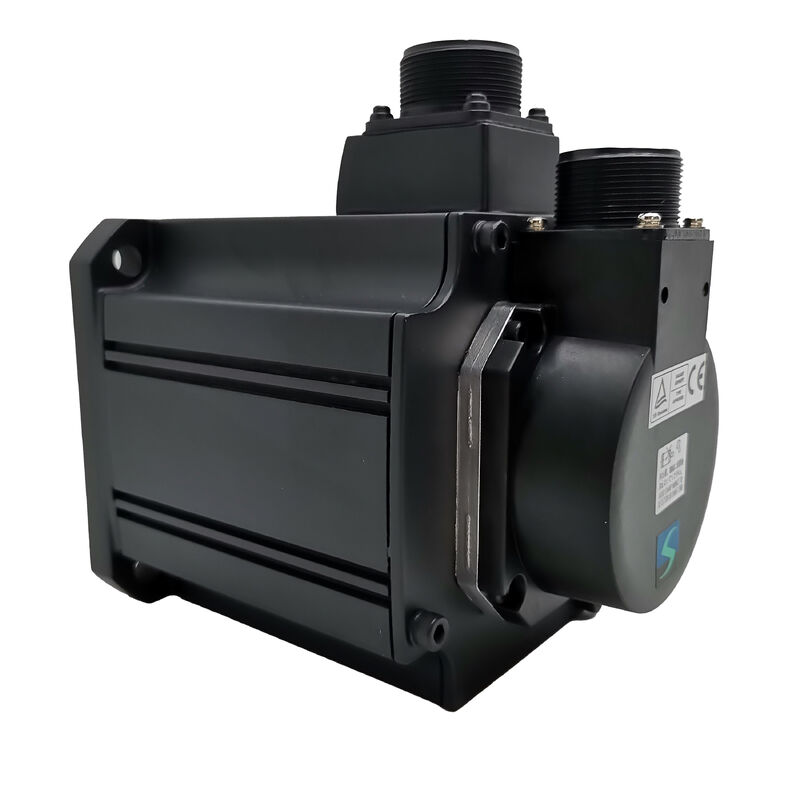
Mitsubishi HC-SFS1524 (HCSFS1524) — 1.5kW, 400V Class AC Servo Motor, 2000 rpm, Straight Shaft, MELSERVO J2-Super Series
Part Number: HC-SFS1524
Also Searched As: HCSFS1524, HC SFS 1524, HC-SFS-1524
Series: Mitsubishi MELSERVO HC-SFS (J2-Super Generation) Classification: Medium-Inertia AC Brushless Servo Motor — 1.5 kW, 400V class, 2000 rpm, Straight Shaft, No Brake
What Sets This Motor Apart
Most of the HC-SFS series runs on 200V AC — the standard voltage class for Japanese-origin servo platforms. The HC-SFS1524 is the 400V version of that same 1.5kW, 2000 rpm motor. Same mechanical envelope, same 17-bit absolute encoder, same 130 × 130 mm flange, same IP65 rating — but wound for 400V class operation and paired with a 400V class MR-J2S-200_4 amplifier.
The practical significance is straightforward: factories and machine builders operating on European or international 400V AC infrastructure no longer need a transformer to run Mitsubishi J2-Super servo drives. The HC-SFS1524 connects directly to the local supply. Panel design is simpler, the transformer's losses and footprint disappear, and the full 1.5kW is available at the motor shaft without conversion overhead.
The motor itself is mechanically and dynamically identical to its 200V counterpart. Rated torque of 7.16 Nm, peak torque of 21.6 Nm, rotor inertia of 0.002 kg·m², and a 17-bit serial absolute encoder at 131,072 ppr — all the same. The "4" suffix in the part number is entirely a power supply designator. For an engineer specifying a servo system for a 400V line, the HC-SFS1524 is the HC-SFS series entry point at 1.5kW.
| Parameter |
Value |
| Part Number |
HC-SFS1524 |
| Rated Output |
1,500 W (1.5 kW) |
| Supply Voltage |
400V class (3-phase 380–480V AC) |
| Rated Speed |
2,000 rpm |
| Maximum Speed |
3,000 rpm |
| Rated Torque |
7.16 Nm |
| Maximum Torque |
21.6 Nm |
| Rated Current |
4.4 A |
| Maximum Current |
13.2 A |
| Encoder Type |
17-bit serial absolute |
| Encoder Resolution |
131,072 ppr |
| Rotor Inertia |
0.002 kg·m² |
| Shaft Type |
Straight (no keyway) |
| Electromagnetic Brake |
None |
| Flange Size |
130 × 130 mm |
| Protection Rating |
IP65 |
| Oil Seal |
Fitted |
| Inertia Class |
Medium inertia |
| Ambient Temperature (Operation) |
0°C to +40°C |
| Motor Weight |
9 kg |
| Compatible Amplifiers |
MR-J2S-200A4 / MR-J2S-200B4 / MR-J2S-200CP4 |
| Series Generation |
MELSERVO J2-Super |
| Status |
Discontinued — available as stock |
The 400V Question: When the Suffix Matters More Than Anything Else
Servo motor selection guides generally walk through power, speed, torque, and encoder resolution. Voltage class tends to get less attention because, within a single factory, it is usually a fixed constraint — the supply is what it is, and every motor in the building runs at the same voltage. That makes the HC-SFS1524 an uncomplicated choice for 400V facilities: it is simply the correct motor.
The complication arises when machines designed for one voltage class are re-exported or relocated. A Japanese-market machine built with HC-SFS152 (200V) units being retrofitted for a European production line needs either a transformer at each drive or a direct motor swap to 400V-class equivalents. The HC-SFS1524 is that direct swap — mechanically identical to the HC-SFS152, wired differently inside the motor and paired with a different amplifier, but otherwise interchangeable without any modification to the machine structure, coupling arrangement, or cable routing.
The amplifier swap is straightforward: MR-J2S-200A / B / CP becomes MR-J2S-200A4 / B4 / CP4. The encoder cable and motor power cable connectors are the same. The parameter configuration carries over directly. For machine builders standardising on a single servo platform across facilities with different supply voltages, the 200V / 400V pairing within the HC-SFS range makes that possible without maintaining two separate mechanical designs.
One caveat worth flagging explicitly: the MR-J2S-200A4 is a 400V class amplifier and must not be connected to a 200V supply. The "4" suffix on both motor and amplifier must match. Mixing voltage classes in this platform is not a recoverable operating error — it is a hardware failure.
Torque Performance at 2000 rpm
Seven point one six Newton-metres continuous at 2,000 rpm is a well-balanced operating point for mid-range industrial servo axes. It is enough torque to drive a 10mm pitch ball-screw at moderate speed, run a medium-weight conveyor section, provide the input to a gear-driven rotary indexing table, or operate a winding tension drive with reasonable working diameter range.
The 21.6 Nm peak — exactly three times the continuous rating — handles the acceleration and deceleration phases of positioning cycles. For an axis moving a typical 130 × 130 mm-class load through a short point-to-point move and back, the peak torque is available for the first and last portions of the trajectory while the thermal budget remains intact during the constant-velocity phase. The J2-Super amplifier monitors this via its built-in electronic thermal model and will alarm before the motor windings reach a damaging temperature under any operating cycle.
Rotor inertia of 0.002 kg·m² keeps the motor's own angular momentum low relative to the torque output. Practical rule of thumb for J2-Super medium-inertia motors: load inertia reflected to the motor shaft should be kept to roughly 10 times the rotor inertia or less for good dynamic response. At 0.002 kg·m², that means a 0.02 kg·m² reflected load inertia ceiling for standard operation. If the application requires a higher load inertia ratio, the J2-Super auto-tuning can compensate to some extent, but the mechanical design should aim to stay within this envelope.
Straight Shaft and No Brake: Application Fit
The HC-SFS1524 comes with a straight, keyway-free shaft and no electromagnetic brake. This combination is appropriate for the majority of servo axes in its capacity class.
Straight shaft. Precision servo couplings, flexible disc couplings, and taper-lock or shrink-disc hubs for timing pulleys all clamp directly to a smooth shaft OD. At 1.5kW and 7.16 Nm continuous torque, friction-clamp couplings on a clean straight shaft handle the full torque range including peaks without slipping. The coupling selection should be made with the 21.6 Nm peak in mind, not just the continuous figure — a coupling sized for rated torque only will be marginal during acceleration.
The HC-SFS1524K adds a machined keyway for applications where a keyed hub is required — chain sprockets, gear hubs, and timing pulleys with keyway bores. Performance is otherwise identical. Both variants use the same MR-J2S-200_4 amplifier.
No brake. Servo lock through the amplifier's closed position loop is sufficient for horizontal axes and any mechanism where no net gravitational or spring force acts in the direction of shaft rotation when the servo is in hold state. The HC-SFS1524 covers all of those applications cleanly and without the additional wiring and relay circuit a brake requires.
For vertical axes, inclined feeds, gravity-loaded mechanisms, or any drive where axis movement at servo-off would create a hazard, the correct motor is the HC-SFS1524B (straight shaft, spring-applied electromagnetic brake) or HC-SFS1524BK (keyed shaft, brake). Within a multi-axis machine, sorting the axes by whether they genuinely need a mechanical brake and specifying accordingly produces a simpler panel and lower ongoing maintenance load.
The HC-SFS1524 requires a 400V class MR-J2S-200 amplifier. There are three variants, each representing a different control architecture:
MR-J2S-200A4 — General-purpose interface. Accepts pulse-train position commands from CNC controllers or PLCs, plus analog speed and torque references. Supports position, speed, and torque control modes and all switched-mode combinations (P/S, S/T, T/P). RS-232C connection for MR Configurator setup software. The standard choice for machine tool and general automation axes where the command source is an external controller.
MR-J2S-200B4 — SSCNET bus interface. Connects to Mitsubishi A-series and Q-series motion controllers via fiber-optic SSCNET serial link. Position commands travel over the network; encoder feedback returns through the same fiber. All absolute position, alarm, and monitoring data is available to the controller without separate wiring. The correct amplifier for coordinated multi-axis systems under a Mitsubishi motion controller.
MR-J2S-200CP4 — Built-in positioning. Up to 31 target positions stored in internal point tables, activated by digital I/O or CC-Link network command. No external motion controller needed. Suited to standalone indexed or point-to-point axes where a full network controller is not required.
All three amplifiers support the MR-J2S-200_4's built-in dynamic brake, real-time auto-tuning, adaptive vibration suppression, and the full suite of J2-Super diagnostic and monitoring functions.
HC-SFS 400V Family — Placing the 1524 in the Lineup
| Model |
Output |
Rated Torque |
Max Torque |
Flange |
Amplifier |
| HC-SFS524 |
500 W |
2.39 Nm |
7.16 Nm |
130 × 130 mm |
MR-J2S-60_4 |
| HC-SFS1024 |
1,000 W |
4.78 Nm |
14.4 Nm |
130 × 130 mm |
MR-J2S-100_4 |
| HC-SFS1524 |
1,500 W |
7.16 Nm |
21.6 Nm |
130 × 130 mm |
MR-J2S-200_4 |
| HC-SFS2024 |
2,000 W |
9.55 Nm |
28.6 Nm |
176 × 176 mm |
MR-J2S-200_4 |
| HC-SFS3524 |
3,500 W |
16.7 Nm |
50.1 Nm |
176 × 176 mm |
MR-J2S-350_4 |
| HC-SFS7024 |
7,000 W |
33.4 Nm |
100 Nm |
176 × 176 mm |
MR-J2S-700_4 |
The HC-SFS1524 is the highest-capacity motor in the 400V family that uses the 130 × 130 mm flange. The step up to the HC-SFS2024 brings both more torque and a larger 176 × 176 mm frame. For applications where the 130 × 130 mm mechanical footprint is a constraint, the 1524 represents the ceiling in this voltage class.
Typical Applications
Machine tool feed axes on 400V infrastructure. CNC turning, milling, and grinding machine feed and auxiliary axes in European and international facilities operating on 400V supply. The HC-SFS1524 provides J2-Super servo performance at 1.5kW without any transformer between the supply and the drive system.
Packaging and labelling machinery. Film drive, register control, and cutter synchronisation axes on packaging lines where machine design follows European electrical standards. The 400V rating allows direct integration with the facility supply and the rest of the machine's 400V drive system.
Textile and printing machine axis drives. Winding, unwinding, and feed roll drives on printing presses, textile winding machines, and slitter-rewinder lines in European plants. The combination of 7.16 Nm continuous torque in torque control mode, 17-bit position feedback, and 400V class operation suits these applications directly.
Conveyor and transfer system drives. Servo-controlled conveyor sections, transfer shuttles, and positioning axes on assembly and test equipment in 400V facilities. The absolute encoder eliminates home-position routines on restart, which matters for high-availability production lines with frequent power cycling.
Robotics and gantry systems. Elbow and wrist joint drives on industrial robots and secondary axes on servo-driven gantry systems where the machine electrical design follows 400V European standards and the 130 × 130 mm motor frame is a packaging requirement.
Frequently Asked Questions
Q1: What is the difference between the HC-SFS1524 and the HC-SFS152?
They are the same motor at different supply voltages. The HC-SFS152 is a 200V class motor rated at 4.4A (wait — the 200V HC-SFS152 draws ~9A at 200V). The HC-SFS1524 is the 400V class equivalent, drawing 4.4A at 400V, producing the same 1.5kW output and the same 7.16 Nm rated torque. Mechanically and dimensionally, they are identical. The difference is entirely in the winding and the compatible amplifier: HC-SFS152 uses MR-J2S-200A/B/CP (200V); HC-SFS1524 uses MR-J2S-200A4/B4/CP4 (400V).
Q2: Can the HC-SFS1524 be used with a 200V amplifier if a step-up transformer is available?
No. The HC-SFS1524 requires a 400V class amplifier (MR-J2S-200A4, B4, or CP4). The motor's winding impedance, back-EMF constant, and encoder protocol are all matched to the 400V amplifier's control parameters. Running the motor through a transformer-fed 200V amplifier would produce incorrect torque constants and current control behaviour. If the site supply is 200V, the correct motor is the HC-SFS152 (or HC-SFS152K for a keyed shaft version), paired with MR-J2S-200A/B/CP.
Q3: Which amplifier variant should I choose — A4, B4, or CP4?
It depends on how the axis is controlled. MR-J2S-200A4 suits axes commanded by pulse-train or analog signal from an external CNC or PLC — the most common choice for general machine tool and automation work. MR-J2S-200B4 is for axes on a Mitsubishi SSCNET motion controller network (A-series or Q-series), where all commands travel over the fiber bus. MR-J2S-200CP4 suits standalone positioning axes that need up to 31 stored positions activated by I/O, with no separate motion controller.
Q4: Where is the absolute encoder battery located?
The backup battery for the multi-turn absolute counter — the Mitsubishi A6BAT lithium unit — is housed inside the MR-J2S-200_4 amplifier, not in the motor. It can be replaced at the panel without touching the motor. Replace it when the amplifier triggers a battery-low alarm. Allowing the battery to go flat resets the multi-turn counter and requires a reference-return cycle before the axis can resume production.
Q5: Is the HC-SFS1524 IP65 rated for the full motor including the connectors?
The motor body is rated IP65 — protected against dust and against water jets from any direction, with an oil seal at the shaft exit. The rating applies only when the encoder and power connectors are fully mated with their corresponding cable assemblies. An unmated or poorly seated connector compromises the IP rating at that point regardless of the motor body's own protection level. Always verify that connector locking mechanisms are fully engaged after installation, and inspect them as part of any scheduled maintenance routine on machines operating in wash-down or coolant-spray environments.


 Your message must be between 20-3,000 characters!