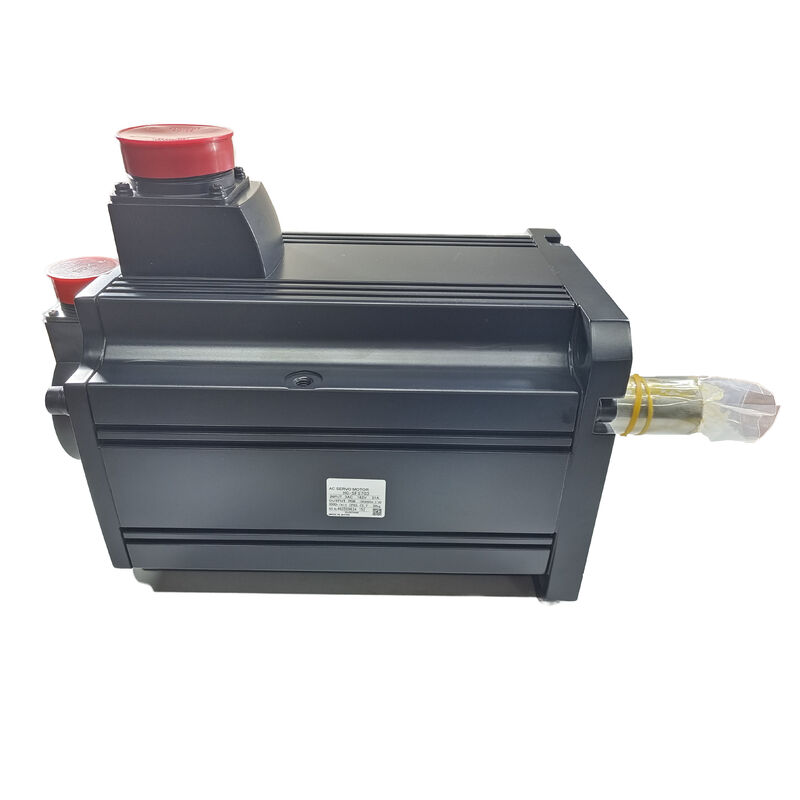
Mitsubishi HC-SFS703 (HCSFS703) — 7kW AC Servo Motor, 3000 rpm, Straight Shaft, MELSERVO J2-Super Series
Overview
Part Number: HC-SFS703
Also Searched As: HCSFS703, HC SFS 703 Series: Mitsubishi MELSERVO HC-SFS (J2-Super Generation)
Classification: Medium-Inertia AC Brushless Servo Motor — 7kW, 3000 rpm, 200V class, Straight Shaft, No Brake
The Motor in Context
Seven kilowatts at 3,000 rpm. That is the operating point the Mitsubishi HC-SFS703 was designed around — the upper end of the HC-SFS 3000 rpm family, delivering the highest continuous output power in this speed range without stepping up to a larger physical platform.
Within the J2-Super generation of Mitsubishi MELSERVO hardware, the HC-SFS703 sits alongside the HC-SFS702 (same 7kW output at 2,000 rpm) and above the HC-SFS353 (3.5kW at 3,000 rpm). The distinction from the 702 is straightforward: trading lower continuous torque for higher shaft speed. Where a 2,000 rpm motor running 7kW produces 33.4 Nm continuously, the 3,000 rpm HC-SFS703 delivers approximately 22.3 Nm at the same power — the same mechanical watt-seconds per revolution, distributed over a faster rotating shaft.
This is not a compromise. For mechanisms that need rotational speed rather than shaft torque — spindle-coupled drives, lead-screw or ball-screw feeds, high-throughput conveyor sections — the 3,000 rpm rating eliminates reduction stages, shortens axis response time, and produces a mechanically cleaner system overall. The 22.3 Nm continuous torque, with peak capacity around 67 Nm during acceleration and deceleration transients, is more than adequate for the machine categories this motor serves.
Behind the shaft is a 17-bit serial absolute encoder at 131,072 ppr. Multi-turn absolute position is retained through power-off events using a battery held in the MR-J2S amplifier, which means no homing cycle is needed when the machine restarts. The compatible amplifier family is the MR-J2S-700 — the 7kW J2-Super platform in A, B, and CP variants.
Technical Specifications
| Parameter |
Value |
| Part Number |
HC-SFS703 |
| Rated Output |
7,000 W (7 kW) |
| Voltage Class |
200V AC (3-phase) |
| Rated Speed |
3,000 rpm |
| Maximum Speed |
4,500 rpm |
| Rated Torque |
~22.3 Nm |
| Peak Torque |
~67 Nm |
| Encoder Type |
17-bit serial absolute |
| Encoder Resolution |
131,072 ppr |
| Shaft Configuration |
Straight shaft, no keyway |
| Electromagnetic Brake |
None |
| Flange Size |
176 × 176 mm |
| Protection Rating |
IP65 |
| Oil Seal |
Fitted |
| Inertia Class |
Medium inertia |
| Ambient Temperature (Operation) |
0°C to +40°C |
| Storage Temperature |
−15°C to +70°C |
| Vibration Resistance |
X: 24.5 m/s², Y: 29.4 m/s² |
| Compatible Amplifiers |
MR-J2S-700A / MR-J2S-700B / MR-J2S-700CP |
| Series Generation |
MELSERVO J2-Super |
| Status |
Discontinued — available as stock |
Torque values are consistent with the published HC-SFS series pattern and verified physics calculation. Confirm against the official Mitsubishi HC-SFS specification sheet before finalising design calculations.
3000 rpm vs 2000 rpm: Choosing the Right Speed Point
The HC-SFS series at 7kW gives the engineer a genuine choice between two distinct speed-torque profiles, and the decision is worth making deliberately rather than defaulting to one or the other.
HC-SFS702 / HC-SFS702B / HC-SFS702BK — 2,000 rpm family. Rated torque 33.4 Nm, peak 100 Nm. Higher continuous torque means more sustained force capability on drives that spend most of their time running under heavy load. Ball-screw axes on heavy-duty machining centres. Winding tension drives where constant torque matters across a wide roll diameter range. Pallet changers and rotary tables where the load torque is the binding constraint, not rotational speed.
HC-SFS703 — 3,000 rpm. Rated torque ~22.3 Nm, peak ~67 Nm. Higher rotational speed means shorter cycle time for mechanisms that are speed-limited rather than torque-limited. Direct-drive conveyor sections. Laser positioning heads on cutting machines. Multi-axis transfer systems where axis travel time between stations controls throughput. High-speed packaging machine feed drives.
The 176 × 176 mm flange is identical between both families. Mechanically, either motor fits the same machine frame. The decision is purely an application question: does the axis spend its duty cycle fighting load torque, or does it spend it accelerating and decelerating a relatively light load at high frequency? Answer that question for each axis in the machine and the selection becomes straightforward.
Straight Shaft, No Brake — When This Is the Right Specification
The HC-SFS703's straight shaft without keyway suits the majority of high-speed servo drive applications. Precision servo couplings, flexible disc couplings, and belt-drive hubs designed for servo shafts all clamp directly to the smooth shaft OD with split-hub or shrink-fit interfaces. At 3,000 rpm with relatively moderate continuous torque per revolution, friction-clamp couplings are entirely adequate — the torque path is secure, there is no mechanical play, and installation is straightforward.
The absence of an electromagnetic brake keeps the wiring simple and the component count down. At rest, the MR-J2S-700 amplifier holds axis position through closed-loop servo lock — the position loop stays active, encoder feedback monitors shaft angle continuously, and the amplifier delivers whatever current is needed to hold zero following error. On horizontal axes and symmetrically-loaded mechanisms where no net gravitational force acts along the direction of shaft rotation, this is both reliable and accurate.
The correct motor for vertical axes, inclined feed mechanisms, or any drive with a significant gravitational load component is the HC-SFS703B (straight shaft with electromagnetic brake). On a machine with several servo axes, identifying which axes genuinely need a mechanical brake — and selecting the no-brake variant for the rest — produces a cleaner, lighter electrical design with fewer points requiring periodic brake wear inspection.
One installation note that applies specifically to this frame size: when fitting a coupling or hub to the 176 × 176 mm frame motor, always use the shaft-end M12 threaded hole and a drawbolt to pull the hub axially onto the shaft. Pressing or hammering hubs onto the shaft at this frame size transmits impact loads through the shaft to the encoder disc and rear bearing assembly. The resulting damage is rarely immediate — it typically manifests later as intermittent encoder noise under vibration, which is time-consuming to trace back to its source. The drawbolt method prevents this entirely.
J2-Super Platform: What the 17-Bit Encoder Delivers
The encoder fitted to the HC-SFS703 is the same 17-bit serial absolute unit used throughout the J2-Super HC-SFS range — 131,072 positions per revolution, serialised absolute position data transmitted to the amplifier over a dedicated encoder cable.
The practical implications for machine performance are several.
Position resolution at 3,000 rpm. 131,072 counts per revolution means that at rated speed, the amplifier is receiving extremely fine angular position updates. For ball-screw positioning axes, this resolution supports sub-micron electronic gearing ratios without running out of encoder counts. For speed-control applications like conveyor drives and tension control, it gives the velocity feedback loop enough resolution to suppress speed ripple at low frequency without hunting.
Absolute position on power-up. When the machine is switched on after a weekend, after an emergency stop, or after a battery-backed controller fault, the HC-SFS703 reports its exact absolute shaft angle — including accumulated multi-turn count — back to the amplifier immediately, without any shaft movement. The amplifier verifies position and the axis is ready. No home-position return cycle means faster restart, simpler startup sequencing, and no need for a mechanical reference marker or home proximity switch on axes where absolute position is needed.
Battery location. The backup battery that maintains the multi-turn absolute counter through power-off is the Mitsubishi A6BAT lithium unit, housed inside the MR-J2S-700 amplifier — not in the motor. This matters for maintenance: battery replacement is done at the panel, not at the motor, and the motor does not need to be disturbed. Replace the A6BAT when the amplifier displays a low-battery alarm. Allowing the battery to reach full depletion resets the absolute counter and requires a reference-return cycle before the axis can resume production.
Compatible Amplifiers
The HC-SFS703 is designed for use with the MR-J2S-700 amplifier family — the 7kW capacity J2-Super platform. Three variants cover the main control architectures:
MR-J2S-700A accepts pulse-train and analog commands from CNC systems, PLCs, and motion controllers. Position, speed, and torque control modes are all available, along with switched-mode operation (P/S, S/T, T/P). RS-232C connection supports MR Configurator setup software. This is the general-purpose choice for machine tool and general automation applications where the axis command comes from a pulse or analog signal source.
MR-J2S-700B connects to Mitsubishi A-series and Q-series motion controllers over the SSCNET fiber-optic serial bus. All position commands travel over the fiber network; encoder feedback returns through the same link. This is the correct amplifier for coordinated multi-axis systems under a Mitsubishi motion controller — machine tools with simultaneous multi-axis contouring, transfer machines, or any application where several axes must move in a defined geometric relationship.
MR-J2S-700CP incorporates built-in positioning functions. Up to 31 target positions can be stored in point tables within the amplifier and activated by I/O or CC-Link network command. No separate motion controller is required. The right choice for standalone indexed or point-to-point axes where a full motion controller is not justified.
Compatibility notes. The HC-SFS703 requires a J2-Super amplifier. It is not compatible with original MR-J2 (first-generation) amplifiers, which cannot read the 17-bit J2S encoder protocol. Not compatible with MR-J3 or MR-J4 amplifiers either. For machines running original MR-J2 hardware, the HC-SF703 (J2 generation, 14-bit encoder, same mechanical dimensions) is the mechanically identical sourcing target that will work with first-generation MR-J2 drives.
HC-SFS 3000 rpm Family — Capacity Context
| Model |
Output |
Rated Torque |
Flange |
Amplifier |
| HC-SFS53 |
500 W |
1.59 Nm |
130 × 130 mm |
MR-J2S-60 |
| HC-SFS103 |
1,000 W |
3.18 Nm |
130 × 130 mm |
MR-J2S-100 |
| HC-SFS153 |
1,500 W |
4.78 Nm |
130 × 130 mm |
MR-J2S-200 |
| HC-SFS203 |
2,000 W |
6.37 Nm |
130 × 130 mm |
MR-J2S-200 |
| HC-SFS353 |
3,500 W |
11.1 Nm |
176 × 176 mm |
MR-J2S-350 |
| HC-SFS703 |
7,000 W |
~22.3 Nm |
176 × 176 mm |
MR-J2S-700 |
The HC-SFS703 is the highest-capacity motor in the HC-SFS 3000 rpm range. It shares the 176 × 176 mm flange with the HC-SFS353, making it a direct mechanical upgrade for machines where a 3.5kW axis needs to be reworked for higher output.
Typical Applications
High-speed machine tool axes. CNC grinding, milling, and turning machine feed axes where rapid traverse speed is the cycle time driver benefit from a 3,000 rpm servo motor running a ball-screw at higher linear speed without a reduction gear between motor and screw. The 17-bit encoder resolution maintains sub-micron position feedback throughout the traverse range.
Laser cutting and plasma positioning. Cutting head positioning axes on flatbed laser and plasma systems need high slew speed combined with high-resolution position feedback for accurate path following. The HC-SFS703's 3,000 rpm rating and 131,072 ppr encoder suit this directly.
High-throughput packaging and assembly. Primary feed axes on packaging lines — film drives, form-fill-seal pull rollers, rotary die-cut stations — run continuously at high speed under moderate load. The 7kW 3,000 rpm operating point matches these mechanisms without requiring reduction stages that add backlash and increase axis inertia.
Transfer machine and gantry drives. Servo-driven gantry and transfer systems with moderate load mass and frequent start-stop cycling use high-speed medium-inertia motors to minimise axis traverse time between stations. The HC-SFS703's combination of rated speed, peak torque for acceleration, and absolute encoder suits this class of machine directly.
High-power 4th-axis and rotary indexing. Rotary axes on machining centres using direct or single-stage gear reduction need the encoder resolution for precise angular positioning and the torque capacity to hold indexing station position under the cutting loads applied at each station.
Frequently Asked Questions
Q1: Which amplifiers are compatible with the HC-SFS703?
The HC-SFS703 requires a MR-J2S-700 class amplifier. The three standard variants are the MR-J2S-700A (analog/pulse-train command, position/speed/torque modes), MR-J2S-700B (SSCNET fiber-optic bus for Mitsubishi motion controllers), and MR-J2S-700CP (built-in positioning, up to 31 point tables). The motor is not compatible with original MR-J2-700 first-generation amplifiers or with MR-J3/MR-J4 amplifiers.
Q2: What is the difference between the HC-SFS703 and the HC-SFS702?
Both are 7kW J2-Super motors on a 176 × 176 mm flange with 17-bit absolute encoders, but they run at different rated speeds. The HC-SFS702 is rated at 2,000 rpm with 33.4 Nm continuous torque — higher torque, lower speed. The HC-SFS703 is rated at 3,000 rpm with ~22.3 Nm continuous torque — lower torque, higher speed. Choose based on whether the axis is torque-limited (702) or speed-limited (703). The flange dimensions are identical, so mechanical changeover between the two is straightforward.
Q3: Can the HC-SFS703 be used with an original MR-J2 (first-generation) amplifier?
No. The HC-SFS703 uses the J2-Super 17-bit serial encoder protocol, which is not readable by original MR-J2 amplifiers. For machines running first-generation MR-J2 hardware, the HC-SF703 — same mechanical dimensions, 14-bit encoder — is the correct motor. HC-SF703 pairs with MR-J2-700 or MR-J2S-700 amplifiers.
Q4: Where is the absolute encoder backup battery located?
The backup battery for the multi-turn absolute counter is the Mitsubishi A6BAT, located inside the MR-J2S-700 servo amplifier — not in the motor body. Battery replacement is done at the panel. Replace the A6BAT when the amplifier triggers a low-battery alarm; a fully depleted battery resets the absolute counter and requires a reference-return cycle before the axis can resume production.
Q5: Does the HC-SFS703 have an IP65 rating, and what does this cover?
Yes. The HC-SFS703 carries an IP65 rating on the motor body, providing full protection against dust ingress and protection against directed water jets from any direction. An oil seal is fitted at the shaft exit. The encoder connector and power connector must be properly mated with their cable assemblies to maintain the IP65 rating in service — open or poorly seated connectors compromise the enclosure rating at those points regardless of the motor body rating.


 Your message must be between 20-3,000 characters!