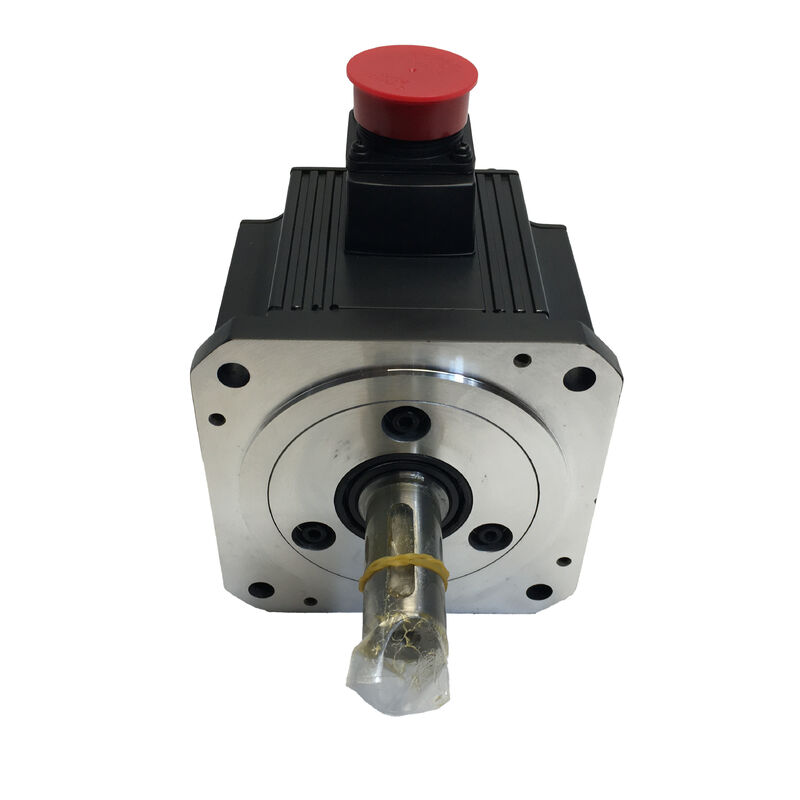
Mitsubishi HC-SFS202K (HCSFS202K) — 2kW AC Servo Motor, Keyed Shaft, No Brake, MELSERVO-J2S Series
Product Identification
Part Number: HC-SFS202K
Also Searched As: HCSFS202K, HC-SFS-202K
Series: Mitsubishi MELSERVO HC-SFS (J2-Super Generation)
Motor Type: AC Brushless Servo Motor — Keyed Shaft, No Brake, 2000 rpm, 200V AC
Platform: MELSERVO J2S (J2-Super)
The Motor and Its Purpose
Pick any two attributes from the HC-SFS202 variant matrix — shaft type and brake presence — and you get a motor configured for a specific class of application. The HC-SFS202K answers with a keyed shaft and no brake: positive torque transmission through a machined keyway, and position hold at rest through amplifier servo lock rather than a spring-applied mechanical device.
That combination places this motor squarely in the territory of horizontal axes, gear-coupled drives, timing belt mechanisms, and any application where a key-and-hub torque path is the engineering preference and the load does not require fail-safe hold on servo-off. At 2kW, 9.55 Nm continuous, and 28.6 Nm peak, the HC-SFS202K covers the mainstream of medium-capacity CNC axis and automation drive requirements — enough torque to handle real production loads, compact enough to fit the machine structures that 2kW axes typically occupy.
The MELSERVO-J2S platform's 17-bit serial absolute encoder at 131,072 positions per revolution provides the feedback quality the MR-J2S amplifier needs to run the speed and position loops at high bandwidth. Paired with the J2-Super amplifier's improved processor, that encoder resolution supports the tight velocity regulation and rapid disturbance rejection that precision machining and high-cycle automation require.
Technical Specifications
| Parameter |
Value |
| Part Number |
HC-SFS202K |
| Rated Output |
2,000 W (2 kW) |
| Supply Voltage |
200V AC class (3-phase) |
| Rated Current |
11 A |
| Rated Speed |
2,000 rpm |
| Maximum Speed |
3,000 rpm |
| Rated Torque |
9.55 Nm |
| Maximum Torque |
28.6 Nm |
| Encoder |
17-bit serial absolute (131,072 ppr) |
| Shaft Type |
Keyed (with keyway) |
| Electromagnetic Brake |
None |
| Inertia Class |
Medium inertia |
| Flange Size |
176 × 176 mm |
| Protection Rating |
IP65 |
| Oil Seal |
Fitted |
| Ambient Temperature |
0°C to +40°C |
| Compatible Amplifiers |
MR-J2S-200A / MR-J2S-200B / MR-J2S-200CP |
| Series |
MELSERVO J2S (J2-Super) |
| Origin |
Made in Japan |
| Product Status |
Discontinued — available stock |
The Keyed Shaft: Engineering a Reliable Torque Interface
Friction between a hub bore and shaft OD transmits torque on a plain straight shaft. The clamping force must be high enough to resist the peak torque — 28.6 Nm — under the worst operating condition the axis encounters. In CNC machine tool service, that worst condition is not steady-state cutting. It is a sudden reversal at maximum rapid traverse, an aggressive deceleration from top speed into a positioning target, or a commanded emergency stop with maximum current. Any of these, repeatedly across a production shift, test a friction interface in ways that can introduce micro-slip over time. Micro-slip is insidious: small enough to miss individual alarm thresholds, large enough to accumulate into dimensional errors over multiple cycles.
The keyway on the HC-SFS202K changes the torque path. The key engages matching slots in both shaft and hub; under load, the key bears in shear and transmits torque mechanically, independent of whatever friction the interface happens to provide. Reversal loads, cyclic loads, shock inputs — none of these progressively degrade a properly fitted keyed connection the way they can degrade a marginal friction clamp.
Where keyways are the natural specification:
Timing belt drive pulleys, where belt tension and cyclic tooth engagement forces create precisely the reversal loads that keyways handle well. Gear hubs in reduced-ratio drive trains, where angular registration between shaft and gear must be maintained for correct tooth meshing. Chain sprockets in pallet transfer systems, where chain engagement shock loads arrive repeatedly in alternating directions. Precision coupling designs where the hub bore incorporates an internal keyway as part of the torque connection specification.
Installation note from the Mitsubishi servo motor manual: draw the coupling hub onto the shaft using the shaft-end threaded hole and a drawbolt — never by hammering or pressing. At the 176 × 176 mm frame size, impact forces during hub fitting transmit through the shaft directly to the encoder disc and bearing assembly at the motor's rear. The encoder damage that results does not necessarily cause an immediate alarm; it tends to produce intermittent position errors under vibration, which are genuinely difficult to trace back to a hub installation event. The drawbolt method takes seconds longer and prevents this entirely.
No Brake: When Servo Lock Is the Right Architecture
Servo lock — the amplifier's continuous closed-loop position hold with motor current active — is effective and accurate for a well-defined class of axes. These are horizontal drives, symmetrically loaded mechanisms, and any application where the load exerts no net force in the direction of shaft rotation when the servo is holding a position. For all of them, a brake would add hardware, wiring, relay sequencing, panel load, and maintenance interval for no functional return.
The HC-SFS202K is the specification for those axes. Removing the brake removes nothing the application actually uses, and it simplifies the electrical system at every axis in the machine where it applies.
Where the picture changes — vertical slides, gravity-loaded arms, inclined feed axes, any drive where the load would move when servo current drops — the axis belongs to the HC-SFS202BK (keyed shaft with spring-applied brake). That is an engineering decision, not a cost optimisation. On machines with multiple 2kW axes, correctly sorting which axes need brakes and which do not simplifies the panel design substantially.
17-Bit Encoder: What the Resolution Provides in Practice
The J2-Super platform's encoder upgrade from the 14-bit device in the earlier HC-SF series to 17 bits was an eight-fold resolution increase — from 16,384 to 131,072 positions per revolution. At 2kW and 2,000 rpm, this shows up practically in several ways.
Velocity estimation for the speed loop improves because successive encoder samples represent finer angular increments. The speed loop receives a lower-noise velocity signal, which allows higher proportional gain without instability. Higher gain means the amplifier corrects velocity disturbances faster — cutting force changes, inertia variations, and transmission compliance effects that push the axis off its commanded velocity profile are rejected more quickly and with less residual error.
At low feed rates and during deceleration to a position target, finer encoder increments mean the position loop can detect and correct smaller errors. The axis settles more repeatably to the commanded position, and the velocity waveform at low speed contains less ripple — which matters for surface finish on contouring operations and for part-to-part dimensional consistency in positioning applications.
The absolute function backs up position storage through any power event. The A6BAT lithium cell in the MR-J2S amplifier keeps the multi-turn counter alive during power-off periods. Every restart — planned or otherwise — brings the axis up in its exact last known position. For production machinery that cycles through e-stops, alarm resets, and shift-end shutdowns routinely, eliminating mandatory homing cycles produces measurable time savings across a year of operation.
Compatible Amplifiers
The HC-SFS202K is driven by the MR-J2S-200 class amplifier, the 2kW J2-Super platform. Three interface types suit different system architectures:
MR-J2S-200A — Analog and pulse-train command interface. Accepts step/direction pulse trains and ±10V analog commands from CNC systems and PLCs. Position, speed, and torque control modes all available. Setup through MR Configurator via RS-232C.
MR-J2S-200B — SSCNET fiber-optic serial bus. Connects to Mitsubishi A-series or Q-series motion controllers for coordinated multi-axis systems. Position commands arrive over the network from the motion controller; encoder data returns through the same fiber link.
MR-J2S-200CP — Built-in positioning. Up to 31 target positions stored in the amplifier, activated by I/O signals or CC-Link command. Suitable for simple standalone indexed positioning without a dedicated motion controller.
The HC-SFS202K is not compatible with original MR-J2-200 amplifiers (first-generation, pre-J2S) which cannot read the 17-bit encoder protocol. For machines running first-generation MR-J2 hardware, the HC-SF202K (J2 generation, 14-bit encoder, same mechanical specification) is the correct sourcing target.
Where the 202K Sits in the HC-SFS 2000 rpm Family
| Model |
Output |
Rated Torque |
Peak Torque |
Shaft |
Brake |
Flange |
| HC-SFS52 series |
500 W |
2.39 Nm |
7.16 Nm |
Str / Keyed |
No |
130 × 130 mm |
| HC-SFS102 series |
1,000 W |
4.78 Nm |
14.4 Nm |
Str / Keyed |
No |
130 × 130 mm |
| HC-SFS152 series |
1,500 W |
7.16 Nm |
21.5 Nm |
Str / Keyed |
No |
130 × 130 mm |
| HC-SFS202 series |
2,000 W |
9.55 Nm |
28.6 Nm |
Str / Keyed |
No / Yes |
176 × 176 mm |
| HC-SFS352 series |
3,500 W |
16.7 Nm |
50.1 Nm |
Str / Keyed |
No / Yes |
176 × 176 mm |
The 202 capacity marks the step up from the 130 × 130 mm flange group to the 176 × 176 mm flange — a mounting footprint shared with the 3.5kW, 5kW, and 7kW motors in this family. A machine designed around the 176 × 176 mm flange can accept any motor from 2kW upward without mounting plate changes, giving the design headroom for future capacity upgrades.
Typical Applications
CNC machining centre X and Y table feed axes. Primary horizontal table axes on vertical and horizontal machining centres carry workpiece and fixture loads at sustained cutting feedrates and high rapid traverse speeds. These are horizontal axes — no brake required — and the keyed shaft suits the precision coupling designs used on high-stiffness ballscrew drives. The 9.55 Nm continuous provides torque authority for sustained heavy cutting without running near the thermal ceiling.
Timing belt drive mechanisms on multi-axis machines. Secondary axes on multi-spindle machining centres, transfer machines, and high-speed assembly equipment that use toothed timing belts between the servo motor and the driven mechanism require keyed motor-side pulleys. The belt's repeated tension cycling creates exactly the directional load reversals that keyways handle more reliably than friction-only clamp designs.
Servo-driven rotary axis and gear-coupled drives. 4th-axis rotary table drives using spur or helical gear reduction between the servo motor and the table input require a keyed motor-side gear hub for positive mesh alignment. The 17-bit encoder provides the angular resolution that precise multi-face machining indexing demands, and the 28.6 Nm peak handles the inertial demand of rapid table indexing.
High-speed packaging and labelling axes. Timing belt driven infeed, film pull, and registration correction axes on packaging lines use servo motors with keyed drive pulleys and benefit from the fast response and high bandwidth of the J2-Super platform. The IP65 rating handles the wash-down and dust conditions common in food and pharmaceutical packaging environments.
Horizontal conveyor and transfer servo drives. Servo-controlled transfer conveyors, rotary indexing stations, and part accumulation systems use medium-capacity servo drives on horizontal axes where servo lock provides adequate rest position hold and the keyed shaft suits the sprocket or coupling drive interface.
Frequently Asked Questions
Q1: Which amplifiers are compatible with the HC-SFS202K?
The HC-SFS202K requires a MR-J2S-200 class amplifier from the MELSERVO-J2S (J2-Super) platform. The three standard variants are the MR-J2S-200A (analog/pulse command), MR-J2S-200B (SSCNET fiber-optic bus for motion controllers), and MR-J2S-200CP (built-in positioning). All support the 17-bit serial encoder and the motor's 11A rated current. This motor is not compatible with first-generation MR-J2-200 amplifiers or with MR-J3 / MR-J4 amplifiers.
Q2: What is the difference between the HC-SFS202K and the HC-SFS202BK?
Identical in every electrical and mechanical specification — same 2kW, 9.55 Nm, 28.6 Nm peak, 17-bit encoder, keyed shaft, 176 × 176 mm flange, same amplifier class. The HC-SFS202BK adds a spring-applied electromagnetic brake; the HC-SFS202K does not. Choose the no-brake variant for horizontal axes where servo lock provides adequate hold at all stop conditions. Choose the BK variant for vertical axes or any application where the load must be held mechanically when servo power is removed.
Q3: What is the difference between the HC-SFS202K and the HC-SFS202 (straight shaft)?
Mechanically and electrically identical — same 2kW output, same torque figures, same encoder, same flange, same amplifier requirements. The only difference is the shaft: HC-SFS202 has a plain straight shaft for friction-clamp couplings; HC-SFS202K has a machined keyway for positive key-and-hub torque transmission. Choose based solely on the coupling design of the driven mechanism.
Q4: Can the HC-SFS202K replace a first-generation HC-SF202K on a machine with MR-J2-200 amplifiers?
Not directly. The HC-SFS202K uses a 17-bit J2S encoder that MR-J2-200 amplifiers cannot read — connecting this motor to a first-generation MR-J2 amplifier will produce an encoder fault. For machines running original MR-J2-200 amplifiers, source the HC-SF202K (J2 generation, 14-bit encoder) for a like-for-like replacement. If the amplifiers are MR-J2S-200, both the HC-SF202K and HC-SFS202K are compatible — the HC-SFS202K offers higher encoder resolution.
Q5: Is a key supplied with the HC-SFS202K?
Standard practice for Mitsubishi keyed-shaft HC-SFS motors is to supply the keyway machined into the shaft without a key included in the motor packaging. Verify keyway dimensions from the servo motor instruction manual for the HC-SFS202 series before ordering a key, and select a key with correct width, height, length, and tolerance for the hub bore design and the application's torque and shock loading conditions.


 Your message must be between 20-3,000 characters!