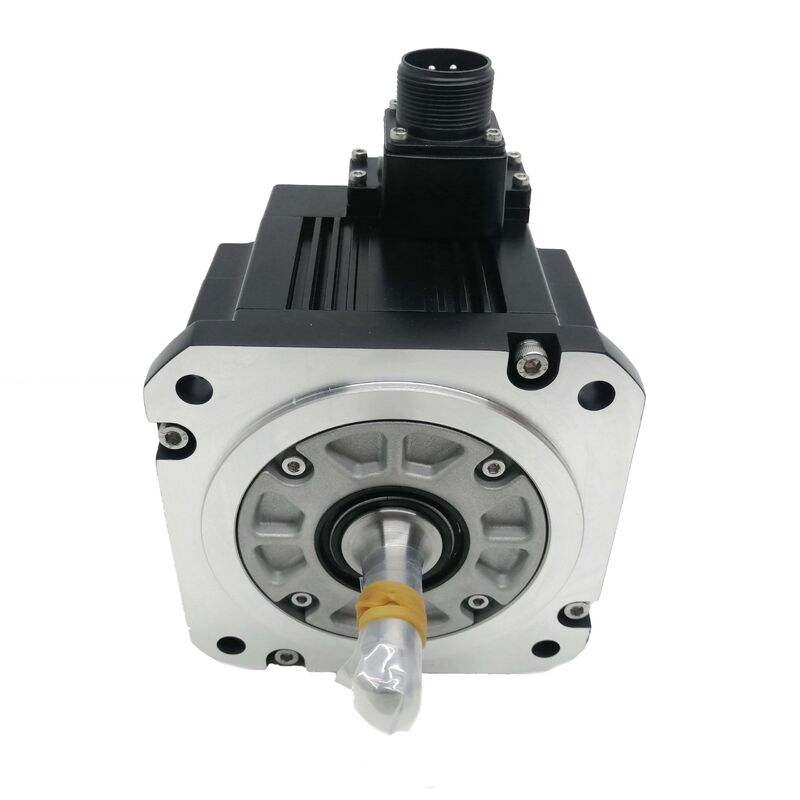
Mitsubishi HF103T | HF Series AC Servo Motor — 1kW, 3000RPM, IP67, 125V, 5.3A, 133Hz
Part Number: HF103T
Brand: Mitsubishi Electric
Series: HF Series
Configuration: Straight Shaft, Standard Encoder, No Brake, No Reduction Gear, Lead Wire Connection
Ingress Protection: IP67
Standard: IEC60034-1
Origin: Made in Japan
Condition: New / Refurbished
Overview
The Mitsubishi HF103T is a 1kW AC servo motor from Mitsubishi Electric's HF series, rated at 3,000 r/min with a three-phase 125V input at 133Hz, drawing 5.3A continuous current. Fully enclosed to IP67 — dust-tight and resistant to temporary immersion — this is a motor built to operate reliably in demanding production environments where coolant, mist, and industrial contamination are part of daily operating conditions.
The motor is IEC60034-1 compliant, Class F insulated (rated to 155°C winding temperature), and weighs 6.5 kg.
At this frame size and IP67 rating, the HF103T occupies the solid mid-range of Mitsubishi's HF series lineup — more environmentally robust than the standard IP55 variants used in cleaner installations, and appropriately specified for the machine tool and general automation environments where its combination of 1kW output, 3,000 RPM speed, and sealed housing was designed to perform.
The lead wire connection style — visible from the flying conductors exiting the motor body — means the power and encoder cables are terminated by the installer at the drive or junction point, rather than through a fixed connector body.
This gives routing flexibility in confined installations but requires proper strain relief and protection at the motor cable entry.
Key Specifications — From Nameplate
| Parameter |
Value |
| Rated Output |
1 kW |
| Rated Speed |
3,000 r/min |
| Input Voltage |
3AC 125 V |
| Rated Current |
5.3 A |
| Rated Frequency |
133 Hz |
| Phase |
3-Phase |
| Insulation Class |
F (max 155°C) |
| Ingress Protection |
IP67 |
| Weight |
6.5 kg |
| Connection Type |
Lead Wire |
| Brake |
None |
| Reduction Gear |
None |
| Standard |
IEC60034-1 |
| Origin |
Made in Japan |
| Series |
HF Series |
IP67 — Fully Sealed for Industrial Environments
IP67 is one of the more stringent ingress protection ratings in industrial servo motor specification: completely dust-tight, and tested for temporary immersion to one metre depth for up to 30 minutes.
In a machine tool or production automation context, this means the motor is reliably protected against all realistic exposure scenarios — cutting fluid spray, coolant mist saturation, wash-down cleaning, and the condensation cycles that occur in machines operating in humid factory environments.
The HF103T carries this protection as a standard characteristic, not an option.
The shaft seal, housing joints, and cable entry are all rated as part of the IP67 assembly. This distinguishes it from the lower-rated variants in the HF family and makes it a suitable choice for axis positions exposed to direct or indirect coolant contact during normal machine operation.
For maintenance reference, IP67 requires that the sealing components be in good condition to maintain their rating.
Shaft seal integrity, cable entry gland condition, and connector seating should be checked periodically on motors in high-exposure positions, particularly on units with extended service histories where seal elastomers may have aged.
133Hz, 125V, 5.3A — The Electrical Operating Point
The nameplate parameters describe the motor's operating point as presented to it by the servo drive: 3-phase 125V at 133Hz, drawing 5.3A at rated load. These figures are generated by the drive's inverter stage from the standard mains supply — the machine's incoming supply is 200–230V three-phase, which the drive rectifies to a DC bus and then inverts at the frequency and voltage needed for the motor to run at rated speed and torque.
At 133Hz and 3,000 r/min, the HF103T's electromagnetic design is optimised for this operating region.
The 5.3A rated current is the amplifier's continuous output requirement for this axis under normal production load — a parameter that determines the servo drive module's current class and the wiring cross-section for the motor power leads.
Class F insulation means the winding is rated to 155°C maximum, giving adequate thermal margin over the expected operating temperature in normal continuous duty.
The 6.5kg weight is a practical figure for installation planning. At this mass, the motor can be handled and positioned by one technician, and standard servo motor mounting hardware is appropriate for the flange and mounting bolt pattern.
HF Series in the Mitsubishi CNC Drive System
The HF series motors are designed to work with Mitsubishi's MELDAS CNC servo drive systems.
The MDS-R series drive units are specifically indicated as compatible with HF motors operating from a 200VAC input — and notably, Mitsubishi's documentation explicitly states that HF series motors are not compatible with the conventional MDS-B, MDS-C1, or MDS-CH series drives. For machines that have undergone drive system upgrades, this compatibility distinction is a necessary check before specifying the HF103T as a replacement.
The standard encoder fitted to this motor provides the feedback interface expected by the compatible Mitsubishi drive generation. Servo drive motor type parameters must be set to match the HF series 1kW specification before the axis is operated.
This is a routine commissioning step but one that must be completed correctly before the first production cycle on any replacement motor.
Lead Wire Connection — Installation Notes
The "T" designation in the HF103T model number indicates the lead wire (terminal) connection style. Flying conductors exit the motor body for the three-phase power supply (U, V, W), protective earth, and encoder feedback signal.
The installer terminates these at the drive or junction box, sizing and routing the cables to suit the machine layout.
This connection style has practical advantages in installations where cable routing through tight spaces is needed, or where custom cable lengths are required.
It also means that the motor cable interface is entirely determined by the installation wiring — replacing a lead wire motor with a connector-style motor requires re-terminating the cable interface at the machine end, which adds time and cost to what would otherwise be a direct swap. Confirming the connection style on the installed motor before ordering a replacement is therefore a simple but important step.
At the motor end, lead wire exits require proper strain relief to prevent mechanical stress on the internal connection point from being transmitted along the cable during machine operation or maintenance access.
This is a common wear point on motors that have been in service for many years or have undergone repeated cable handling.
FAQ
Q1: What are the confirmed electrical parameters of the HF103T from the nameplate?
The nameplate reads: INPUT 3AC 125V 5.3A Cl.F / OUTPUT 1kW / 3000r/min (133Hz) / 6.5kg / IP67 / IEC60034-1. The 125V and 133Hz are the motor's operating voltage and frequency as supplied by the servo drive inverter — not the mains supply voltage, which remains the standard 200–230V three-phase. Class F insulation indicates a 155°C winding temperature rating.
Q2: Which Mitsubishi servo drive is compatible with the HF103T?
HF series motors are specified for use with the Mitsubishi MDS-R series drive units operating from 200VAC. Mitsubishi's documentation states that HF series motors are not compatible with the conventional MDS-B, MDS-C1, or MDS-CH series drives.
Before replacing the HF103T, confirm that the installed drive is an MDS-R series unit or its compatible successor. Fitting an HF motor to an incompatible drive generation will result in drive alarm or failure to commission.
Q3: What does IP67 mean in practice for this motor's installation?
IP67 means the motor is completely dust-tight and tested for temporary immersion (1 metre depth, 30 minutes). In a machine tool environment, this covers all realistic exposure: coolant spray, mist saturation, condensation, and cleaning operations.
The rating applies to the motor as a complete assembly — shaft seal, housing, and cable entry included. Check shaft seal and cable gland condition on used motors, as seal degradation over time can reduce protection below IP67 even if the motor is otherwise functional.
Q4: The motor has no brake — what does this mean for vertical axis applications?
Without an integrated electromagnetic brake, position holding at rest depends entirely on the servo drive maintaining active torque retention. For vertical axes carrying gravity load — spindle heads, column drives, or any mechanism where the load would descend under gravity if the servo were de-energised — a brake is a safety requirement.
The HF103T without brake is appropriate for horizontal axes and lightly loaded drives where active servo holding is sufficient. For gravity-loaded vertical axes, a braked variant must be specified.
Q5: What should be checked when evaluating a used HF103T?
Start with the cable exits — inspect the lead wire strain relief and insulation for damage, abrasion, or pull-through stress, as flying leads are more mechanically exposed than connector-style motors. Check the IP67 shaft seal for hardening or cracking at the lip.
Measure three-phase winding resistance for phase balance and verify insulation resistance to earth. Rotate the shaft by hand to check bearing condition. Inspect the motor flange mating face for damage. At 6.5 kg, the motor is manageable for a single technician during inspection.
A no-load bench run-up to 3,000 r/min with encoder signal monitoring on a compatible MDS-R drive is the correct final verification before the motor returns to a production axis.


 Your message must be between 20-3,000 characters!