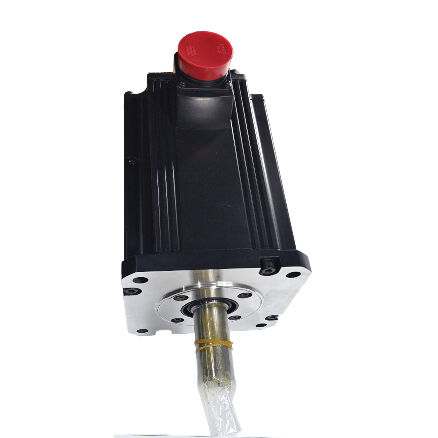
Mitsubishi HC-SFS7024 (HCSFS7024) — 7kW AC Servo Motor, 400V Class, Straight Shaft, MELSERVO-J2S Series
Product Identification
Part Number: HC-SFS7024
Also Searched As: HCSFS7024, HC-SFS-7024
Series: Mitsubishi MELSERVO HC-SFS (J2-Super Generation)
Motor Type: AC Brushless Servo Motor — Straight Shaft, No Brake, 2000 rpm, 400V Class
The 400V Difference
Everything about the HC-SFS7024 is mechanically identical to the HC-SFS702 — same 7kW output, same 33.4 Nm continuous torque, same 100 Nm peak, same 176 × 176 mm flange, same IP65 protection, same 17-bit serial absolute encoder. What the "4" suffix at the end of the part number means is a fundamentally different electrical specification: this motor is wound and rated for 400V class supply — three-phase 380–480V AC — rather than the 200V class of the standard HC-SFS702.
That distinction matters enormously at the system design level. In industrial plants running 400V supply infrastructure — the standard in much of Europe, and widely used in large-format industrial facilities worldwide — the 400V class motor eliminates the need for a step-down transformer between the factory supply and the servo drive. Panel design is simplified, transformer losses are eliminated, and the installed electrical system more closely matches the actual supply voltage. At 7kW, that transformation cost and power loss is not trivial; operating at the native supply voltage across a multi-axis machine with several 7kW axes adds up to a meaningful difference in system efficiency and panel space.
The HC-SFS7024 requires a 400V class MR-J2S amplifier — specifically the MR-J2S-700A4, MR-J2S-700B4, or MR-J2S-700CP4. A 200V class amplifier will not drive this motor. The motor and amplifier must be matched by voltage class without exception.
Technical Specifications
| Parameter |
Value |
| Part Number |
HC-SFS7024 |
| Rated Output |
7,000 W (7 kW) |
| Supply Voltage |
400V AC class (3-phase, 380–480V) |
| Rated Current |
17.5 A |
| Power Facility Capacity |
10 kVA |
| Rated Speed |
2,000 rpm |
| Maximum Speed |
3,000 rpm |
| Rated Torque |
33.4 Nm |
| Maximum Torque |
100 Nm |
| Encoder |
17-bit serial absolute (131,072 ppr) |
| Shaft Type |
Straight (no keyway) |
| Electromagnetic Brake |
None |
| Inertia Class |
Medium inertia |
| Flange Size |
176 × 176 mm |
| Protection Rating |
IP65 |
| Oil Seal |
Fitted |
| Motor Weight |
Approx. 32 kg |
| Ambient Temperature |
0°C to +40°C |
| Compatible Amplifiers |
MR-J2S-700A4 / MR-J2S-700B4 / MR-J2S-700CP4 |
| Series |
MELSERVO J2S (J2-Super), 400V class |
| Origin |
Made in Japan |
| Product Status |
Discontinued — available stock |
Why 400V Class at 7kW Matters
The rated current of the HC-SFS7024 is approximately 17.5A — roughly half that of the equivalent 200V motor at the same output power. This is a direct consequence of operating at twice the voltage: P = V × I, so doubling the voltage halves the current for the same power. That current reduction has practical implications throughout the installed system.
Cable cross-section. At half the current, the cable carrying motor power can be one conductor size smaller while staying within the same thermal rating. On a large machine with 7kW servo axes and 20m cable runs to an enclosure — not uncommon on large machining centres — the difference in cable cost, weight, and conduit fill across all axes of the machine is real and measurable.
Amplifier switching losses. The 400V class MR-J2S-700A4/B4 amplifiers handle lower current at higher voltage, which affects their internal thermal management and switching characteristics. The amplifier panel can often be designed with fewer cooling provisions for a given installed power when operating at 400V rather than 200V.
Supply transformer avoidance. In a 400V supply environment, a 200V class servo system requires a step-down transformer. At 7kW, that transformer is a physical, electrical, and financial overhead. The HC-SFS7024 with a 400V class amplifier connects directly to the plant supply bus without intermediate transformation.
The 10 kVA power facility capacity figure is the system design reference for supply connection, fusing, and regenerative energy calculations — the same figure applies regardless of the supply voltage class, since the electrical power demand is determined by the motor's rated output.
33.4 Nm Continuous, 100 Nm Peak
The torque profile of the HC-SFS7024 is identical to the HC-SFS702 at 200V: 33.4 Nm of sustained continuous torque and 100 Nm for acceleration bursts. At 2,000 rpm rated speed, these are substantial figures — the continuous rating covers the heaviest sustained machining or transfer loads the axis is likely to encounter in production, and the three-to-one peak ratio gives the amplifier authority over the acceleration phase of every rapid traverse move.
What separates the 7kW capacity from smaller motors in the HC-SFS family is that 33.4 Nm continuous figure. The HC-SFS502 at 5kW delivers 23.9 Nm. The step from 23.9 Nm to 33.4 Nm — a 40% increase in continuous torque — is the margin between an axis that runs within its thermal budget on heavy-production days and one that approaches overload under the same duty cycle. For the largest machine tool axes, the heaviest pallet transfer systems, and high-load industrial automation where the 5kW motor's continuous rating is genuinely the ceiling, 7kW is the necessary specification.
The 100 Nm peak supports aggressive acceleration profiles. A large VMC table or heavy rotary fixture does not accelerate to rapid traverse speed slowly. The ability to command 100 Nm for the duration of the acceleration phase — then step back to the 33.4 Nm operating level — is what enables short rapid traverse times on heavy axes without requiring a still-larger motor.
Straight Shaft at 7kW: Installation Discipline
At 33.4 Nm continuous and 100 Nm peak, the demands on the shaft-to-coupling interface require careful attention. The straight shaft on the HC-SFS7024 relies on a friction-clamp hub to transmit torque — the clamping force between shaft OD and hub bore must be sufficient to carry 100 Nm at peak without slip under any operating condition.
Coupling selection must be based on the peak torque figure, not the continuous torque. The coupling manufacturer's service factor for reversing servo axis duty must be applied. At 7kW and 32 kg of motor mass, the mechanical consequences of hub slip are serious: position errors at minimum, possible mechanical damage at worst, and the diagnostic difficulty of intermittent slip events that correlate with specific motion profiles rather than producing consistent fault conditions.
Hub installation follows the same guidance as all HC-SFS series motors: use the shaft-end threaded hole and a drawbolt to seat the hub axially rather than pressing or hammering it on. At this frame size, axial impact during hub fitting transmits directly to the encoder disc and bearing assembly at the motor's rear, and the resulting damage tends to produce intermittent encoder faults under vibration that are difficult to trace back to the original installation.
For applications where the driven mechanism requires a key connection — timing belt pulleys, gear hubs, chain sprockets — the HC-SFS7024K (keyed shaft) is the correct variant. The straight-shaft HC-SFS7024 is for friction-clamp coupling designs.
17-Bit Encoder: J2-Super Feedback at 400V
The voltage class does not affect the encoder. The HC-SFS7024 carries the same 17-bit serial absolute encoder as every other HC-SFS family motor — 131,072 positions per revolution, serial digital transmission to the amplifier, and multi-turn absolute position backed by the A6BAT lithium battery in the MR-J2S-700_4 amplifier.
At 7kW and 2,000 rpm, the 17-bit resolution pays off in two areas. Velocity loop quality improves because the amplifier's velocity estimate from consecutive position samples is eight times finer than with the 14-bit encoder in the older HC-SF generation. That cleaner velocity signal supports higher speed loop bandwidth and better disturbance rejection during cutting loads, which matters most on heavy axes where load force variations are largest. Low-speed feed rate smoothness also improves — relevant for surface grinding, contouring, and any operation that runs at slow feedrate over the full axis stroke.
The absolute function provides machine restart without homing cycles on every power-up. For large machining centres where a Z-column homing cycle takes 30–90 seconds and occurs every shift start, multiple e-stop recoveries per day, and every alarm reset, the productivity value of eliminating that cycle accumulates significantly across a working year.
Compatible Amplifiers: 400V Class Only
The HC-SFS7024 is strictly a 400V class motor. Its winding is designed for 400V supply and cannot be used with 200V amplifiers under any circumstance. The matching amplifiers are:
MR-J2S-700A4 — 7kW, 400V class, general-purpose interface. Accepts analog velocity commands and pulse-train position commands from CNC systems and PLCs. Position, speed, and torque control modes. The standard choice for 400V machines with CNC or PLC pulse-train axis control.
MR-J2S-700B4 — 7kW, 400V class, SSCNET fiber-optic bus interface. Connects to Mitsubishi A-series or Q-series motion controllers for coordinated multi-axis interpolation. The axis receives trajectory commands over the SSCNET network; encoder feedback loops back through the same network.
MR-J2S-700CP4 — 7kW, 400V class, built-in positioning with CC-Link interface. For standalone positioning applications or machines using CC-Link fieldbus.
Using a 200V class amplifier (MR-J2S-700A, MR-J2S-700B without the "4" suffix) with this motor will result in motor damage. The motor's rated voltage is 400V; applying 200V class drive signals will cause thermal and electrical problems. The "4" suffix on both the motor and the amplifier must always match.
HC-SFS7024 vs HC-SFS702: Same Performance, Different Supply
| Feature |
HC-SFS7024 |
HC-SFS702 |
| Supply voltage |
400V class (380–480V) |
200V class (200–230V) |
| Rated current |
~17.5 A |
35 A |
| Compatible amplifiers |
MR-J2S-700_4 (400V) |
MR-J2S-700 (200V) |
| Rated torque |
33.4 Nm |
33.4 Nm |
| Peak torque |
100 Nm |
100 Nm |
| Flange |
176 × 176 mm |
176 × 176 mm |
| Encoder |
17-bit, 131,072 ppr |
17-bit, 131,072 ppr |
| Protection |
IP65 |
IP65 |
| Shaft / Brake |
Straight, no brake |
Straight, no brake |
The mechanical output is identical. The supply voltage class, rated current, and amplifier compatibility are the operative differences. Machine designers choosing between them should base the decision on the available supply infrastructure. 400V supply — choose HC-SFS7024 with 400V amplifiers. 200V supply — choose HC-SFS702 with 200V amplifiers.
Typical Applications
400V infrastructure VMC and HMC primary feed axes. Large vertical and horizontal machining centres installed in European and international facilities running 400V three-phase supply use the 400V class servo motors throughout. On a large VMC, the X, Y, and Z axes driving heavy tables and spindle heads at sustained cutting feedrates are the natural application for the HC-SFS7024 capacity. The 400V supply connects directly to the MR-J2S-700_4 amplifiers without intermediate transformation.
Heavy pallet transfer and shuttle drives on 400V HMC lines. Pallet changers and transfer systems on large-format horizontal machining centres in 400V facilities use 7kW servo drives on the shuttle and clamping station drives. The reduced current draw at 400V simplifies the panel wiring for a machine with multiple high-capacity servo axes.
Large CNC lathe and turning centre feed axes. Heavy-duty turning centres with large turret and carriage masses, operating from 400V supply, use the HC-SFS7024 on Z-axis carriage and X-axis cross-slide drives. The 33.4 Nm continuous provides the sustained torque authority for deep turning operations under constant cutting load.
Direct-drive rotary table and large 4th-axis systems. Large-format 4th-axis rotary tables on machining centres in 400V environments use 7kW servo motors for the primary indexing and contouring drive. The absolute encoder maintains angular positioning accuracy across all power events, and the 17-bit resolution supports the fine angular increments required for 5-axis contouring operations.
400V industrial transfer machine and line integration. Multi-station transfer lines and automated assembly systems in large European and Asian industrial facilities standardised on 400V supply integrate servo drives at the 400V class throughout the line design. The HC-SFS7024 provides 7kW capacity at the system's native supply voltage for the highest-capacity transfer and indexing axes.
Frequently Asked Questions
Q1: Can the HC-SFS7024 be used with a standard 200V MR-J2S-700A or MR-J2S-700B amplifier?
No. The HC-SFS7024 is a 400V class motor wound for 380–480V AC supply. It must only be used with 400V class amplifiers — the MR-J2S-700A4, MR-J2S-700B4, or MR-J2S-700CP4. Connecting a 400V motor to a 200V class amplifier will cause motor damage. Always verify that both the motor and the amplifier carry the "4" suffix (indicating 400V class) before installation.
Q2: What is the practical difference between the HC-SFS7024 and the HC-SFS702?
The two motors produce identical mechanical output — the same 33.4 Nm continuous torque, 100 Nm peak, 2,000 rpm rated speed, 17-bit encoder, and 176 × 176 mm flange. The only difference is the supply voltage class: the HC-SFS7024 operates on 400V class supply (380–480V); the HC-SFS702 operates on 200V class supply (200–230V). The HC-SFS7024's lower rated current (~17.5A vs 35A) simplifies wiring and eliminates the need for a step-down transformer in 400V infrastructure environments.
Q3: Does the HC-SFS7024 have an electromagnetic brake?
No. The HC-SFS7024 is the straight-shaft, no-brake variant. Position at rest is maintained through amplifier servo lock. For vertical axes, gravity-loaded mechanisms, or any axis requiring fail-safe mechanical hold when servo power is removed, the HC-SFS7024B (straight shaft with spring-applied brake) is the correct specification. The brake is a safety-critical choice for any axis where losing servo control causes uncontrolled movement.
Q4: Where is the absolute encoder battery and when should it be replaced?
The Mitsubishi A6BAT lithium battery that backs the 17-bit absolute encoder's multi-turn position counter is located inside the MR-J2S-700_4 servo amplifier — not in the motor. Replace it when the amplifier displays its low-battery warning alarm, before full depletion. A completely discharged A6BAT resets the absolute position counter, requiring a reference return cycle before the machine can resume production.
Q5: Is the HC-SFS7024 a direct drop-in replacement for the HC-SFS7024B if the brake variant is unavailable?
No — the two models are not interchangeable if the machine was designed with a brake. The HC-SFS7024 has no electromagnetic brake; the HC-SFS7024B has a spring-applied fail-safe brake. Substituting a no-brake motor on an axis that was specified with a brake removes a designed-in safety function. This substitution should only be made after formal reassessment of the axis safety requirements confirms it is acceptable. For maintenance and repair purposes, always source the variant with the correct brake specification for the machine.


 Your message must be between 20-3,000 characters!