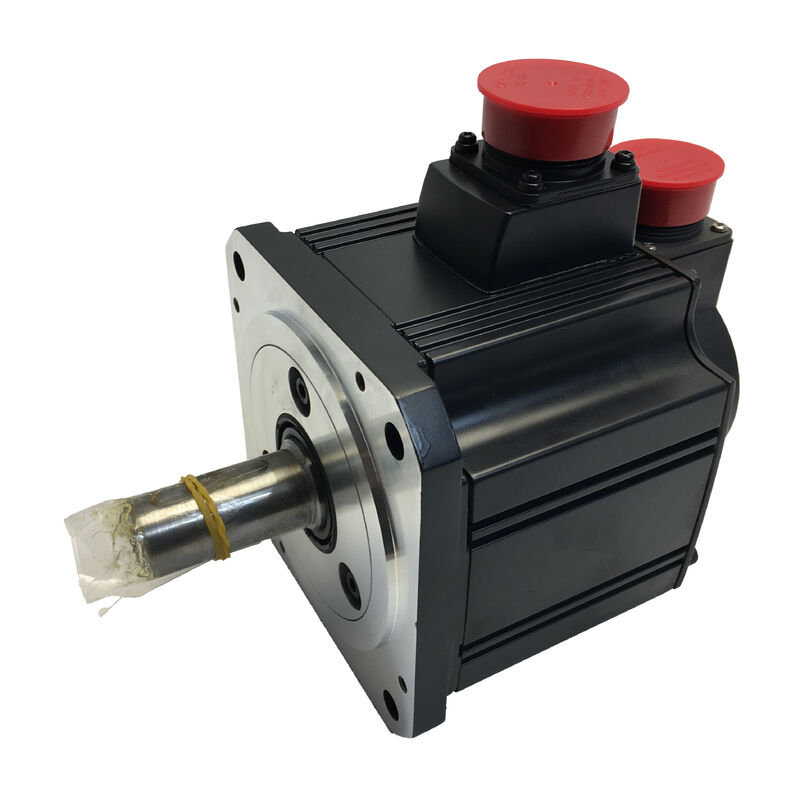
There is a class of servo application where the fundamental problem is not speed — it is force at the output shaft. Rotary tables, precision angular positioners, tension-controlled web drives, slow-feed machine axes: the common thread is a load that demands more torque than a bare servo shaft can deliver, at a shaft speed lower than the motor's rated rpm, with positioning accuracy that holds across hundreds of thousands of cycles. The Mitsubishi HC-SFS52G1H is purpose-built for that category. It pairs the 500W HC-SFS52 medium-inertia motor — with its 17-bit absolute encoder and IP65-sealed, oil-seal-equipped housing — with a factory-integrated G1H high-precision gearhead, producing a compact, directly mountable gear-motor unit that delivers amplified torque at reduced output speed without sacrificing positioning resolution.
| Parameter | Value |
|---|---|
| Part Number | HC-SFS52G1H |
| Alternate Code | HCSFS52G1H |
| Manufacturer | Mitsubishi Electric Corporation |
| Platform | MELSERVO J2S / HC-SFS Series |
| Rated Output | 500 W (0.5 kW) |
| Supply Voltage | 200 V AC class |
| Rated Current | 3.2 A |
| Motor Rated Torque | 2.39 Nm |
| Peak Torque | 7.16 Nm |
| Rated Speed | 2,000 rpm |
| Maximum Speed | 3,000 rpm |
| Encoder | Built-in Absolute, 17-bit / 131,072 ppr |
| Electromagnetic Brake | None |
| Gearhead Type | G1H — High-Precision |
| Shaft | Straight, with Oil Seal |
| Motor Flange | 130 × 130 mm |
| Motor Protection | IP65 |
| Gearhead Protection | IP44 |
| Insulation Class | F |
| Cooling | Totally Enclosed, Self-Cooled |
| Operating Temperature | 0 °C to +40 °C |
| Compatible Amplifier | MR-J2S-60A / MR-J2S-60B |
| Condition | New In Box |
On many servo motor product pages, the gearhead is treated as an add-on: here is the motor, and here is a gearbox you can attach. The HC-SFS52G1H is different. Mitsubishi factory-assembles and ships this unit as a single component, pre-aligned and tested. The gearhead is not bolted to the motor in the field — it arrives as part of the motor, with defined mechanical interfaces and verified performance.
That distinction has practical weight. Field-assembled gearbox-to-motor combinations require careful shaft alignment, coupling selection, and mechanical verification. Torque transmission depends on the quality of that assembly. Factory integration eliminates those variables: the alignment is done, the interface is defined, and the whole assembly is dimensionally repeatable unit to unit.
What the G1H gearhead does mechanically:
Gear reduction multiplies output torque by the gear ratio and divides output speed by the same factor. The HC-SFS52's rated 2.39 Nm motor torque becomes, at a 1/20 ratio, approximately 47.8 Nm at the gearhead output shaft — with output speed reduced to 100 rpm. That transformation allows the 500W motor class to handle load requirements that would otherwise demand a significantly larger and more expensive drive.
Why G1H specifically, not G1:
The G1H is Mitsubishi's high-precision gearhead designation. Compared to the standard G1 general industrial gearhead, the G1H is built to tighter tolerances with controlled backlash. In a servo system where positioning accuracy originates at the encoder — 131,072 counts per motor revolution — a high-backlash gearhead at the output would absorb a portion of that resolution as dead-band, degrading the effective positioning accuracy seen at the load. The G1H prevents that degradation, carrying the encoder-level resolution effectively through the reduction stage to the output shaft.
For applications where output shaft angular position is a quality variable — index table stopping angle, workpiece fixture orientation, label placement angle — that distinction between G1 and G1H shows up directly in the output.
The HC-SFS52 is Mitsubishi's 500W representative in the HC-SFS medium-inertia family, a motor class engineered for the broad middle ground of industrial servo applications. Medium inertia means the rotor is deliberately sized to handle higher reflected load inertia without requiring extremely tight gain tuning — the servo loop stays stable across a wider range of connected load conditions than low-inertia motors would allow.
IP65 housing with oil seal. The motor casing achieves complete dust exclusion and water jet resistance from any direction. The drive-end shaft exits through a factory-fitted oil seal, closing the path by which cutting fluid, lubricant mist, and fine particulate could otherwise migrate into the bearing cavity and encoder housing over the motor's service life. This combination is the standard specification for servo motors installed directly on machine tools without additional environmental enclosures.
130 × 130 mm flange. The mounting footprint puts this motor in the mid-range of the HC-SFS family — larger than the 60mm and 80mm compact variants, appropriate for the 500W power class and the mechanical stiffness required by a gearhead assembly.
17-bit absolute encoder. 131,072 position counts per motor revolution, retained through power-off cycles with a Mitsubishi A6BAT backup battery in the amplifier. The practical outcome: at every power-up, the machine is at its last commanded position without a reference return sequence. In production environments where startup homing takes time and involves careful axis movement management, eliminating that routine is a concrete operational benefit.
The HC-SFS52G1H has no electromagnetic brake. This is not a limitation — it is the correct specification for a substantial class of applications.
Brake-equipped variants (HC-SFS52BG1H) are designed for axes that need to hold position mechanically at zero current: vertical ballscrews under gravity load, clamping mechanisms, tilted positioners where the load produces torque on the output shaft at rest. If the application has that requirement, the B variant is correct.
For horizontal axes, tension-controlled drives, rotary tables driven to stop by the servo rather than held against a gravitational load, and any axis where the servo amplifier's electronic brake (dynamic braking) handles deceleration adequately — the no-brake HC-SFS52G1H is the correct and simpler specification. No 24V DC brake supply circuit to design. No brake wear to monitor. No brake release timing to manage in the motion program. Fewer components in the system, with equivalent servo performance.
The HC-SFS52G1H operates with the MR-J2S-60A or MR-J2S-60B amplifier, both rated at 500W within the MELSERVO J2S platform.
MR-J2S-60A is the general-purpose pulse-train and analog-input variant. It receives position commands as pulse trains from PLCs, stand-alone CNC controllers, and motion cards, and supports position, speed, and torque control modes independently or in combination. RS-232C and RS-422 serial communication ports allow parameter access and monitoring via Mitsubishi's MR Configurator software.
MR-J2S-60B connects to the SSCNET high-speed serial bus used by Mitsubishi motion controllers (Q172D, Q173D, and A-series motion units). In SSCNET systems, all axes receive synchronized command packets at each communication cycle — typically 0.88ms — achieving tight multi-axis coordination. For machines with multiple servo axes requiring synchronized motion, the B variant and SSCNET architecture eliminate inter-axis timing jitter that pulse-train systems cannot fully prevent.
The amplifier choice follows from the host controller. The motor and gearhead assembly is identical regardless of which amplifier type is used.
The G1H gearhead on the HC-SFS52 platform is offered across multiple reduction ratios — typically 1/5, 1/9, 1/12, 1/15, 1/20, and 1/25. Each ratio is a distinct part number configuration within the HC-SFS52G1H family.
Selecting the ratio requires knowing the required output shaft speed and torque. At a given motor operating speed, output shaft speed equals motor speed divided by the gear ratio, and continuous output torque equals motor rated torque multiplied by the gear ratio (factoring in gearhead efficiency). The motor always operates at its rated speed range of 0–2,000 rpm — the ratio transforms that range to whatever output speed the application requires.
When ordering a replacement unit, confirm the gear ratio from the original machine documentation or the gearhead nameplate. Substituting a different ratio produces incorrect kinematics and may cause motion errors, overspeed faults, or mechanical interference.
The HC-SFS52G1H combination of gear-reduced precision output, IP65 sealed motor, and absolute encoder fits a consistent range of industrial equipment:
Precision rotary index tables — fixture tables requiring accurate angular index moves between machining or assembly stations. The G1H precision limits index angle error; the absolute encoder means the machine is at position on every startup; horizontal mounting eliminates the need for a brake.
Angular positioners on automated assembly equipment — axes that rotate parts or tools to a defined angle for assembly, inspection, or dispensing, where output shaft angular accuracy is tied to product quality.
Tension-controlled material feed drives — web handling, wire feeding, and foil dispensing axes where gear reduction brings motor speed into the range of process speed while the servo controls torque to maintain constant tension.
Slow-feed precision drives on grinding and finishing equipment — table traverse axes where very slow, smooth, torque-controlled motion requires reducing a 2,000 rpm motor down to single-digit rpm at the drive shaft.
CNC auxiliary axes not requiring brake holding — tool magazine drives, rotary fixture drives, and chip conveyor mechanisms on CNC machining centers, operating in the same MELSERVO J2S system as the main axis HC-SFS motors.
| Model | Shaft | Brake | Gearhead |
|---|---|---|---|
| HC-SFS52 | Straight | No | None |
| HC-SFS52B | Straight | Yes | None |
| HC-SFS52K | Keyed | No | None |
| HC-SFS52BK | Keyed | Yes | None |
| HC-SFS52G1 | Straight | No | G1 General Industrial |
| HC-SFS52G1H | Straight | No | G1H High-Precision |
| HC-SFS52BG1H | Straight | Yes | G1H High-Precision |
The HC-SFS52G1H is the correct selection when high-precision gear reduction is required, no mechanical brake is needed, and a straight shaft output from the gearhead suits the driven component interface.
Q1: What gear ratios are available for the HC-SFS52G1H?
The G1H gearhead is offered in multiple ratio options — commonly 1/5, 1/9, 1/12, 1/15, 1/20, and 1/25. Each ratio is a separate configuration. The gear ratio must be confirmed from the original machine documentation or the gearhead nameplate before ordering a replacement. Installing a unit with a different ratio will produce incorrect output speed and torque and may cause motion faults or machine damage.
Q2: What is the difference between HC-SFS52G1H and HC-SFS52BG1H?
The two models are identical in motor, encoder, gearhead type, and all electrical specifications. The only difference is the B designation: the HC-SFS52BG1H includes a spring-applied electromagnetic brake; the HC-SFS52G1H does not. Select the B variant for vertical axes, gravity-loaded mechanisms, or any application that requires mechanical shaft holding at zero current. Select the HC-SFS52G1H for horizontal axes and applications where the servo's dynamic braking is sufficient for deceleration and rest.
Q3: Which servo amplifier works with the HC-SFS52G1H?
The HC-SFS52G1H is compatible with the MR-J2S-60A (pulse-train/analog command interface) and MR-J2S-60B (SSCNET serial network interface). Both are 500W-class MELSERVO J2S amplifiers. The amplifier choice depends on the host controller type. Unlike the brake variant, the HC-SFS52G1H requires no separate 24V DC brake supply circuit.
Q4: Does the 17-bit encoder maintain position data after a power loss?
Yes, with the Mitsubishi A6BAT lithium battery installed in the servo amplifier's battery holder. The battery maintains the multi-turn absolute position count through any power interruption. Without the battery, position is lost at shutdown and homing is required at restart. The amplifier generates a low-battery alarm before the threshold is reached, giving advance warning for scheduled battery replacement.
Q5: What is the IP rating of the gearhead section, and does it affect installation planning?
The motor body is IP65 — fully dust-tight, resistant to water jets. The gearhead section carries IP44, which protects against solid particles over 1mm and water splashing from any direction, but is not rated for direct coolant jet exposure. On machine tools where coolant is actively sprayed near the gearhead housing, a mechanical deflector or shield should be incorporated into the machine design. The motor body itself does not require additional protection in standard CNC environments.
Contact Us at Any Time