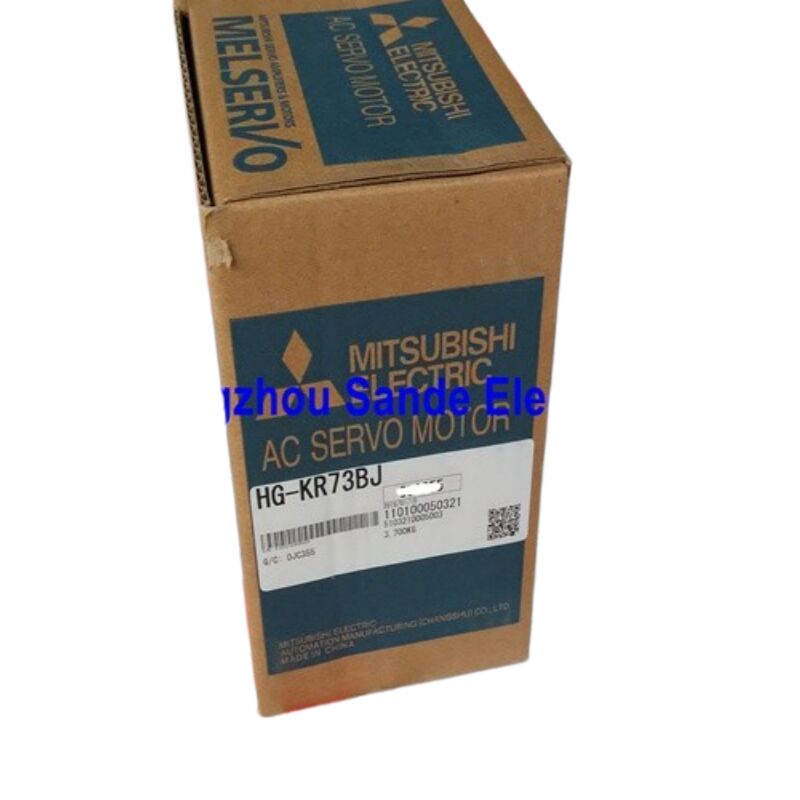
Mitsubishi HC-MFS73BG1 — 750W AC Geared Servo Motor, Brake + G1 Reduction Gear, MELSERVO-J2S Series
Product Identification
Part Number: HC-MFS73BG1
Also Searched As: HCMFS73BG1, HC-MFS-73BG1
Series: Mitsubishi MELSERVO HC-MFS (J2-Super Generation)
Motor Type: AC Brushless Geared Servo Motor — Ultra-Low Inertia, Electromagnetic Brake, G1 Flange-Type Reduction Gear
Condition: New In Box
Overview
The Mitsubishi HC-MFS73BG1 combines three things in a single compact package: a 750W ultra-low inertia AC servo motor, an integrated G1 general industrial flange-type reduction gear unit, and a spring-applied electromagnetic brake. The motor runs at 3,000 rpm, the brake provides fail-safe mechanical hold the moment 24V DC is removed, and the G1 gear unit steps down the motor speed to the output shaft while multiplying torque proportionally — all in a self-contained assembly that mounts directly into the machine without requiring a separately aligned external gearbox.
The HC-MFS series is built around ultra-low inertia. Where the HC-SFS and HC-KFS families are medium and low inertia respectively, the HC-MFS motors are at the opposite end of the inertia spectrum — extremely small rotors with minimal angular momentum. That characteristic is what makes them fast. Ultra-low inertia servo motors accelerate and decelerate rapidly, respond to velocity and position commands almost instantly, and are the correct specification for high-cycle applications where the servo axis spends most of its life in the transient phase — starting, stopping, reversing — rather than in steady-state motion. Robotics, pick-and-place systems, semiconductor handling, packaging and labelling, and any mechanism that indexes dozens or hundreds of times per minute belong to this application class.
Adding the G1 reduction gear and brake to that fast, light motor body creates a versatile geared servo drive: high-cycle capability at reduced output speed, multiplied output torque, fail-safe brake hold at each index position, and the 17-bit serial absolute encoder providing 131,072 ppr of position feedback on the motor shaft regardless of the gear ratio.
Technical Specifications
| Parameter |
Value |
| Part Number |
HC-MFS73BG1 |
| Base Motor Output |
750 W (0.75 kW) |
| Supply Voltage |
200V AC class (single or 3-phase) |
| Rated Current |
5.1 A |
| Base Motor Rated Speed |
3,000 rpm |
| Base Motor Maximum Speed |
4,500 rpm |
| Base Motor Rated Torque |
2.4 Nm |
| Base Motor Maximum Torque |
7.2 Nm |
| Encoder |
17-bit serial absolute (131,072 ppr), motor shaft |
| Inertia Class |
Ultra-low inertia |
| Electromagnetic Brake |
Spring-applied, 24V DC release, fail-safe (motor shaft) |
| Reduction Gear Type |
G1 — General industrial, flange-type shaft output |
| Available Gear Ratios |
1/5, 1/9, 1/15, 1/20, 1/25 (stamped on gear housing) |
| Motor Flange Size |
80 × 80 mm |
| Motor Protection Rating |
IP55 |
| Gear Section Protection |
IP44 |
| Ambient Temperature |
0°C to +40°C |
| Compatible Amplifiers |
MR-J2S-70A / MR-J2S-70B / MR-J2S-70CP |
| Series |
MELSERVO J2S (J2-Super) |
| Origin |
Made in Japan |
| Product Status |
Discontinued — new-in-box stock available |
Ultra-Low Inertia: What It Means in Practice
The rotor inertia of the HC-MFS73 is 0.6 kg·cm² — substantially lower than the HC-KFS73 and dramatically lower than medium-inertia motors at equivalent output. That small number has a direct effect on how the axis behaves during every acceleration and deceleration event.
A lower-inertia rotor requires less torque to accelerate at a given rate, or equivalently, can achieve a higher acceleration rate for the same torque input. When an axis cycles through hundreds of short positioning moves per hour — each move consisting of an acceleration phase, a brief period at constant velocity, and a deceleration phase — the time consumed in the transient phases dominates the overall cycle time. Reducing rotor inertia reduces the time spent in each transient, and that reduction compounds across every cycle in a production shift.
The trade-off is load sensitivity. Ultra-low inertia motors are more sensitive to load inertia mismatch than their medium-inertia counterparts. When the load inertia reflected to the motor shaft is many times larger than the motor's own rotor inertia, the amplifier's auto-tuning routine must work harder to find stable gains. The G1 reduction gear on the HC-MFS73BG1 directly addresses this: the gear ratio reduces the reflected load inertia by the square of the ratio. A 1/20 reduction gear reduces reflected load inertia by a factor of 400, bringing even moderate external load inertias within a comfortable range for the ultra-low inertia motor to control stably.
The G1 Gear Unit: Torque Multiplication and Speed Reduction
The G1 reduction gear is Mitsubishi's general industrial, flange-output gear option for the HC-MFS series — a flange-mounted gear housing presenting a shaft output at the outer face, with the motor's front flange as the input side mounting point. The result is a single axially aligned assembly with the motor at one end, the gear housing in the middle, and the output shaft projecting from the gear housing's far face.
The base motor runs at 3,000 rpm and delivers 2.4 Nm continuously. After the gear stage — at a 1/20 ratio, for example — the output shaft turns at 150 rpm and the theoretical continuous torque at the output, before gear losses, is approximately 48 Nm. That transformation is the practical reason for combining the reduction gear with an ultra-low inertia motor: the motor operates in its optimal high-speed, low-torque regime where it is most efficient, while the output shaft delivers the slow-speed, high-torque profile that the application actually requires.
Available gear ratios are 1/5, 1/9, 1/15, 1/20, and 1/25. The specific ratio in a given unit is marked on the gear housing nameplate. The choice of ratio involves balancing output speed range, output torque level, effective encoder resolution at the output shaft, and reflected load inertia management. Lower ratios give higher output speed and lower output torque; higher ratios give lower output speed, higher torque, and better reflected inertia reduction.
Effective encoder resolution at the gear output is one of the less-obvious advantages of motor-shaft encoding through a reduction gear. The 17-bit encoder on the motor shaft reads 131,072 positions per motor revolution. At a 1/20 ratio, each output shaft revolution corresponds to 20 motor revolutions, giving 20 × 131,072 = 2,621,440 effective encoder counts per output revolution. For slow-speed positioning applications, this is an exceptionally fine angular reference — finer than most dedicated output-shaft encoders at this scale.
The gear section protection is IP44, a step below the motor body's IP55. For environments involving splash water, wash-down, or significant coolant exposure, this protection level must be considered. Installations where the gear housing may be exposed to directed water jets or immersion should use supplemental sealing or a different motor-gearbox configuration.
Electromagnetic Brake on a Small Geared Motor
The brake on the HC-MFS73BG1 sits on the motor shaft, between the motor's encoder assembly and the gear input stage. When 24V DC is removed — intentionally during a shutdown sequence, or automatically during a fault or e-stop — the spring engages the motor shaft. Because the load is connected through the gear, the effective holding torque at the gear output equals the brake's motor-shaft rated hold torque multiplied by the gear ratio.
On a 750W motor with a brake rated to hold the motor-shaft torque, this multiplication effect is significant. At a 1/20 gear ratio, a motor-shaft brake holding 2.4 Nm becomes approximately 48 Nm of effective holding force at the gear output (before gear inefficiency losses). For small vertical axes, lightweight robot joints, and compact indexing mechanisms, this amplified hold is more than adequate to prevent any gravitational or spring-loaded drift when the servo is off.
The MBR signal from the MR-J2S amplifier controls brake relay timing. MBR delays engagement until the amplifier's deceleration routine has brought the motor to rest. On an ultra-low inertia motor with a small load, deceleration is fast — but engaging the spring against even a low-inertia spinning motor shaft produces wear that accumulates rapidly over thousands of cycles. MBR interlock ensures the brake always engages into a stopped condition. A surge absorber directly across the brake coil terminals suppresses the inductive transient at switch-off, protecting the relay output and other 24V DC circuit components.
17-Bit Encoder: Fine Feedback Through the Gear Ratio
The encoder is positioned on the motor shaft, before the gear stage, and reads 131,072 positions per revolution. This location is deliberate: the encoder sees the full motor shaft resolution at all times, regardless of what gear ratio is downstream. The amplifier works with this high-resolution signal to run the motor speed loop and position loop with the same bandwidth it would achieve on a bare motor, and the absolute position counter covers the full multi-turn range of the output shaft with corresponding resolution multiplication.
Battery backup for the absolute counter uses the A6BAT lithium cell in the MR-J2S amplifier. Position is retained through any power interruption, and the machine restarts in exact known position without a homing cycle. For high-cycle automation where shift start-up time matters, or for systems that undergo frequent e-stops during production, this is a real operational benefit.
Compatible Amplifiers
The HC-MFS73BG1 pairs with the MR-J2S-70 class amplifier — the 750W J2-Super platform. Three interface variants:
MR-J2S-70A handles analog and pulse-train commands from PLCs and CNC systems. Position, speed, and torque control modes, with RS-232C for MR Configurator setup. Accepts single-phase or 3-phase 200V AC input, making it flexible for panel installations where only single-phase power is available.
MR-J2S-70B operates on SSCNET fiber-optic serial bus under a Mitsubishi A-series or Q-series motion controller — the standard for coordinated multi-axis systems where all servo axes communicate over a common network.
MR-J2S-70CP has a built-in point table for standalone positioning without an external motion controller, with CC-Link or I/O command interface.
All three support the 17-bit serial encoder. The HC-MFS73BG1 is not compatible with MR-J3 or MR-J4 amplifiers. For systems currently running original first-generation MR-J2-70 amplifiers, note that the J2S encoder protocol differs from the first-generation J2 encoder — compatibility depends on the specific MR-J2 amplifier software version; verify before installation.
HC-MFS 3000 rpm Family — 750W in Context
| Model |
Output |
Rated Torque |
Flange |
Inertia |
| HC-MFS13 |
100 W |
0.32 Nm |
40 × 40 mm |
Ultra-low |
| HC-MFS23 |
200 W |
0.64 Nm |
60 × 60 mm |
Ultra-low |
| HC-MFS43 |
400 W |
1.27 Nm |
60 × 60 mm |
Ultra-low |
| HC-MFS73 |
750 W |
2.4 Nm |
80 × 80 mm |
Ultra-low |
The HC-MFS73 is the largest capacity in the HC-MFS family. All models carry the 17-bit absolute encoder as standard and pair with J2-Super amplifiers in the corresponding capacity class. The 80 × 80 mm flange of the HC-MFS73 is compact relative to the motor's output capacity, keeping the overall assembly footprint small even with the G1 gear unit attached.
Typical Applications
Compact robot joint and wrist drives. Small industrial robots, SCARA robots, and delta-type pick-and-place mechanisms use ultra-low inertia motors on the outer joints and wrist axes where minimising moving mass is as important as minimising motor inertia. The HC-MFS73BG1 provides the speed, responsiveness, and gear-multiplied output torque these joints need, with the brake holding joint position during power-down sequences.
High-cycle indexing and rotary station drives. Rotary index tables on assembly and test lines that cycle rapidly through fixed angular positions — dwell, index, dwell, index — at rates of sixty or more cycles per minute use ultra-low inertia geared servo drives to minimise index time. The brake holds each station position firmly during the dwell without servo lock current, reducing amplifier thermal load during high-duty production runs.
Packaging and labelling machine servo axes. Label applicator rolls, product infeed indexers, and sealing station drives on packaging lines run at high cycle rates with compact mounting envelopes. The HC-MFS73BG1's small 80 × 80 mm motor flange and gear housing suit the constrained installation spaces typical of packaging machine design, and the absolute encoder maintains product register through every e-stop and restart.
Semiconductor and electronics assembly equipment. Wafer handling, component insertion, and solder paste dispense axes on semiconductor and electronics production equipment require fast, precise, low-mass servo drives. The ultra-low inertia characteristic of the HC-MFS73 is directly specified into this equipment class, and the compact footprint suits the tight machine geometries involved.
Conveyor diverter and sorting gates. Servo-controlled diverter gates and lane-change mechanisms on sorting conveyors require fast actuation, reliable position hold in the set position, and small physical size to fit within the conveyor structure. The brake holds the gate position mechanically, the gear unit provides the output torque to move the gate mechanism against belt resistance, and the absolute encoder ensures the gate position is known immediately on power-up without a calibration cycle.
Frequently Asked Questions
Q1: Which amplifiers are compatible with the HC-MFS73BG1?
The HC-MFS73BG1 requires a MR-J2S-70 class amplifier from the MELSERVO-J2S platform. The three main variants are the MR-J2S-70A (general-purpose analog/pulse command, accepts single or 3-phase 200V input), MR-J2S-70B (SSCNET fiber-optic bus for Mitsubishi motion controllers), and MR-J2S-70CP (built-in positioning function). All three support the 17-bit serial encoder. This motor is not compatible with MR-J3 or MR-J4 amplifiers.
Q2: How does the G1 reduction gear affect the output torque and speed?
The G1 gear unit reduces output shaft speed and multiplies torque in proportion to the gear ratio. At the base motor's 3,000 rpm rated speed and 2.4 Nm, a 1/20 ratio produces approximately 150 rpm at the output shaft with theoretical torque multiplication of 20× — before gear efficiency losses, typically 85–90% for this type of reduction gear. The specific ratio installed in a given unit is marked on the gear housing nameplate. The encoder remains on the motor shaft and reads at full 17-bit resolution regardless of ratio.
Q3: Why is the motor protection IP55 while the gear section is only IP44?
The motor body and encoder assembly on the HC-MFS73BG1 carry an IP55 rating — protected against dust and low-pressure water jets from any direction. The reduction gear housing section is rated IP44, which covers solid particle protection and splash water from any direction, but does not cover sustained directed water jets. This is a standard characteristic of integrated servo gearmotor designs in this series. For wash-down environments or applications with significant coolant splash, the IP44 gear section rating must be verified against the installation's protection requirements.
Q4: Where is the electromagnetic brake in the assembly, and how does gear ratio affect the holding force?
The brake is located on the motor shaft, between the motor rotor and the gear input stage. When 24V DC is removed, the spring engages the motor shaft mechanically. Because the load connects to the motor through the gear ratio, the effective holding force at the gear output shaft equals the brake's motor-shaft holding torque multiplied by the gear ratio. A higher gear ratio produces greater load-side holding force from the same brake. Always use the MR-J2S amplifier's MBR interlock output to ensure the brake only engages after the motor has come to rest.
Q5: Does the absolute encoder battery sit in the motor or the amplifier?
The battery is in the MR-J2S servo amplifier, not in the motor or gear assembly. The Mitsubishi A6BAT lithium cell installed inside the amplifier maintains the 17-bit encoder's multi-turn absolute position counter through any power interruption. Replace it when the amplifier displays a low-battery alarm — before full depletion, which would reset the absolute counter and require a reference return cycle before the machine resumes production.


 Your message must be between 20-3,000 characters!