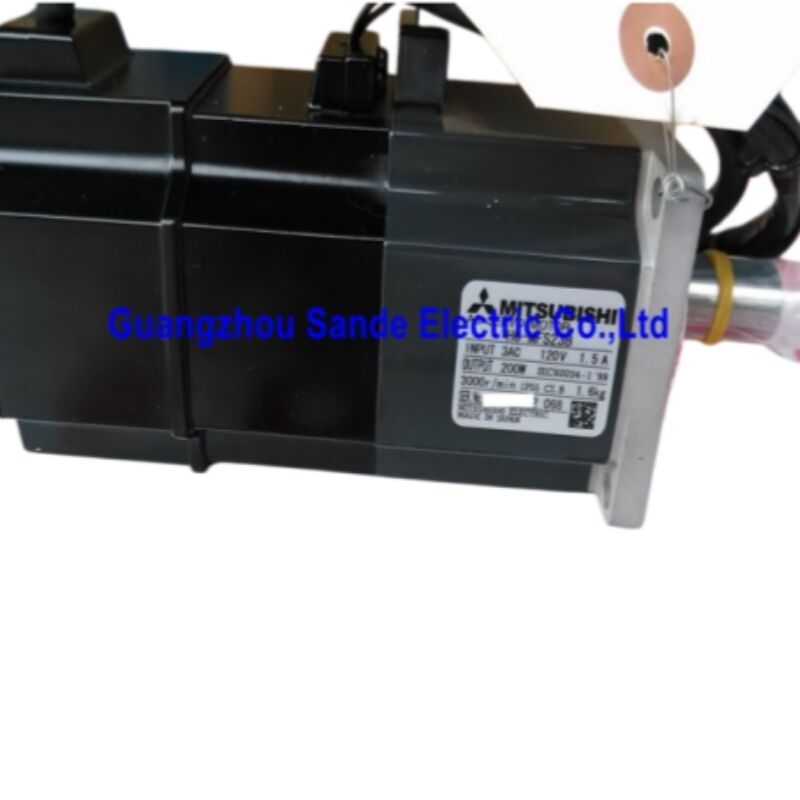
Mitsubishi HC-SFS202G1H — 2kW AC Geared Servo Motor, G1H Leg-Type Reduction Gear, MELSERVO-J2S Series
Product Identification
Part Number: HC-SFS202G1H
Also Searched As: HCSFS202G1H, HC-SFS-202G1H
Series: Mitsubishi MELSERVO HC-SFS (J2-Super Generation)
Motor Type: AC Brushless Geared Servo Motor — Straight Shaft, No Brake, G1H Leg-Type Reduction Gear
Series: MELSERVO-J2S (J2-Super)
What Makes This Motor Different
The HC-SFS202G1H takes a well-established 2kW J2-Super servo motor and integrates it with a G1H leg-type (foot-mounted) reduction gear unit in a single factory-assembled package. The distinction between G1H and G1 is about mounting geometry: where the G1 variant mounts via a flange face, the G1H uses a foot/leg mounting configuration — the gear housing sits on mounting pads at its base, with the output shaft projecting from the side of the housing. This makes it the correct choice wherever the machine layout requires a shaft-parallel or base-mounted drive rather than an inline flange-mounted assembly.
The result is a compact geared servo drive that delivers all the performance of the HC-SFS J2-Super platform — 17-bit serial absolute encoder, MR-J2S-200 amplifier compatibility, 9.55 Nm base motor continuous torque, and 28.6 Nm peak — while presenting the high-torque, low-speed output shaft profile that many practical drive system designs require. No external gearbox to separately source, mount, align, and maintain. The motor and gear unit arrive as one precision-assembled component, ready to install directly into the machine structure.
No brake is fitted on the HC-SFS202G1H. For applications requiring fail-safe mechanical hold on servo-off, the HC-SFS202BG1H (with brake) is the corresponding variant.
Technical Specifications
| Parameter |
Value |
| Part Number |
HC-SFS202G1H |
| Base Motor Output |
2,000 W (2 kW) |
| Supply Voltage |
200V AC class (3-phase) |
| Rated Current |
11 A |
| Base Motor Rated Speed |
2,000 rpm |
| Base Motor Maximum Speed |
3,000 rpm |
| Base Motor Rated Torque |
9.55 Nm |
| Base Motor Maximum Torque |
28.6 Nm |
| Encoder |
17-bit serial absolute (131,072 ppr), motor shaft |
| Shaft Type |
Straight |
| Electromagnetic Brake |
None |
| Reduction Gear Type |
G1H — General industrial, leg-type (foot-mounted) |
| Available Gear Ratios |
1/5, 1/9, 1/15, 1/20, 1/25 (ratio marked on housing) |
| Motor Flange Size |
176 × 176 mm |
| Motor Protection |
IP65 |
| Gear Section Protection |
IP44 |
| Oil Seal |
Fitted (motor shaft) |
| Ambient Temperature |
0°C to +40°C |
| Compatible Amplifiers |
MR-J2S-200A / MR-J2S-200B / MR-J2S-200CP |
| Series |
MELSERVO J2S (J2-Super) |
| Origin |
Made in Japan |
| Product Status |
Discontinued — new-in-box stock available |
G1H Leg Mounting: Why It Exists and When to Specify It
The difference between G1 and G1H is purely mechanical — both are general industrial reduction gears, both produce the same range of output ratios, and both use the same motor and encoder. What changes is the housing mounting interface.
The G1 flange type mounts the gear housing face against a machine flange bore, in-line with the motor axis. The assembly is axial — motor body, gear housing, and output shaft all on the same centreline, with the output shaft projecting forward. This suits machine designs where the servo motor and gearbox drop into a bore or mount against a flat face in the machine structure.
The G1H leg type uses mounting feet or pads on the base of the gear housing. The motor sits alongside rather than behind the gear housing in the machine layout. The output shaft may project at 90° to the motor axis depending on the gear unit design, or parallel to it — the key characteristic is that the housing is supported by its base rather than its face. This suits:
Conveyor and transfer drive installations where the motor must lie parallel to the conveyor frame rather than projecting axially from a face plate. The base-mounted housing bolts to the frame rail directly, and the output shaft drive wheel or sprocket sits at the correct height and orientation without requiring a separate mounting bracket.
Machine tool auxiliary drive installations where panel space and structural clearance favour a side-mounted motor arrangement over an axial cantilevered one. Chip conveyor drives, coolant pump drives, and tool magazine drive assemblies frequently use this configuration.
Low-profile machine frames where the available axial depth is limited but base-mounting space is available. The G1H assembly's footprint along the output shaft axis is shorter than the equivalent G1 inline arrangement for the same gear ratio.
Retrofit and replacement applications where the original machine used a foot-mounted gearmotor and the replacement needs to maintain the same mounting geometry and shaft orientation.
The Torque Picture: What the Gear Does to 9.55 Nm
The base HC-SFS202 motor delivers 9.55 Nm continuously at 2,000 rpm. After the G1H gear stage, that output is transformed:
At a 1/20 ratio, the output shaft turns at 100 rpm and the theoretical continuous torque at the output reaches approximately 162–172 Nm (accounting for typical gear efficiency of 85–90%). Peak torque at the output rises proportionally from the motor's 28.6 Nm base figure, potentially exceeding 480 Nm for brief acceleration transients.
At a 1/9 ratio, output speed is approximately 222 rpm and continuous output torque is around 77–81 Nm — a profile suited to moderate-speed conveyor and transfer applications where the output shaft speed needs to remain in a useful operating range.
At a 1/5 ratio, the output runs at 400 rpm with roughly 43–45 Nm continuous — appropriate for applications requiring higher output shaft speed with moderate torque multiplication.
These figures illustrate why the HC-SFS202G1H is not just a convenience product. The base motor alone produces 9.55 Nm, which serves a limited range of load requirements. With the G1H gear unit, the same motor and amplifier combination can drive loads requiring 150+ Nm continuously at slow shaft speeds — loads that a direct-drive solution would require a significantly larger and more expensive motor to handle. The gear unit buys torque capacity at the cost of output speed, and for many real drive system requirements, that trade is exactly right.
Motor Shaft Encoder: Resolution Through the Gear Ratio
The 17-bit encoder sits on the motor shaft and reads 131,072 positions per revolution at that location. What this means after the gear stage is significant: each complete output shaft revolution corresponds to multiple motor shaft revolutions, and each of those motor revolutions produces 131,072 encoder counts. The amplifier therefore sees an extremely fine effective position resolution at the output shaft.
At a 1/20 gear ratio, each output shaft revolution produces 20 × 131,072 = 2,621,440 effective encoder counts. For a low-speed output shaft positioning application — a conveyor stopping at a precise location, a rotary station indexing to a fixed angular position — this resolution provides position feedback far finer than the mechanical positioning accuracy of most driven mechanisms. The encoder is never the limiting factor in positioning accuracy for these applications.
At low output speeds, velocity estimation quality benefits similarly. The amplifier computes velocity from position sample differences; with motor-shaft encoding and a high gear ratio, each velocity sample covers many encoder counts even at slow output shaft speeds, giving the speed loop a clean, high-signal-to-noise velocity estimate. Smooth velocity control at very low output shaft rpm — important for conveyor speed regulation and winding applications — is a direct result of this combination.
The A6BAT lithium battery in the MR-J2S amplifier maintains the multi-turn absolute counter through any power interruption. The output shaft's absolute position is retained across power cycles, enabling machine restart without a reference return cycle.
Amplifier Requirements and Electronic Gear Setup
The HC-SFS202G1H pairs with the MR-J2S-200 class amplifier — the same 2kW J2-Super platform used for all HC-SFS202 variants. From the amplifier's perspective, it is driving an HC-SFS202 motor. The encoder protocol, motor model recognition, and current control are unchanged by the presence of the gear unit.
What changes at commissioning is the electronic gear ratio in the amplifier parameters. The electronic gear function (parameters CMX/CDV in MR-J2S terminology) establishes the correspondence between position command units from the CNC or controller and actual output shaft movement. With a reduction gear between the motor and the load, each commanded unit of output shaft movement requires more motor shaft rotation than in a direct-drive arrangement, and the electronic gear parameters must reflect the installed gear ratio accurately.
Setting these parameters incorrectly produces the wrong relationship between commanded position and actual axis movement — the axis either overshoots, undershoots, or generates position errors on every move. Verifying the electronic gear ratio settings against the gear housing nameplate ratio should always be the first commissioning check on any geared servo axis.
Compatible amplifiers:
- MR-J2S-200A — General-purpose analog/pulse command, position/speed/torque control modes
- MR-J2S-200B — SSCNET fiber-optic bus for coordinated motion controller systems
- MR-J2S-200CP — Built-in positioning with CC-Link, standalone point-table operation
Not compatible with original MR-J2-200 (first-generation) amplifiers, MR-J3, or MR-J4 amplifiers.
G1 vs G1H vs G5/G7: Choosing the Right Gear Variant
| Suffix |
Type |
Mounting |
Typical Use |
| G1 |
General industrial, flange output |
Flange (output-side face) |
Standard inline machine drives |
| G1H |
General industrial, leg/foot type |
Base/foot mounting pads |
Side-mounted, base-mounted layouts |
| G5 |
Precision, flange output |
Flange (output-side face) |
Low-backlash precision positioning |
| G7 |
Precision, shaft output |
Flange (output-side face) |
Low-backlash, shaft-coupled precision |
For general industrial motion control — conveyor drives, transfer systems, indexing stations, material handling — G1 and G1H are the appropriate and cost-effective choices. G5 and G7 are precision variants with tighter backlash specifications for applications where angular accuracy at the output shaft is a primary requirement. The G1H specifically addresses layout requirements that the G1 cannot satisfy — it is not a downgrade or a substitute, it is the correct variant for a different set of machine designs.
Typical Applications
Roller conveyor and belt conveyor servo drives. Production line conveyors that must start, stop, and hold position accurately — part accumulation systems, transfer lines between assembly stations, exit conveyors on CNC cells — use servo drives with foot-mounted gear units to fit within the conveyor frame structure. The HC-SFS202G1H's leg mounting integrates cleanly into standard conveyor framing, and the absolute encoder maintains consistent part positioning through every e-stop and restart.
Chain-driven transfer machine station drives. Transfer line station indexing drives using chain and sprocket systems typically require foot-mounted gearmotors at the drive station end. The G1H mounting allows the motor and gear housing to bolt directly to the transfer machine base frame, with the output sprocket positioned at the correct height for the chain drive.
Winding and unwinding tension control. Material winders and unwinds running in torque control mode at low shaft speeds use foot-mounted servo drives where the output shaft connects directly to the roll arbour through a coupling or torque limiter. The G1H provides the correct mounting orientation and output shaft height to suit the mechanical design of winding stands on converting, printing, and laminating lines.
Rotary index table drives with base-mounted motor. Large rotary index tables where the drive motor must sit below the table surface and connect to the worm gear or pinion input from below use foot-mounted gearmotors as their primary drive. The HC-SFS202G1H positions the output shaft correctly for this geometry, and the J2-Super encoder provides the angular precision required for multi-station assembly indexing.
Industrial gate, hatch, and door actuator drives. Servo-driven industrial gate and access control applications use foot-mounted gearmotors where the motor must be anchored to a base structure rather than projecting from a face plate. The combination of low output speed, high output torque, and absolute position feedback covers the functional requirements of servo-controlled access gate systems.
Frequently Asked Questions
Q1: What is the difference between the G1H and G1 reduction gear variants?
Both are general industrial reduction gears in the same ratio range, and both use the same base motor and encoder. The difference is mounting: the G1 is a flange-type gear unit that mounts face-to-face against a machine flange bore, with the output shaft projecting axially in line with the motor. The G1H is a leg-type unit that mounts via base/foot pads, with the motor sitting alongside the gear housing rather than behind it. Specify G1H when the machine layout requires base mounting or the available axial depth does not suit an inline assembly.
Q2: Which amplifiers are compatible with the HC-SFS202G1H?
The HC-SFS202G1H uses the same amplifier as all HC-SFS202 variants: the MR-J2S-200 class. The three options are the MR-J2S-200A (analog/pulse command), MR-J2S-200B (SSCNET bus for motion controllers), and MR-J2S-200CP (built-in positioning). All support the 17-bit encoder. The motor is not compatible with original MR-J2-200 amplifiers, MR-J3, or MR-J4 amplifiers. Remember to set the electronic gear ratio parameters in the amplifier to match the actual installed gear ratio before commissioning.
Q3: How does the gear ratio affect the output shaft torque and speed?
The output shaft speed equals the motor's rated speed divided by the gear ratio. Output torque equals the motor's rated torque multiplied by the gear ratio, then reduced by gear efficiency (typically 85–90%). At a 1/20 ratio with the base motor's 9.55 Nm rated torque and approximately 87% efficiency, continuous output torque is roughly 166 Nm at 100 rpm. The specific ratio is stamped on the gear housing nameplate — confirm this before setting amplifier electronic gear parameters.
Q4: Does the gear unit affect encoder resolution at the output shaft?
The encoder reads on the motor shaft at 131,072 ppr regardless of the gear ratio. After the gear stage, each output shaft revolution corresponds to multiple motor revolutions, multiplying the effective encoder count per output shaft revolution by the gear ratio. At 1/20, the effective resolution at the output shaft is over 2.6 million counts per revolution — far finer than the mechanical positioning accuracy of most driven mechanisms, meaning the encoder is never the limiting factor in positioning accuracy for this type of application.
Q5: Is the HC-SFS202G1H suitable for vertical axis applications without a brake?
The HC-SFS202G1H does not have an electromagnetic brake. Position at rest is maintained through amplifier servo lock. For vertical axes or gravity-loaded mechanisms where the load must be held mechanically when servo power is removed — to prevent uncontrolled movement during e-stops, power faults, or planned shutdowns — the HC-SFS202BG1H (same motor and gear unit, with added spring-applied electromagnetic brake) is the correct specification. Using the no-brake variant on a vertical axis requires careful assessment of the machine's safety requirements; in most cases, the brake variant is the appropriate choice for any axis with a gravitational load component.


 Your message must be between 20-3,000 characters!