Home
>
Products
>
Industrial Servo Motor
>
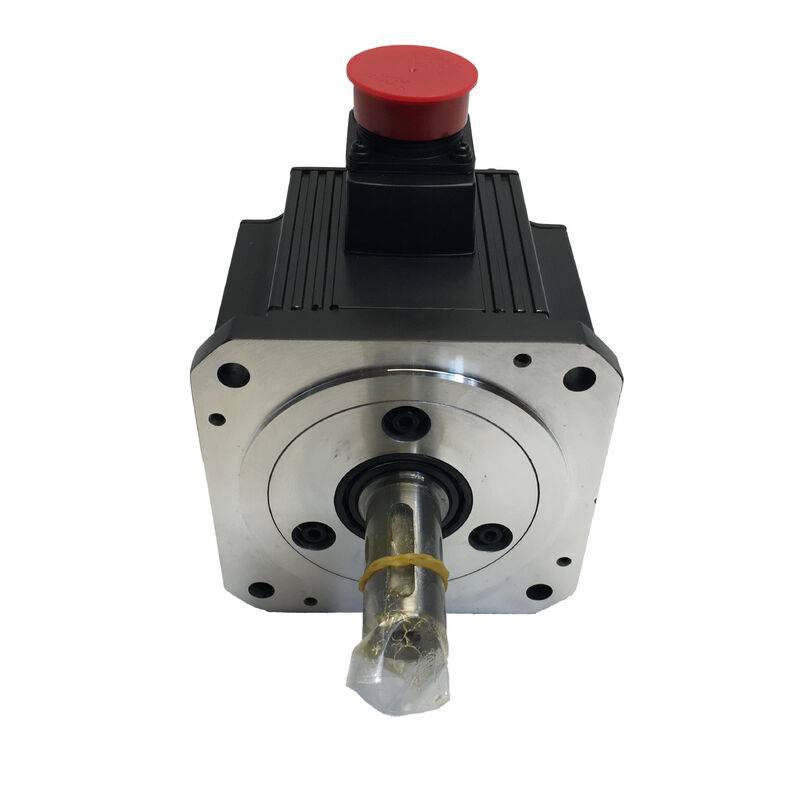
Some motion control problems don't yield to a fast, light servo motor. They need sustained torque at reduced output speed, reliable mechanical holding at standstill, and positioning precision that survives tens of millions of duty cycles without degrading. The Mitsubishi HC-SFS52BG1H is engineered for exactly that category: a 500W medium-inertia motor from the HC-SFS series, fitted with a factory-installed electromagnetic brake and a G1H high-precision gearhead — three components integrated at the factory into a single, dimensionally defined unit ready for direct machine installation.
| Parameter | Value |
|---|---|
| Part Number | HC-SFS52BG1H |
| Alternate Code | HCSFS52BG1H |
| Manufacturer | Mitsubishi Electric Corporation |
| Series | MELSERVO J2S / HC-SFS |
| Motor Type | AC Brushless Rotary Servo Motor with Brake + Gearhead |
| Inertia Class | Medium Inertia, Medium Capacity |
| Rated Output | 500 W (0.5 kW) |
| Supply Voltage | 200 V AC class |
| Motor Rated Torque | 2.39 Nm |
| Maximum Torque | 7.16 Nm |
| Motor Rated Speed | 2,000 rpm |
| Maximum Motor Speed | 3,000 rpm |
| Encoder Type | Built-in Absolute, 17-bit |
| Encoder Resolution | 131,072 ppr |
| Electromagnetic Brake | Yes (Spring-Applied, Power-Off Type) |
| Gearhead Type | G1H — High-Precision Gearhead |
| Shaft Type | Straight |
| Oil Seal | Yes |
| Motor Flange | 130 × 130 mm |
| Gearhead Section | IP44 |
| Motor Section | IP65 |
| Insulation Class | F |
| Cooling | Totally Enclosed, Self-Cooled |
| Operating Temperature | 0 °C to +40 °C |
| Compatible Amplifier | MR-J2S-60A / MR-J2S-60B |
There's a practical reason engineers specify an assembly like the HC-SFS52BG1H rather than sourcing its components separately. Every interface between systems — motor shaft to gearbox input, gearbox housing to machine frame, brake to motor body — is an opportunity for misalignment, assembly error, or dimension stack-up. Mitsubishi factory-assembles and tests this combination as a unit, eliminating those variables.
What the assembly contains:
The HC-SFS52 motor provides the servo drive core: 500W at 2,000 rpm through a 130×130mm medium-inertia platform with a 17-bit absolute encoder and the oil seal that keeps the bearing cavity sealed against contaminants in industrial environments. Medium-inertia design gives this motor broader load compatibility than low-inertia variants — it handles higher reflected load inertia without requiring tight gain tuning to maintain servo stability.
The B electromagnetic brake locks the output mechanically when the 24V DC coil supply is disconnected. Spring engagement means the shaft holds position through any power interruption — planned or unplanned. The brake is a static holding device sized to the motor's torque output, not a dynamic braking element; it engages after the axis decelerates to rest.
The G1H high-precision gearhead takes the motor's 2,000 rpm rotor speed and reduces it to the output speed required by the application, multiplying torque by the gear ratio in the process. The distinction between G1H and G1 is meaningful: G1H is Mitsubishi's high-precision gearhead designation, characterized by tighter backlash control compared to the standard G1 general industrial type. Where positioning repeatability matters — rotary table index accuracy, tooling angle, workpiece fixture location — that backlash difference shows up directly in part quality.
Gearhead backlash is the angular dead-band at the output shaft — the range of output rotation that occurs with no corresponding input rotation, caused by gear tooth clearances. In a standard general-purpose gearhead, this figure is acceptable for applications where some positioning tolerance is allowable. In high-precision gearheads, the tolerance stack is deliberately tightened, cutting the backlash down to a value that directly extends the servo system's effective positioning accuracy to the gearbox output shaft.
For the HC-SFS52BG1H, the G1H designation means the system's 17-bit encoder resolution — 131,072 position counts per motor revolution — is not undermined by gearhead slop at the output. The angular position commanded by the servo amplifier is the angular position delivered at the output shaft, within the tight backlash limits the G1H maintains over its service life.
Available gear ratios for the G1H gearhead on the HC-SFS52 platform span from 1/5 through 1/25, including 1/5, 1/9, 1/12, 1/15, 1/20, and 1/25. When ordering or replacing this unit, confirm the gear ratio from the original equipment nameplate or engineering documentation — the ratio is part of the assembly's specific configuration and must match the original for correct output speed and torque.
The power-off architecture of the B brake is a deliberate engineering choice, not a default. Consider the alternative: a power-on brake releases only when energized, meaning a powered shaft and a locked brake can coexist if wiring logic fails. The spring-applied power-off design avoids that scenario entirely. The brake is off only when it is actively energized. Remove the supply for any reason — power failure, emergency stop, normal shutdown — and the shaft locks.
For a 500W servo motor driving a tilted fixture, a clamping axis, or a vertical lead screw application, that behavior is what keeps the machine safe and the workpiece secure between moves. With the G1H gearhead multiplying output torque by the gear ratio, the brake holds the full amplified output torque at standstill without servo current being applied.
One installation point worth noting: the brake coil requires a dedicated 24V DC power supply, wired separately to the motor's brake connector. This supply must be incorporated into the machine electrical design independently — the MR-J2S servo amplifier does not power the brake directly.
At 131,072 positions per revolution, the HC-SFS52's encoder delivers feedback resolution well suited to the medium-inertia positioning work this motor class handles. More importantly for production environments, the absolute architecture means the motor never loses its position reference.
With a Mitsubishi A6BAT backup battery installed in the servo amplifier, position data persists through any power cycle — shift changes, weekend shutdowns, maintenance stops, emergency power losses. When the machine restarts, every axis is at its last known position without a reference return sequence. On equipment with G1H gearheads where the output shaft has been moved mechanically during maintenance, that retained position reference is particularly valuable for verifying the axis is in a known state before resuming production.
The HC-SFS52BG1H pairs with the MR-J2S-60A or MR-J2S-60B amplifiers — the 500W-class units within Mitsubishi's MELSERVO J2S amplifier family.
The MR-J2S-60A accepts pulse-train commands from PLCs, dedicated CNC controllers, and motion cards via differential receiver or open-collector input. It supports position, speed, and torque control modes and includes RS-232C/RS-422 communication for MR Configurator parameter access.
The MR-J2S-60B connects to SSCNET (Servo System Controller NETwork), Mitsubishi's high-speed serial bus linking servo amplifiers to motion controllers in synchronized multi-axis systems. SSCNET systems drive coordinated multi-axis motion — electronic gearing, interpolation, synchronized clamping — without individual pulse-train wiring from the controller to each axis.
The amplifier selection depends entirely on the host controller. The motor and gearhead assembly is identical in both cases.
The combination of 500W output, precision gearhead, electromagnetic brake, and absolute encoder maps to a specific and common class of production equipment:
Rotary indexing tables and dial plates — fixture tables that must step between stations accurately and lock between index moves for machining or assembly operations. The G1H gearhead delivers the precision index angle; the brake holds it while work is performed; the absolute encoder confirms the position every startup without a homing run.
Vertical lead screw and clamping axes — any axis that supports load under gravity or clamping force at rest benefits from the power-off brake holding without servo current. The 500W output with gear ratio torque multiplication gives clamping force well above the motor's bare shaft rating.
Automated welding positioners and fixture rotators — workpiece positioning axes where the combination of gear-reduced output torque, precise angular positioning, and mechanical holding between welds describes the specification.
CNC machine tool auxiliary rotary axes — 4th-axis and B-axis drives on machining centers, where index repeatability, brake holding during cutting, and coolant-resistant IP65 motor housing are all standard requirements.
The HC-SFS52 base motor is available in several configurations, all sharing the 500W, 17-bit encoder, oil seal, IP65, 130×130mm platform:
| Variant | Shaft | Brake | Gearhead |
|---|---|---|---|
| HC-SFS52 | Straight | No | None |
| HC-SFS52B | Straight | Yes | None |
| HC-SFS52K | Keyed | No | None |
| HC-SFS52BK | Keyed | Yes | None |
| HC-SFS52G1 | Straight | No | G1 General Industrial |
| HC-SFS52BG1H | Straight | Yes | G1H High-Precision |
The HC-SFS52BG1H is correct for applications requiring all three: brake holding, high-precision gear reduction, and straight-shaft output from the gearhead.
Q1: What gear ratios are available for the HC-SFS52BG1H?
The G1H high-precision gearhead on the HC-SFS52 platform is offered in multiple gear ratios — typically 1/5, 1/9, 1/12, 1/15, 1/20, and 1/25. Each ratio configuration is a separate part number. Before ordering a replacement unit, verify the gear ratio from the original equipment nameplate or machine documentation. Installing the wrong ratio changes output speed and torque and can cause motion profile errors or mechanical interference.
Q2: Which servo amplifier is compatible with the HC-SFS52BG1H?
The HC-SFS52BG1H is compatible with the MR-J2S-60A (analog/pulse-train command interface) and MR-J2S-60B (SSCNET serial network interface). Both are 500W-class amplifiers in the MELSERVO J2S family. The B brake requires a separate dedicated 24V DC power supply — this is wired to the motor's brake connector independently from the servo amplifier power supply.
Q3: What is the difference between the G1 and G1H gearhead options?
Both G1 and G1H are Mitsubishi reduction gearhead designations for the HC-SFS series, but they differ in precision. G1 is the general industrial gearhead — suitable for applications with moderate positioning tolerance requirements. G1H is the high-precision variant, with tighter backlash control that preserves the motor's encoder-level positioning accuracy through to the output shaft. G1H is the correct choice whenever output shaft angular accuracy is a functional requirement, such as rotary table indexing or precision fixture drives.
Q4: Does the HC-SFS52BG1H require a battery for absolute position retention?
Yes. The 17-bit absolute encoder retains multi-turn position data during power-off cycles only with a Mitsubishi A6BAT lithium battery installed in the servo amplifier's battery holder. Without the battery, position data is lost at shutdown and a reference return homing cycle is required at next startup. Battery condition should be checked as part of routine maintenance — the amplifier generates an alarm when battery voltage drops below the minimum threshold.
Q5: What IP rating applies to the gearhead section?
The motor body of the HC-SFS52BG1H carries an IP65 rating — fully dust-tight and resistant to water jets. The gearhead section, consistent with standard Mitsubishi gearhead specifications, is rated IP44 — protected against solid particles larger than 1mm and splashing water from any direction. For applications where direct coolant impingement on the gearhead housing is anticipated, additional shielding or coolant deflectors should be incorporated into the machine design.
Contact Us at Any Time