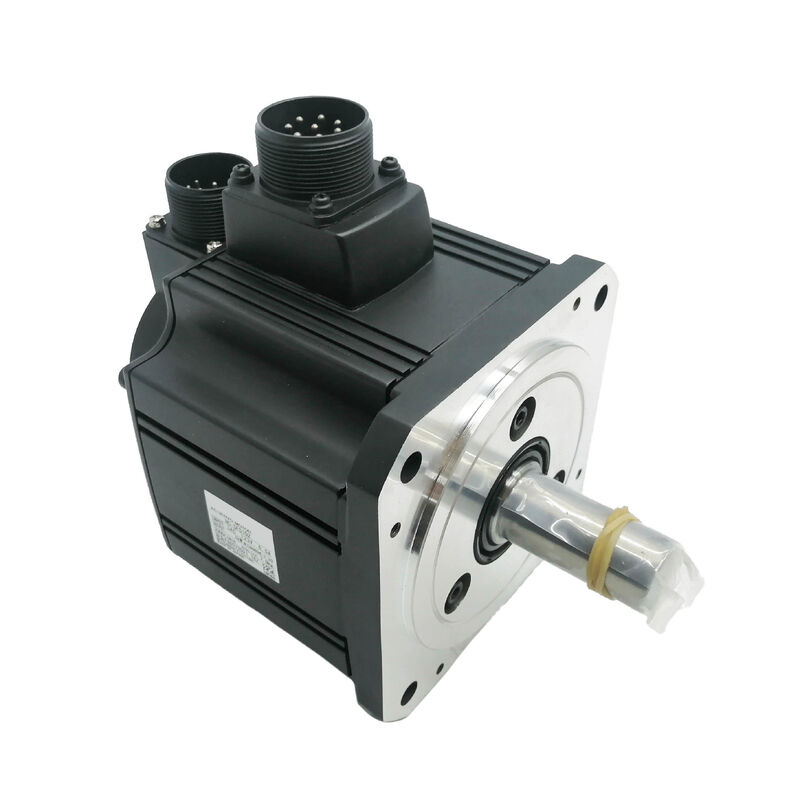
Mitsubishi HC-SFS352BG1H AC Servo Gearmotor — 3.5 kW with Electromagnetic Brake & G1H High-Precision Gearhead | MELSERVO J2S | New In Box
Three things can make a servo axis genuinely difficult to engineer: large load inertia that outpaces the motor's control bandwidth, a requirement to hold position mechanically when power is removed, and the need for high output torque at reduced speed without a clunky external gearbox installation.
The Mitsubishi HC-SFS352BG1H addresses all three in a single factory-assembled unit.
It combines the proven 3.5 kW HC-SFS352 medium-inertia servo motor with a G1H high-precision planetary gearhead and a built-in electromagnetic brake — a complete integrated drivetrain for demanding industrial automation and machine tool applications. New in original Mitsubishi Electric packaging.
Technical Specifications
| Parameter |
Value |
| Part Number |
HC-SFS352BG1H |
| Alternate Code |
HCSFS352BG1H |
| Manufacturer |
Mitsubishi Electric Corporation |
| Series |
MELSERVO J2S / HC-SFS |
| Configuration |
Gearmotor with Brake (Motor + G1H Gearhead + Electromagnetic Brake) |
| Motor Rated Output |
3,500 W (3.5 kW) |
| Supply Voltage |
200 V AC class |
| Rated Current |
17 A |
| Motor Rated Torque |
16.7 Nm |
| Motor Maximum Torque |
50.1 Nm |
| Motor Rated Speed |
2,000 rpm |
| Gearhead Type |
G1H — High-Precision Gearhead |
| Electromagnetic Brake |
Yes (spring-applied, power-off lock) |
| Encoder Type |
Built-in absolute, 17-bit |
| Encoder Resolution |
131,072 ppr |
| Motor Flange |
176 × 176 mm |
| Motor Protection |
IP65 (excluding gearhead section: IP44) |
| Shaft Type |
Straight |
| Insulation Class |
F |
| Cooling |
Totally enclosed, self-cooled |
| Operating Temperature |
0 °C to +40 °C |
| Origin |
Japan |
| Condition |
New In Box, Fast Shipping |
Three Components, One Factory-Matched Assembly
The HC-SFS352BG1H brings together three subsystems that would otherwise require separate sourcing, mechanical alignment, and installation engineering:
The HC-SFS352 base motor is Mitsubishi's 3.5 kW member of the medium-inertia HC-SFS 2,000 rpm series — a motor with 16.7 Nm rated torque and a 50.1 Nm peak, 17-bit absolute encoder, IP65 housing with oil seal, and the 176 × 176 mm flange common to the larger HC-SFS models.
It is an established platform for CNC machine tool feed axes and industrial automation drives.
The G1H gearhead is Mitsubishi's high-precision planetary reduction gear configuration.
The G1H designation indicates a higher-precision output than the standard G1 general industrial gear — tighter backlash specifications and more controlled gear accuracy, suited for positioning axes where angular repeatability at the output shaft matters as much as torque multiplication.
The electromagnetic brake is a spring-applied, power-off type: the brake locks the shaft mechanically when brake coil voltage is removed, and releases when energized.
This is the correct fail-safe configuration for vertical axes, inclined drives, and any load that must hold position safely when servo power is absent.
All three are factory-fitted, aligned, and tested as a matched assembly.
The machine builder receives a complete drivetrain with verified dimensional relationships between motor, gearhead, and brake.
G1H Gearhead — High Precision for Positioning Applications
Within Mitsubishi's HC-SFS gearhead catalog, the G1H designation places this unit above the standard G1 general industrial gear in terms of output accuracy.
The G1H is a high-precision gearhead configuration with controlled backlash, intended for applications where the position accuracy at the gearhead output shaft is critical to the machine's performance.
The gearhead serves two engineering functions simultaneously.
First, it multiplies the motor's rated torque in proportion to the gear ratio, delivering substantially higher output torque than the 3.5 kW motor alone could produce at the output shaft. Second, it reduces the reflected inertia of the load back to the motor shaft by the square of the gear ratio — making it possible to drive high-inertia loads that would otherwise exceed the motor's recommended inertia ratio in direct-coupled configurations.
For large-format rotary tables, heavy workholding fixtures, and multi-axis gantry drives where the mechanical load presents significant inertia, the G1H gearhead changes the system from marginal to well-within-specification.
Electromagnetic Brake — Why This Configuration Matters
The B in HC-SFS352BG1H is the spring-applied electromagnetic brake, and its inclusion here is not incidental.
At 3.5 kW output with a high-precision gearhead adding further torque multiplication, the motor drives loads with substantial mechanical energy. When servo power is removed — whether deliberately at end of cycle, during an emergency stop, or on power loss — a load without a mechanical brake can move under gravity or inertia.
The spring-applied brake locks the gearhead output shaft the moment brake coil voltage drops. This is the correct specification for:
- Vertical axes where the load mass must be held against gravity whenever the motor is not commanded
- Inclined or tilted axes where gravity creates a persistent torque component on the drive
- Safety-hold requirements in machine designs where shaft immobility during maintenance or guard-open conditions is mandated
- Precision positioning hold applications where the position must be mechanically locked between motion cycles without relying on continuous servo current
One important note: the electromagnetic brake is a mechanical holding device, not a dynamic deceleration brake.
It is designed to engage after the axis has stopped, locking the shaft at rest.
17-Bit Absolute Encoder — Position Without Homing
The encoder integrated into the HC-SFS352BG1H reads the motor shaft at 131,072 ppr through Mitsubishi's high-speed serial link to the servo amplifier.
The amplifier accounts for the gearhead ratio in its electronic gear parameters, translating motor position data accurately into output shaft angle for the CNC or motion controller.
The absolute architecture means position is retained through power cycles.
With the servo amplifier battery installed, the multi-turn position counter persists when the machine shuts down — so startup does not require a homing sequence.
For a machine with a large-format rotary table or heavy multi-axis fixture where homing each axis before production begins is time-consuming, eliminating that startup routine is a direct productivity gain.
Compatible Servo Amplifiers
The HC-SFS352BG1H pairs with the MR-J2S-350A (analog/pulse-train command) or MR-J2S-350B (SSCNET digital network command) servo amplifiers, both rated at 3.5 kW within the MELSERVO J2S platform.
The G1H gearhead ratio must be programmed into the amplifier's electronic gear ratio parameter during commissioning. The electromagnetic brake requires a separate 24V DC power supply connected to the brake circuit per Mitsubishi's wiring specifications.
Application Environments
The HC-SFS352BG1H is a purpose-built solution for specific application categories where motor, brake, and high-precision gearhead must all be present:
Large-format rotary tables and tilting heads on machining centers where the workholding fixture mass creates high load inertia, the 4th or 5th axis must hold position under cutting forces, and the drive must lock mechanically when the machine guard opens
Heavy vertical axes on CNC machining centers, drilling machines, and automated assembly equipment where 3.5 kW at the gearhead output provides the force margin to move and hold substantial loads at any position in the axis travel
Industrial robots — shoulder and upper-arm joints on medium-to-large payload articulated robots where torque multiplication through the G1H gearhead extends the motor's effective torque range to match the joint's structural requirements
Precision indexing drives — dial indexers, star indexers, and rotary transfer systems where the G1H's tighter backlash specification ensures repeatable angular positioning at the output station after each index
Automated welding and cutting systems — large gantry and portal axes where the combination of 3.5 kW output, gearhead torque multiplication, and mechanical brake provides reliable controlled motion with safe hold capability
HC-SFS352 Variant Summary
The HC-SFS352 base motor is available in several configurations. The BG1H combines two options:
- HC-SFS352 — straight shaft, no brake, no gearhead
- HC-SFS352B — with electromagnetic brake, no gearhead
- HC-SFS352G1H — with G1H gearhead, no brake
- HC-SFS352BG1H — with electromagnetic brake + G1H gearhead (this listing)
All variants share the same 3.5 kW output, 17-bit absolute encoder, IP65 motor housing, and 176 × 176 mm motor flange.
FAQ
Q1: What servo amplifier is compatible with the HC-SFS352BG1H?
The correct amplifiers are the MR-J2S-350A (analog or pulse-train command from a PLC or external controller) or MR-J2S-350B (SSCNET fiber-optic network for multi-axis Mitsubishi motion systems). Both are rated at 3.5 kW within the MELSERVO J2S platform.
The gearhead ratio must be programmed into the amplifier's electronic gear ratio parameters at commissioning.
Q2: What power supply does the electromagnetic brake require?
The spring-applied electromagnetic brake requires a separate 24V DC power supply connected to the brake circuit through the motor's brake cable and connector. The brake releases when 24V DC is applied to the coil, and locks when voltage is removed.
The servo amplifier itself does not supply brake power — a dedicated 24V DC source must be provided in the machine electrical design. Refer to Mitsubishi's wiring specifications for the correct connector type and cable routing.
Q3: What is the difference between G1, G1H, G5, and G7 gearheads on the HC-SFS series?
G1 is the standard general industrial reduction gear — spur gear type, suitable for most automation and handling applications where moderate output shaft accuracy is acceptable. G1H is the high-precision version of the G1 configuration — it has tighter backlash and improved gear accuracy compared to G1, making it appropriate for positioning axes where angular repeatability at the output matters.
G5 and G7 are spiral bevel precision gears with the tightest backlash specifications, for applications requiring the highest output shaft angular accuracy such as precision rotary tables. G1H is the correct middle-ground choice for demanding industrial positioning without the premium cost of G5/G7.
Q4: Can the HC-SFS352BG1H be used on a vertical axis without the electromagnetic brake active at all times?
The brake is not required to be continuously energized during normal operation — it only needs to be energized (released) during powered motion.
During any state where servo power is removed or the axis is at rest and must hold against gravity, the brake should be de-energized to allow the spring to lock the shaft. Mitsubishi's general guidance is that the vertical axis unbalanced torque should remain within 70% of rated motor torque for reliable brake holding.
Always confirm brake holding torque against the actual load before commissioning.
Q5: Is the HC-SFS352BG1H still in production, and what is the current-generation equivalent?
The HC-SFS series belongs to Mitsubishi's MELSERVO J2S generation, which has been succeeded by J4 and J5 series products. New-in-box HC-SFS352BG1H units remain available through industrial automation channels for machine maintenance, spare parts, and existing J2S-platform systems.
For new machine designs, Mitsubishi's current-generation equivalents with G1H gearhead and brake in the 3.5 kW class are from the HG-SR (MELSERVO J4) series — offering a 22-bit encoder and IP67 housing but requiring J4 amplifiers and different cable interfaces.


 Your message must be between 20-3,000 characters!