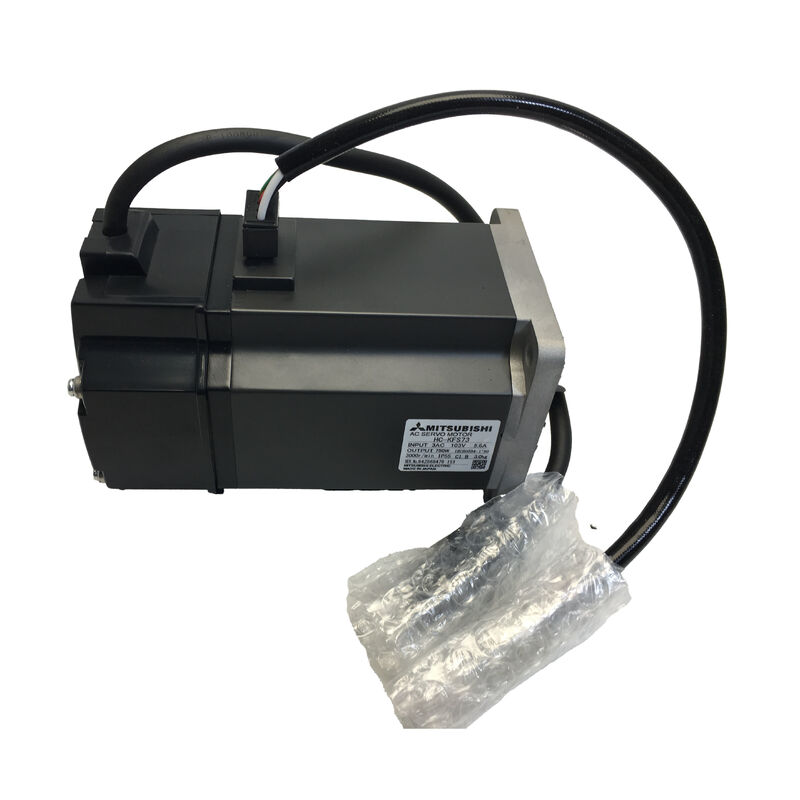
Mitsubishi HC-KFS43G1 AC Servo Motor — 400W | 3,000 rpm | 17-Bit Absolute Encoder | G1 General Industrial Gearhead | MELSERVO J2S
The HC-KFS43G1 combines Mitsubishi's compact HC-KFS 400W low-inertia servo motor with a G1-type general industrial flange-output reduction gearhead — giving automation engineers a factory-integrated gear-motor unit ready to mount directly to machine frames without external adapter plates, coupling alignment, or separate gearbox sourcing. The result is a self-contained motion solution: one part number, one mounting interface, reduced assembly complexity.
Core Specifications
| Parameter |
Value |
| Part Number |
HC-KFS43G1 |
| Alternate Code |
HCKFS43G1 |
| Manufacturer |
Mitsubishi Electric Corporation |
| Series |
MELSERVO J2S / HC-KFS |
| Motor Type |
AC Brushless Rotary Servo Motor with Gearhead |
| Inertia Class |
Low Inertia, Small Capacity |
| Rated Output |
400 W (0.4 kW) |
| Supply Voltage |
200 V AC class |
| Motor Rated Torque |
1.3 Nm |
| Motor Rated Speed |
3,000 rpm |
| Encoder Type |
Built-in Absolute, 17-bit |
| Encoder Resolution |
131,072 ppr |
| Gearhead Type |
G1 — General Industrial Flange Output |
| Shaft Type |
Straight |
| Electromagnetic Brake |
None |
| Motor Flange |
60 × 60 mm |
| Protection Rating |
IP55 |
| Cooling |
Totally Enclosed, Natural |
| Operating Temperature |
0 °C to +40 °C |
| Compatible Amplifier |
MR-J2S-40A / MR-J2S-40B |
What G1 Actually Means — and Why It Matters for Mechanical Integration
Mitsubishi uses a well-defined gearhead suffix system across the HC series. G1 designates the general industrial flange-output gearhead, where the output stage presents a standard square flange face for direct bolt-on mounting.
This is the workhorse configuration — designed for the broad class of applications where the gearbox output flange bolts to a machine structure, rotary stage, or driven axis housing.
The alternative G2 designation covers the leg-mounted gearhead variant, where the gearbox body is fixed to the machine via legs rather than a face flange. G1 and G2 suit different mechanical envelope constraints.
For the vast majority of machine tool, conveyor, and automation axis installations, G1 flange mounting is the standard choice — it locates the output shaft precisely relative to the load and eliminates the secondary support structure required by leg-mount configurations.
What the integrated G1 gearhead brings to the HC-KFS43:
Mechanical gear reduction multiplies the motor's 1.3 Nm rated torque at the output shaft proportional to the selected gear ratio, while reducing output speed by the same factor. This allows a compact 400W motor to drive loads requiring substantially higher torque than the motor shaft alone can deliver, without moving to a higher power class.
Inertia matching improvement — after reduction, the reflected load inertia at the motor shaft is divided by the square of the gear ratio.
For a low-inertia motor like the HC-KFS43, this dramatically extends the range of loads the motor can control responsively without compromising servo loop stability.
Direct system integration — the G1 output flange mounts to the machine in a single operation, versus sourcing a standalone gearbox, coupling, motor mount plate, and alignment procedure separately. Downtime during replacement is correspondingly shorter.
HC-KFS43 Base Motor — 400W Low-Inertia Platform
The HC-KFS43 belongs to Mitsubishi's HC-KFS series — the low-inertia, small-capacity family within the MELSERVO J2S platform. Low-inertia motors respond faster to velocity and torque commands than medium-inertia designs at the same power rating.
The servo amplifier can tighten gains without exciting resonance, and the motor tracks acceleration profiles more precisely during high-cycle operations.
At 400W with a 60 × 60 mm body and 1.3 Nm rated torque, the HC-KFS43 is sized for the large category of automation axes where the combination of fast response, small footprint, and direct-to-J2S-amplifier integration defines the specification.
Packaging equipment index drives, conveyor positioning axes, pick-and-place carriage drives, and compact multi-axis machine tool auxiliaries are all natural applications for this power class.
The 17-bit absolute encoder (131,072 ppr) provides position feedback that persists through power-off cycles with a backup battery in the servo amplifier. Every startup, the axis position is known immediately — no homing sequence, no reference return, no waiting.
In high-cycle production equipment where machine downtime between shifts or for maintenance is a cost factor, the absolute encoder's elimination of homing time is a tangible operational benefit.
IP55 protection — sealed against dust ingress and low-pressure water jets — makes the motor suitable for typical industrial environments without additional external protection.
Drive and Control Compatibility
The HC-KFS43G1 pairs with the MR-J2S-40A (pulse-train/analog command interface) or MR-J2S-40B (SSCNET digital network interface) servo amplifiers within Mitsubishi's MELSERVO J2S platform.
The MR-J2S-40A accepts pulse-train position commands from PLCs, CNC controllers, and motion cards, and supports position, speed, and torque control modes independently. It includes RS-232C/RS-422 serial communication for setup via MR Configurator software on Windows.
The MR-J2S-40B connects to SSCNET (Servo System Controller NETwork) — Mitsubishi's synchronous serial network linking servo amplifiers to motion controllers such as the Q172D, Q173D, and A172SHCPUN. In SSCNET systems, all axes receive synchronized command packets at each communication cycle, achieving tight multi-axis coordination without individual pulse-train wiring from controller to each amplifier.
The choice between A and B variants depends entirely on the host controller being used — the motor is identical, and both amplifiers support the same MELSERVO J2S functions including real-time auto-tuning, adaptive vibration suppression, and MR Configurator parameter management.
Typical Application Environments
The HC-KFS43G1's specific combination of 400W low-inertia motor, absolute encoder, and G1 flange gearhead defines a well-characterized set of application fits:
Conveyor indexing and positioning axes — small-to-medium conveyor drives where moderate output torque, fast positioning cycle times, and simple mechanical integration are the primary requirements.
The G1 flange output bolts directly to the conveyor frame; the absolute encoder means the system is at position immediately after every power cycle.
Packaging machine product handling — rotary and linear drives on filling, sealing, labeling, and wrapping machines where the compact 60mm motor body, fast low-inertia response, and gearhead torque multiplication combine to handle product transport at high cycle rates within tight machine envelopes.
Multi-axis assembly automation — secondary axes on assembly cells and robotic fixtures where a 400W drive provides the force needed for clamping, rotating, or translating workpieces without the size and cost penalty of a larger servo class.
Machine tool auxiliary axes — tool changers, chip conveyors, coolant valve actuators, and workpiece fixture rotation on CNC machining centers, where the HC-KFS series is frequently specified alongside the main HC-SFS axis drives in the same MELSERVO J2S system.
HC-KFS43 Variant Reference
The HC-KFS43 base motor is offered with several configuration options, all sharing the 400W, 1.3 Nm, 3,000 rpm, 17-bit encoder, IP55, 60×60mm platform:
- HC-KFS43 — straight shaft, no brake, no gearhead
- HC-KFS43K — keyed shaft, no brake, no gearhead
- HC-KFS43B — straight shaft, with electromagnetic brake
- HC-KFS43BK — keyed shaft, with electromagnetic brake
- HC-KFS43G1 — straight shaft, G1 general industrial flange gearhead (this listing)
The HC-KFS43G1 is the correct selection when geared output is needed, a flange-face mounting interface is required, and the application does not require a shaft key or electromagnetic brake on the gearhead output shaft.
FAQ
Q1: What does the G1 suffix mean on the HC-KFS43G1, and what gear ratios are available?
G1 identifies the general industrial flange-output reduction gearhead attached to the motor. Mitsubishi offered multiple gear ratio options for the G1 gearhead on the HC-KFS43 platform — available ratios included 1/5, 1/9, 1/12, 1/15, 1/20, and 1/25.
The output shaft torque and speed are determined by multiplying or dividing the motor's base values by the selected ratio. When ordering or replacing this unit, confirm the gear ratio from the original equipment documentation or the nameplate on the existing gearhead before purchasing.
Q2: Which servo amplifier should be used with the HC-KFS43G1?
The correct amplifiers are the MR-J2S-40A (for analog or pulse-train command systems) and the MR-J2S-40B (for SSCNET multi-axis network systems). Both are rated at 400W within the MELSERVO J2S platform and are confirmed compatible with the full HC-KFS43 motor family.
The amplifier choice depends on the host controller type — MR-J2S-40A for standalone PLC-based positioning; MR-J2S-40B for Mitsubishi motion controller systems using SSCNET.
Q3: The HC-KFS series is listed as discontinued — can the HC-KFS43G1 still be used in existing machines?
Yes. The HC-KFS43 motor and compatible MR-J2S amplifiers were discontinued from Mitsubishi's standard production lineup, but new and surplus stock remains available through authorized industrial parts distributors for maintenance and repair of existing J2S-platform machines.
The motor specification, wiring, and amplifier parameters are unchanged — a new-stock HC-KFS43G1 is a direct drop-in replacement for the original unit. For new machine designs, Mitsubishi's current-generation equivalent is the HF-KP series paired with MR-JN or MR-J4 amplifiers.
Q4: Does the 17-bit encoder on the HC-KFS43G1 require a battery for absolute position retention?
Yes. The absolute encoder retains multi-turn position data during power-off cycles only when a Mitsubishi A6BAT lithium battery is installed in the servo amplifier's battery holder. Without the battery, position data is lost at power-down and the axis must be re-homed at next startup.
With the battery properly installed and in good condition, position is preserved through shutdowns indefinitely — including extended machine storage periods. Battery replacement is a routine maintenance item; Mitsubishi's documentation specifies the interval based on usage patterns and ambient temperature.
Q5: What is the difference between the G1 and G2 gearhead options on Mitsubishi HC-KFS servo motors?
Both G1 and G2 are general industrial (as opposed to high-precision) gearhead types.
The difference is the mounting interface: G1 is flange output — the gearbox presents a square face flange for direct bolting to a machine structure or driven component.
G2 is leg output — the gearbox body is secured via mounting legs, and the output shaft is free-standing.
G1 is the more common industrial choice for rotary table, conveyor, and machine axis drives where precise output shaft location relative to the machine frame is important. G2 is used where the gearbox body needs to be fixed independently of the output shaft plane.


 Your message must be between 20-3,000 characters!