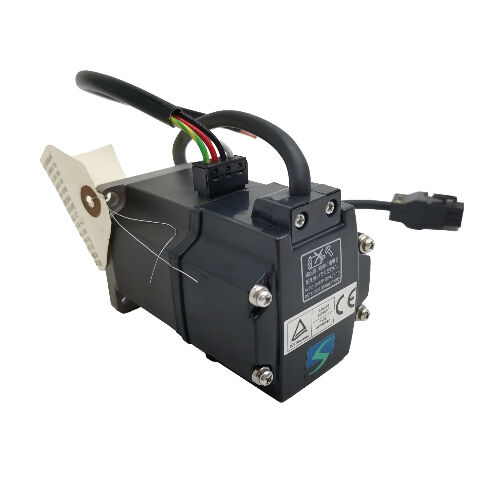
Mitsubishi HC-KFS23BG1-S45 (HCKFS23BG1S45) — 200W AC Servo Motor with Brake and G1 Reduction Gear, Special Specification, 3000 rpm, MELSERVO J2-Super Series
Product Overview
Part Number: HC-KFS23BG1-S45
Also Searched As: HCKFS23BG1S45, HC KFS 23BG1 S45, HC-KFS23-BG1-S45
Series: Mitsubishi MELSERVO HC-KFS (J2-Super Generation)
Classification: Low-Inertia AC Brushless Servo Motor — 200 W, 200V class, 3000 rpm, with Electromagnetic Brake, G1 Flange-Type Reduction Gear, Factory Special Specification S45
Four Designators, One Complete System
The Mitsubishi HC-KFS23BG1-S45 is not simply a motor. It is a fully integrated servo gearmotor assembly — motor, brake, and reduction gear combined in a single factory-built unit, with a factory special specification that defines a specific OEM configuration. Each element of the part number contributes a distinct physical component and specific functionality, and understanding all four together is necessary to specify, source, or replace this unit correctly.
The HC-KFS23 is the base motor: a 200W low-inertia servo motor from the J2-Super platform, rated at 3,000 rpm with 0.64 Nm continuous torque, carrying a 17-bit serial absolute encoder at 131,072 ppr and IP55 protection on its motor body. It is one of the smallest motors in the J2-Super HC-KFS range, designed for high-cycle-rate compact axes where rotor inertia must be minimised.
The B adds the spring-applied electromagnetic brake: 24V DC holds the shaft free; remove that voltage and the spring closes the brake immediately. For a reduced-output axis driving a vertical or gravity-loaded mechanism, this fail-safe characteristic is the design requirement that the B suffix meets.
The G1 adds the general industrial flange-type reduction gear: a factory-integrated gear unit mounted at the output end of the motor, available in standard ratios of 1/5, 1/12, and 1/20. The gear multiplies the motor's output torque by the reduction ratio (minus efficiency losses) and divides the output shaft speed proportionally. The gear section carries an IP44 protection rating.
The -S45 designates a factory special specification — a defined modification from the standard configuration, created for a specific OEM application. The motor's electrical and dynamic performance remains that of the base HC-KFS23B. The S45 specification defines a physical or configuration detail — shaft dimensions, cable exit arrangement, mounting feature, or encoder modification — documented in Mitsubishi's internal specification records.
Technical Specifications
| Parameter |
Value |
| Part Number |
HC-KFS23BG1-S45 |
| Motor Rated Output |
200 W |
| Supply Voltage |
200V class (3-phase 200–230V AC) |
| Motor Rated Speed |
3,000 rpm |
| Motor Rated Torque |
0.64 Nm |
| Motor Peak Torque |
1.9 Nm |
| Encoder Type |
17-bit serial absolute |
| Encoder Resolution |
131,072 ppr |
| Shaft Type |
Straight |
| Electromagnetic Brake |
Spring-applied, electrically released (24V DC) |
| Reduction Gear Type |
G1 — general industrial, flange-type output |
| Available Gear Ratios |
1/5, 1/12, 1/20 |
| Gear Section Protection |
IP44 |
| Motor Body Protection |
IP55 |
| Inertia Class |
Low inertia |
| Ambient Temperature (Operation) |
0°C to +40°C |
| Storage Temperature |
−15°C to +70°C |
| Compatible Amplifier |
MR-J2S-20A / MR-J2S-20B / MR-J2S-20CP |
| Special Specification |
S45 (factory-defined OEM configuration) |
| Series Generation |
MELSERVO J2-Super |
| Status |
Discontinued — available as surplus stock |
The gear ratio applicable to this specific S45 unit must be confirmed against the original machine documentation or motor nameplate. Standard G1 ratios for the HC-KFS23BG1 series are 1/5, 1/12, and 1/20.
The G1 Reduction Gear: What It Adds and Why It Matters
The G1 designation in Mitsubishi's servo motor nomenclature refers to the general industrial flange-type reduction gear — a factory-integrated gear unit attached to the motor output, with a flange face on the gear output that allows direct mounting to the driven mechanism.
The purpose of a reduction gear on a servo motor is the same as it is for any gear drive: trading rotational speed for torque. At a given power level, a gear reduction multiplies the available output torque by the reduction ratio while dividing the output shaft speed by the same ratio. For the HC-KFS23 base motor with 0.64 Nm rated torque and 3,000 rpm rated speed:
At 1/5 reduction: output speed ~600 rpm, output torque ~3.0 Nm (accounting for gear efficiency) At 1/12 reduction: output speed ~250 rpm, output torque ~7.2 Nm At 1/20 reduction: output speed ~150 rpm, output torque ~12 Nm
These output torque figures transform a 200W motor into a genuinely capable slow-speed actuator. Twelve Newton-metres from a 200W motor at 150 rpm output is a practical operating point for small rotary tables, compact conveyor sections, light robot joint drives, and indexed transfer mechanisms — applications where the output speed requirement is low and the torque requirement exceeds what the bare motor shaft can deliver directly.
The flange-type output of the G1 gear is matched to the motor's 60 × 60 mm frame. The gear housing presents a mounting face and output shaft to the driven machine component, and the assembly is dimensionally self-contained — the gear is not a separate bolt-on unit but an integral part of the motor assembly as shipped from the factory. This integration matters for maintenance: the entire HC-KFS23BG1-S45 is replaced as one assembly.
IP44 on the gear section. The motor body of the HC-KFS23 carries IP55 — protection against dust ingress harmful to operation and against water jets from any direction. The gear section reduces this to IP44, which protects against solid objects larger than 1mm and against water splashed from any direction. This is the standard limitation on geared servo motors across the Mitsubishi HC series. In environments where coolant spray, oil mist, or wash-down operations could reach the gear section, this protection level difference needs to be assessed against the actual environmental conditions.
The Brake in Context: 200W, Reduced Speed, Vertical Axis
The electromagnetic brake on the HC-KFS23BG1-S45 is spring-applied — the same design principle that applies on every braked motor in the J2-Super range regardless of capacity. Coil de-energised by default means shaft held by default; 24V DC applied releases the shaft for motion.
On a 200W geared motor, the brake's function and the application context are specific. The gear reduction multiplies the torque the motor needs to provide to hold the load against gravity. At a 1/20 ratio, the gear stage reduces the reflected gravitational load torque back to the motor shaft by a factor of 20 (minus efficiency losses). This means the motor and brake only need to hold a small fraction of the actual output shaft gravitational load — which is one of the practical advantages of using a geared servo motor on a vertical or inclined axis: the brake requirement at the motor shaft is much smaller than the output shaft torque would suggest.
What does not change with the gear ratio is the fail-safe behaviour. The spring closes the brake the moment 24V is removed from the coil. E-stop, power loss, planned servo-off — in all cases, the brake closes and holds. For a small vertical axis on assembly equipment, a compact robot joint, or an indexed vertical transfer mechanism, this is the safety characteristic that the application requires regardless of how small the 200W rating makes the motor appear.
24V DC brake wiring. The brake coil requires a dedicated 24V DC circuit in the machine panel — separate from the amplifier's control supply. Include a relay with appropriate surge suppression (flyback diode for DC circuits) across the coil terminals. The MBR (Magnetic Brake Release) output on the MR-J2S-20 amplifier sequences the brake relay correctly relative to servo enable. Always confirm servo lock before releasing the brake; always bring the axis to rest before engaging the brake.
The -S45 Special Specification
The -S45 suffix identifies this unit as a factory special specification — a defined variation from the standard HC-KFS23BG1 configuration, established by Mitsubishi for a specific OEM customer or application requirement. Special specification suffixes appear across the HC-KFS, HC-MFS, HC-SFS, and other series, and they typically modify one or more of the following: shaft dimensions or end configuration, cable exit routing or length, connector type, gear ratio or mounting orientation, or encoder type.
What is consistent across all Mitsubishi special specifications is that the base motor's electrical and dynamic performance is unchanged. The HC-KFS23BG1-S45 operates with the same 0.64 Nm rated torque, same 1.9 Nm peak, same 17-bit encoder, same MR-J2S-20 amplifier compatibility, and same G1 gear characteristics as the standard HC-KFS23BG1. The S45 designation records a physical attribute of this specific variant.
The practical consequence for procurement: only the exact full part number — HC-KFS23BG1-S45 — is a confirmed direct replacement for an existing unit carrying this designation. A standard HC-KFS23BG1 without the S45 suffix may differ physically from the S45 variant in a way that affects installation. Confirming the specific S45 modification details against the original machine documentation or Mitsubishi's specification records — or physically comparing the dimensions of the unit on hand against the original before committing to a replacement — is the reliable approach when sourcing a replacement.
Compatible Amplifier: MR-J2S-20
The HC-KFS23BG1-S45 pairs with the MR-J2S-20 amplifier family — the 200W capacity J2-Super platform. This is the same amplifier class used for all HC-KFS23 variants (standard, braked, geared, and special specification) at 200W.
MR-J2S-20A is the general-purpose pulse-train and analog interface amplifier. It accepts position commands as pulse trains from CNC controllers and PLCs, and speed or torque references as analog voltage signals. Position, speed, and torque control modes are all supported. RS-232C connects to MR Configurator for commissioning and setup.
MR-J2S-20B connects to Mitsubishi A-series and Q-series motion controllers via SSCNET fiber-optic serial bus. For systems where the reduced-speed axis must coordinate with other axes under a motion controller — a small indexed joint on a multi-axis robot, an auxiliary axis on a coordinated transfer machine — the SSCNET link provides tight real-time coupling.
MR-J2S-20CP provides built-in single-axis positioning with up to 31 stored point-table positions, activated by digital I/O or CC-Link command. For standalone indexed positioning applications where no external motion controller is required, the CP provides the positioning logic locally.
Compatibility notes. The HC-KFS23BG1-S45 requires an MR-J2S-20 amplifier. It is not compatible with the first-generation MR-J2-20 amplifier, which cannot read the 17-bit J2-Super encoder protocol. Not compatible with MR-J3 or MR-J4 amplifiers without a renewal adapter kit. The brake, gear, and special specification suffix do not affect amplifier compatibility — the amplifier selection is determined by the base motor capacity and encoder generation.
HC-KFS 200W Family: Understanding the Options
| Model |
Brake |
Gear |
Output Torque (approx. at 1/12) |
| HC-KFS23 |
None |
None |
0.64 Nm (motor shaft) |
| HC-KFS23B |
Spring-applied |
None |
0.64 Nm (motor shaft) |
| HC-KFS23G1 |
None |
G1 flange |
~7.2 Nm |
| HC-KFS23BG1 |
Spring-applied |
G1 flange |
~7.2 Nm |
| HC-KFS23G2 |
None |
G2 shaft |
~7.2 Nm |
| HC-KFS23BG2 |
Spring-applied |
G2 shaft |
~7.2 Nm |
The HC-KFS23BG1 combines the brake and the G1 flange-type gear in a single factory assembly. The G2 variants use a shaft-type gear output instead of a flange face — a different mechanical interface for different machine mounting configurations. All variants at 200W use the MR-J2S-20 amplifier.
The -S45 suffix can in principle be applied to any of these variants, though in practice special specifications are created for specific OEM requirements and tend to be tied to a particular combination.
Typical Applications
Compact indexed rotary tables and turntable drives. Small rotary indexing tables on assembly machines, test fixtures, and inspection equipment where the output shaft speed is low (150–600 rpm range depending on gear ratio), the required output torque exceeds what the bare motor provides directly, and a vertical or inclined axis requires brake holding at each station. The G1 flange-type output mounts directly to the table mechanism; the spring-applied brake holds the table at each dwell position with the servo off.
Small robot arm joint drives. Elbow and wrist joint actuators on compact assembly robots, SCARA robot secondary axes, and articulated arm joint drives where the J2-Super servo encoder provides the positioning precision needed for repeatable part placement. The gear reduction adapts the high motor speed to the low angular velocity needed at the robot joint; the spring-applied brake holds joint position when the robot is in a powered-off or e-stopped state.
Vertical feed axes on small automation equipment. Vertical transfer slides, lift actuators, and Z-axis drives on compact assembly and test equipment where the 200W capacity is appropriate for the light payload and the gear reduction provides the output torque needed to lift, hold, and lower that payload at controlled speed. The spring-applied brake provides the fail-safe holding required on any axis with a gravitational load component.
Indexed conveyor and transfer drives. Servo-driven indexed conveyor sections and small transfer mechanisms on assembly lines where the motor drives a belt, roller, or chain mechanism through the G1 gear reduction. The gear output connects directly to the drive mechanism's input flange; the brake holds the mechanism between index steps.
OEM-specific machine axis drives. The -S45 special specification indicates this unit was created for a specific OEM application. The most likely use context is a machine where the standard HC-KFS23BG1 configuration required a dimensional or configuration modification to fit an existing machine structure, cable routing requirement, or mounting interface that the standard product could not accommodate directly.
Frequently Asked Questions
Q1: What is the G1 reduction gear, and what output torque does the HC-KFS23BG1-S45 produce?
The G1 is a general industrial flange-type reduction gear factory-integrated with the motor. Available in ratios of 1/5, 1/12, and 1/20, it multiplies the motor's 0.64 Nm rated torque at the gear output by the reduction ratio (less gear efficiency losses). At 1/12 ratio, the output shaft delivers approximately 7 Nm at ~250 rpm. At 1/20 ratio, approximately 12 Nm at ~150 rpm. The specific ratio fitted to the -S45 unit must be confirmed from the machine documentation or motor nameplate, as the ratio is part of the specific product configuration and is not deducible from the S45 designation alone.
Q2: What does the -S45 special specification mean, and can a standard HC-KFS23BG1 substitute?
The -S45 is a factory special specification defining a modification from the standard HC-KFS23BG1. Mitsubishi creates these configurations for specific OEM requirements — commonly a shaft dimension, cable routing, or mounting modification. The base motor performance is unchanged. Whether a standard HC-KFS23BG1 can substitute depends entirely on what the S45 modification specifies. Without confirming those details against the Mitsubishi S45 specification record, substitution carries the risk of a physical mismatch. Match the full part number for a confirmed direct replacement.
Q3: Which amplifier is required, and does the brake or gear change the amplifier selection?
The compatible amplifier is the MR-J2S-20 class — the 200W J2-Super platform — in A (general-purpose), B (SSCNET), or CP (built-in positioning) variants. The brake, gear reduction, and special specification suffix do not affect amplifier selection. All HC-KFS23 variants at 200W use the MR-J2S-20 regardless of configuration. The motor is not compatible with first-generation MR-J2-20 or with MR-J3/MR-J4 amplifiers.
Q4: The gear section is rated IP44 while the motor body is IP55. Does this matter for installation?
Yes, in some environments. The motor body withstands directed water jets (IP55), but the gear section only withstands water splashed from any direction (IP44). In applications where coolant spray, oil mist, or periodic wash-down operations could reach the gear housing, IP44 may be insufficient. Assess the actual environmental conditions against this rating before installation. If higher protection is required, Mitsubishi can in some cases provide special-specification oil-sealed gear units — consult the Mitsubishi application note for geared motor environmental specifications.
Q5: Is the HC-KFS23BG1-S45 still available, and what does replacement look like?
The HC-KFS23BG1-S45 is discontinued by Mitsubishi but remains obtainable through industrial automation surplus specialists and Mitsubishi servo component dealers as new old stock and tested refurbished units. For like-for-like replacement on an existing machine, procuring the exact part number is the reliable path. For new machine designs or platform upgrades, the functional equivalent on current hardware would draw from the HG-MR or HG-KR series (MR-J4 generation) with an equivalent gear unit and brake — but both motor and amplifier must be replaced together as the encoder protocols are incompatible across generations, and the mechanical footprint of current-generation 200W motors differs from the HC-KFS23's 60 × 60 mm frame.


 Your message must be between 20-3,000 characters!