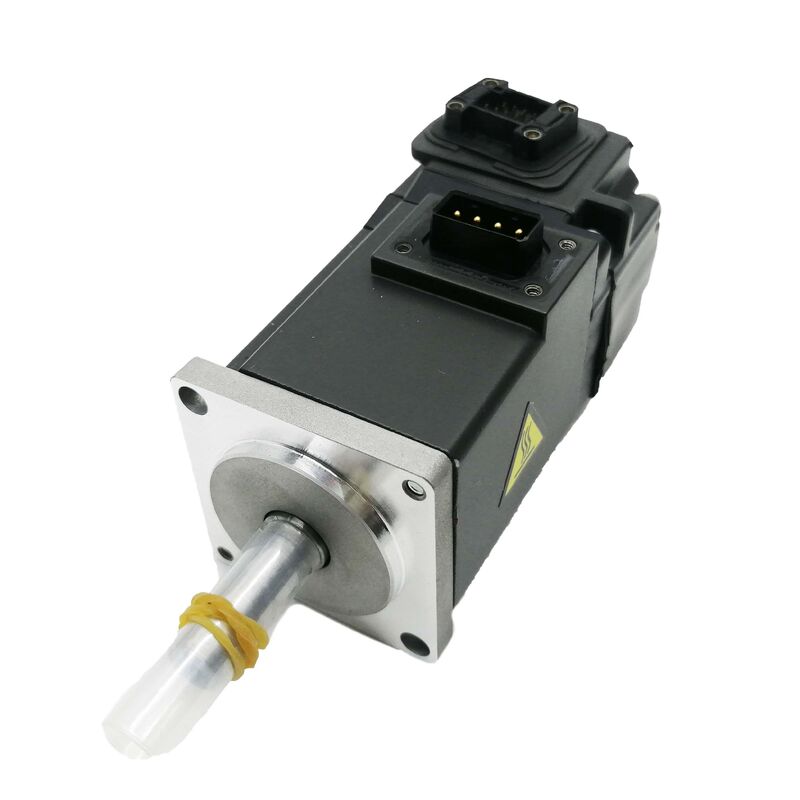
Mitsubishi HG-KR73J AC Servo Motor — 750W | 3,000 rpm | 22-Bit Absolute Encoder | Oil Seal | IP65 | MELSERVO J4
When a servo axis needs to cycle fast, hold position accurately, and survive inside a machine tool enclosure without extra protection measures, the shortlist is short. The Mitsubishi HG-KR73J ticks every column: 750W low-inertia output, a 22-bit absolute encoder resolving 4,194,304 positions per revolution, a factory-fitted oil seal, and an IP65 housing — all in an 80×80mm body from Mitsubishi's current-generation MELSERVO J4 platform. This is a working servo motor for working machines, not a shelf piece.
Technical Specifications
| Parameter |
Value |
| Part Number |
HG-KR73J |
| Alternate Code |
HGKR73J |
| Manufacturer |
Mitsubishi Electric Corporation |
| Series |
MELSERVO J4 / HG-KR |
| Motor Type |
AC Brushless Rotary Servo Motor |
| Inertia Class |
Low Inertia, Small Capacity |
| Rated Output |
750 W (0.75 kW) |
| Supply Voltage |
200 V AC class |
| Rated Torque |
2.4 Nm |
| Maximum Torque |
7.2 Nm |
| Rated Rotational Speed |
3,000 rpm |
| Maximum Speed |
6,000 rpm |
| Rated Current |
4.8 A |
| Maximum Current |
17 A |
| Encoder Type |
Built-in Absolute, 22-bit |
| Encoder Resolution |
4,194,304 ppr |
| Power Rate |
45.2 kW/s |
| Moment of Inertia |
1.26 × 10⁻⁴ kg·m² |
| Shaft Type |
Straight with Oil Seal |
| Flange Dimensions |
80 × 80 mm |
| Protection Rating |
IP65 |
| Insulation Class |
130 (B) |
| Cooling |
Totally Enclosed, Natural |
| Permissible Radial Load |
392 N |
| Permissible Thrust Load |
147 N |
| Weight |
2.8 kg |
| Operating Temperature |
0 °C to +40 °C |
| Storage Temperature |
-15 °C to +70 °C |
| Connector |
4-pin rectangular |
| Compatible Amplifiers |
MR-J4-70A / MR-J4-70B / MR-J4-70GF |
| Certifications |
CE, TÜV, cULus, KC, EAC |
22-Bit Encoder: The Number That Drives the Performance Difference
The HG-KR73J's encoder is where this motor pulls away from J2S-generation predecessors. The older HC-MFS73 carried a 17-bit absolute encoder at 131,072 ppr. The HG-KR73J runs a 22-bit absolute encoder at 4,194,304 ppr — that is 32 times more position resolution per shaft revolution from the same physical frame size.
In concrete terms: at 3,000 rpm, the encoder is delivering roughly 209 million position updates per minute to the servo amplifier. The MR-J4 amplifier's control loop uses that density of feedback to suppress velocity ripple, tighten following error, and maintain position accuracy through the full speed range. The payoff shows up in surface finish on machined parts, seam quality on welded assemblies, and repeatability on pick-and-place operations that run thousands of cycles per shift.
Being absolute, the encoder retains full multi-turn position data through power-off cycles — provided the MR-BAT6V1SET battery is installed in the amplifier. No homing sequence at startup. The machine is at position the instant it powers up.
Oil Seal and IP65 — Specified for the Environment, Not the Showroom
The J suffix on HG-KR73J designates the factory-fitted oil seal at the drive-end shaft opening. The base HG-KR73 (no J) ships without it. The oil seal closes the primary ingress path into the bearing cavity and encoder housing — the gap through which cutting fluid, lubricant mist, and metallic fines would otherwise migrate over time.
Combined with the IP65-rated housing — complete dust exclusion, resistance to directed water jets — this motor is rated for direct installation on CNC machine tools, surface grinders, and automated production equipment without additional protective enclosure. The IP65 + oil seal specification is the standard combination Mitsubishi documents for machine tool environments, and the reason the J variant should be selected for any installation where coolant or process fluids are present near the motor mounting location.
For clean-room or dry automation environments where shaft sealing is not required, the base HG-KR73 is the lighter, more cost-effective choice.
Low-Inertia Dynamics: 45.2 kW/s Power Rate
Power rate — rated torque squared divided by motor inertia — is the single number that best describes how aggressively a motor can accelerate. The HG-KR73J delivers a power rate of 45.2 kW/s. For a 750W motor in an 80mm frame, that figure reflects the fundamental advantage of the low-inertia HG-KR design: a rotor built to change speed quickly, not just sustain it.
What this means operationally: the motor reaches 3,000 rpm from standstill in a shorter time interval, completes positioning moves with shorter dwell periods at speed, and recovers from load disturbances faster. In high-cycle automation — robotic joint drives, pick-and-place axes, feeding mechanisms, indexing tables — those fractions of a second per cycle accumulate across a production shift into measurable throughput difference.
The recommended load-to-motor inertia ratio for the HG-KR73J is up to 17 times the motor's own inertia. The MR-J4 amplifier's adaptive tuning functions can handle loads within this range without manual gain intervention — the amplifier identifies load characteristics automatically at startup and adjusts parameters accordingly.
MELSERVO J4 Platform Integration
The HG-KR73J is a current-production MELSERVO J4 motor, pairing with the MR-J4-70A, MR-J4-70B, or MR-J4-70GF servo amplifiers.
MR-J4-70A handles analog voltage and pulse-train command inputs — the standard interface for PLCs, standalone CNC systems, and motion cards that output pulse/direction or CW/CCW signals.
MR-J4-70B connects to Mitsubishi's SSCNETIII/H optical network, where multiple axes are synchronized over high-speed fiber communication at communication cycles down to 0.222 ms. Multi-axis machines with tight synchronization requirements — gantry systems, electronic gearing, coordinated robot joints — are the natural domain of the B variant.
MR-J4-70GF supports CC-Link IE Field Network for factory network integration.
All three amplifiers share the MR-J4 feature set: real-time auto-tuning, adaptive vibration suppression, one-touch tuning, and full parameter access via MR Configurator2 software. The encoder cable for the HG-KR73J uses Mitsubishi's MR-J3ENCBL series (A1 or A2 type depending on cable exit direction) — the same cable family used across the HG-KR and HG-MR motor lines, which simplifies spares management in multi-axis systems.
Where the HG-KR73J Gets Installed
The 750W low-inertia profile at 80mm frame size sits in a specific and well-populated application zone:
CNC machining center auxiliary axes — tool magazine drives, automatic pallet changers, rotary fourth-axis units, and chip conveyor drives on small-to-medium machining centers all share the same general specification window this motor fills.
Industrial robot joint drives — wrist and elbow joints on 6-axis robots in the 5–10 kg payload class where fast, lightweight, torque-dense actuators are the specification requirement.
Electronic assembly automation — PCB handling, component placement, and dispenser axis drives where the 22-bit encoder resolution and low-inertia fast response directly support placement accuracy and throughput.
Packaging and labeling equipment — film feed, label application, and sealing jaw drives where cycle speed and position repeatability over millions of cycles define machine value.
Conveyor indexing and rotary transfer systems — servo-driven indexing tables and conveyor positioning axes where the combination of fast settling and absolute-encoder startup is operationally useful.
HG-KR73 Variant Overview
The HG-KR73 motor is available in four mechanical configurations, all sharing the 750W, 22-bit, 2.4Nm, 3,000rpm, IP65, 80×80mm platform:
| Variant |
Shaft |
Oil Seal |
Brake |
| HG-KR73 |
Straight |
No |
No |
| HG-KR73J |
Straight |
Yes |
No |
| HG-KR73B |
Straight |
No |
Yes |
| HG-KR73BJ |
Straight |
Yes |
Yes |
The HG-KR73J is the correct choice for coolant-present environments without shaft-holding requirements. For vertical axes or gravity-loaded installations requiring powered-off holding, the HG-KR73BJ (oil seal + brake) is the appropriate variant.
FAQ
Q1: What is the difference between the HG-KR73 and the HG-KR73J?
The only mechanical difference is the oil seal at the drive-end shaft. The HG-KR73J includes it as standard; the HG-KR73 does not. All performance specifications — power, torque, speed, encoder, IP rating, flange size — are identical. Select the J variant for any installation in a machine tool enclosure, near coolant, or in any environment where liquids or lubricant mist are present around the motor mounting area.
Q2: Which servo amplifier pairs with the HG-KR73J?
The HG-KR73J is compatible with the MR-J4-70A (pulse-train/analog interface), MR-J4-70B (SSCNETIII/H fiber network), and MR-J4-70GF (CC-Link IE Field Network). All are 750W-class MR-J4 amplifiers. The correct choice depends on the command interface of the host controller being used. The encoder cable is the MR-J3ENCBL series (A1 type for shaft-end exit, A2 type for opposite-end exit).
Q3: Does the 22-bit encoder require a battery, and which battery is used?
Yes — the absolute multi-turn position counter requires a lithium battery for power-off retention. Mitsubishi specifies the MR-BAT6V1SET battery unit, installed in the servo amplifier's battery holder (not in the motor). Without the battery, position data is lost at power-down and homing is required at next startup. Battery replacement is a routine maintenance task; the interval varies with ambient temperature and how frequently power is cycled.
Q4: What is the permissible load inertia ratio for the HG-KR73J?
Mitsubishi specifies a recommended load-to-motor inertia ratio of 17 times or less for the HG-KR73J (1.26 × 10⁻⁴ kg·m² rotor inertia). The MR-J4 amplifier's real-time auto-tuning adapts gain settings automatically to the connected load at startup. Exceeding the recommended ratio is possible but typically requires careful manual gain adjustment and may compromise servo response bandwidth.
Q5: How does the HG-KR73J compare to the HC-MFS73 from the older J2S generation?
The HG-KR73J (MELSERVO J4) is the functional successor to the HC-MFS73 (MELSERVO J2S) in the 750W low-inertia 80mm class. The principal upgrades are the encoder — 22-bit / 4,194,304 ppr versus the HC-MFS73's 17-bit / 131,072 ppr — and the MR-J4 amplifier platform, which adds SSCNETIII/H fiber communication, faster control loop bandwidth, and improved auto-tuning. The two generations use different amplifiers and different encoder cables and are not interchangeable without re-wiring and amplifier replacement.


 Your message must be between 20-3,000 characters!