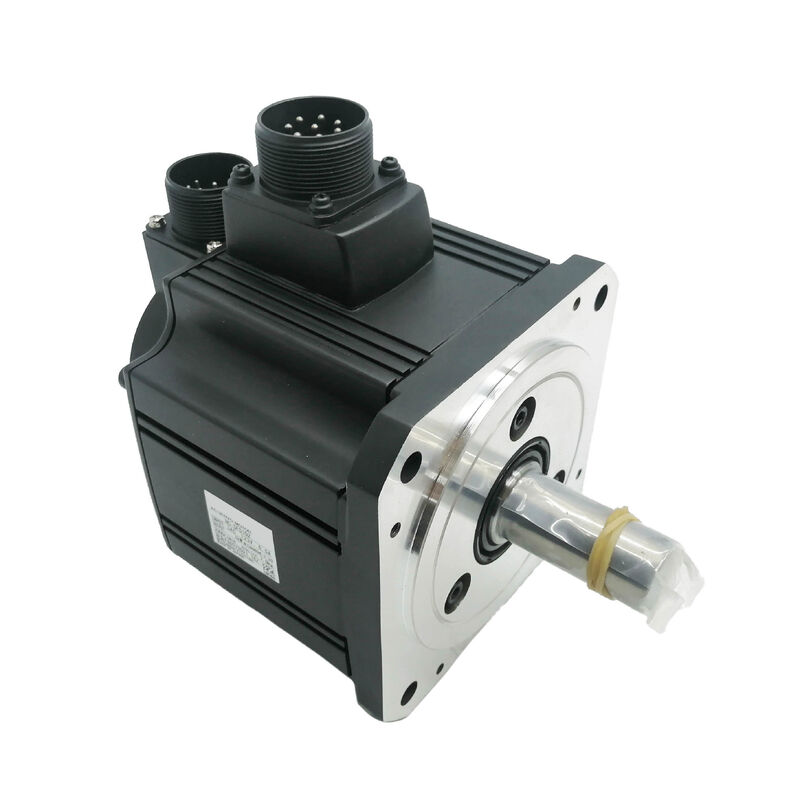
Mitsubishi HC-SFS121K (HCSFS121K) — 1.2kW AC Servo Motor, Keyed Shaft, No Brake, 1000 rpm, MELSERVO-J2S Series
Product Identification
Part Number: HC-SFS121K
Also Searched As: HCSFS121K, HC-SFS-121K
Series: Mitsubishi MELSERVO HC-SFS (J2-Super Generation)
Motor Type: AC Brushless Servo Motor — Keyed Shaft, No Brake, 1000 rpm, 200V AC
What This Motor Is Built For
At 1,000 rpm with 11.5 Nm of continuous torque, the Mitsubishi HC-SFS121K occupies a specific and deliberate position in the MELSERVO-J2S lineup — a medium-inertia servo motor that delivers a high torque-to-power ratio at low shaft speed, with a machined keyway for positive mechanical coupling and no electromagnetic brake for applications where servo lock alone is sufficient.
The 1000 rpm rating is the defining characteristic. Running the same 1.2kW through a 2,000 rpm motor would halve the continuous torque to roughly 5.7 Nm. The HC-SFS121K's slower rated speed concentrates the available power into substantially higher shaft torque — 11.5 Nm continuously — without any gearing between the motor and the load. For axes where the torque budget is the binding constraint, not the speed limit, this is the operating point that resolves the design problem directly.
The keyed shaft completes the picture. Where the driven component — a worm gear input, a timing belt pulley, a chain sprocket — requires a positive mechanical torque path rather than a friction-clamp interface, the machined keyway provides it. No brake means simpler wiring, no relay sequencing, and no MBR interlock overhead on axes where gravity is not a factor and the amplifier's servo lock holds position adequately at rest.
Paired with the 17-bit serial absolute encoder at 131,072 ppr and the MR-J2S-200 amplifier, the HC-SFS121K delivers J2-Super platform performance — high-bandwidth velocity control, fine encoder resolution, and multi-turn absolute position backup — at this mid-range 1000 rpm capacity point.
Technical Specifications
| Parameter |
Value |
| Part Number |
HC-SFS121K |
| Rated Output |
1,200 W (1.2 kW) |
| Supply Voltage |
200V AC class (3-phase) |
| Rated Speed |
1,000 rpm |
| Maximum Speed |
1,500 rpm |
| Rated Torque |
11.5 Nm |
| Maximum Torque |
34.4 Nm |
| Encoder |
17-bit serial absolute (131,072 ppr) |
| Shaft Type |
Keyed (with keyway) |
| Electromagnetic Brake |
None |
| Inertia Class |
Medium inertia |
| Flange Size |
130 × 130 mm |
| Protection Rating |
IP65 |
| Oil Seal |
Fitted |
| Ambient Temperature |
0°C to +40°C |
| Compatible Amplifiers |
MR-J2S-200A / MR-J2S-200B / MR-J2S-200CP |
| Series |
MELSERVO J2S (J2-Super) |
| Origin |
Made in Japan |
| Product Status |
Discontinued — available stock |
11.5 Nm at 1000 rpm: Understanding the Torque Advantage
The physics are straightforward. Power equals torque multiplied by angular velocity. Hold the power constant and lower the speed, and the torque must rise proportionally to maintain the same output. At 1.2kW and 1,000 rpm, the HC-SFS121K delivers 11.5 Nm continuously. A comparable motor at 2,000 rpm with 1.2kW would produce roughly 5.7 Nm. Same electrical power drawn, same amplifier class — but the torque available at the shaft for sustained work is doubled.
For applications where the critical design parameter is the torque the motor can sustain continuously under production load, not how fast the shaft spins, this difference is practically significant. Heavy slow-speed conveyor drives. Worm gear input axes where the motor torque feeds directly into the reduction without an additional stage. Material winding drives that must maintain constant tension across a wide roll diameter range. Rotary indexing tables that dwell at each station under load. Each of these benefits from the higher continuous torque at the shaft, and the HC-SFS121K delivers it without requiring any additional mechanical reduction.
The 34.4 Nm peak — three times the rated continuous figure — handles acceleration. When the axis must reach operating speed from a standing start, or when a rapid dwell-to-dwell indexing cycle demands high torque for the acceleration and deceleration phases, the peak capacity is available for those transients. The motor returns to continuous operating conditions during the sustained phase of each cycle, and the thermal budget remains intact.
The Keyed Shaft at This Capacity
Eleven and a half Newton-metres of continuous torque, with a 34.4 Nm peak, places real demands on the shaft-to-hub interface. The torque path between motor shaft and driven component needs to be reliable across the full range of operating conditions — steady-state load, cyclic reversal, shock inputs from chain engagement or gear mesh, and the high-torque transients during acceleration and deceleration.
A friction-clamp coupling depends entirely on the contact force between hub bore and shaft OD. That force is set at installation and must remain sufficient to resist the peak torque at the worst operating condition throughout the motor's service life. Vibration, thermal cycling, and wear can reduce that force over time, and a marginal clamp that handles the continuous torque may slip under a peak transient — introducing position error that accumulates undetected before it causes a visible problem.
The keyway changes the torque transmission mechanism. The key occupies matched slots in both shaft and hub, transmitting torque through the key's shear cross-section rather than through friction. This is mechanically robust under all of the conditions — reversal, cyclic loading, shock — that friction interfaces find most challenging. It is also insensitive to the loss of clamping force over time that friction interfaces are vulnerable to.
The hub fitting procedure matters at this frame size. The Mitsubishi servo motor instruction manual is explicit: use the shaft-end threaded hole and a drawbolt to pull the hub axially onto the shaft rather than pressing or hammering it on. Impact loads during hub installation at the 130 × 130 mm frame size travel through the shaft to the encoder disc and bearing assembly at the motor's rear. The damage this causes is rarely immediate and rarely produces a clean fault alarm — it surfaces later as intermittent encoder errors under vibration, which are genuinely difficult to trace back to the original installation. The drawbolt method prevents this entirely and takes seconds longer.
No Brake: The Right Choice for These Axes
Position at rest on the HC-SFS121K is maintained by amplifier servo lock — the position loop remains active, encoder feedback monitors shaft angle continuously, and the amplifier supplies the current needed to hold zero following error. For horizontal axes and any drive where no net force acts in the direction of shaft rotation when the servo is in hold state, this is reliable, accurate, and draws no additional panel resources beyond what the normal servo system already requires.
The axes this motor typically serves — winding drives, slow-speed conveyors, rotary tables on horizontal equipment, gear-driven transfer mechanisms — are horizontal or symmetrically loaded. Servo lock holds them cleanly. A brake on these axes would add a relay, a surge absorber, 24V DC wiring, MBR interlock circuit, and periodic brake disc inspection to the installation, for no functional return. The no-brake HC-SFS121K eliminates all of that on every axis in the machine where it applies.
The choice changes on vertical axes, inclined feeds, or any mechanism where load imbalance would cause uncontrolled movement when servo current drops. Those applications belong to the HC-SFS121BK (keyed shaft with spring-applied electromagnetic brake). On machines with several servo axes of this capacity, correctly sorting which ones need brakes and which do not produces a cleaner and simpler electrical design overall.
Compatible Amplifiers
The HC-SFS121K pairs with the MR-J2S-200 class amplifier — the 2kW J2-Super platform. Three interface types:
MR-J2S-200A handles analog and pulse-train commands from CNC systems and PLCs. Position, speed, and torque control modes, with RS-232C connection for MR Configurator setup. The standard choice for most machine tool and general automation applications.
MR-J2S-200B connects to Mitsubishi A-series or Q-series motion controllers via SSCNET fiber-optic serial bus. All position commands arrive over the network; encoder data returns through the same fiber link. The correct choice for coordinated multi-axis systems under a motion controller.
MR-J2S-200CP incorporates built-in positioning. Up to 31 target positions are stored in the amplifier and activated by I/O or CC-Link command. For standalone indexed positioning applications where a separate motion controller is not required.
The HC-SFS121K is not compatible with original MR-J2-200 (first-generation) amplifiers, which cannot read the 17-bit J2S encoder protocol. For machines running first-generation MR-J2 hardware, the HC-SF121K (J2 generation, 14-bit encoder, same mechanical specification) is the correct sourcing target. Not compatible with MR-J3 or MR-J4 amplifiers either.
HC-SFS 1000 rpm Family — Position and Context
| Model |
Output |
Rated Torque |
Peak Torque |
Flange |
| HC-SFS81 series |
800 W |
7.64 Nm |
22.9 Nm |
130 × 130 mm |
| HC-SFS121 series |
1,200 W |
11.5 Nm |
34.4 Nm |
130 × 130 mm |
| HC-SFS201 series |
2,000 W |
19.1 Nm |
57.3 Nm |
176 × 176 mm |
| HC-SFS301 series |
3,000 W |
28.6 Nm |
85.9 Nm |
176 × 176 mm |
The HC-SFS121K is the second step in the 1000 rpm family, sitting above the HC-SFS81 (800W) and sharing the 130 × 130 mm flange with it. The step up to the 201 at 2kW brings both higher torque and a larger 176 × 176 mm flange — so the 121K is the highest capacity motor in the compact 130 × 130 mm frame within the 1000 rpm range.
Each capacity point in this family is available in the full shaft-and-brake matrix: straight shaft no brake (no suffix), straight shaft with brake (B), keyed shaft no brake (K), and keyed shaft with brake (BK). Shaft type and brake presence do not affect amplifier selection — all variants at 1.2kW 1000rpm use MR-J2S-200.
Typical Applications
Winding and unwinding tension drives. Material winders and unwinds on converting, printing, and slitting lines use 1000 rpm servo motors in torque control mode to regulate web tension continuously across a changing roll diameter. The HC-SFS121K's 11.5 Nm continuous holds the tension setpoint through the winding profile; the keyed shaft handles the coupling design at the roll arbour drive.
Slow-speed conveyor and indexing station drives. Servo-controlled conveyor sections and rotary indexing stations on assembly and test lines run at low output shaft speeds with sustained load torque. The 1000 rpm rating keeps the motor in a sensible speed range for these mechanisms without requiring a reduction stage, and the keyed shaft suits the sprocket or gear-coupled drive interface typical in industrial conveyor design.
CNC rotary table and gear-coupled 4th-axis drives. Compact rotary tables and 4th-axis gear drives on machining centres where the motor connects through a worm gear or spur gear reduction to the table use a keyed motor-side gear hub. The 11.5 Nm continuous torque provides the input to the gear drive, the 17-bit encoder gives the angular resolution needed for multi-face machining indexing, and the absolute position backup ensures the rotary axis restarts in exact known position after any stop.
Injection moulding and press auxiliary axes. Servo-driven material feed, ejector, and clamp assist axes on injection moulding machines and presses use 1000 rpm medium-inertia motors where the load demand is primarily torque at moderate speed. The HC-SFS121K handles mid-range feed and ejector mechanisms within the 130 × 130 mm frame size.
Robot joint and articulation drives. Secondary robot joint axes — elbow joints, wrist rotation — that operate at low angular velocity under significant load torque use medium-inertia 1000 rpm servo drives where direct drive or single-stage reduction suits the mechanism geometry. The keyed shaft and the high continuous torque relative to motor mass make the HC-SFS121K a well-matched drive for this class of robot axis.
Frequently Asked Questions
Q1: Which amplifiers are compatible with the HC-SFS121K?
The HC-SFS121K requires a MR-J2S-200 class amplifier. The three variants are the MR-J2S-200A (analog/pulse command, position/speed/torque modes), MR-J2S-200B (SSCNET fiber-optic bus for Mitsubishi motion controllers), and MR-J2S-200CP (built-in positioning with CC-Link). All support the 17-bit serial encoder. This motor is not compatible with original MR-J2-200 amplifiers or with MR-J3 / MR-J4 amplifiers.
Q2: What is the difference between the HC-SFS121K and the HC-SFS81K?
Both are keyed shaft, no-brake motors on a 130 × 130 mm flange with 17-bit encoders and 1000 rpm rated speed. The difference is power and torque: the HC-SFS81K is 800W with 7.64 Nm continuous torque and uses a MR-J2S-100 amplifier. The HC-SFS121K is 1.2kW with 11.5 Nm continuous torque and uses a MR-J2S-200 amplifier. Choose based on the axis torque budget — if 7.64 Nm is comfortable margin for the worst-case continuous duty, the 81K is sufficient; if the load consistently approaches or exceeds that, the 121K provides the necessary headroom.
Q3: Why does a 1.2kW motor use the MR-J2S-200 (2kW) amplifier rather than the MR-J2S-100?
The HC-SFS121K at 1000 rpm draws more current than the MR-J2S-100 is rated to supply — the 11.5 Nm rated torque at 1000 rpm requires a higher current rating than the 1kW amplifier can deliver. Mitsubishi's motor-amplifier pairing documentation confirms the HC-SFS121 with the MR-J2S-200 class. This is standard practice when a motor's current demand from its torque profile exceeds the next smaller amplifier's continuous rating.
Q4: Does the absolute encoder retain position through power loss, and where is the battery?
Yes. The 17-bit serial absolute encoder retains multi-turn position data through any power-off event using a Mitsubishi A6BAT lithium battery housed inside the MR-J2S servo amplifier — not in the motor. Replace the A6BAT when the amplifier displays a low-battery alarm, before full depletion causes the absolute counter to reset. A depleted battery requires a reference return cycle before production can resume.
Q5: Can the HC-SFS121K substitute for a HC-SFS121BK if only the no-brake variant is available?
Only if the application genuinely does not require a brake. The HC-SFS121BK and HC-SFS121K are identical in all electrical and mechanical specifications except the brake. If the machine was specified with the BK variant — typically because it is a vertical axis, a gravity-loaded mechanism, or any drive where servo-off causes unsafe axis movement — removing the brake removes a designed safety function. That substitution requires a formal review of the axis safety requirements. For axes that are confirmed horizontal with no gravitational load component, the no-brake HC-SFS121K is a valid and correct specification from the outset.


 Your message must be between 20-3,000 characters!